

An ingress protection rating describes how an enclosure protects against solid objects, access to hazardous parts and harmful water ingress. The first IP digit concerns solids and access; the second concerns water. IEC 60529 defines this classification system.
The main distinction is straightforward: IP54 and IP64 cover splashes; IP65 and IP66 cover water jets; IP67 and IP68 cover specified immersion conditions. They are not a single ladder from “slightly waterproof” to “safe in any water”. For an outdoor solar light, match that protection to rain, sprinklers, cleaning and the location of the complete assembly.
Waterproof Rating Chart: What the Numbers Mean
The following chart covers seven common classifications. Each water description depends on its applicable test conditions.
| Code | Solid-object protection | Water protection | What the code alone does not establish |
|---|---|---|---|
| IP44 | Objects of 1 mm diameter and larger | Splashes | Dust protection, jets or immersion |
| IP54 | Dust-protected; limited dust entry may occur without impairing operation or safety | Splashes | Dust-tightness, jets or immersion |
| IP64 | Dust-tight | Splashes | Jet or immersion protection |
| IP65 | Dust-tight | Water jets | Immersion or unrestricted pressure washing |
| IP66 | Dust-tight | Powerful water jets | Immersion or every hot-water/chemical cleaning process |
| IP67 | Dust-tight | Temporary immersion under specified conditions | Automatic jet protection or indefinite submerged use |
| IP68 | Dust-tight | Continuous immersion under agreed conditions more severe than IPX7 | Unlimited depth, time or automatic jet protection |
Definitions follow the concise explanations in Inventronics’ technical guide and Palazzoli’s protection guide. The right-hand column translates their limits into purchasing checks.
Quick Selection: Choose the IP Rating for Outdoor Lights by Exposure
For ordinary rain without expected pooling, outdoor-use IP65 models are a practical starting shortlist. The table below is selection advice, not a universal regulatory minimum; local rules and model instructions still apply.
| Actual exposure | Practical starting point | Decision that matters |
|---|---|---|
| Ordinary rain; no expected pooling | Screen outdoor-use IP65 models | Confirm the mounting direction and complete assembled configuration |
| Sheltered entrance; occasional splashes | Assess IP44, IP54 or IP64 candidates only where their outdoor-use instructions support the location | Check whether dust, sprinklers or wind-driven water defeat the shelter |
| Directed spray or planned washdown | Identify the water-jet conditions; consider IP66 where powerful jets are relevant | Match the cleaning method to the specific product; do not assume any pressure washer is allowed |
| A base or connection could become submerged | Relocate, use an approved raised mounting arrangement or improve drainage first | If immersion remains unavoidable, select an explicitly suitable product and installation |
| Coastal air, chemical cleaners or extreme temperatures | Assess those conditions separately from ingress protection | The IP code does not supply corrosion, chemical or temperature limits |
Use four steps before comparing quotations:
- Photograph the position. Include the ground level, base, sprinkler direction, separate battery enclosure and any connections.
- Describe the exposure. Separate splashing, directed jets and immersion; record cleaning as well as weather.
- Shortlist the complete configuration. With IP rated lighting, a rating on the head does not settle the protection of a separate connection or battery box.
- Record the decision. Agree the location, mounting and permitted cleaning method before ordering.
The best IP rating is the one supported for the actual conditions. A larger number does not fix a connection in a puddle. If you already have site photographs, discuss the mounting positions with NEWSKYPOWER while shortlisting the fixture type.
Read the IP Code Before Comparing Lights
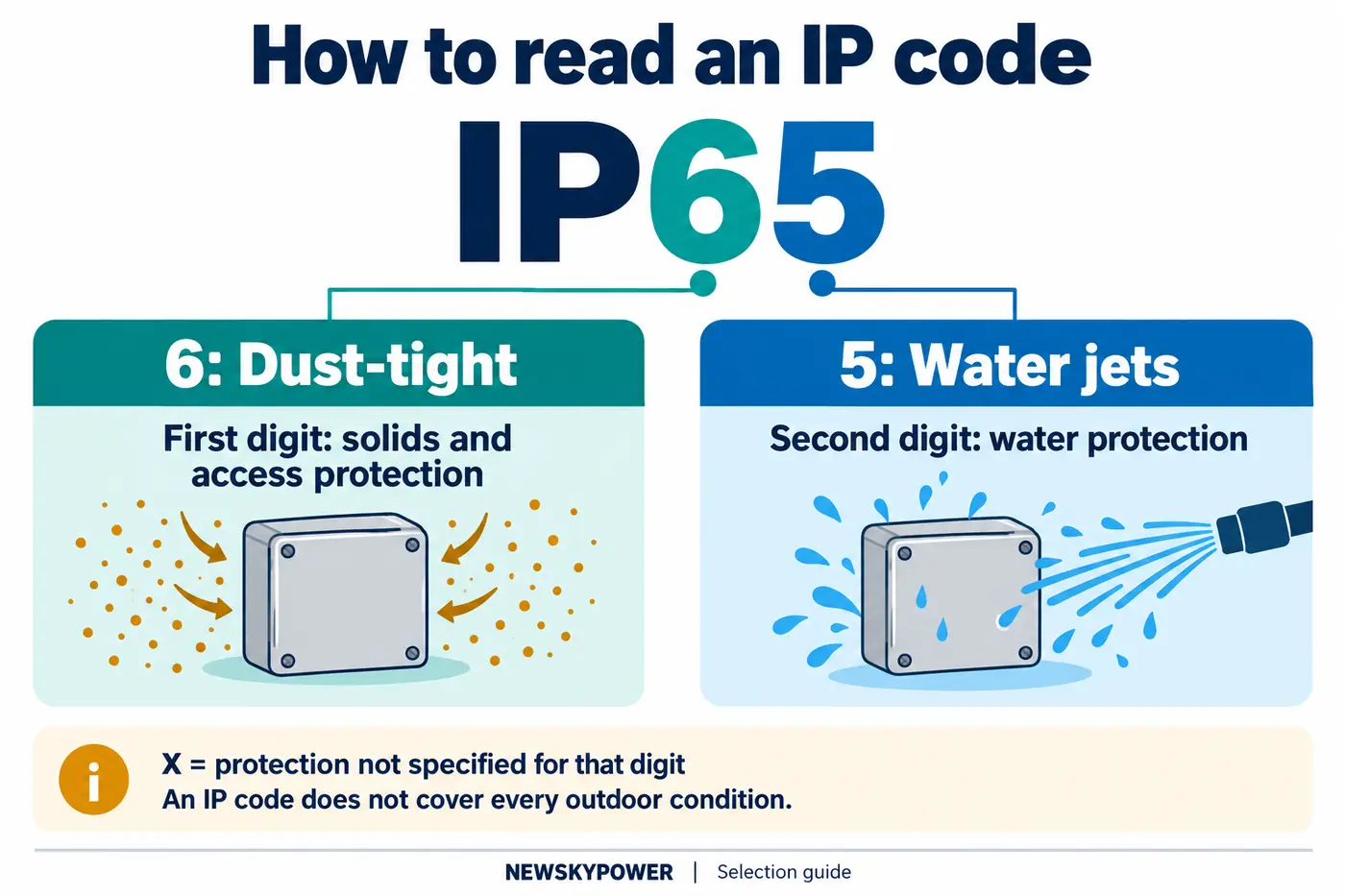
Read the two digits and the letter X
In IP65, the first digit describes solid-object and access protection; the second describes water protection. First-digit 5 means dust-protected, while 6 means dust-tight under the applicable conditions. First-digit 4 concerns objects of 1 mm diameter and larger; it is not a dust-protection classification.
An X means that the degree of protection in that position is not specified. It does not mean zero protection, and it does not allow a buyer to assume a dust grade. When a datasheet lists an IP protection rating such as IPX7, read only the stated classification. Intertek’s IP Code FAQ explains the code structure and separate designations.
IP44 and IP54 meaning: is IP54 waterproof?
An IP44 waterproof claim should be read as splash protection with the stated solid-object protection—not as dust-tightness or permission to hose the light. A covered entrance still needs assessment if irrigation reaches it from below.
The IP54 rating meaning adds dust protection to that splash classification. If a quotation calls it an “IP54 waterproof rating”, do not interpret the wording as a jet or immersion rating. An “IP54 water resistant rating” is useful shorthand only when its splash limitation is clear.
If a light is IP54 rated, its dust protection does not determine whether the proposed outdoor position is approved. An “IP54 weatherproof” description adds no separate evidence of corrosion, UV or temperature performance. Check the mounting instructions and actual exposure rather than assuming that a roof overhead protects every interface.
Is IP64 waterproof in the same way as IP65?
No. An IP64 rating keeps the same water digit as IP54 and increases the dust classification to 6. An IP64 rated light may be useful at a dusty sheltered entrance, but its splash classification does not answer a water-jet requirement. A fully exposed position needs its own suitability assessment; a larger first digit does not change the second.
What is IP65 waterproof protection?
What does IP65 waterproof mean in practice? An IP65 rating combines dust-tightness with protection against water jets under the applicable test conditions. An IP65 waterproof rating does not authorise immersion, burial in wet soil or cleaning with any nozzle at any distance. Use it as one part of a rain-exposed light shortlist, then match the supplied assembly and installation to its instructions.
What does an IP67 rating allow?
An IP67 waterproof rating concerns temporary immersion, with defined test conditions. It does not mean that leaving a light in a puddle overnight is an approved use. Check the tested arrangement and the manufacturer’s permitted immersion conditions, not only a headline depth.
IP68 also needs a stated depth, duration and supported arrangement. Neither code by itself makes a garden bollard an underwater luminaire. If the project requires jets and immersion, the evidence must cover both.
Compare the Ratings by the Problem You Need to Solve
| Comparison | What changes | Practical conclusion |
|---|---|---|
| IP44 vs IP65 | Both solid-object and water protection | A splash-rated sheltered fixture is not automatically an equivalent choice for dusty, jet-exposed conditions |
| IP54 vs IP65 | Dust exclusion and water-jet protection | Compare the exposure and instructions, not just the word “waterproof” |
| IP64 vs IP65 | Water protection; both are dust-tight | Dust-tightness alone does not answer a jet requirement |
| IP54 vs IP67 | Dust-tightness and an immersion classification | Temporary immersion is a different task from splashes; still check any required jet protection separately |
| IP54 vs IP68 | Dust-protected and splash-resistant versus dust-tight and continuous immersion under agreed conditions | IP54 is not an immersion rating; IP68 still needs stated depth, duration and configuration, and does not automatically establish jet protection |
| IP65 vs IP66 | A more demanding water-jet test | Compare the intended cleaning method with the model’s permitted use |
| IP66 vs IP67 | Powerful jets versus temporary immersion | Neither label should substitute for the other requirement without supporting evidence |
| IP67 vs IP65 | Immersion versus jets | If both exposures are present, ask for both to be addressed |
| IP65 vs IP67 vs IP68 | Jets, temporary immersion and specified continuous immersion | Do not arrange these as a single “good, better, best” ladder |
Is IP65 or IP67 better? Choose against the exposure. IP67 and IP68 do not automatically include IP65/IP66 jet protection. A supported dual designation such as IP66/IP67 covers both stated types; verify that it belongs to the exact supplied configuration. Intertek explains why these classifications are separate.
IPX7 vs IP67, and IPX6 vs IP67
For IPX7 vs IP67, both have water digit 7. The difference is that IP67 declares dust-tightness, while IPX7 leaves the first classification unspecified. Do not translate X into a dust-test failure or assume that the missing classification is 6.
For IPX6 vs IP67, two issues change: the first classification is unspecified versus dust-tight, and the water requirement is powerful jets versus temporary immersion. One comparison therefore cannot be answered only by comparing 6 and 7.
Worked Selection Example: a Hotel Path with Sprinklers
In this hypothetical procurement example, a hotel needs 12 solar bollard lights along a path. Two proposed positions receive direct sprinkler spray; one is in a shallow low point.
First redirect the two sprinklers and move the low-point fixture to a supported, freely draining position. After those changes, the shortlist concerns ordinary rain exposure without expected immersion. Start with outdoor-use IP65 candidates and verify the complete arrangement; do not buy an immersion label as a substitute for correcting the layout.
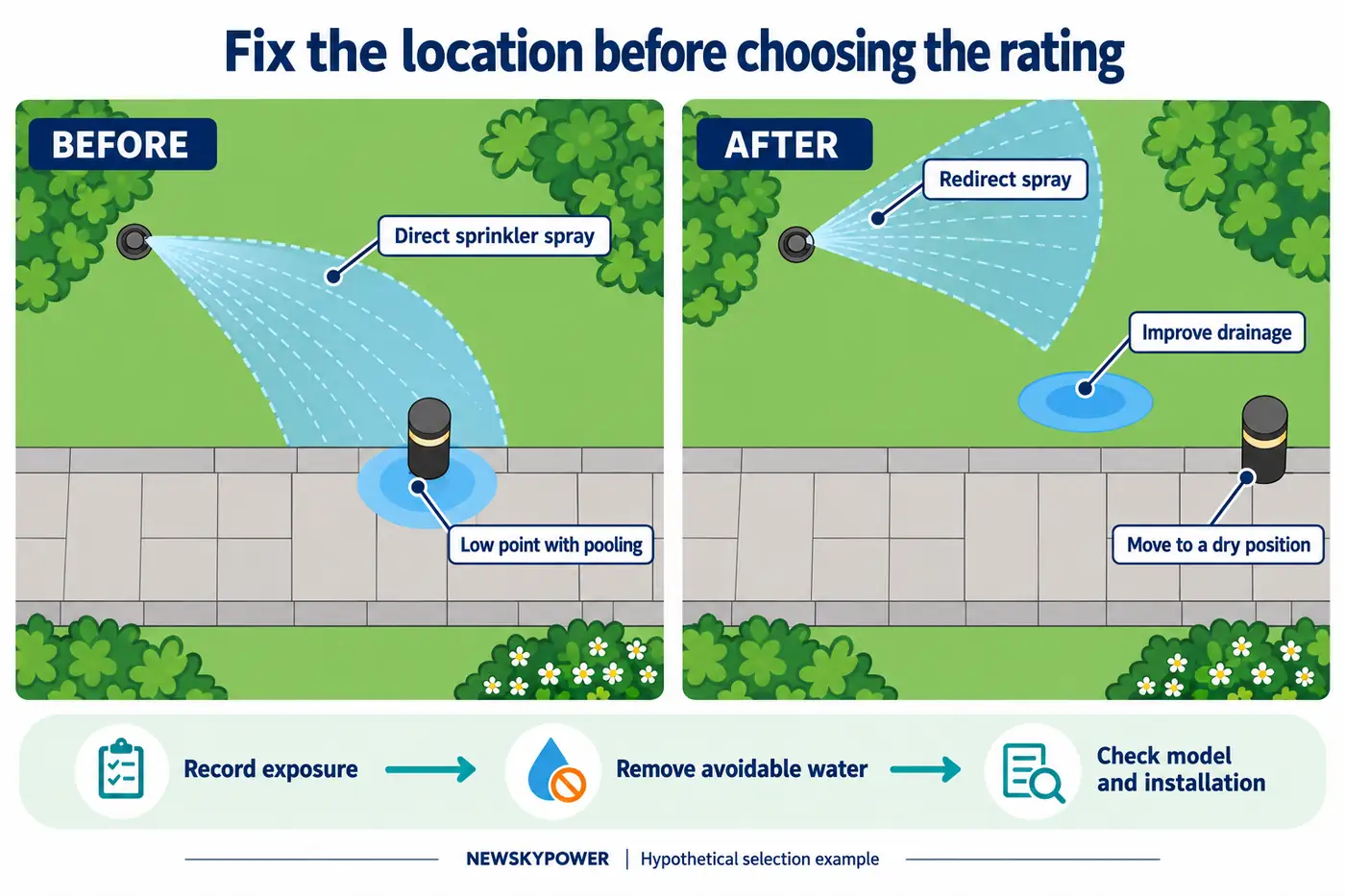
Filled purchasing brief
| Brief item | Filled example to send with the enquiry |
|---|---|
| Product and quantity | 12 solar bollard lights for a hotel pedestrian path |
| Revised position | Rain-exposed; sprinkler direction changed at two positions; the low-point fixture relocated |
| Expected water exposure | Rain and incidental splashes; no intended immersion or pressure washing |
| Candidate ingress protection | IP65 candidates intended for the stated outdoor use; final acceptance subject to the matching model and installation information |
| Configuration to identify | Exact model/version; head, housing, base interfaces and any separate battery enclosure or connectors |
| Cleaning plan | External wiping using the method approved for the chosen model; no direct hosing unless separately approved |
| Supporting material supplied by buyer | Marked-up layout, photos of all positions and connections, site climate and proposed mounting details |
| Supplier response required | Model-specific suitability, report reference and configuration coverage, installation details and any conditions still unresolved |
Here is a short message based on that brief:
Please propose 12 solar bollard lights for the attached hotel-path layout. We have redirected the sprinklers at two positions and moved the fixture from the drainage low point. The revised positions are exposed to rain, with no intended immersion or pressure washing. Please identify the model and complete supplied configuration, explain its suitability for these conditions, and provide the applicable installation information and available ingress-test evidence. State any remaining restrictions or site changes before we confirm the order.
Replace these illustrative details with the real project information. When choosing the form of solar bollard light, also keep light distribution, access and mounting requirements in the separate lighting-design brief.
How to judge the supplier’s answer
| Response received | Is it enough to close this item? | Next action |
|---|---|---|
| Only “IP65, waterproof” | No: model, arrangement and use remain unclear | Ask for the identified model and a response to the supplied site conditions |
| A report for a similar-looking housing | Not by appearance alone | Ask for a traceable link to the actual model/version and included interfaces |
| Matching identification, relevant evidence and clear installation/cleaning conditions | Enough to review this ingress item, not automatic acceptance of every project requirement | Check that the final layout and supplied assembly match; keep other lighting, battery and mounting checks open |
| A reply excluding one planned exposure | The mismatch remains unresolved | Revise the position or select another supported configuration before ordering |
If the low point cannot be removed and immersion remains foreseeable, revise the brief. Describe the likely water level and duration, and require both immersion suitability and any jet exposure to be addressed. Do not simply change “IP65” to “IP67” while leaving the rest of the brief unchanged.
A different decision: cleaning a high-mounted courtyard light
Consider another hypothetical position: the light is above ground, but staff want to hose it down because access is difficult. If the selected model permits wiping only, arrange suitable access or choose a product that supports the required method. For powerful jets, review IP66 candidates and their restrictions; an IP67-only declaration does not answer that cleaning requirement.
Use the solar courtyard light category to compare fixture forms, then assess the chosen model against the site's cleaning and other environmental conditions.
What the Model Instructions Add: SDC-001 and SML-100
Read the IP declaration together with the assembly details. The SDC-001 manufacturer manual lists IP65 and specifies a ground-spike installation: attach the base to the spike with four screws, then join the aluminium post sections. The same manual says the charging part should not be opened by a non-professional technician.
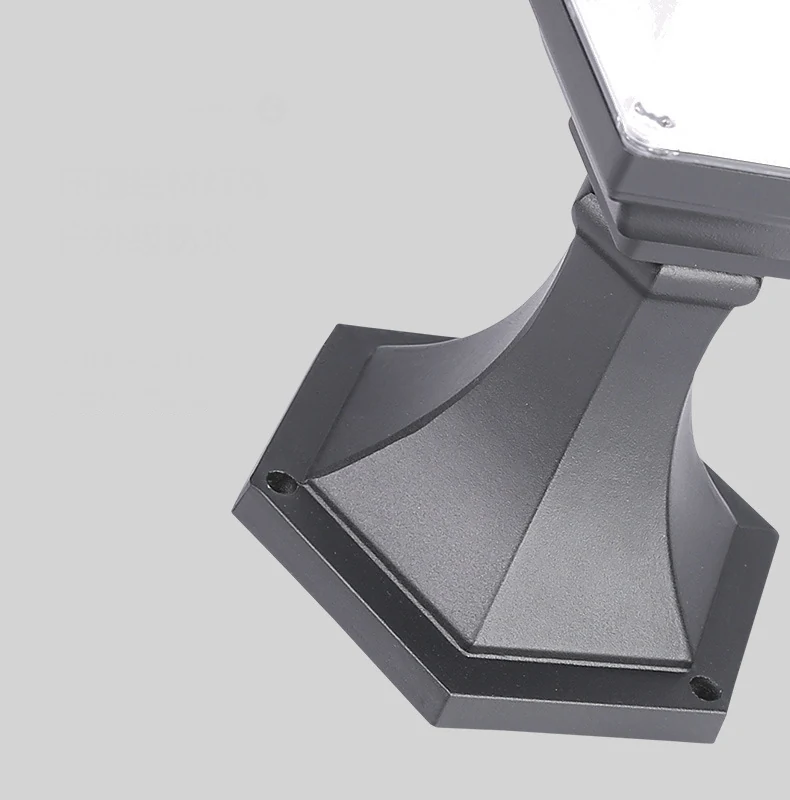
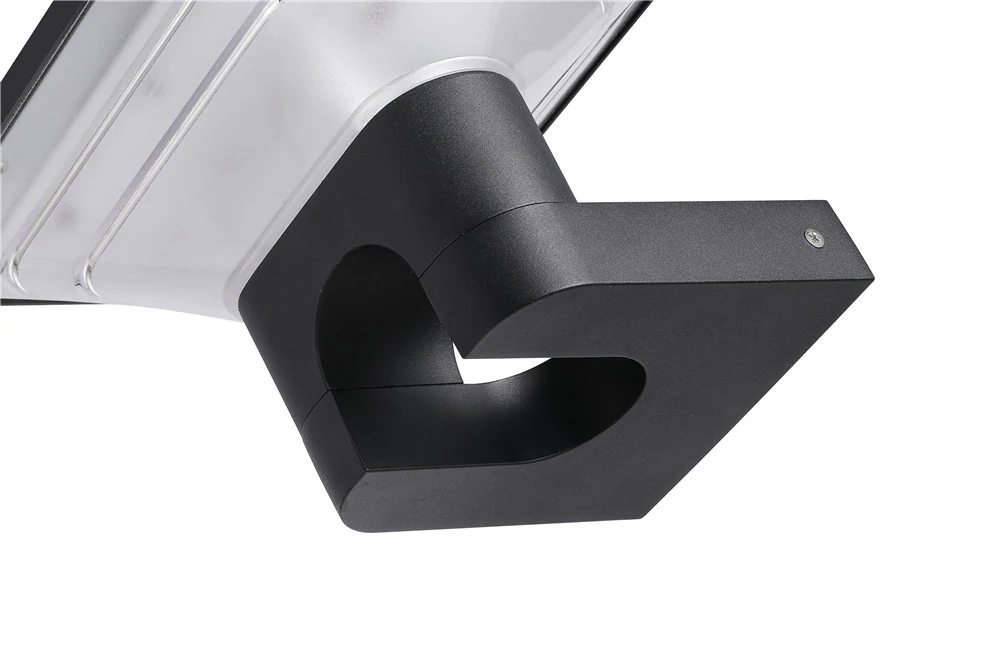
The SML-100 source photograph shows fixing holes around the base, the lower housing and external joints. These are useful inspection points for visible damage and fit before installation; the photograph does not show the internal sealing details.
These details turn a generic requirement into a practical check: confirm the supplied mounting parts and plan service access according to the selected model's instructions.
How to Read the Water-Test Conditions
The difference between splashes, jets and immersion is physical, not just a stronger marketing adjective. A jet test controls how moving water reaches the enclosure. An immersion test controls the water level or pressure and exposure time. Those conditions matter when interpreting a report.
IEC 60529 enclosure-test reference conditions
These laboratory reference values explain the difference between the two jet classifications; they are not a site-testing procedure.
| Classification | Nozzle diameter | Water flow | Reference duration |
|---|---|---|---|
| IPX5 | 6.3 mm | 12.5 L/min | 1 minute per m² of enclosure surface likely to be sprayed; at least 3 minutes |
| IPX6 | 12.5 mm | 100 L/min | 1 minute per m² of enclosure surface likely to be sprayed; at least 3 minutes |
Castle Compliance’s test explanation provides these values; Relia Test Labs describes a 2.5–3 m jet distance. Flow, nozzle and distance work together. A pressure washer with an unknown nozzle or a much closer working distance is not made acceptable simply by comparing its flow rate with this table.
For IPX7, the reference depth is tied to enclosure height. A published SGS report records these IEC 60529 conditions: for an enclosure below 850 mm high, its lowest point is 1,000 mm below the water surface; for an enclosure 850 mm or higher, its highest point is 150 mm below the surface. The reference duration is 30 minutes. This explains why “1 m for 30 minutes” alone omits an important dimensional condition. Published SGS test-condition record
For IPX8, read the agreed depth, duration and other conditions. Luminaire reports may use product-specific requirements, so also check the stated standard, edition, mounting arrangement, sample condition and acceptance criteria. These general references do not certify a NEWSKYPOWER model.
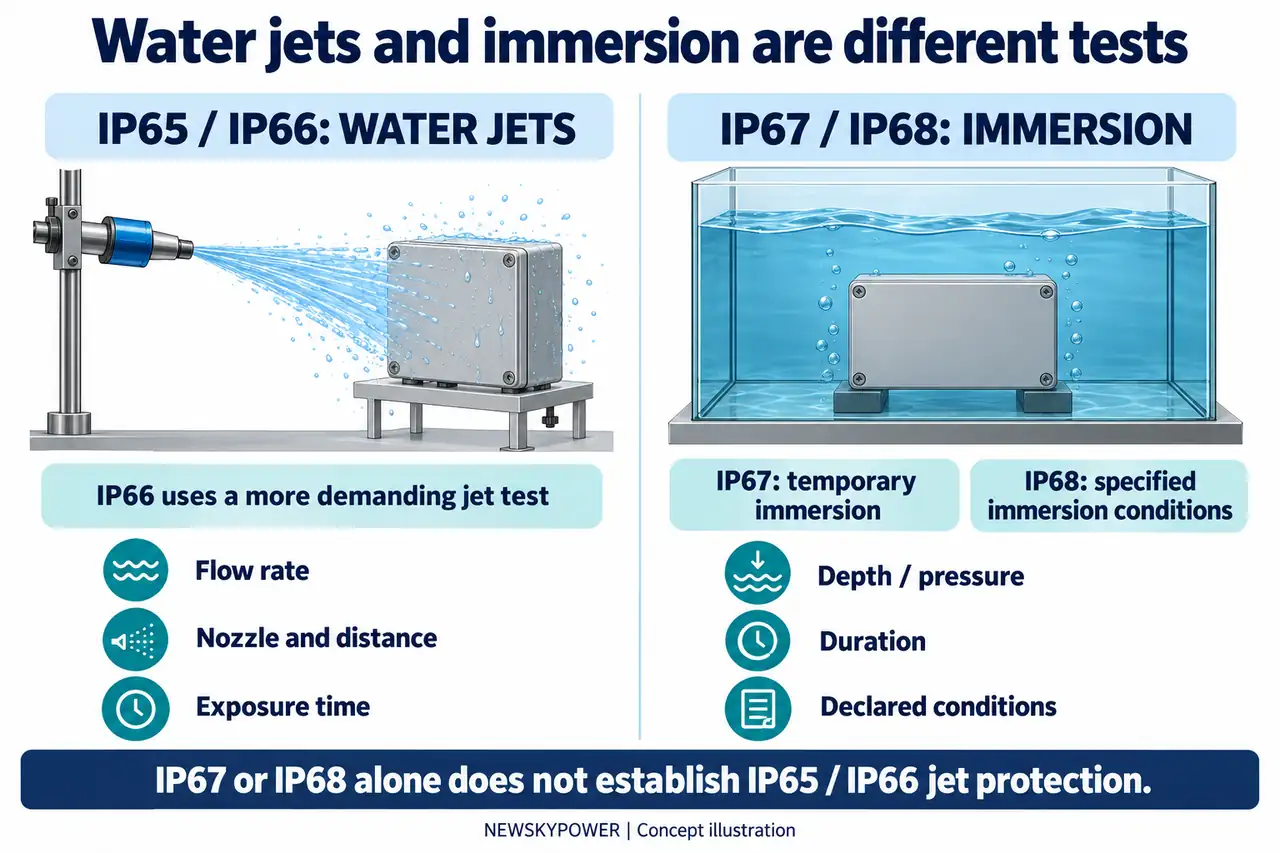
An IP66 waterproof description still needs a cleaning limit. Hot water, chemicals and a close nozzle can introduce conditions outside the stated protection. Follow the model’s documented cleaning method.
Keep the Specified Protection in the Installed Light
Match the supplied assembly, then maintain it
Record the exact model/version, manufacturer or applicant, report reference and configuration. A rating for a head or similar housing does not establish protection for a separate battery box or connector. Match the documents to the supplied assembly and installation instructions; keep unresolved exposure conditions open before ordering. Electrical safety, wet-location approvals or NEMA requirements remain separate project checks.
Before installation, inspect for cracked housings, displaced covers, damaged visible seals and missing parts. Follow the specified mounting and service procedure, including approved replacement gaskets or connectors. A stable base and suitable mounting surface matter too; neither is established by the IP marking.
Keep a short record against each fixture position: installation, approved service and replaced parts, cleaning method, and changes to sprinklers, plants, mulch or ground level. Inspect after unusual weather or visible disturbance according to the maintenance plan. Do not improvise repairs with glue or tape, or open a sealed unit merely to show it is dry.
Moisture inside: observe before deciding the cause
Moisture already present in enclosure air can become liquid as it cools. This condensation mechanism differs from external liquid water passing through a seal; an IP marking does not promise that condensation can never occur. Gore explains the cooling mechanism.
- Brief mist or a thin film: photograph the location, weather and clearing pattern. Appearance alone cannot establish its cause or acceptability.
- Recurring droplets or collected water: record recurrence, recent service and exposure changes for a supplier assessment. There is no universal “clears within a few minutes, therefore safe” rule.
- Moisture with corrosion, damage or abnormal operation: stop operation where a safety concern exists and follow service instructions. Drying and resealing a unit does not by itself restore its original protection.
Does “IP65 weatherproof” cover every outdoor condition?
No. “Weatherproof” does not add test results to the IP code. Salt exposure, UV ageing, cleaning chemicals, impact and temperature need their own specifications or evidence. Do not infer corrosion life from colour or housing thickness.
For a solar system, separate storage, operation, charging and discharging limits: a battery's charging range is not automatically its discharge range, and an LED temperature limit does not describe the whole light. See our guide to using solar lights in winter for related seasonal selection questions.
Frequently Asked Questions
Can solar garden lights stay outside in rain?
Yes, when the exact model is intended for that exposure and is installed in its supported configuration. The IP code helps screen the enclosure protection, but does not remove the mounting, temperature or condition checks.
Does an IP rating permit standing water around a light?
Not automatically. Establish whether the water reaches an enclosure or connection, and whether the exposure and installation are supported. Relocation or drainage can be the appropriate first decision.
What evidence should a buyer request?
The exact code, matching model/version, report scope and installation/cleaning instructions. Use the worked brief and supplier-answer table above; keep corrosion, temperature and other requirements separate.
How do I specify the IP rating for external lights?
State the actual rain, spray, pooling and cleaning conditions first; then give the candidate rating and the required configuration coverage. A location photograph and a clear exposure description are more useful than requesting the highest number without context.
Discuss Your Installation with NEWSKYPOWER
For broader fixture choices, use our garden and courtyard lighting guide. Then send your installation brief to the NEWSKYPOWER team with the quantity, fixture type, site photographs and sprinkler, pooling, coastal or cleaning conditions. Ask for candidate models, applicable installation information and available supporting documents against those details.
More Outdoor Solar Lighting Guides
After checking water exposure, use these guides to choose the fixture, weigh the trade-offs and plan for winter use.