

Do solar lights work in winter? Yes, they can, but winter performance is conditional. It depends on the useful solar resource at the panel, seasonal shade, temperature, panel and battery configuration, nighttime load and the operating program.
Cold weather does not automatically stop every solar light, and a large battery does not automatically guarantee reliable winter operation. The practical question is whether the complete system can collect and store enough energy for the required lighting task under the site’s design conditions.
1. Winter Operation Requires a Site-Specific Answer
A standalone solar light follows an energy cycle: the panel converts sunlight into electricity, the controller manages charging, the battery stores energy, and the LED system consumes it after dark. Winter can change several parts of that cycle at the same time.
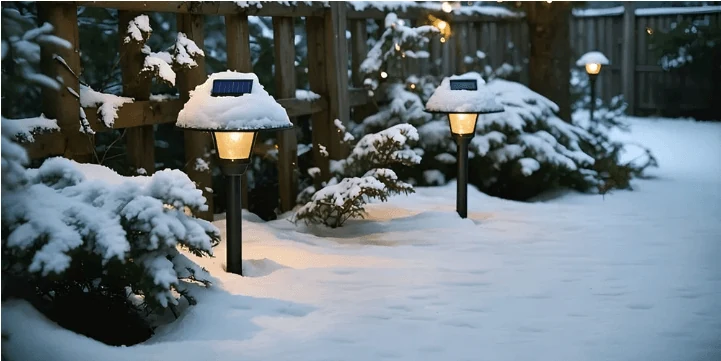
Days may be shorter, the sun path may change, nearby objects may cast longer shadows and nights may require longer operation. Low temperatures can also affect batteries and controls. Snow, dust or other material on the panel may reduce the solar energy reaching the cells.
For this reason, neither latitude nor day length can answer the question alone. According to the U.S. Department of Energy’s explanation of solar radiation, the solar energy available at a surface depends on factors including location, time, weather and orientation. A project should therefore consider the useful solar resource at the actual panel position, not just the number of daylight hours.
2. How Winter Conditions Affect Solar Lights
Less solar input changes the energy balance
When the panel receives less useful solar energy, the battery may recover less energy during the day. At the same time, a longer night may ask the system to operate for more hours. Whether the light completes the required schedule depends on the collected energy, usable battery energy, system losses, load and program.
There is no universal number of cloudy or rainy days that every solar light can support. A backup-time statement is meaningful only when the starting state of charge, nighttime program, load, weather and cutoff condition are defined.
Seasonal shade can matter more than expected
Trees, buildings, walls, poles and eaves can block direct sunlight. The pattern may change by season, so a location selected in summer should be checked against the winter sun path. Partial shade at an important charging period can affect energy collection even when the surrounding area still looks bright.
Do not apply one direction rule to every country. Panel orientation should follow the local sun path, hemisphere, site geometry and the mounting structure. An integrated panel cannot be assumed to adjust independently from the luminaire.
Temperature specifications need to be separated
The permitted charging, discharging and storage temperature ranges are different questions. A general whole-luminaire operating range does not automatically prove that a battery can charge safely at every temperature within that range.
Check the documentation for the current battery pack, controller and luminaire. If low-temperature charging protection or heating is required, it should be confirmed as a documented feature. Do not infer it from an IP rating or from the words “LiFePO4” or “lithium battery.”
Changing to a different battery chemistry is not a simple winter upgrade. The voltage, battery-management system, controller, charge limits, physical design and temperature protection must all be compatible. Battery changes should follow the manufacturer’s instructions for the exact model.
Snow, ice and contamination can reduce exposure
Material covering the panel can reduce the light reaching the solar cells. Inspect the panel from a safe position and follow the manufacturer’s maintenance instructions. The U.S. Department of Energy’s winter-weather guidance for photovoltaic systems also highlights the importance of planning for winter conditions and safe access.
Do not scrape hard ice with tools that may damage the surface, pour hot water on a frozen panel or climb to a high fixture without suitable equipment and procedures. High-mounted systems should be handled by qualified maintenance personnel. The correct inspection frequency depends on the environment and the product, not on a universal daily rule.
3. What to Check Before Selecting a Solar Light for Winter
The following information gives a supplier or lighting professional a basis for evaluation.
| Check | Information or evidence needed |
|---|---|
| Project location and season | City or coordinates, design month, local winter solar resource, weather exposure and seasonal shade |
| Lighting requirement | Application, required operating time, output or target illuminance, and whether scheduled dimming is acceptable |
| Solar panel and battery | Panel specification; battery voltage, amp-hours and nominal watt-hours; usable energy; estimated losses; controller limits |
| Temperature suitability | Charging, discharging and storage ranges for the battery pack and luminaire; documented protection or heating if required |
| Installation and maintenance | Whether the panel can be adjusted, snow or contamination exposure, safe access, and manufacturer maintenance instructions |
Nominal battery energy can be calculated as voltage multiplied by amp-hours, but nominal watt-hours are not the same as usable energy. Similarly, a larger panel may collect more energy under comparable conditions, but it does not automatically have higher conversion efficiency.
If a project requires fixed output or a measurable lighting result, ask for the nighttime power program and a project-specific energy and lighting assessment. Sensor operation may reduce consumption in some situations, but the result depends on supported modes and trigger frequency. A sensor should not be treated as an automatic all-night guarantee.
4. Safe Checks for Existing Solar Lights
If a light becomes dim or stops earlier in winter, start with non-invasive checks.
Check daylight access
Observe whether the panel receives useful sunlight and whether new seasonal shade comes from trees, buildings, eaves or accumulated material. Compare the actual panel position with the manufacturer’s placement requirements.
Check the panel surface from a safe position
Look for leaves, dust, snow or other contamination. Clean only with a method permitted by the product instructions. Avoid abrasive tools, incompatible chemicals and unsafe work at height.
Adjust only when the structure supports adjustment
Some products have an adjustable or separate panel; many integrated lights do not. Do not force a fixed joint or change the luminaire angle in a way that affects light distribution, structural security or water protection.
Review the switch and operating program
Confirm that the light is enabled and that the selected mode matches the winter requirement. If the product supports scheduled output reduction, a lower-energy program may help match consumption to available energy. Use only modes documented for the model.
Do not assume that switching the light off will continue charging. Confirm this behavior in the product manual. Even when charging continues, there is no universal promise that one or two days will restore a full charge.
Inspect for damage without opening sealed components
Look for loose fixtures, damaged housings, visible seal problems or water-related symptoms. IP protection does not prove resistance to freezing, condensation, corrosion or every installation condition. Do not open a sealed luminaire or replace internal batteries unless the manufacturer authorizes the procedure.
5. When to Change the Mode or Contact the Supplier
If the product supports more than one program, compare the available modes with the actual priority. A site may prefer longer operation at reduced output, or shorter operation at a higher output. This is a project decision, not a universal winter schedule.
Contact the supplier when:
- the light repeatedly fails to meet the required operating time after reasonable solar exposure;
- the manual does not clearly state charging, discharging or storage limits;
- a low-temperature protection function is required but not documented;
- the battery, controller or luminaire shows a fault indication;
- the panel, housing, seal, pole or fixing is damaged;
- the project requires a verified illuminance or runtime result.
Send the model, serial or order reference, site location, current mode, installation photos, approximate sunlight and shade conditions, recent weather, observed operating time and any fault indication. This is more useful than asking whether all solar lights should behave the same way in winter.
For broader product selection, read How to Choose Solar Garden and Courtyard Lights.
6. Frequently Asked Questions
Do solar garden lights work in cold weather?
They may work, but the permitted charging and discharging conditions must be checked for the actual battery pack, controller and luminaire. A material name or IP rating does not establish the full cold-weather operating range.
Does a bigger battery solve winter problems?
Not by itself. The battery must receive enough energy, be compatible with the controller and operate within its permitted conditions. Usable energy, load and operating program also matter. Compare voltage and amp-hours together rather than using mAh alone.
Should a solar panel always face south in winter?
No universal direction applies to every site. Consider the hemisphere, local sun path, seasonal shade and the mounting structure. Follow the product instructions and a site-specific assessment.
Should snow be removed from a solar light every day?
Use observation and the manufacturer’s guidance rather than a universal schedule. Only perform maintenance that is safe and permitted. Do not use damaging tools, hot water or unsafe access methods.
Does IP65 mean a solar light is winter-proof?
No. IP65 is a stated ingress-protection level; it does not by itself verify low-temperature charging, freeze resistance, condensation control, corrosion resistance or whole-system winter performance.
Can solar lights run all night in winter?
Some configurations may meet a long runtime under defined conditions, but no universal answer applies. Winter solar input, shading, usable battery energy, electrical load, temperature and the output program must be evaluated together.