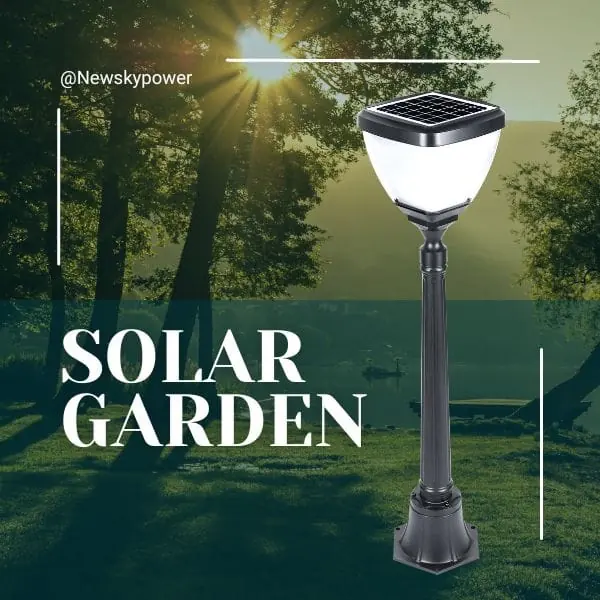


For a remote solar lighting project, a shorter pole package can solve only part of the delivery problem. Before ordering sectional light poles, agree on the supplied components, completed height, mounted equipment, surface treatment, foundation responsibilities and route from the receiving point to the installation site. These checks make quotations and incoming deliveries easier to compare.
A project in Asia, Africa or the Middle East should be described by its actual site and delivery conditions. A country or region name does not establish wind loading, corrosion exposure, road access or installation requirements. The checklist below uses documented NEWSKYPOWER SP pole dimensions and production details to turn a general enquiry into a specification and receiving plan.
1. Define whether the order is for a pole or a complete system
A solar light pole enquiry can mean the support structure alone, a pole with brackets, or the entire lighting system. Put these items on separate lines: pole sections, base and anchors, lamp arm, panel bracket, luminaire, solar panel, battery and controller. Mark what is included, supplied by another party or still to be selected.
The SP product discussed here is a sectional steel pole body. Its height does not specify lighting coverage, and its construction does not establish battery runtime. If buying a complete solar system, the lighting and energy design must be resolved alongside the structural package.

Existing component illustration; the accepted order's parts list defines the supplied items and options.
Use the solar light pole selection page to discuss the support structure. State explicitly when the quotation also needs lights, solar equipment or installation accessories. This avoids treating a low pole-only price as an offer for a complete operating system.
2. Put completed height and version on the purchase specification
Do not order from the model's number alone. The regular SP range and separate MF full-height range have different completed heights:
| Nominal model size | Regular SP model / completed height | Full-height version / completed height |
|---|---|---|
| 2.5 m | SP-2.5M / 2.23 m | SP-2.5MF / 2.5 m |
| 3 m | SP-3M / 2.82 m | SP-3MF / 3 m |
| 3.5 m | SP-3.5M / 3.23 m | SP-3.5MF / 3.5 m |
| 4 m | SP-4M / 3.73 m | SP-4MF / 4 m |
| 5 m | SP-5M / 4.65 m | SP-5MF / 5 m |
| 6 m | SP-6M / 5.72 m | SP-6MF / 6 m |
These are the heights in the respective specification sheets. Confirm the supplied drawing, measurement reference and luminaire mounting arrangement. A required installation height should not silently become a different completed pole height during purchasing.
The documented ranges extend to the listed 6 m versions. Projects requiring a higher structure need a separate engineering and supply assessment; an 8–12 m road pole should not be assumed to be a standard SP option. Consult the SP split pole model details and request the exact version before confirming quantities.
3. Send the whole luminaire and panel arrangement for review
Provide drawings or dimensional information for the luminaire, arm, panel, bracket and any pole-mounted battery box. Record their weights and positions. A broad panel exposed to wind creates a different structural requirement from a compact fitting of similar weight.
The regular SP sheet lists a 76 mm upper tube and 114 mm bottom tube. Use these as starting dimensions for an interface check, not proof that a particular light or bracket fits. Clamp range, fasteners, arm geometry and the mounting drawing also need to match.
The specification's listed 10 kg load value is not a site wind rating. It cannot establish an acceptable panel size, a wind speed or a foundation by itself. Ask the responsible designer to assess the complete structure against the project's requirements. Adding a camera, sign or other accessory after selection also changes the inputs and needs review.
4. Identify the surface-treatment version
The SP specification sheets identify Q235 steel and use the description “cold galvanized”; the parameter sheet also lists a hot-dip galvanized option. A quotation should name the selected treatment instead of relying on the word “galvanized” alone. Request the coating specification and any inspection documentation required by the project.
For a coastal location, give the actual exposure and project requirements. For a dusty or hot site, specify those conditions rather than assuming that all sites in the same region have the same environment. Paint colour is a separate selection and does not demonstrate corrosion performance.
NEWSKYPOWER's documented production process includes tube preparation, socket forming, removal of internal burrs, finishing and an inspection before packing. Those details provide useful questions for supplier review. Project-specific coating evidence should still match the quoted version and order; a general manufacturing description is not a test report for a particular shipment.
5. Assign responsibility for foundations and installation
Agree who provides the foundation design, anchor arrangement, site preparation and installation method. A drawing of the pole base or an anchor supplied in the package is not a complete foundation design for every ground condition. Concrete condition, anchor geometry, soil information and structural loads must be considered by the responsible project professionals.
Do not specify a base simply because asphalt or paving is present. Identify the supporting structure below it. Where electrical connections are required, the project must also address cable routing, earthing and the applicable electrical requirements.

Existing assembly illustration. Follow the instructions for the supplied joint version and the approved installation plan.
The English SP assembly instructions describe inserting the sections, aligning screw holes and fastening with bolts. Obtain that version's current instructions and required fastener details. Do not substitute an assembly method from a different joint design. The contractor should determine safe handling and lifting arrangements; sectional delivery does not guarantee a two-person installation or remove the need for equipment.
6. Plan light pole shipping beyond the destination port
Record the port or receiving warehouse, transfer points, final delivery address, vehicle limits, unloading arrangements and storage conditions. If the route includes a ferry, a narrow access road or several local transfers, list those requirements before asking for the final packing plan.
The regular SP parameter sheet gives these carton dimensions:
| Regular SP versions | Listed carton dimensions |
|---|---|
| SP-2.5M, SP-3M, SP-3.5M, SP-4M and SP-5M | 1020 × 240 × 230 mm |
| SP-6M | 1520 × 240 × 230 mm |
These dimensions refer to the listed regular SP configurations. Do not automatically reuse them for MF versions, alternative joints, extra brackets or palletized shipments. Ask for the order's final package count, dimensions, gross weight and contents before booking transport. The longest package and total load both matter when selecting local vehicles.
The documented packing process describes protective corners, foam and a separate inner box for the anchor. It also describes screws and a matching hex key for the bolted set. Confirm the actual contents against the purchase order rather than assuming every accessory is included in every quotation. The purpose is to receive complete, identifiable pole sets that can be checked before they travel farther inland.
Documents to agree before shipment
| Document or record | What the buyer should be able to verify |
|---|---|
| Accepted quotation and parts list | Exact model, height version, finish, included accessories and exclusions |
| Assembly and interface drawings | Section sequence, joint type, completed height and mounting details |
| Final packing list | Package count, dimensions, gross weights and which package contains each set or accessory |
| Assembly instructions | Instructions that match the supplied joints and fasteners |
| Agreed inspection records | The checks required by the order, with any coating or dimensional evidence identified |
| Shipping and destination documents | Requirements agreed with the importer and freight provider for the shipment |
Agree document availability and timing before payment or dispatch. Do not describe a certificate as covering a pole or destination unless the document's scope actually does so. Keep the accepted revision with the order and give the receiving team a copy; a newer drawing sent only to procurement can otherwise leave the site working from an older version.
Inspect the delivery before distributing it to site
NEWSKYPOWER's production process includes sleeve-fit trial assembly during packing. For a bulk order, agree how that check will be documented and how incoming samples will be checked. The receiving team still needs to compare the delivery with the accepted specification.
- Check identification and count. Match carton labels, quantities and model versions to the packing list. Record missing or damaged packages before redistribution.
- Inspect protection and visible damage. Look for crushed ends, wet packaging, damaged finishes and missing small-parts boxes. Photograph the affected package and part identifiers.
- Compare parts with the drawing. Verify the supplied section combination, accessories and joint type. Measure the agreed dimensions using the agreed method.
- Check a sample assembly. Follow the supplied instructions and the agreed inspection plan. Check joint engagement, hole alignment and parts completeness. Do not improvise by cutting, drilling or forcing a mismatched joint.
- Hold discrepancies for resolution. Separate affected sets, send records to the supplier and agree a remedy before installation. Keep the remaining sets protected and traceable during storage.
Send a project brief that can be quoted
Include the actual location, quantity, completed height, luminaire and panel arrangement, finish requirements, foundation responsibilities and final delivery route. State the versions under comparison and the documents or inspection checks required. Regional information is useful when it identifies practical conditions; it cannot replace those inputs.
Send that brief through the NEWSKYPOWER light pole manufacturer enquiry page. If the site type is still undecided, read the seven application and site-selection checks. For an equivalent-scope comparison with one-piece construction, use the pole construction and project-cost discussion.
For the complete selection process, see our modular light pole buying guide covering height, joints and delivery checks.
FAQ
1. Does a solar light pole quotation include the light and panel?
Not automatically. Require an itemized scope showing the pole, anchors, brackets, light, panel, battery and controller, with each item marked included, excluded or supplied separately.
2. What is the difference between SP-5M and SP-5MF?
The regular SP-5M has a listed completed height of 4.65 m. The separate full-height SP-5MF is listed at 5 m. Confirm the model suffix and drawing on the order.
3. Can the regular SP carton sizes be used for every version?
No. The 1020 mm and 1520 mm lengths listed here apply to the regular SP configurations in the parameter sheet. Confirm MF, accessory and palletized packing separately.
4. Does the listed 10 kg load establish wind resistance?
No. Wind performance also depends on the mounted equipment's dimensions and position, site conditions, pole structure and foundation. A weight value alone cannot approve the installation.
5. Is every SP pole hot-dip galvanized?
Do not assume that. The documents distinguish treatment descriptions and options. The quotation and accepted specification should identify the selected treatment and required inspection evidence.
6. Can supplied anchors replace a site foundation design?
No. The anchor arrangement, supporting foundation and ground conditions must suit the project. Confirm who is responsible for the design and installation before dispatch.
7. Are two people enough to install every sectional pole?
A universal crew size cannot be specified from the sectional design. Handling depends on the complete assembly, access and work method; the contractor should plan personnel and equipment accordingly.
8. Which documents are most useful for receiving inspection?
Use the accepted parts list, version-specific drawing, packing list, matching assembly instructions and agreed inspection criteria. Record the revisions so procurement and site teams check the same requirements.
9. What should we do if a section will not assemble correctly?
Stop and record the model, package and part identifiers, with photographs and measurements. Ask the supplier to resolve the discrepancy before cutting, drilling, forcing or installing the affected set.
10. Does a project in Africa, Asia or the Middle East need a different pole automatically?
No. Specify the actual loads, environment, foundation, lighting arrangement and delivery route. Different sites within one country can need different solutions; geography alone does not decide the pole.