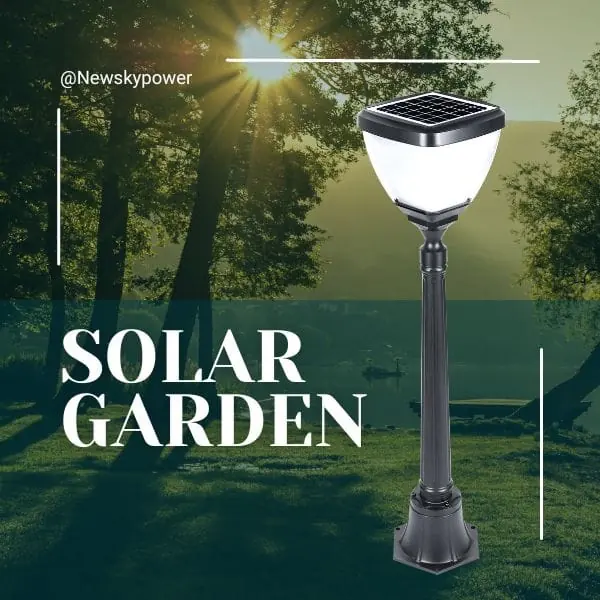


Comparing aluminum vs plastic solar garden lights begins with identifying the part being discussed. A metal housing can be combined with a plastic diffuser, a separate base and different connecting hardware. Calling the whole product aluminum or plastic may hide the details that matter for outdoor use, cleaning and replacement.
Neither material name is a complete quality ranking. Compare the documented material, construction, finish, exposure and service arrangements for each candidate. Then distinguish what you can observe on a sample from what needs a specification or an appropriate test report.
This guide provides a purchasing and sample-review method. It does not assign material grades by appearance, promise a service life or claim that every metal product outperforms every polymer product. The useful result is a part-by-part evidence table that supports a decision for the intended application.
Identify Housing, Diffuser and Connection Materials
Break the product into meaningful parts
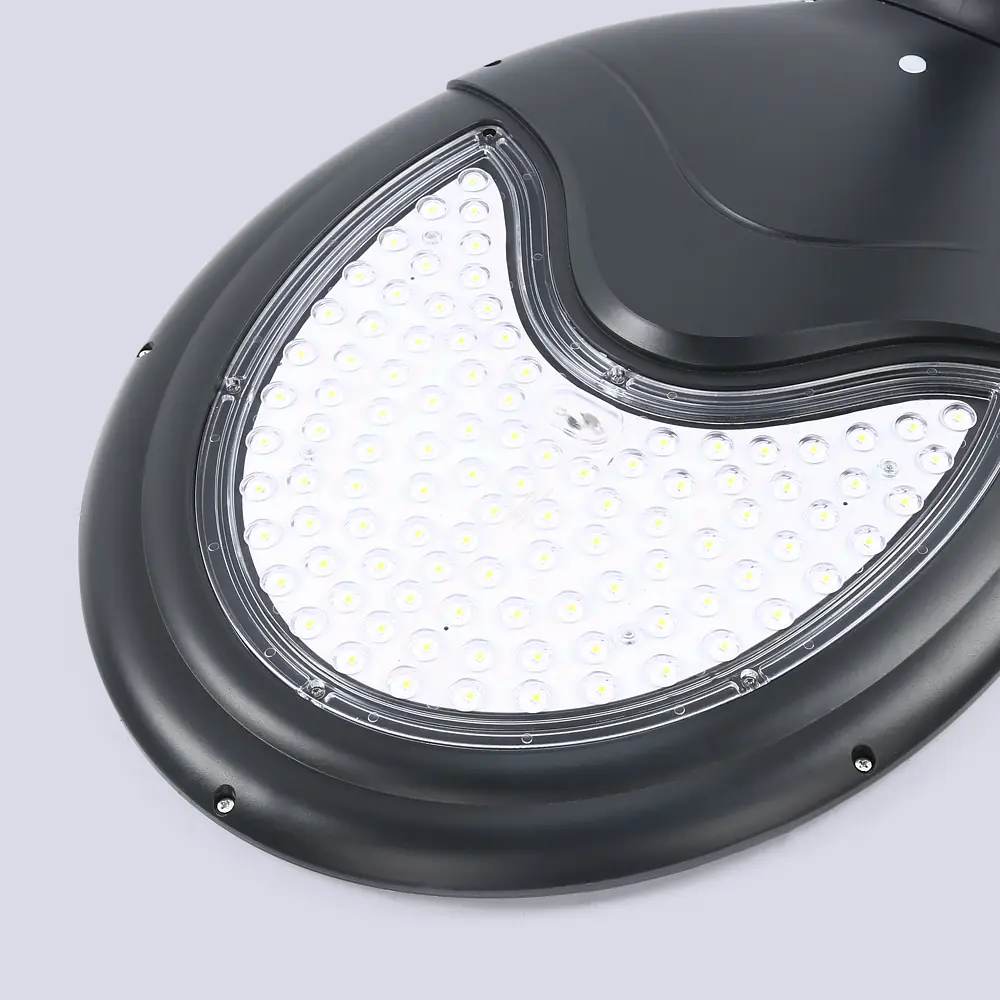
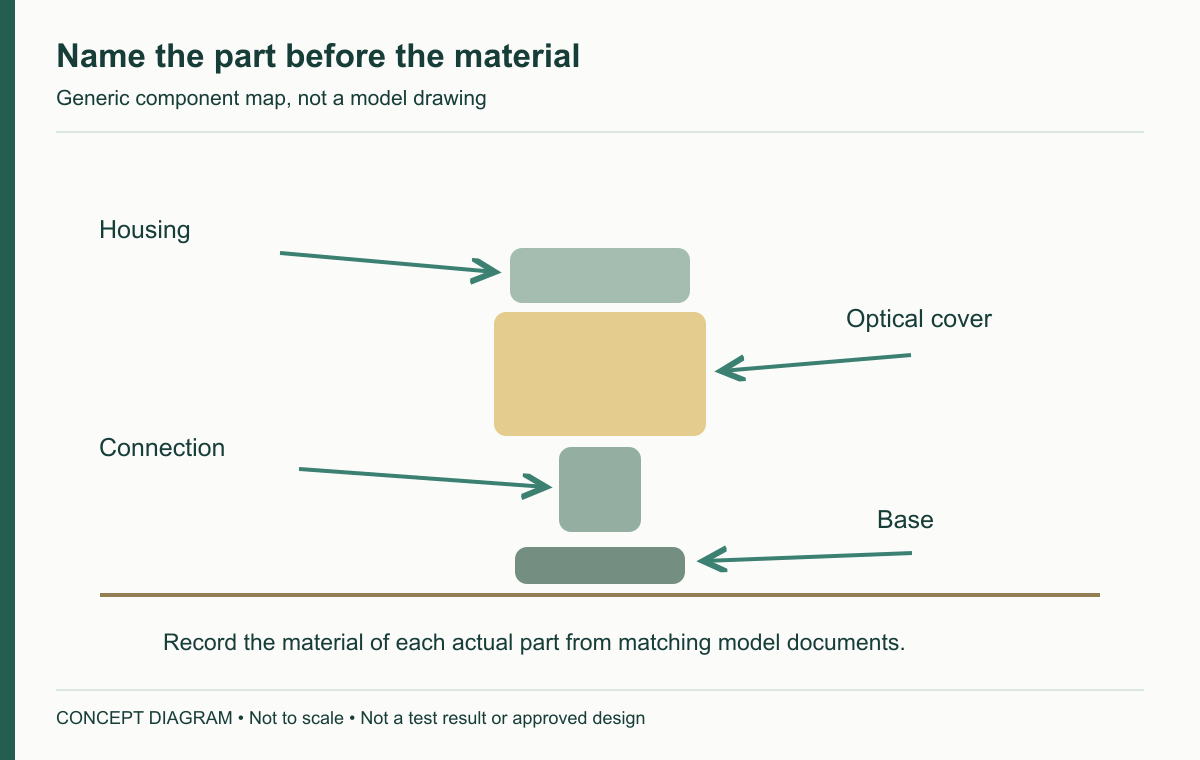
List the housing, diffuser or lens, base, visible connecting components and relevant fixings. Ask the supplier to identify the material of each part for the actual model and configuration. If a product contains several optical pieces, do not merge them into a single assumed material simply because they all look transparent.
A declared aluminum housing does not imply an all-metal product. Likewise, a transparent part should not be called glass, PC or another polymer based on a photograph. The terms describe different information that should be tied to a specific component and a documented source.
Keep the model identity with the material statement
Record the full model, revision and source document. An ABS statement for one pathway light is not evidence that another plastic solar pathway light uses the same material. A series name may group products visually while their construction differs.
When reviewing solar pathway lights or solar bollard lights, treat category pages as ways to identify candidate forms. Obtain component-specific information before presenting those candidates as a verified aluminum-versus-ABS comparison. Missing material information should remain an enquiry, not be inferred from colour or gloss.
Compare Construction and Surface Finishes
Inspect the visible assembly
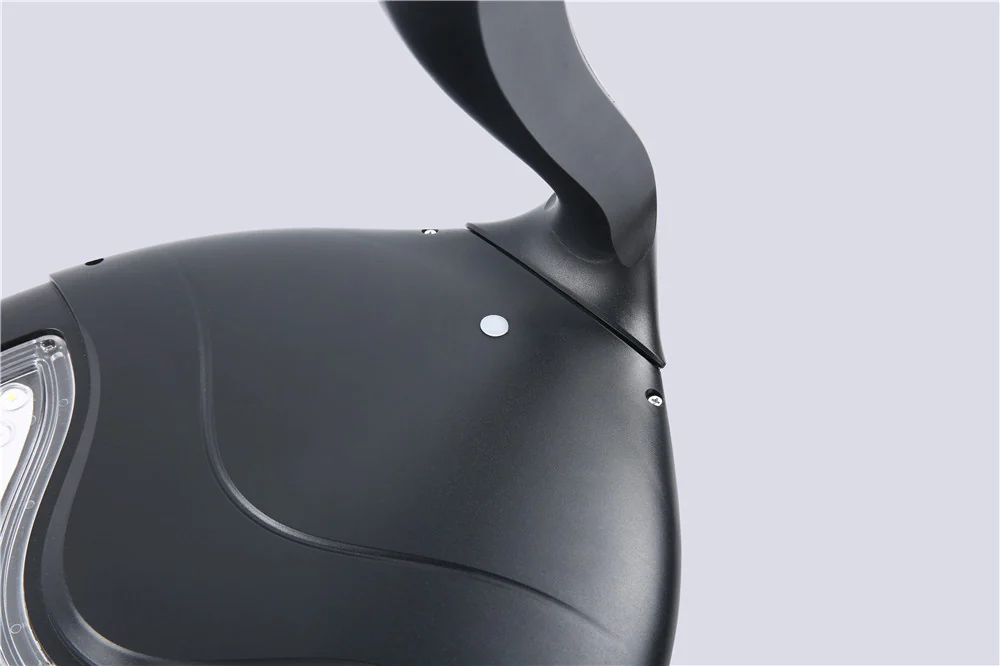
Observe how accessible exterior parts meet, how the sample sits on its base and whether visible surfaces show damage or inconsistent workmanship. Record the location of each observation with a photograph. Do not jump from one visible mark to a conclusion about the entire manufacturing process or product lifetime.
Weight can be recorded when measured appropriately, but it is not a quality score by itself. Two products may have different dimensions, components and designs. A heavier candidate is not automatically more durable, just as a lighter candidate is not automatically unsuitable for outdoor use.
Ask what the finish claim refers to
If the supplier describes a coating or surface treatment, identify which part receives it and which document supports the statement. Do not invent coating thickness, alloy grade or a manufacturing process from the visual finish. A promotional rendering can show intended appearance without verifying the actual sample’s construction.
The relevant comparison is between complete, documented configurations. For example, a buyer might need a finish compatible with a specified environment and a supported maintenance method. That enquiry is more useful than asking whether all aluminum solar garden lights are simply better than all plastic alternatives.
Keep exterior inspection non-destructive
Routine purchasing inspection should not require scratching a coating, burning a plastic piece or striking a sample to guess its material class. Such actions can damage the product and do not constitute an appropriate performance test. Where a property genuinely needs verification, ask for the corresponding evidence and an agreed professional assessment method.
Record visible defects without giving an unsupported cause. “A mark is visible at this joint” is a traceable observation. “The alloy is poor” is a different claim requiring different evidence. This distinction makes the conversation with the supplier more precise and less dependent on opinion.
Assess Sun Exposure, Moisture and Use Conditions
Describe the site before asking for resistance claims
Record whether the actual installation is exposed to persistent sun, moisture, irrigation, coastal conditions or possible mechanical contact. A property near the sea may need questions different from an inland shaded courtyard. Do not assume that all island sites have the same salt exposure or that every Southeast Asian location shares one environment.
For Australia, Europe and North America, identify the local conditions and intended season of operation. Where cold conditions matter, examine the relevant complete-system requirements separately from the housing material. A material comparison cannot establish battery charging limits or a guaranteed winter operating period.
Match each claim to the right evidence
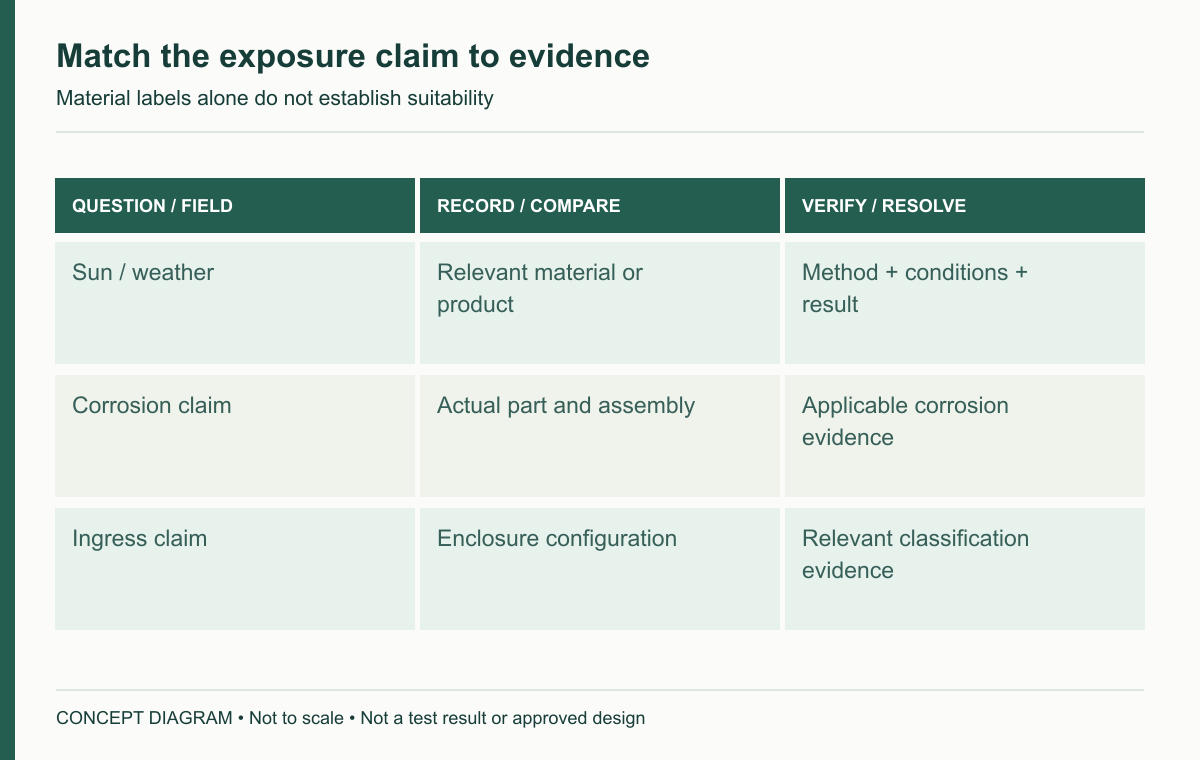
Use material-specific evidence for the property being claimed. The scope of IEC 60529 concerns enclosure protection classifications; IEC 60068-2-11 addresses a salt-mist test. These are different evidence routes. Citing either standard does not show that the product under review has been tested to it.
Ask what supports a corrosion-resistant, UV-resistant or impact-resistant statement. The evidence should identify the object tested, configuration, method, conditions and result relevant to the claim. A material-level result and a whole-luminaire result do not necessarily answer the same question.
Do not use a water-ingress rating as a shortcut for unrelated properties. The purchasing question is whether the supplied evidence actually addresses the exposure or performance being claimed. If it does not, record the missing relationship rather than assigning a general outdoor pass.
| Site question | Information to request | What not to infer |
|---|---|---|
| Sun and outdoor exposure | Relevant material or product evidence, with conditions | A glossy surface proves UV resistance |
| Coastal exposure where applicable | Corrosion-related evidence for the identified parts and assembly | Aluminum automatically means suitable for every coast |
| Water and moisture | Applicable protection and installation information | One protection claim proves all environmental performance |
| Possible mechanical contact | Appropriate evidence and permitted use conditions | A thick-looking housing proves impact resistance |
| Seasonal cold where relevant | Model-specific system and maintenance information | A metal or plastic label establishes charging suitability |
Compare Cleaning, Repair and Part Replacement
Ask what maintenance the manufacturer permits
Obtain the cleaning instructions for the actual surfaces and optical components. A method suitable for one finish or diffuser should not be assumed suitable for another. Do not recommend solvents, polishing or surface restoration merely because a material name sounds familiar.
Check how a permitted service action affects seals, joints and the product’s subsequent use. A part that appears removable is not automatically user-serviceable. Identify who may perform the work and what verification is required afterwards, using the applicable instructions rather than a general repair assumption.
Compare serviceable parts as part of procurement
Ask which components have confirmed replacement support, how they are identified and which versions are compatible. An available diffuser does not establish battery serviceability, and a replacement housing does not necessarily reuse every existing component. Keep each serviceable part tied to its own documentation.
For an island or remote site, replacement identification and service access may influence the purchasing decision alongside appearance. A product with a clear, confirmed service route may be easier to manage than one with an attractive material claim but unresolved support. This is a criterion to investigate, not a promise of parts availability or delivery time.
Make maintenance differences visible
In a comparison worksheet, record permitted cleaning, responsible personnel, replacement scope and unresolved support questions. Do not assign an arbitrary durability score to compensate for missing documents. If both candidates lack sufficient evidence, the correct next step is clarification, not declaring a winner from the material names.
Review courtyard-light configurations separately when a pole-top form is under consideration. Its maintenance access and supporting structure differ from a low-level pathway product, so an apparent material comparison should not conceal a different installation and service task.
Inspect Workmanship on Real Samples
Prepare a repeatable observation record
Identify the sample before making comparisons: model, configuration, document revision and date received. Use comparable lighting and photograph the same types of locations on each candidate. Retain original files so that another reviewer can understand what was visible at the time.
| Observation field | What to record | Boundary |
|---|---|---|
| Sample identity | Full model and available version | Do not assume all series members match |
| Part and location | Housing, optical part, base or connection | Keep different materials separate |
| Visible condition | Descriptive observation and photo reference | Do not turn appearance into material identification |
| Assembly information | What is visible and what the manual states | Do not dismantle sealed components without an approved process |
| Question for supplier | Specific information needed | Keep unknown properties unresolved |
Compare like with like
If candidates differ in size, optical arrangement or mounting form, record those differences before discussing their materials. Otherwise, a preference for one design may be presented incorrectly as evidence that its material is superior. A useful comparison can conclude that two products serve different requirements rather than selecting one universal winner.
For a hypothetical courtyard enquiry, one candidate may have clearer documented replacement arrangements while another has an appearance preferred by the designer. The next step is to resolve the maintenance and material evidence relevant to the site. No invented test score is needed to explain that trade-off.
Do not treat a factory or sample photograph as a test record. It can support an observation about visible construction or packaging, but test conditions, acceptance criteria and actual results belong in a different evidence category. The distinction protects both the buyer and the supplier from claims the image cannot support.
Separate Material Claims from Test Evidence
Build the final evidence table
| Component | Material statement and source | Visible observation | Performance claim | Evidence still required |
|---|---|---|---|---|
| Housing | Enter exact document and revision | Describe only what is visible | Enter only the actual claim | Relevant method, object and conditions |
| Diffuser or lens | Identify the particular optical part | Record photo location | Record the claimed property, if any | Evidence matching that part and claim |
| Base or connection | Confirm material and configuration | Record accessible features | Do not infer structural acceptance | Appropriate product and project review |
| Finish | Identify treated part and source | Record surface condition | Do not infer a lifetime | Applicable supporting evidence |
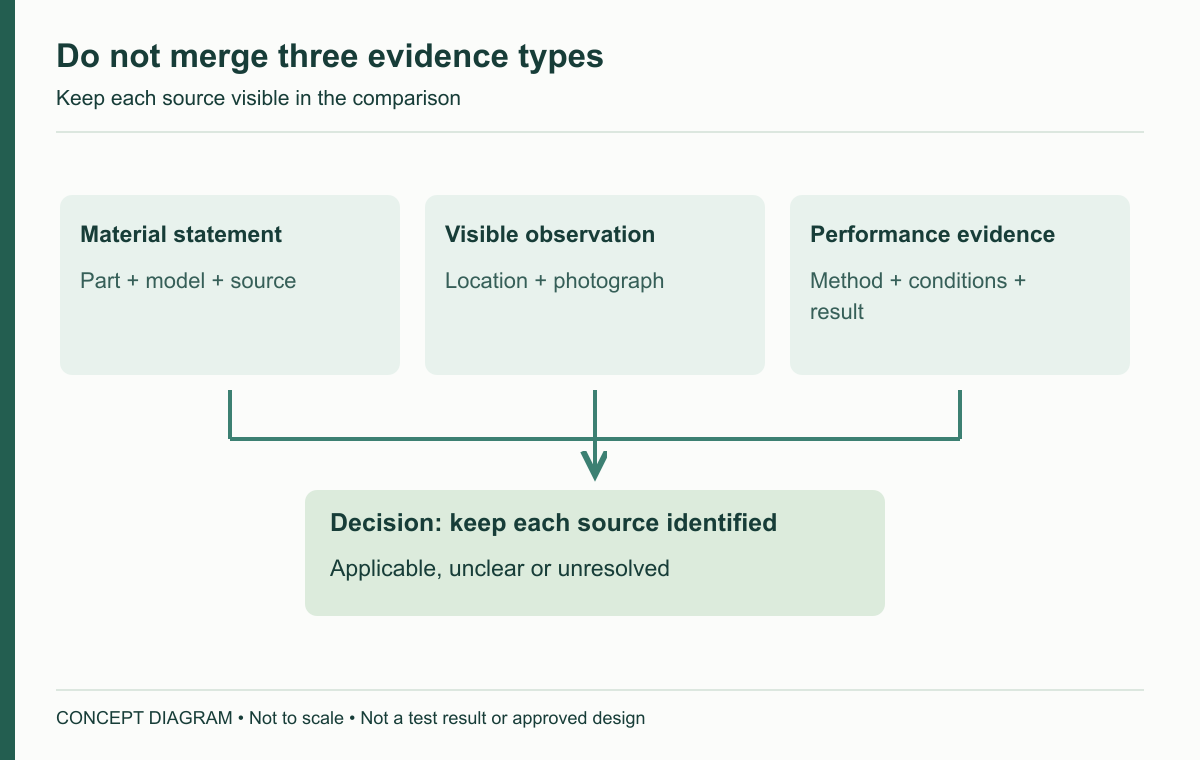
The table deliberately separates statements, observations and proof. A supplier declaration may support the description of a material; it does not automatically support every performance claim associated with that material. A clear report can be useful only when its tested object and conditions correspond to the decision being made.
Turn gaps into a focused request
Send the supplier a short list of unresolved items, each tied to a component and intended use. Ask for the applicable document rather than a general assurance that the product is high quality. If a comparison cannot yet be made fairly, say which evidence would make it possible.
Frequently asked questions
Are aluminum lights always more durable than plastic lights? No universal conclusion follows from the names. Compare the actual components, construction, environment, maintenance and supporting evidence before making an application-specific decision.
Can a metal housing be combined with a plastic diffuser? Yes, a luminaire can use different materials for different components. Confirm the exact material of each part; mixed construction is not inherently a defect or an all-metal product.
Does an IP rating demonstrate corrosion resistance? It should not be used as a substitute for corrosion evidence. Ask for information addressing the actual environmental claim, tested object and relevant conditions.
To request a component-level comparison, provide the intended environment, mounting form and maintenance expectations. That gives the supplier a concrete basis for supplying material information and suitable evidence instead of an unsupported aluminum-versus-plastic ranking.
For an overview of fixture types, site conditions and selection priorities, see our garden and courtyard lighting guide.