

Solar garden light sample testing should begin with an agreement about the sample, the questions to answer and the evidence required. A light switching on is an observation, not a complete acceptance result. One night’s operation does not establish output, lifetime, protection ratings or consistency across future production.
Identify the exact configuration, define the permitted checks and record conditions before looking for a pass or fail. Keep observations, instrument measurements and professional reports separate. Where an item was not tested, say so; do not enter zero, assume compliance or fill the gap with a catalogue claim.
This guide helps buyers and project teams structure a sample review. It does not invent a laboratory procedure, acceptance threshold or destructive test. A sample acceptance record is useful when another person can trace each conclusion back to the correct sample and evidence.
Agree on the Sample and Acceptance Conditions
Identify what the sample represents
Record the full model, configuration, options, quantity received and the purpose of the review. A display sample, a pre-production sample and an order-confirmation sample may represent different stages. Ask what has actually been supplied rather than assuming any item sent before an order represents the final production configuration.
Attach the relevant specification, manual and written configuration confirmation. If they do not agree, record the difference before testing the affected function. A successful observation on an unidentified version is difficult to use when the order later specifies different parts or controls.
Set agreed criteria before observing results
For each check, define the requirement, method, conditions, responsible person and evidence to retain. The project team should agree what constitutes an acceptable result in the applicable context. Do not decide a threshold after seeing the sample and then present it as the original criterion.
| Preparation field | Entry to agree |
|---|---|
| Sample identity | Full model, configuration, sample ID and stage |
| Purpose | Appearance review, function check or other defined evaluation |
| Requirement | Applicable document or agreed criterion |
| Method and conditions | Permitted process and relevant inputs |
| Evidence | Photo, observation record, measurement file or report |
| Responsibility | Who performs, reviews and accepts the item |
| Untested scope | Items not covered by this review |
Keep supplier information in its proper role
The solar courtyard light range and solar bollard range can help identify the intended product family. A category page is not the sample’s configuration record. Ask for the document that applies to the specific item received.
Similarly, a manufacturer’s quality-control overview can inform questions about available processes and reports. It does not prove that every listed process was performed on the sample in your possession. Request the relevant evidence rather than assuming a general page is an individual acceptance certificate.
Check Appearance, Model, Dimensions and Assembly
Record arrival condition before changing anything
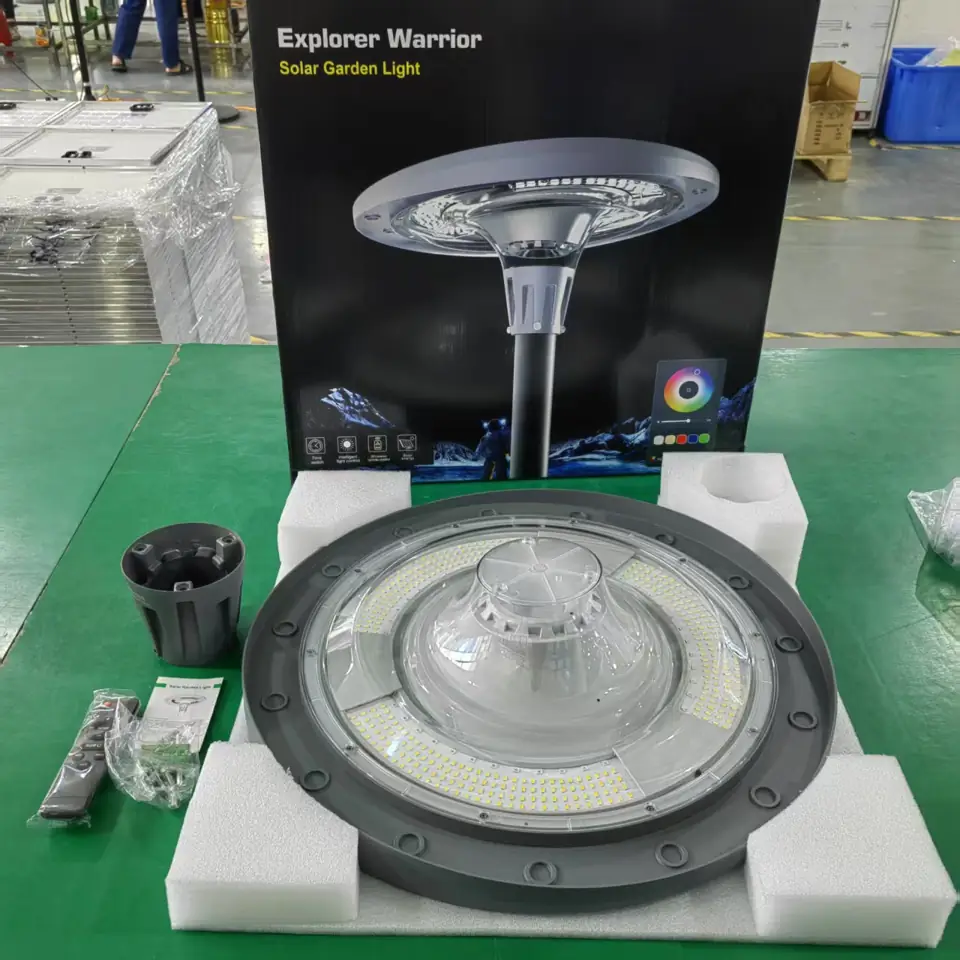
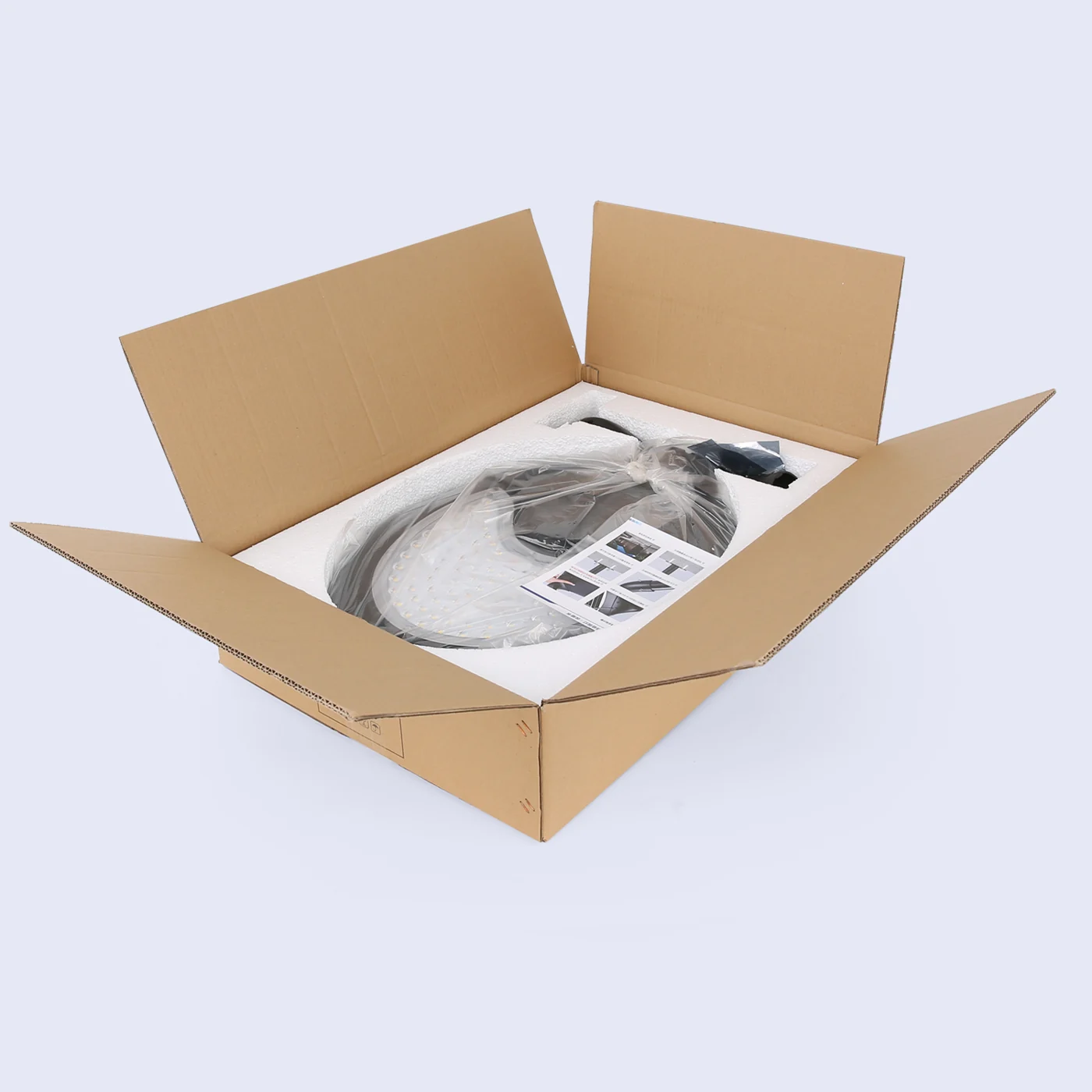
Identify packaging, labels, supplied parts and visible damage. Connect photographs to the sample ID and the observed location. If the packaging contains several versions or accessories, record them separately rather than treating every nearby item as part of one sample assembly.
Keep the unpacking and observation record descriptive. Damage visible on arrival should be documented without automatically attributing its cause to manufacturing, transport or handling. The evidence may help the responsible parties investigate, but the initial record should not claim more than it shows.
Measure only what the agreed method supports
For permitted accessible dimensions, state the measured object, units and method. Compare with the correct drawing revision and distinguish a housing dimension from a mounting interface. If a relevant feature cannot be inspected safely or without disturbing a sealed assembly, mark it as outside the current check.
General appearance and assembly observations do not replace structural, material or ingress-protection testing. Do not scratch coatings, open sealed parts or perform improvised impact and water tests. A specialist test needs an appropriate agreed procedure and qualified execution, not a dramatic demonstration for a purchasing video.
Record a discrepancy precisely
Describe where the sample differs from the document and which decision is affected. A missing accessory, unclear label and dimensional concern are different findings and may need different owners. Avoid a single “sample problem” entry that makes later resolution hard to verify.
Retain the original description when a supplier answers. Add the response, document revision and any recheck instead of silently replacing the earlier evidence. The record should show how the issue was resolved, not merely the final preferred wording.
Verify Switches and Operating Modes
Use the exact instructions
Check only functions documented for the received configuration, following the applicable instructions. Record the control input, conditions, expected behaviour and actual observation. Do not invent a universal long press, reset sequence or sensor function because another solar light uses it.
A light-sensitive dusk control and motion detection are different functions. If the supplied documents are unclear about either, ask for clarification. Do not turn a response to one condition into proof of another feature, or assume every member of a product range supports the same modes.
Observe transitions as well as steady operation
Where the confirmed mode includes changes of state, record the relevant transitions and what triggered them. The observation should say which conditions were actually covered. Seeing one transition does not establish every possible operating state or its energy demand.
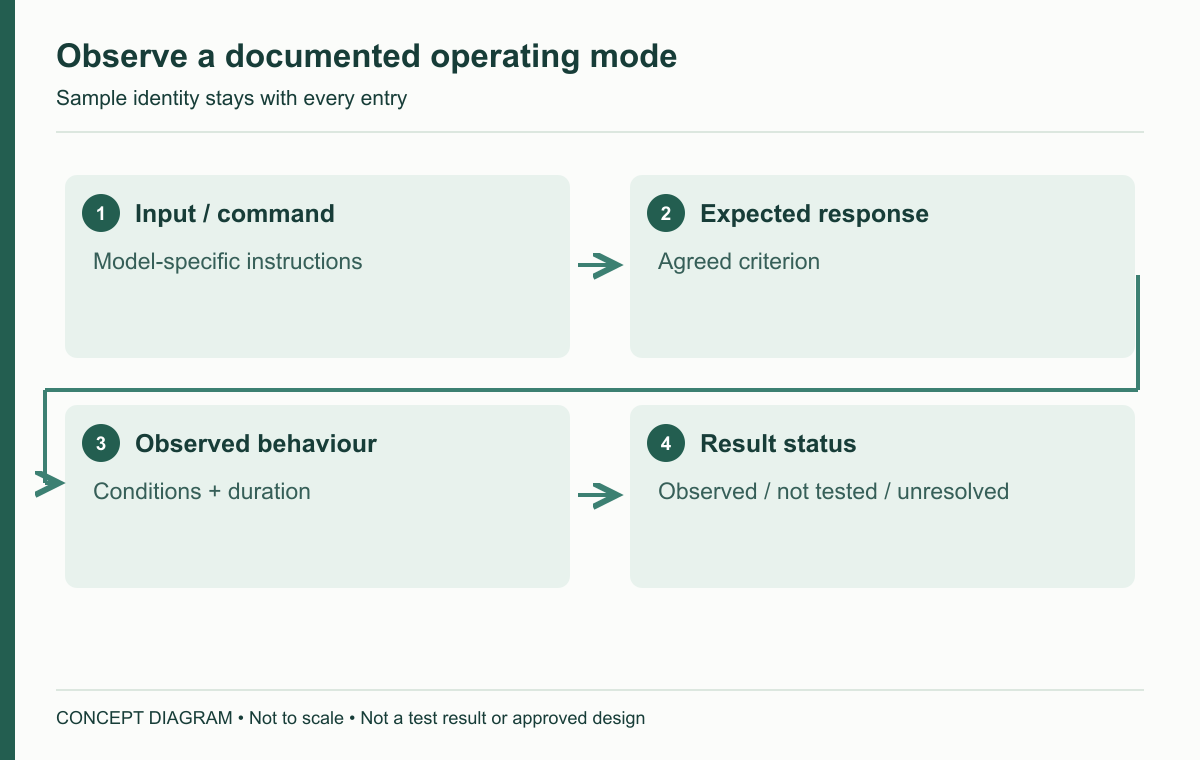
For a hypothetical hotel enquiry, the team may need to evaluate the behaviour relevant to late arrivals and room-facing views. For a community, it may prioritise a continuously used pedestrian route. These are different evaluation purposes, not reasons to create new control capabilities in the sample description.
If observed behaviour and the manual disagree, keep the discrepancy open and request the correct instructions or an explanation from the supplier. Do not modify programming or bypass protection in order to make the sample match an expected result.
Record Charging Conditions and Night-Time Behaviour
Document the starting point
Record the known initial state, charging arrangement, weather, shade and selected mode. If the starting battery state is unknown, include that limitation. A runtime observation cannot be interpreted fairly when its energy input and operating programme are omitted.
Define the observation period and end condition before beginning. Record when the light starts, any relevant changes and when observation ends. If the team stops observing before dawn, the record does not demonstrate an entire night, even if the light was still operating at the last check.
Keep nominal energy separate from measurement
A capacity or energy value on a specification is not a capacity measured during this review. Similarly, arithmetic using nominal ratings does not establish the usable energy available under the test conditions. Keep documented ratings, calculated quantities and actual measured results in separate fields.
Do not extrapolate one night to a year of rainy, cloudy or cold conditions. A sample review in one season may leave other operating conditions untested. For island or Southeast Asian applications, record the relevant weather and shading requirements; for seasonal Australian, European or North American sites, identify the conditions that still need assessment.
Keep temperature and exposure questions model-specific
Where seasonal cold matters, obtain the applicable battery and controller charging information separately from a general working-temperature statement. Where coastal exposure matters, request the relevant evidence instead of treating a short outdoor sample trial as a corrosion test. No region name automatically supplies those missing results.
Use the winter-use guide for further context on conditions to consider, while retaining the sample’s own instructions as the basis for permitted actions. The guide is not a substitute for a test covering the actual requirement.
Separate Observation, Measurement and Test Reports
Choose evidence that can answer the question
| Evidence type | Suitable record | What it does not establish alone |
|---|---|---|
| Visual observation | Visible condition, source identity and viewpoint | Material grade, light output or a protection rating |
| Functional observation | Input, state and observed response | Every mode or future reliability |
| Instrument measurement | Instrument, method, units and conditions | Unmeasured properties or universal site suitability |
| Professional report | Identified object, scope, method and result | Unrelated configurations or conditions outside the report |
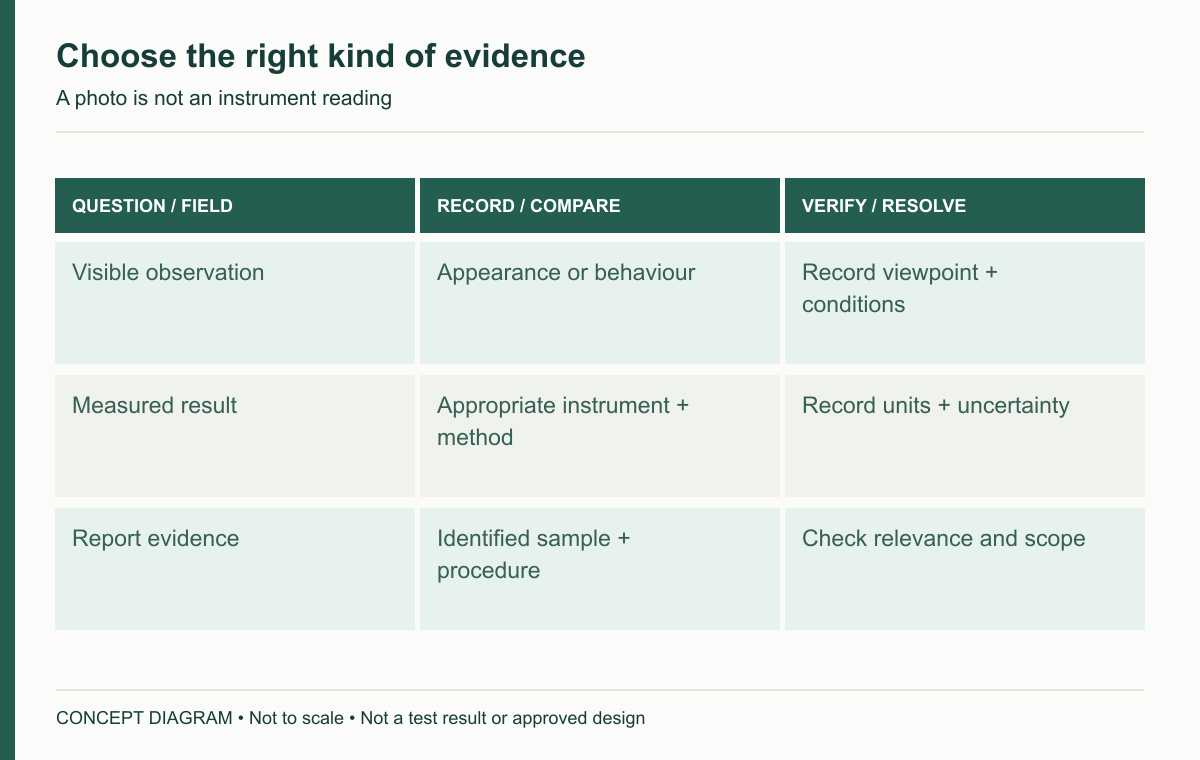
Illuminance at a stated surface and whole-luminaire luminous flux are different quantities. A handheld illuminance reading should not be entered as the lamp’s lumens. A photograph is also not an instrument measurement, regardless of how bright the image appears.
Where instruments are used, record the equipment and method information needed to understand the result. If suitable equipment or an agreed method is unavailable, mark the item not tested and decide how appropriate evidence will be obtained. An honest limitation is more useful than a number with no valid interpretation.
Check the relationship between a report and the sample
Ask whether the report covers the same model, component version and relevant configuration. A report for a similar-looking product is not automatically applicable. Record the document reference and any unresolved scope question so that the reviewer can decide what the evidence supports.
Do not describe a supplier statement, a site observation and a professional report as interchangeable proof. Each may contribute useful information, but its purpose and limitations should remain clear in the acceptance record.
Log Issues and Decide the Next Step
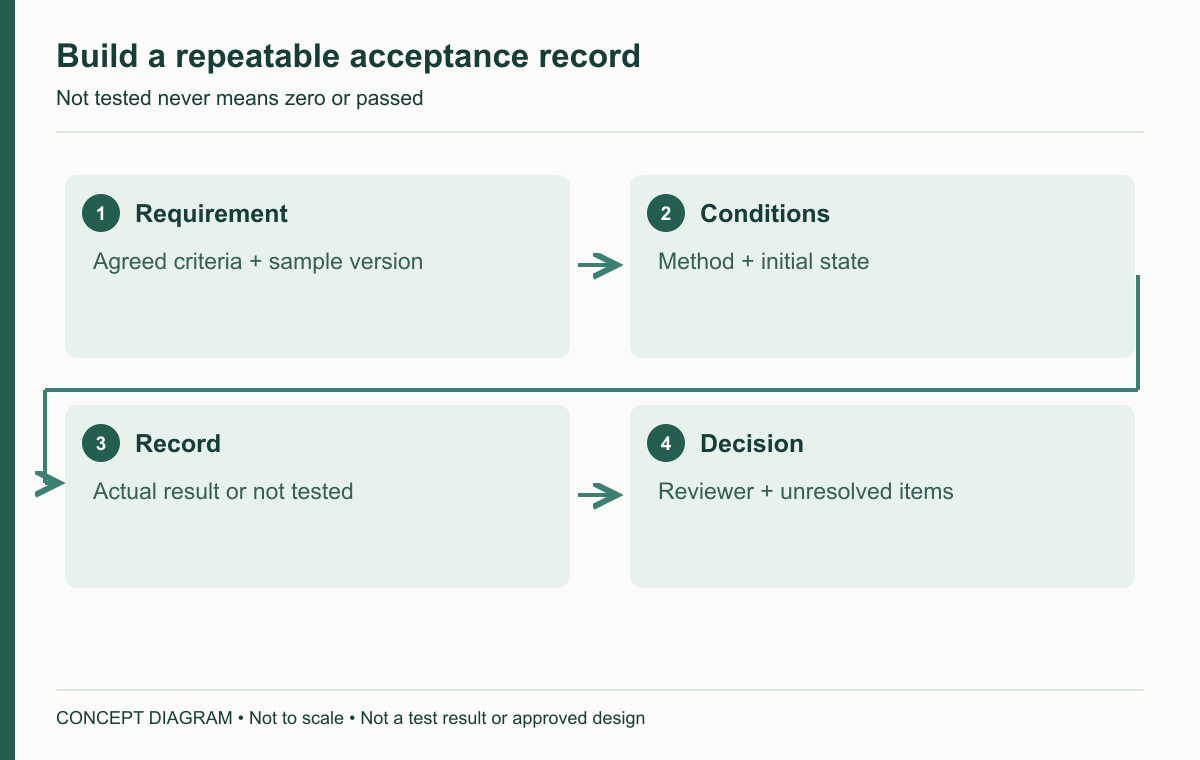
Use an item-level acceptance record
| Check item | Agreed requirement | Conditions and method | Actual result | Evidence | Decision and follow-up |
|---|---|---|---|---|---|
| Identity and configuration | Document reference | Record comparison method | Observation or unresolved | Label and document IDs | Named reviewer |
| Accessible appearance/dimension | Agreed criterion | Permitted method and units | Actual observation/value | Photo or measurement reference | Accept, clarify or recheck |
| Supported operating mode | Applicable manual | Input and observed state | Actual behaviour | Observation record | Resolve any difference |
| Night-time requirement | Agreed scope | Charging and observation conditions | Actual coverage or not tested | Time record | Further evaluation if needed |
| Specialist property | Applicable evidence requirement | Appropriate procedure | Reported result or not tested | Matched report | Scope reviewed separately |
Keep acceptance bounded by the evidence
The responsible reviewer may accept a defined item, request clarification or require another evaluation. Record the decision and the scope it covers. Avoid a single large passed stamp that obscures untested properties or an unresolved configuration difference.
Sample approval also needs a connection to the eventual order. Retain the approved configuration and any agreed changes, then confirm how production identity and consistency will be addressed. One acceptable sample does not guarantee that every later unit or option is identical.
Frequently asked questions
Does one night of operation mean the sample passes? It supports only the observations actually covered under the recorded conditions. Other requirements, the sample identity and untested properties remain separate acceptance items.
What can buyers check without specialist instruments? They can record identity, visible condition and permitted functional behaviour under the relevant instructions. They should not fill unmeasured output, capacity or protection fields with assumed results.
Does sample approval guarantee every production unit is identical? No. Confirm the order configuration, change control and appropriate quality-verification arrangements. A sample result has a defined scope, not an automatic all-batch guarantee.
Start with an agreed record rather than an improvised demonstration. The sample will then produce useful, traceable information for the purchasing decision—even when some results correctly remain not tested.
For an overview of fixture types, site conditions and selection priorities, see our garden and courtyard lighting guide.