

Nightly runtime depends on usable energy collected and stored during the day and the actual energy consumed at night. “Dusk-to-dawn,” “12 hours,” panel watts and rated lamp watts cannot be combined into an unconditional promise of full-power operation all night.
Separate nightly runtime from service life
Runtime is how a light behaves during one night after a given charging period. Backup through several low-sun days is a different question, and component ageing over years is different again. A small stake light and a post-top courtyard light should not be expected to share one standard runtime.
Separate three questions in an enquiry: “How long did it operate in the stated test?”, “How does the controller change output during that period?” and “What happens after days with reduced solar input?” A single hour value cannot answer all three. Service life should be handled separately because it concerns change over repeated cycles and calendar time, not the length of one night.
How much usable energy is stored?
Solar resource, shade, panel orientation, temperature, starting state of charge and the controller all affect daytime input. Daylight hours are not the same as effective charging energy. Battery nameplate energy is also not fully available to the load in every condition.
The nominal-energy calculation is voltage × amp-hours. The reviewed SCL-008 source lists 3.2 V and 36 Ah, giving 115.2 Wh nominal. SCL-009PLUS lists 3.2 V and 48 Ah, giving 153.6 Wh nominal. These are calculations from stated ratings—not usable-energy or field-runtime measurements.
Usable energy is lower than a simple nameplate total in many real systems because the controller protects the battery, conversion has losses and temperature or ageing can change behaviour. The available share is model- and condition-specific. For that reason, nominal Wh is useful for checking the arithmetic and comparing documentation, but it should not be divided by a lamp wattage to publish a guaranteed number of hours.
Match energy to the actual night load
Constant output, scheduled dimming and motion-triggered operation produce different consumption profiles. “Dusk-to-dawn” means the controller responds to day and night; it does not necessarily mean unchanged brightness. Only attribute a mode to a model when its current instructions confirm it.
| Record | Entry |
|---|---|
| Exact model/version and mode | ______ |
| Date, location and daytime conditions | ______ |
| On, dimming and off times | ______ |
| Nearby night lighting | ______ |
| Repeat-night observations | ______ |
Add one row for every change that could affect the result: a new mode, relocation, cleaning, pruning, unusual cloud cover or nearby lighting. Without this change log, an apparent improvement may be attributed to the wrong cause.
Run a useful nighttime observation
Start with the product’s documented setup and a clearly identified mode. Record daytime conditions and any visible shade, then note the time the light turns on, each visible output change and the time it turns off. Repeat for several comparable nights rather than selecting the best result. If two lights are compared, use the same observation format but do not assume their different sites received equal solar energy.
The record can describe what happened; it does not turn an uncontrolled site observation into a laboratory test. Supplier test claims should therefore retain their own location, charging, temperature, load and cutoff conditions.
How dimming changes nightly energy use
Dimming changes the demand side of the energy balance. A light using a lower actual electrical input for part of the night consumes less energy during that period than the same light operating at its higher input, provided other conditions stay comparable. However, a displayed brightness percentage does not automatically equal the same percentage of electrical power. Ask for the actual input or documented load program.
Here is a hypothetical arithmetic example, not a runtime claim for SCL-008, SCL-009PLUS or any other product. A measured load of 4 W running for 3 hours uses 12 Wh. A subsequent measured load of 1 W for 7 hours uses 7 Wh. Those two load periods total 19 Wh. Constant-on operation at 4 W for the same 10 hours would use 40 Wh at the stated measurement boundary.
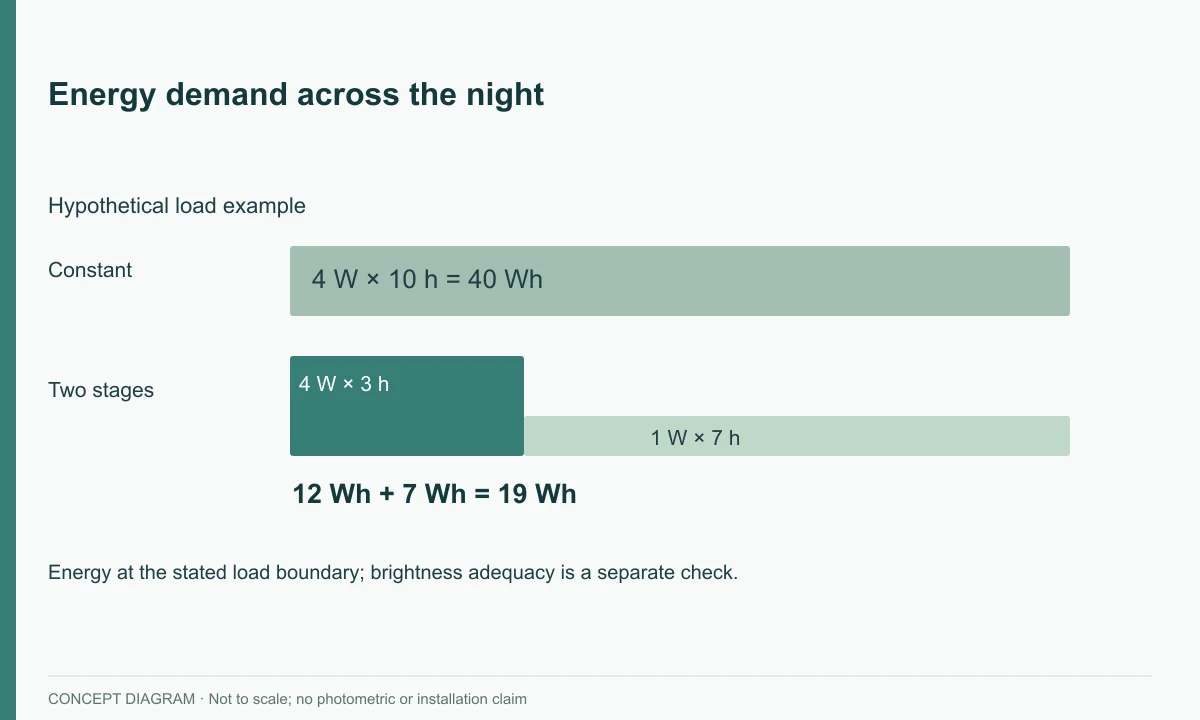
The calculation explains why the program matters. It does not establish battery size, charge recovery or usable energy, and it does not include losses outside the stated load boundary. Nor does it prove that 1 W provides enough light for the later task. Agree the required lighting function first, then use the supported program to evaluate energy demand.
A motion-activated program, where the model supports one, adds another variable: how frequently the light is triggered and how long the higher state lasts. A quiet test night may consume less energy than a busy entrance. Record activity as part of the observation instead of comparing both nights as if their loads were identical.
Explain cloudy-day operation over a sequence of nights
A cloudy day can still contribute some solar energy, but the amount received and stored depends on the conditions and system. The useful question is whether input over the observed days replaces the energy used at night. A partially charged battery may carry a light through one evening while becoming progressively depleted if the deficit continues.
After charging, a light therefore does not have one universal number of operating hours. Its starting charge, usable storage, night load and control cutoffs all matter. A larger battery can provide more reserve under suitable conditions, yet repeated low input still has to be addressed. These relationships apply to the energy balance; they do not establish a fixed number of rainy days for a product.
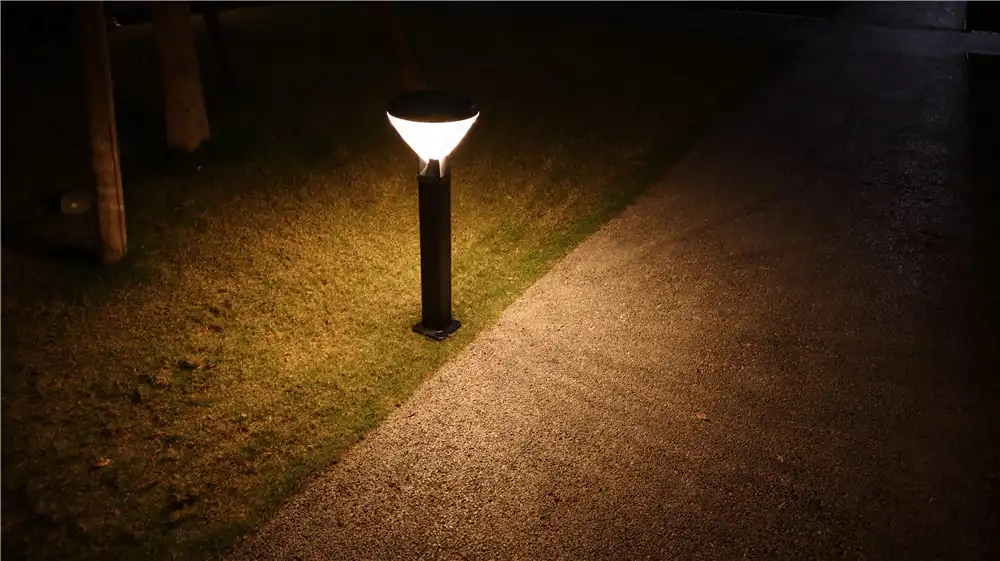
When comparing courtyard-light configurations, request the exact program and charging assumptions with the model specification. Keep a timeline of input conditions and operating states, rather than treating one “all-night” photograph as the performance record. That makes a supplier’s runtime answer something you can check against the duty you actually need.
Why a light may switch off early
Possible branches include reduced daytime input, shade or dirt, a different program, increased night use, temperature limitations, ageing or a fault. One short night does not prove that the battery has failed. Record conditions before moving to troubleshooting; do not open the battery pack or substitute another chemistry.
Use the pattern across nights to choose the next check. A result that changes with sunny and cloudy days points first to energy input and load. A consistent change immediately after a mode adjustment points to the program. One unit behaving differently from identical nearby units calls for a version, position and condition comparison before any component conclusion. Visible swelling, leakage, abnormal heat or damaged wiring is a stop condition, not a reason to continue testing.
Example: record a short night without guessing the fault
Consider a battery-backed garden light that previously met its evening task but now turns off early. The following filled entries are hypothetical and show the record format only. They are not customer results or promised performance.
| Observation | Daytime information | Night record | Next action |
|---|---|---|---|
| First evening | New shrub growth visible; weather noted | On at dusk; off before required end period | Inspect panel exposure and confirm mode |
| After permitted position adjustment | New position documented; weather different | Required evening period completed | Repeat under comparable conditions |
| Following observation | Same position and mode | Record on, dimming and off times again | Decide whether more review is needed |
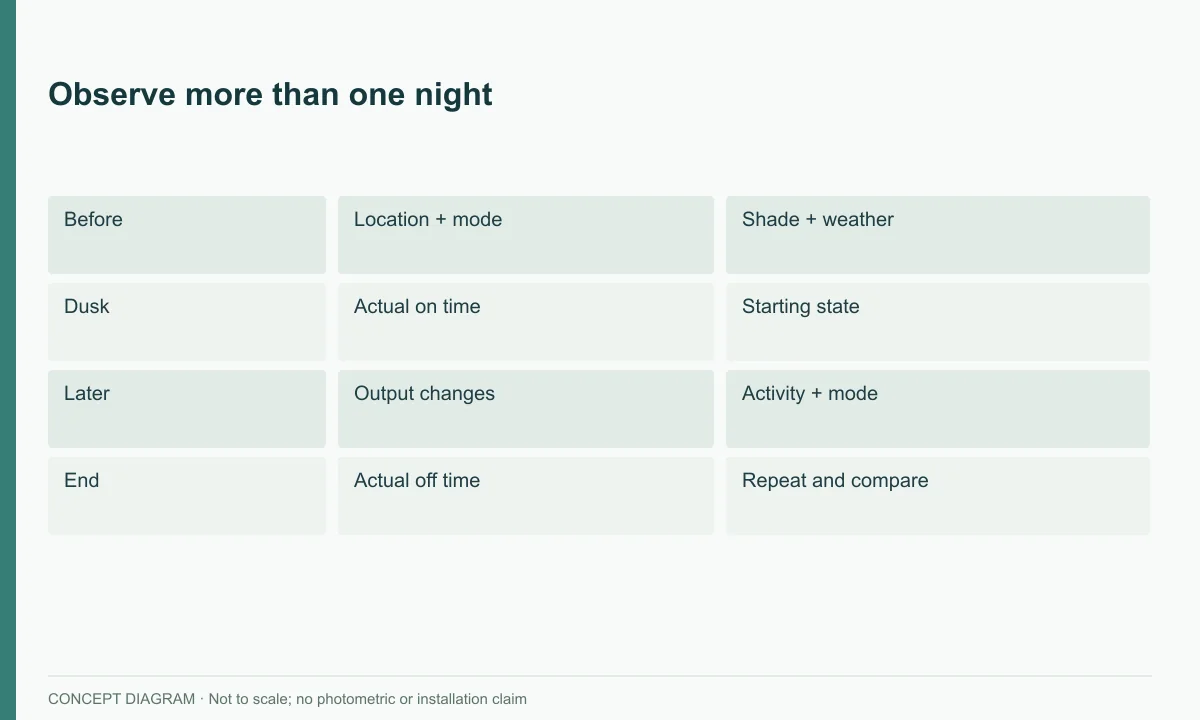
The second entry does not prove that relocation solved the problem because weather also changed. The next useful step is a repeat observation with the position and mode held steady. This is how a log improves diagnosis: it shows both the apparent result and the confounding change.
If the light remains short of the required period, send the log through the supplier support contact. Include the complete model, site ID, current program and label photographs. A supplier can then ask targeted questions rather than starting with an unsupported battery-replacement recommendation.
Verify runtime and ask the right questions
Ask the supplier for the exact model and version, stated charging and runtime test conditions, control program, actual load profile and usable-energy assumptions. Observe several comparable nights. If the conditions change, report them rather than calculating an improvement percentage.
Request the answer in a table so that marketing phrases do not replace conditions:
| Supplier item | Required detail |
|---|---|
| Runtime statement | Mode, brightness stages and cutoff definition |
| Charging basis | Solar or test input, duration and starting state |
| Environment | Relevant temperature and test setting |
| Battery information | Voltage, capacity, chemistry and whether energy is nominal or usable |
| Low-sun claim | Number of cycles, load program and test method |
If any field is unknown, leave it open. An honest open item is more useful than an apparently precise runtime that cannot be reproduced.
Read the winter-use guide for seasonal factors and the yard-light selection guide for product context.
FAQ
Why did a “12-hour” light run for less time? Check the source’s test conditions, recent charging and actual program.
Does a larger battery always run longer? Not alone; charging input, usable energy and night load also matter.
How long after cloudy days? There is no universal number; it depends on prior stored energy, daytime input and load.