


To retrofit garden lighting with solar, assess the existing installation before deciding what can remain. An old light position may serve the walking route well but provide poor solar access. A reusable-looking pole may lack the records needed to confirm its suitability. Changing the energy source does not automatically remove installation, electrical or structural work.
The practical starting point is an inventory of fixtures, poles, bases and wiring, connected to the site’s current lighting needs. From there, compare conditional options: retain, replace, relocate or investigate further. Keep the supply scope separate from site work so that a quotation does not leave important responsibilities unassigned.
This guide explains assessment and documentation for garden and courtyard projects. It is not an instruction to disconnect wiring, modify a pole or construct a foundation. Unknown conditions should become questions for the appropriate people, not assumptions used to justify an order.
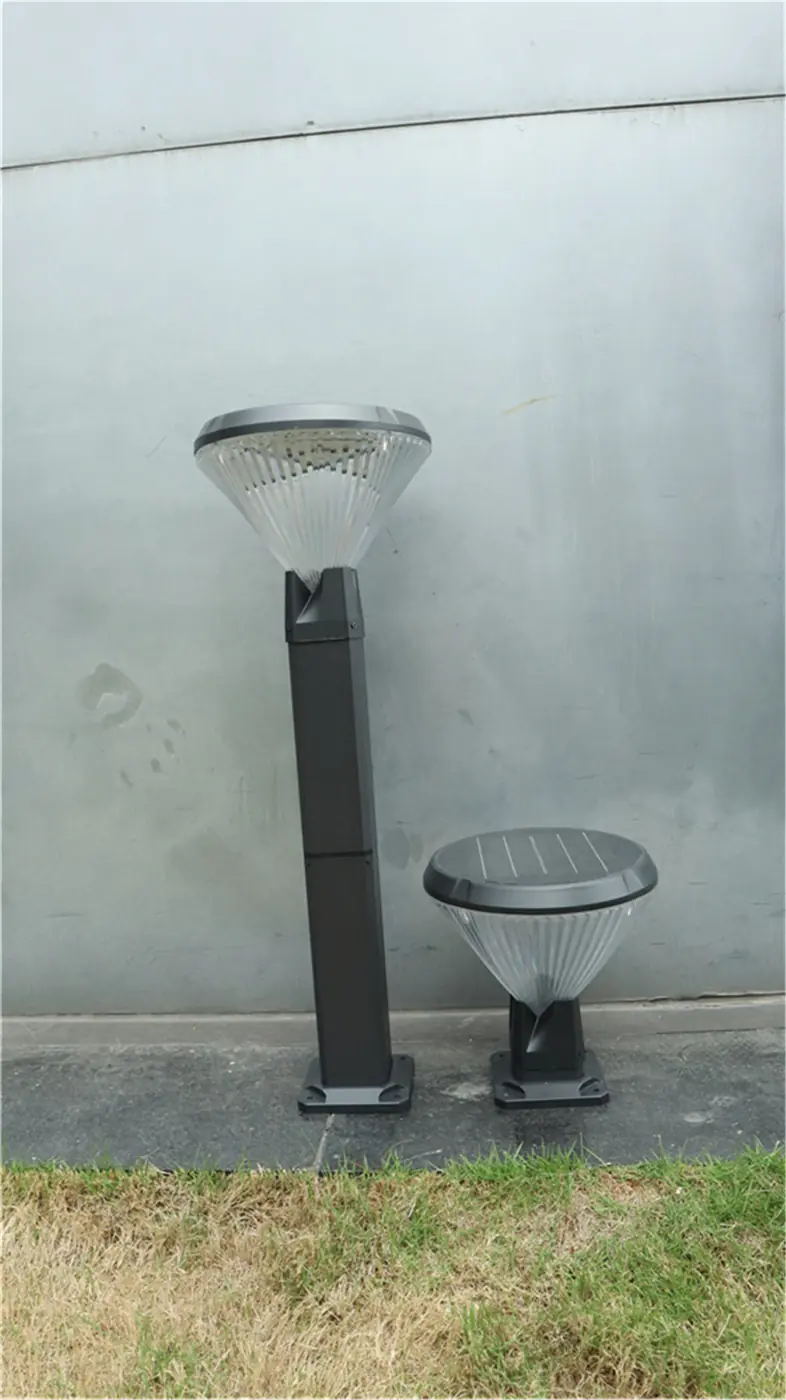
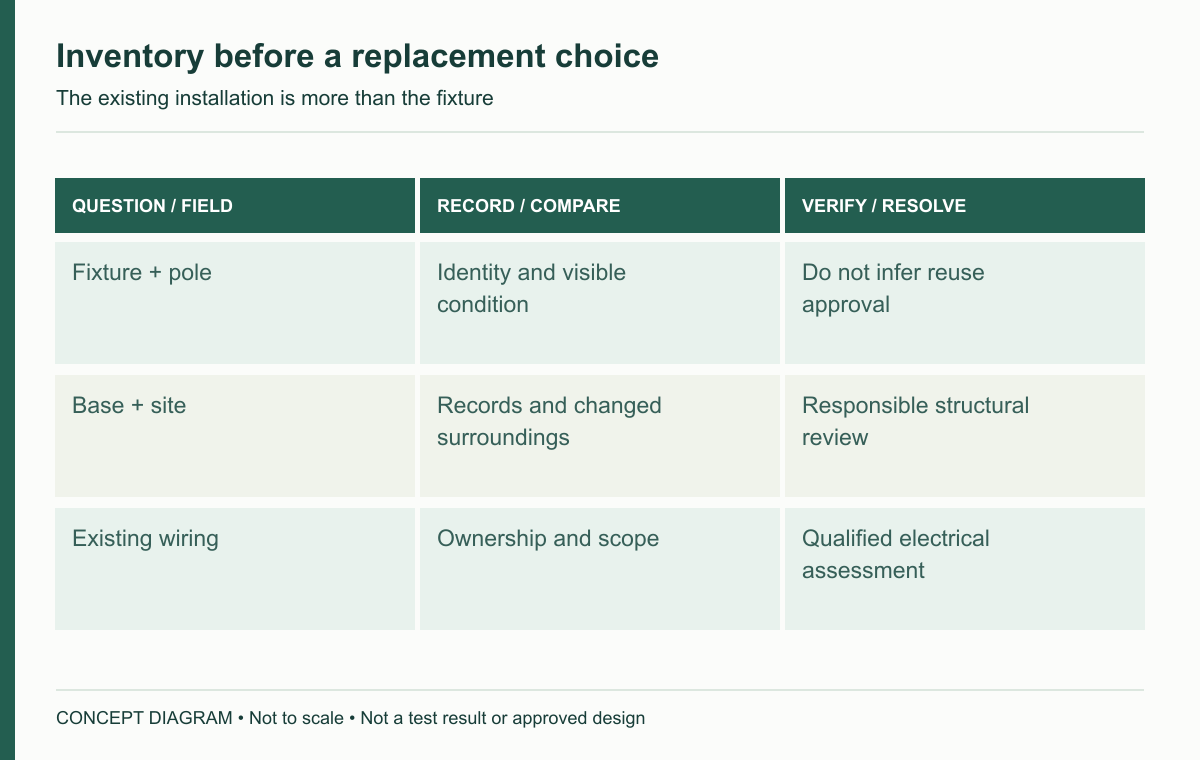
Inventory Fixtures, Poles, Bases and Wiring
Start with one position identifier
Give each existing position an identifier that appears on the plan and in photographs. Record the visible fixture form, any accessible model information, the known power arrangement and the available drawings. Note what is unknown rather than filling in a likely installation date or assuming every similar-looking light is the same version.
Photographs should describe visible conditions from safe positions. They may show a leaning assembly, damaged exterior or a route obstruction, but they do not reveal the full condition of a foundation or electrical system. Do not ask ordinary users to open electrical enclosures, test live wiring or excavate foundations to complete the inventory.
Separate the asset from its supporting evidence
| Position ID | Existing item | Known information | Available evidence | Unresolved owner |
|---|---|---|---|---|
| To assign | Fixture and accessories | Identity, visible condition, reported issue | Label, permitted photograph, manual | Person to identify missing version |
| Same ID | Pole or supporting surface | Available history and visible condition | Existing drawing or inspection record | Relevant structural reviewer |
| Same ID | Base or foundation | Documented information only | Existing records | Responsible site reviewer |
| Same ID | Wiring and supply | Known system description | Authorised electrical records | Qualified electrical personnel |
| Same ID | Surrounding area | Route, planting and access | Site plan and observation | Property or landscape team |
The inventory is not a condition certificate. Its value lies in showing what is known, how it is known and who can resolve the rest. A clear unknown is more useful than a confident but unsupported entry that later becomes the basis of procurement.
Reassess Current Lighting Needs
Describe the problem before a proposed fixture replacement
Record why a retrofit is being considered. Examples of issues to investigate include changed routes, difficult maintenance, unavailable parts or an operating pattern that no longer serves the site. A failed old lamp does not by itself establish that solar is the best replacement strategy.
Review current pedestrian movements, entrances, seating, windows and changes in landscaping. The original layout may have been appropriate for a different use. Replacing every fixture in the same location can preserve an outdated arrangement even when the new equipment is functioning correctly.
Distinguish a goal from evidence of improvement
Write the desired outcome in a form that can later be reviewed: clearer route identification at a specified area, a documented service arrangement or a supported operating schedule. Avoid statements such as “reduce costs by half” unless an actual comparison supports them. No percentage is needed to explain what the project is trying to improve.
Consider the alternatives before committing to a power source. Retaining some existing equipment, replacing selected fixtures or redesigning one area may all be worth investigating. A phased retrofit is useful only if each phase has a defined purpose and can be handed over coherently.
Set the boundary of the enquiry
The solar courtyard light range can help identify head forms to investigate, while solar bollard lights represent a different low-level mounting approach. Product categories help organise candidates; they do not decide which existing assets should remain.
For every candidate, ask whether its intended purpose matches the revised task. A decorative replacement at an old functional position should not inherit a performance responsibility merely because it fits visually. Keep vehicle-road and emergency-lighting interfaces outside an unqualified landscape replacement proposal.
Check Solar Access at Existing Positions
Reassess a wired location as a solar location
A wired fixture does not need sunlight at its mounting point to obtain operating energy. A self-contained solar fixture does. Record buildings, trees, overhangs and other obstructions around the proposed panel, including the conditions relevant to the intended operating season.
Do not use a single sunny photograph as the entire assessment. Record when observations were made, which panel position they represent and what seasonal information remains unresolved. If the panel cannot be adjusted independently, do not assume the installer can simply turn it towards a preferred direction.
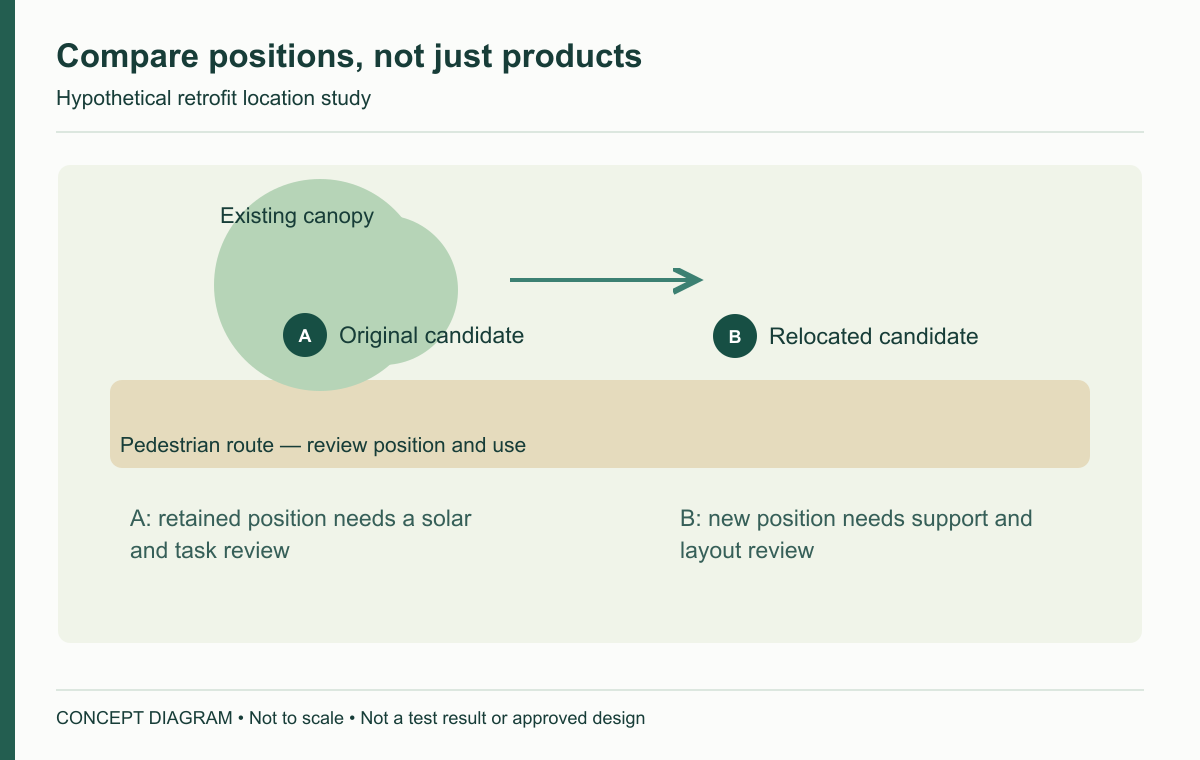
Compare original, adjusted and new locations
At a hypothetical shaded path position, retaining the original support might reduce some replacement work if its condition and compatibility are confirmed. Moving to a more open position could change both the lighting layout and the scope of site work. Neither alternative should be selected without stating those consequences.
Where a separate panel is proposed, first confirm the candidate system supports it. Panel mounting and any permitted connections create additional requirements. Moving trees, adding remote panels or avoiding all excavation should not appear as automatic solutions in a retrofit brief.
For island and Southeast Asian sites, assess the actual combination of weather, vegetation and operating needs. For relevant Australian, European or North American locations, include seasonal solar and temperature conditions. The solar radiation overview supports the need for a location-and-season check, not a blanket regional conclusion.
Decide What to Retain, Replace or Relocate
Give each option a condition
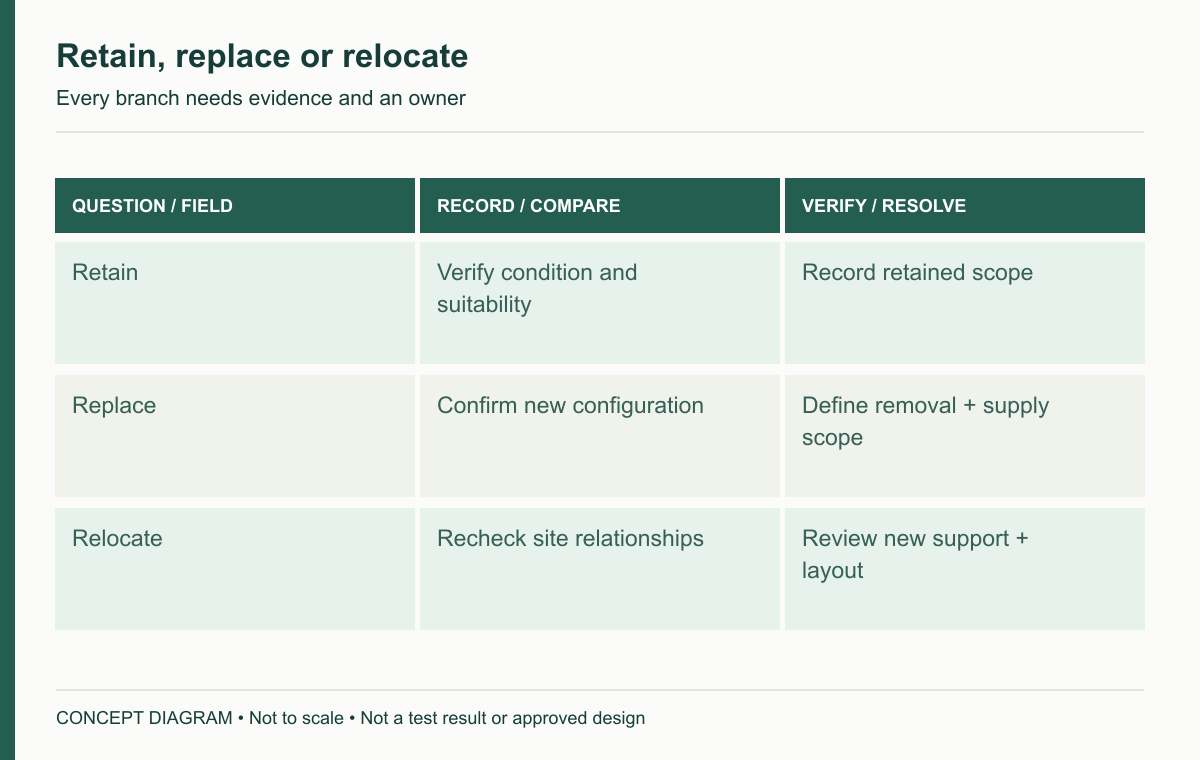
The reuse assessment should distinguish the fixture interface, supporting asset and lighting task. A documented mating diameter does not verify an existing pole or foundation. A sound support does not establish that its position is suitable for solar collection or the revised lighting need.
| Existing item | Candidate action | Evidence required before a decision | Decision responsibility |
|---|---|---|---|
| Fixture | Replace with a supported configuration | Identity, task, controls and supply list | Project team and supplier |
| Pole | Investigate retention | Interface, condition and structural information | Responsible reviewer |
| Position | Retain or relocate for comparison | Solar access and lighting layout | Design and site teams |
| Base or foundation | Assess separately | Appropriate records and review | Relevant qualified personnel |
| Existing supply | Define authorised treatment | Site electrical requirements | Qualified electrical personnel |
Do not prefill the action column with an approved outcome. A useful worksheet can carry multiple candidates until the evidence is sufficient. Record why an option was rejected as well as why another is retained for further review.
Understand the complete assembly option
Reviewing solar pole-light assemblies may be relevant where the project considers replacing both head and support. Confirm the exact supply scope and configuration. A complete-looking product photograph does not establish inclusion of foundations, site installation or all accessories.
An island project with costly handling may prefer to investigate retention carefully, while another site may favour a coordinated new assembly. Those are commercial and practical considerations to compare, not regional rules or proof of lower overall cost. Document the actual requirements behind the choice.
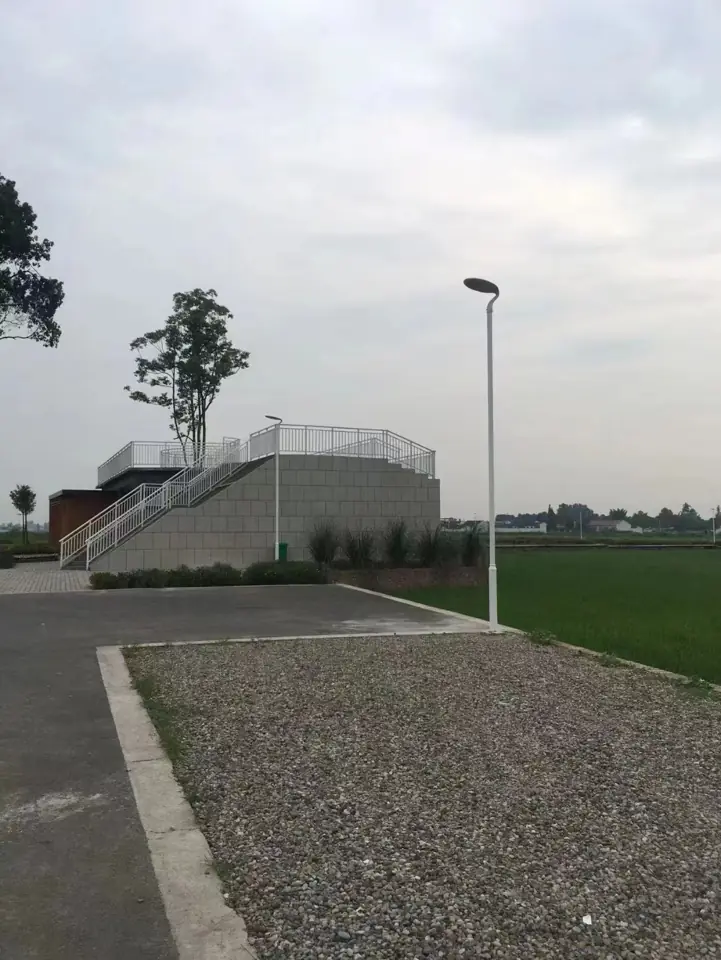
Define Electrical and Structural Work
Separate equipment delivery from site responsibilities
A supplier’s equipment quotation may not include isolation of old wiring, removal, structural work, installation or surface restoration. List each item explicitly, including who provides it and who confirms completion. An unspecified item is not automatically included, free or unnecessary.
The term wire-free describes a proposed supply arrangement only within its actual scope. It does not establish that old wiring can be abandoned without review, that existing supports are safe or that the new installation requires no work. Avoid turning a product benefit into an unconditional project claim.
Keep assessment separate from hazardous instructions
Electrical isolation, connection changes, structural modifications, excavation and elevated work belong with appropriately qualified personnel under the site’s requirements. The article’s role is to identify the information and responsible parties, not provide a generic method for carrying out those tasks.
If an external observation suggests damaged wiring, a loose structure or battery abnormality, follow the site’s established procedures and escalate the issue. Do not continue manipulating equipment to complete an article’s checklist. The authority to inspect a visible exterior is not automatically authority to dismantle or repair it.
Make the handover between parties explicit
Record dependencies between supply and site work. For example, a configuration cannot be accepted for an existing support until the relevant compatibility and support questions are resolved. Delivery can be complete while installation acceptance remains open. These states should not share a single ambiguous “done” box.
For a multi-party project, agree where current drawings and written clarifications will be retained. If a contractor receives a different revision from the supplier, stop the affected decision and reconcile the difference. A written boundary of responsibility prevents a missing scope item from disappearing between parties.
Plan Phased Work and Acceptance Records
Define what each stage hands over
A phased approach should identify the old and new equipment in each area, the purpose of the phase and the conditions for acceptance. The property team must also confirm any temporary arrangements needed for continuing activities. The retrofit plan should not assume that an occupied route can simply remain unlit between stages.
| Phase field | Information to enter | Evidence or decision |
|---|---|---|
| Area and asset IDs | Exact scope of this stage | Plan revision |
| Retained and replaced items | Accepted action for each asset | Relevant approvals |
| Required supply and work | Components and responsible parties | Confirmed scope |
| Sample or initial review | Configuration and conditions | Findings and unresolved items |
| Handover | Documents, identities and service route | Acceptance responsibility |
| Follow-up | What needs checking again and when | Project-agreed condition, not a universal interval |
Compare outcomes only with comparable evidence
If before-and-after photographs are used, document their positions and conditions and obtain the relevant permission. Photographs can illustrate a scene but do not establish an energy saving, illumination value or payback period. Those claims require appropriate underlying data and a defined comparison.
Keep the original inventory alongside the final asset record. Future maintenance should be able to identify what was retained, what changed and which version was installed. That traceability is especially useful when a later order looks similar but includes a changed connector, control or component.
Frequently asked questions
Can existing poles always be reused for solar lighting? No. Interface compatibility, pole condition, foundation information and the proposed lighting task need separate review. A good-looking exterior is not complete evidence.
Does switching to solar remove all site work? No. Removal, installation, authorised electrical treatment, support assessment and surface restoration may still be required. Confirm the actual supply and site-work scope.
What helps decide between a partial and full retrofit? An asset inventory, current problems, site plan, solar-access information, operating goals and clear responsibilities allow conditional options to be compared. Missing information should be assigned for investigation rather than guessed.
For a focused next step, send the retrofit information for review: existing-system photos, available drawings, issue records and the intended task. Request a configuration and scope discussion before treating a replacement product as a complete retrofit solution.
For an overview of fixture types, site conditions and selection priorities, see our garden and courtyard lighting guide.