

Solar flood lights can stay on all night when the usable stored energy supports the selected lighting schedule. That does not necessarily mean constant full brightness. Some configurations reduce output at set times or maintain low-level light with motion-triggered boosts. To assess a runtime claim, you need the battery's usable energy, the actual load profile, and the conditions at the start of the night.
The practical question is how long the light provides the illumination you need. A lamp that is still faintly glowing at dawn may have stopped serving its task much earlier. Define that task first, then evaluate both energy consumption and the output delivered over time.
What Does “All-Night Lighting” Actually Mean?
Constant Output, Scheduled Dimming, or Low-Level Lighting with Motion Boost?
Constant output aims to maintain a selected level throughout the operating period. Scheduled dimming changes output as the night progresses. Motion operation raises output when triggered and may return to a low background level or switch off between events, depending on the model.
These modes can produce very different energy demands. A quiet entrance using short boosts should not be compared directly with a continuously occupied yard. A low background setting can support orientation but may not provide the task lighting needed for reading, working, or identifying an obstacle.
Describe the required service in stages: arrival hours, quieter hours, and any early-morning activity. State the minimum acceptable lighting effect in each stage. This gives a supplier something more useful to match than the phrase “must last all night.”
Conditions to Clarify When a Supplier Promises All-Night Operation
Ask how many hours the claim covers and whether those hours represent the night at your location during the demanding season. Obtain the programmed brightness stages, motion assumptions, starting charge condition, and ambient temperature. Confirm whether an automatic energy-saving strategy can change the stated schedule.
Also ask how the endpoint was defined. “Still emitting light” and “still meeting the agreed illuminance at the target” are different endpoints. For an entrance, a recorded reading at the latch or walking route is more useful than simply checking that the LED surface remains visible.
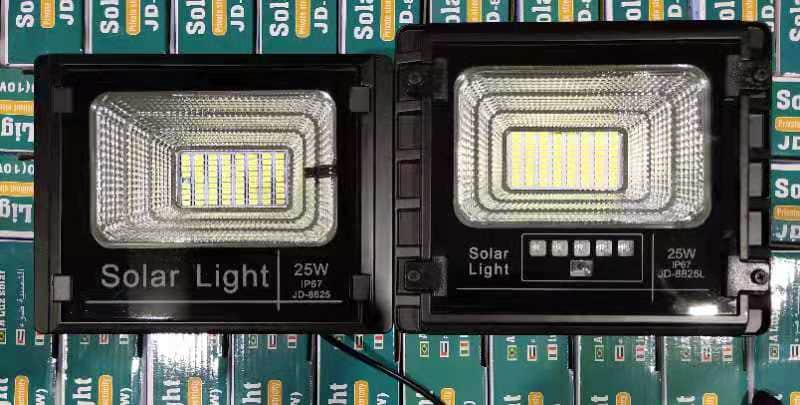
Product pages such as the JD solar flood light range can help identify a candidate, but the runtime decision needs the exact version's schedule and test conditions. Treat an hours-per-night description as the beginning of the discussion, then request the evidence behind it.
Compare Battery Energy, Not Capacity Labels Alone
How Nominal Voltage and Amp-Hours Relate to Watt-Hours
Battery capacity expressed in amp-hours must be combined with the corresponding nominal battery voltage to estimate nominal stored energy:
Nominal energy (Wh) ≈ nominal battery voltage (V) × capacity (Ah).
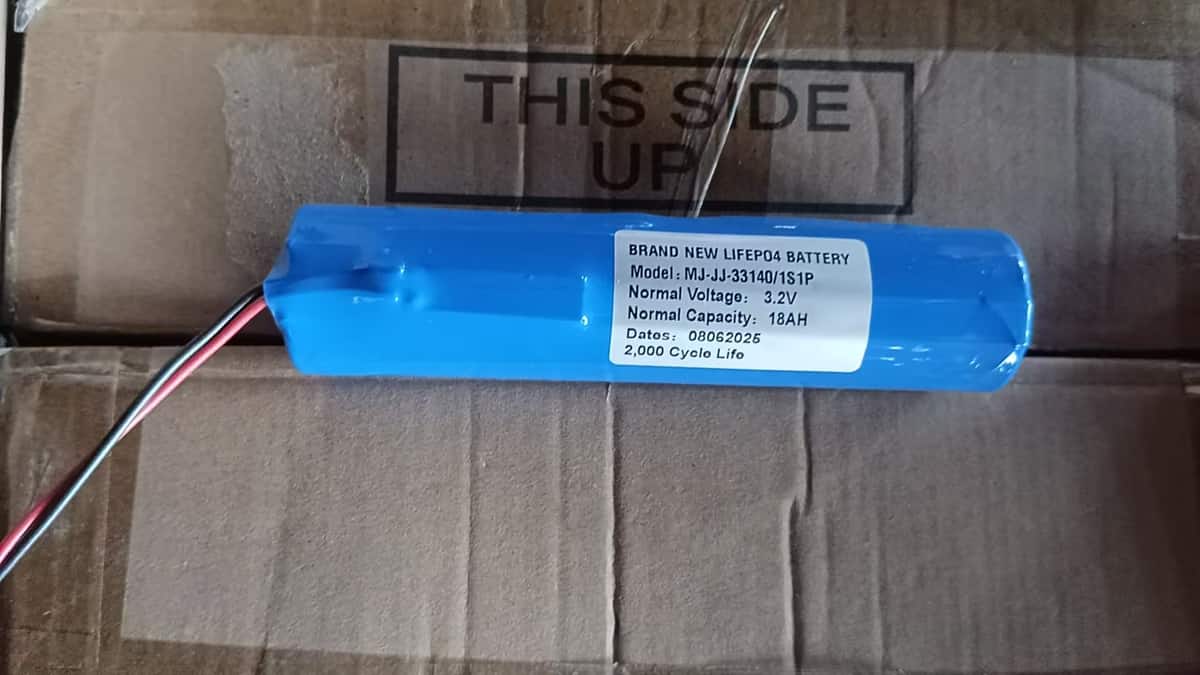
Convert milliamp-hours to amp-hours by dividing by 1,000. A hypothetical 20,000mAh battery is therefore 20Ah. At a hypothetical nominal voltage of 3.2V, its nominal energy is approximately 64Wh. The SAM battery-model documentation likewise uses voltage and amp-hours when calculating nominal battery energy.
The voltage must belong to the battery pack whose capacity is being quoted. The solar panel's voltage is not a substitute. Nor should individual cell capacities be added without understanding the pack configuration. Ask for the pack-level voltage, capacity, chemistry, and identification on the relevant specification sheet.
For comparison, a hypothetical 10Ah pack at 6.4V also represents approximately 64Wh nominally. Its smaller Ah number does not mean it stores half the energy of the 20Ah, 3.2V example. Equal nominal Wh still does not prove equal usable energy or identical performance under load.
Why Nominal Energy Is Not the Same as Usable Lighting Energy
Nominal energy is a starting reference, not a promise that the light can use every watt-hour. Starting charge, the permitted discharge window, battery condition, temperature, and protection cutoffs affect how much can be delivered. Power conversion and control loads then affect how much of that delivered energy serves the LEDs.
Keep the calculation boundary consistent. If usable energy is stated at the battery output, compare it with power drawn at that output. If you instead calculate from LED-board power, include the applicable driver losses and other loads separately. Do not subtract the same driver loss from the energy budget and add it again to the load.
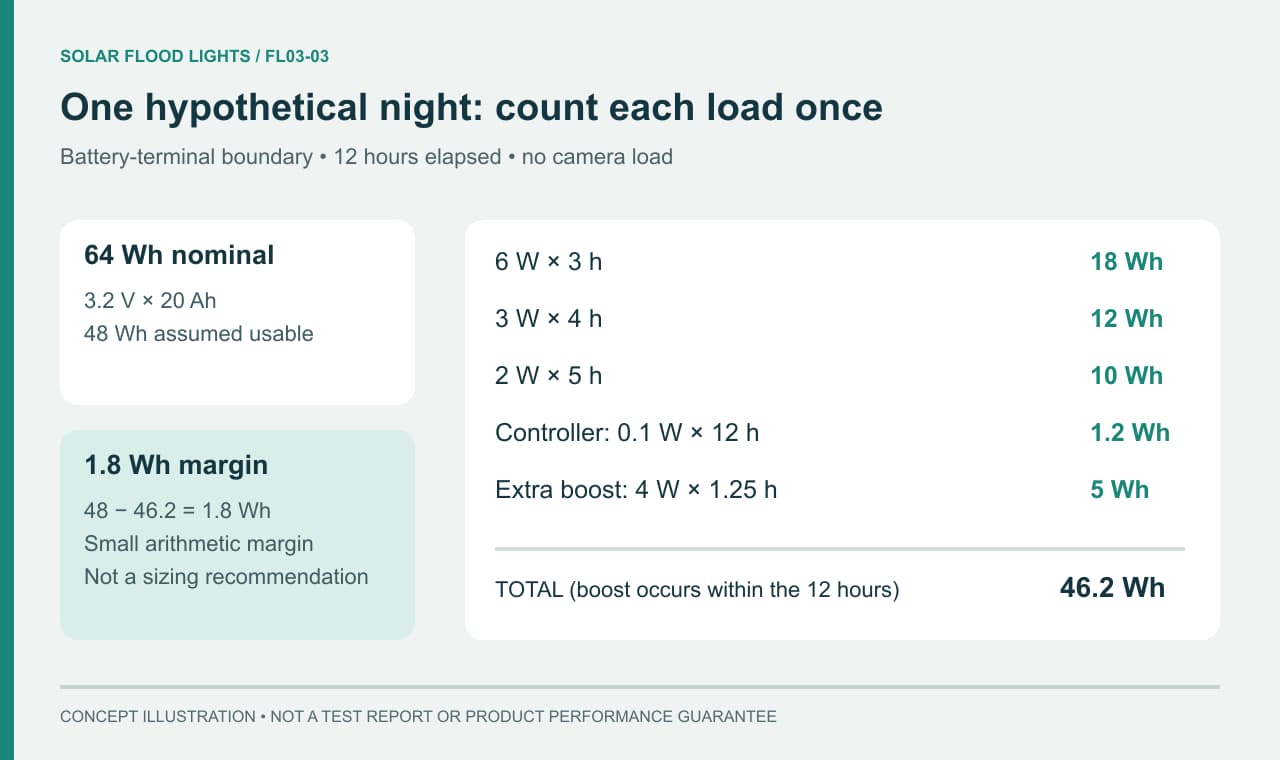
The following example assumes 48Wh available at the battery output, or 75% of the hypothetical 64Wh nominal energy. This is an illustrative allowance for the starting state and usable battery discharge window under the assumed conditions. It is not a universal utilization factor, and it does not already deduct downstream driver or controller consumption.
Estimate Nighttime Consumption by Operating Period
Record Actual Power and Duration for Each Stage
For each stage, multiply the actual power by its duration, then add the results. Use measured power for that mode at a stated boundary. A remote-control setting labeled “50%” does not necessarily mean exactly half the electrical input, so do not substitute button percentages for power measurements.
Stage energy (Wh) = actual power (W) × duration (h).
The table below is a hypothetical 12-hour schedule for a light without a camera. Lighting-branch power is measured on the battery side and already includes the driver's consumption. It excludes a separate assumed 0.1W controller load, which is counted once across the night. No solar charging occurs during this example night.
| Time period | Operating state | Actual power assumption | Duration | Estimated energy |
|---|---|---|---|---|
| Hours 0–3 | Higher lighting level | 6W lighting branch | 3h | 18Wh |
| Hours 3–7 | Reduced lighting level | 3W lighting branch | 4h | 12Wh |
| Hours 7–12 | Low background level | 2W lighting branch | 5h | 10Wh |
| Hours 0–12 | Controller operating throughout | 0.1W additional load | 12h | 1.2Wh |
| Within hours 7–12 | Motion raises lighting from 2W to 6W | 4W additional to background | 1.25h cumulative boost time | 5Wh |
| Total | Complete illustrated night | — | 12h elapsed | 46.2Wh |
The 1.25 hours of motion boost occur within the five-hour background period; they are not extra hours added to the night. Because the background consumption has already been counted, only the 4W increase is added. This avoids counting both the full boosted load and the background load for the same time.
The assumed demand of 46.2Wh fits within the assumed 48Wh available, leaving just 1.8Wh. That is a narrow arithmetic margin, not evidence of a robust installation. A real selection needs an allowance appropriate to its conditions and a test showing that each stage provides enough useful light.
Allow for Controller Loads, Standby Consumption, and Motion Activity
Now compare constant operation at the example's 6W lighting level. Including the same controller, the load is 6.1W. Twelve hours would require 73.2Wh, exceeding the assumed 48Wh available. A simple constant-load estimate gives 48 ÷ 6.1 ≈ 7.9 hours before that energy allowance is exhausted, without any automatic dimming intervention.
This calculation explains how a configuration might support the illustrated dimming schedule but fail to sustain the initial brightness all night. It does not predict the behavior of a real controller, and the wattage levels do not establish lumens or adequate coverage.
Motion activity also matters. In the same example, another 30 minutes at the 6W boost level during the low-background stage would add 4W × 0.5h = 2Wh. Total demand would rise to 48.2Wh, slightly exceeding the assumed budget. Use a plausible busy-night scenario, not only an unusually quiet test.
Include every relevant load in the appropriate period. A camera, communications module, or standby electronics may consume energy while the main light is off, including during daytime. The illustrated 46.2Wh total excludes those loads; it cannot be used as a camera-equipped system's complete daily energy budget.
What Can Reduce Available Runtime?
Initial Charge, Temperature, Battery Condition, and Control Strategy
A partly charged battery starts the night with a smaller energy allowance. An indicator may help establish status, but do not treat an uncalibrated bar display as a precise percentage measurement. Follow the supplier's defined starting-condition method when comparing samples or checking a claim.
Temperature and battery aging can change available capacity and operating behavior. Request the allowed charging and discharging temperatures separately, along with any low-temperature protections. An ingress-protection rating does not establish cold-weather charging capability, and an enclosure that resists rain does not resolve battery temperature limits.
Control strategy also affects the observed endpoint. A controller may reduce output before shutting down to preserve service, while another configuration may hold a selected output for longer and then stop. A longer visible runtime can therefore coexist with less useful illumination late in the night.
Whether the Previous Day Replenished Enough Energy
Stored energy and daily replenishment answer different questions. A battery can support one long night after a full charge while losing charge over repeated days if the panel harvest does not replace consumption. Panel shading and low sunlight can reduce the next night's starting allowance.
A larger battery can buffer a shortfall for a period, but does not resolve a continuing daily energy deficit. When reviewing all-night claims, ask how the proposed panel position and seasonal conditions support repeated operation at the requested schedule.
Keep charging conditions in the record even when the immediate concern is nighttime runtime. Otherwise, an early shutdown caused by a low starting charge may be mistaken for evidence that the nominal battery capacity is wrong.
How Can You Check an All-Night Runtime Claim?
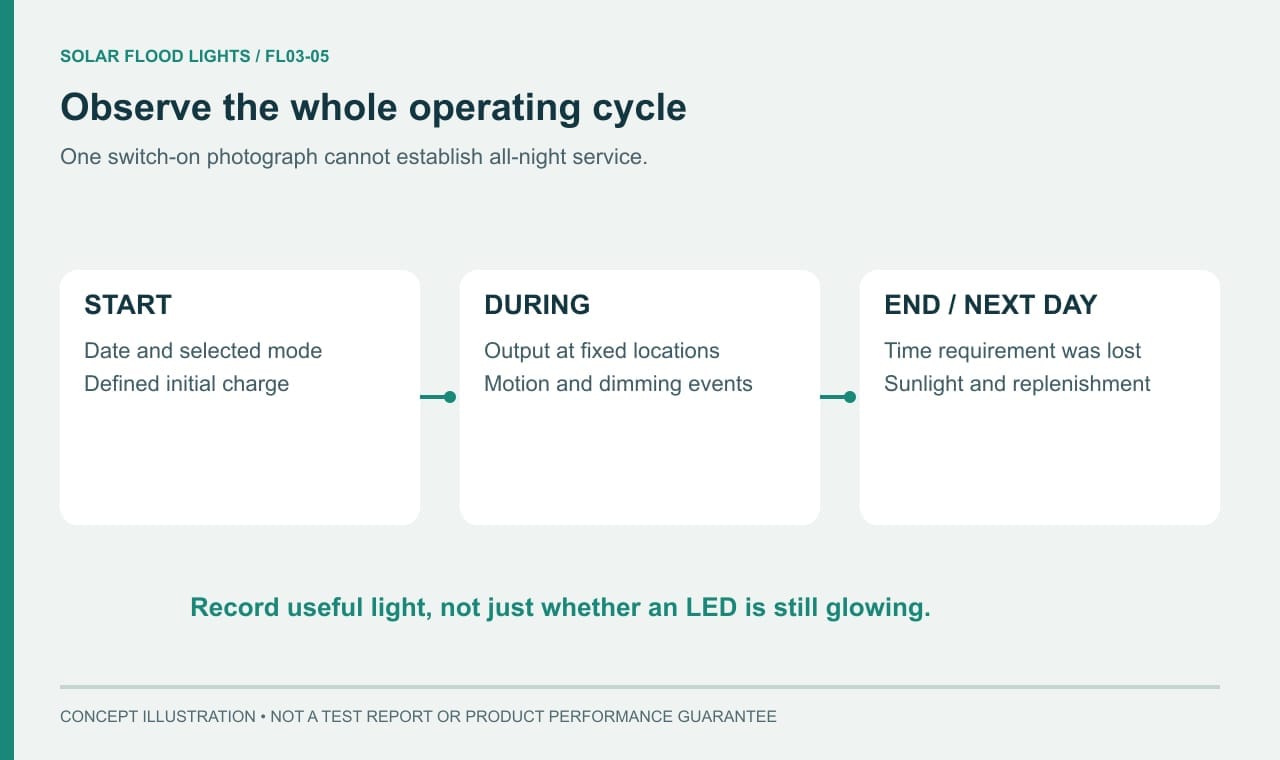
Record the Date, Mode, Starting Charge, Hourly Output, and Shutoff Time
Agree on the acceptance conditions before the trial. Identify the sample and configuration, date, location, temperature, required lighting period, mode, and starting-charge procedure. Record mounting and aiming so that later readings describe the same target.
At switch-on and at regular intervals, record illuminance at fixed task positions together with the operating state. Note scheduled changes, motion boosts, and any automatic low-energy behavior. Record when the light first falls below the agreed useful level as well as when it finally switches off.
For a motion mode, log activity or use an agreed repeatable trigger pattern. For scheduled dimming, check around the transition times. A time-stamped video or data logger can help document behavior, but keep any camera exposure settings consistent if images are used to compare output.
Distinguish a Single-Night Test from Multi-Day Energy Balance
A single-night test checks what the starting energy and selected schedule can deliver. A multi-day test checks whether the system can repeat that service under the recorded charging conditions. These are related but different tests, and passing one does not establish the other.
During a repeated-operation trial, record daily weather and panel exposure, nighttime output, and any change in starting or ending charge information. Do not reset the battery with an additional charge between nights unless that intervention is part of the stated test procedure and clearly recorded.
For a claim such as “several rainy nights,” request the starting charge, number and duration of nights, brightness schedule, motion frequency, temperature, and any solar input during the period. “Rainy” is not a measured charging condition: some daylight energy may still enter the system, while heavily shaded conditions may differ substantially.
Specify the Nighttime Service You Actually Need
Turn the requirement into a short operating profile. State which hours need the main lighting level, which can use reduced output, and where light must remain useful. Include likely motion activity, the longest required night, and any monitoring load that operates outside lighting hours.
Ask for the exact configuration's nominal and usable energy information, battery-side load profile, controller behavior, and supporting runtime record. Where a supplier cannot provide every measurement, agree on a sample test that resolves the decision-critical gaps.
Choose on the evidence that the required service can be repeated at your site. The most useful answer is a supported output schedule and its conditions, not simply the largest mAh number or longest advertised operating time.
For a rainy-season acceptance trial, keep the initial-charge method, nightly schedule, and minimum useful lighting requirement in the record. Observe successive days without an undocumented top-up charge, and include a plausible busy evening for motion-triggered lights. If stored energy declines across the sequence, distinguish the temporary reserve from a system that can repeat the service. Do not promise a fixed number of rainy nights without configuration-specific evidence.
Frequently Asked Questions
Will a Larger Battery Stop a Solar Flood Light Turning Off Early During the Rainy Season?
A larger compatible battery may provide more reserve, but it does not fix a continuing shortfall between daily charging and nighttime demand. First compare usable stored energy, the operating schedule, and repeated charging conditions. Request an approved complete configuration if changes are needed; do not add or substitute batteries merely because their capacity label is larger.
Can Frequent Motion at a Shop Entrance or Compound Gate Shorten Runtime?
Yes, if each activation increases electrical demand. A busy entrance can spend much more time at the boosted level than a quiet sample test suggests. Record cumulative boost time and any extensions caused by repeated triggers. When background consumption is already included, count only the additional power during those periods so the energy calculation does not count the same load twice.
What Test Conditions Support a Claim of Several Rainy Nights?
The record should identify the configuration, starting charge, temperature, night lengths, brightness stages, motion activity, and charging input or documented weather and exposure. It should show useful lighting during the required hours, not just a lamp still glowing at the final check.
How Long Do Solar Flood Lights Last at Night on a Full Charge?
Nighttime runtime depends on usable stored energy and the selected load profile, so a full charge alone does not establish a universal number of hours. Check the dimming schedule, motion activity, temperature, and the point at which illumination stops meeting the task. Ask for a runtime record at the required output, not only the time until the last LED goes dark.
Can I Compare Solar Flood Light Batteries Using mAh Alone?
No. Compare nominal energy using the battery's nominal voltage as well as capacity: Wh equals V multiplied by Ah, with mAh divided by 1,000 to obtain Ah. Then check usable energy and operating conditions. Do not substitute the solar panel voltage for a missing battery voltage, and do not assume that equal nominal Wh means equal useful runtime.
Does a Dusk-to-Dawn Solar Flood Light Stay at Full Brightness All Night?
Not necessarily. Dusk-to-dawn describes an operating period, while the controller may reduce output in stages or increase it only on motion. Obtain the mode's output schedule and check illumination later in the night. If constant brightness is required, specify that separately and verify both the stored-energy budget and repeated daily charging under the intended conditions.