

Solar flood lights can operate during a rainy season when daily charging and usable battery reserves support the required lighting schedule within the product's permitted conditions. Rainy-season suitability has two separate parts: obtaining enough energy during low-sunlight periods and keeping the installed equipment within its environmental limits. A light receiving some charge under clouds has not necessarily collected enough energy for the next night.
A panel may receive some daylight while the system gradually runs short of stored energy. Equally, a well-exposed panel and a suitable lighting schedule can make a site more workable than its gloomy appearance suggests. Assess the panel location, the difficult season, and the required nighttime service together before accepting an all-night performance claim.
Generating Some Power Is Different from Meeting the Lighting Requirement
Cloud cover does not make every solar panel completely inactive. Sunlight reaching a surface includes both direct and diffuse radiation, and the balance changes with atmospheric conditions. The U.S. Department of Energy's solar radiation explanation helps explain why visible daylight is not a measurement of the energy available to a panel.
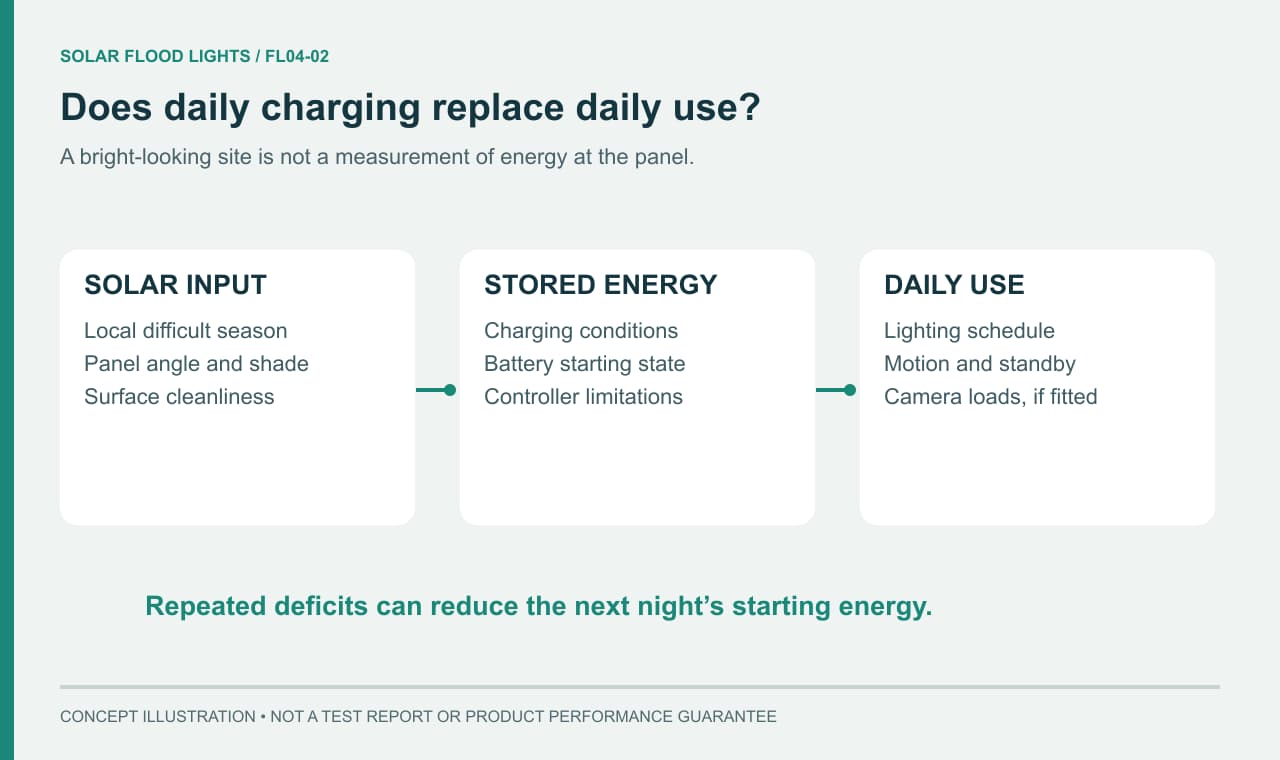
For a flood light, energy collected during the day must support the LED's operating schedule, the control electronics, and any additional functions. Some of the generated energy is also lost through conversion and storage. A charging indicator therefore answers a limited question: it may show charging activity, but it does not establish that the battery is full or that the next night's requirement will be met. Read the indicator's meaning in the exact model's instructions.
Think of three possible patterns. When useful daily charging matches consumption, the installation can repeat its intended cycle under those conditions. When charging temporarily falls below consumption, stored energy covers some of the difference. When that shortfall continues, the reserve eventually becomes insufficient. A larger battery can buffer a difficult period, but it does not correct a recurring shortage of harvested energy.
This distinction matters when evaluating a sample. A unit charged before delivery may perform well during its first cloudy night while relying on that starting reserve. Record repeated charging and operating cycles, the selected mode, and the weather before judging whether the site can sustain the result. One good night shows an observed outcome, not a seasonal guarantee.
Where and When Should You Check Sunlight on Site?
Look for Eaves, Trees, Buildings, and Seasonal Shade
Inspect the proposed panel position at different parts of the day. Note when a roof edge, adjacent building, branch, sign, or rooftop structure casts a shadow across it. A single photograph at noon can miss morning and afternoon obstructions. Photograph from a safe accessible position and include enough of the surroundings to explain where the shadows come from.
Also consider changes that a visit cannot show directly. A tree's foliage may change, neighboring construction may add shade, and the seasonal path of the sun may bring an obstruction into the panel's view. A location that works during a summer sample test may behave differently during the season with the weakest usable solar resource. Ask the installer or supplier to assess that season for the actual site, using local information and the panel's orientation.
Partial shade deserves attention even when most of the panel looks bright. Its effect depends on the module construction and the pattern of shading; estimating the loss purely from the percentage of visible shadow can be misleading. Record where and when shade occurs instead of inventing a percentage reduction in charging.
Assess the Panel Position Separately from the Light Position
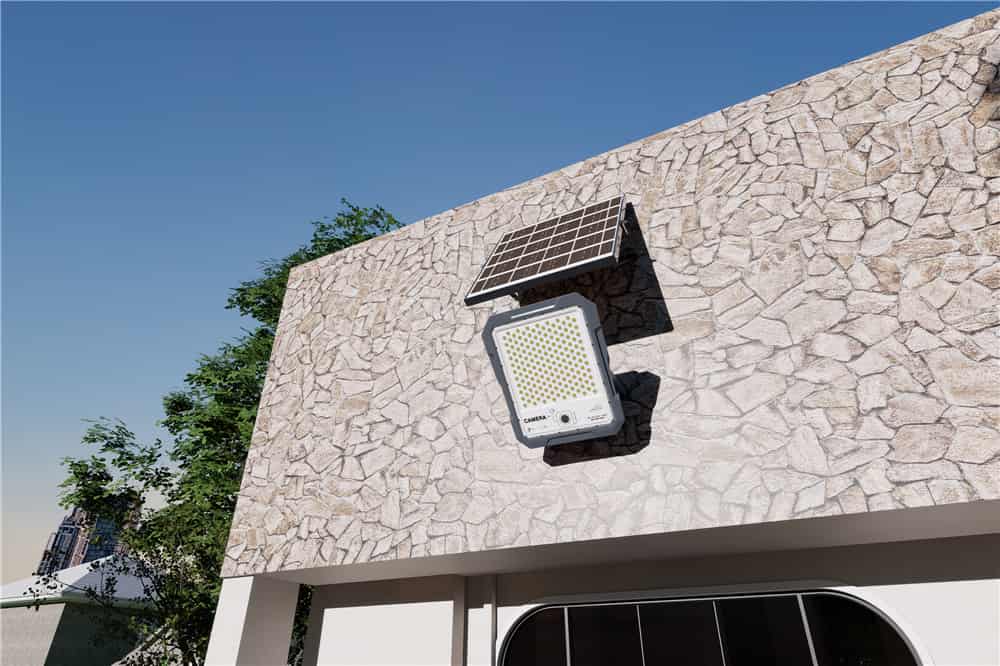
The lamp belongs where its beam serves the entrance, yard, or working area. The panel belongs where it receives useful sunlight. Those positions need not coincide. A covered doorway can be a reasonable place for the lamp while being a poor charging location for its panel.
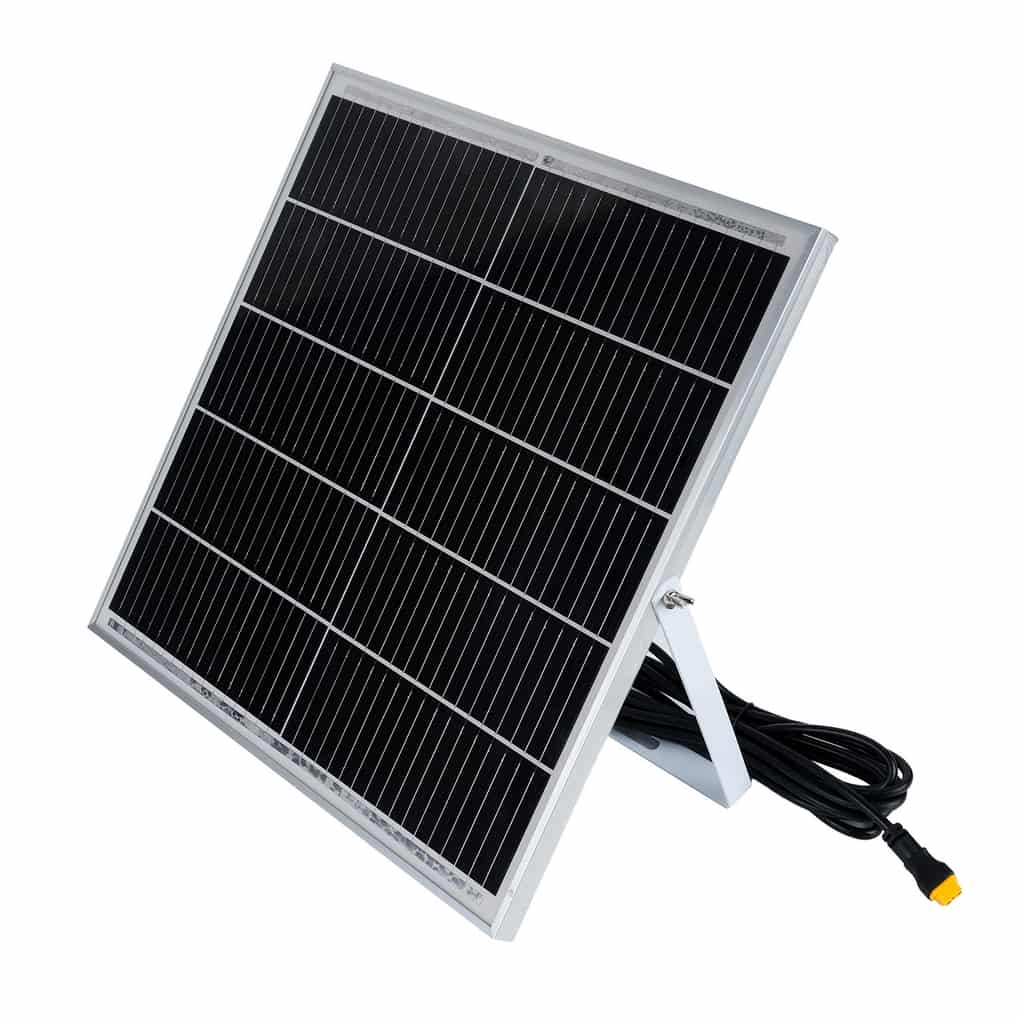
A separate panel may help when a nearby unobstructed mounting position is available, but the whole route must remain within the product's approved installation limits. Check mounting permission, access, weather exposure, and the actual cable route before assuming that a roof or distant wall solves the problem. For products to assess against those conditions, browse the outdoor solar flood light range and confirm the arrangement for the selected version.
For Southeast Asian and African sites, identify the local difficult season from the actual location rather than assuming that winter is always the limiting case. Where a wet season is relevant, review repeated cloudy days and the required evening service together. Where heat, dust, coastal exposure, or cold conditions are relevant, list them separately for the supplier. Regional names alone do not establish solar resource, equipment suitability, or a maintenance interval.
Why Daylight Hours Are Not Equivalent to Effective Charging Hours
Solar Resource, Panel Orientation, and Obstructions
The time between sunrise and sunset is a clock interval. It does not describe a constant level of sunlight striking the panel. Solar-resource estimates account for the strength of irradiation over time; they are not interchangeable with the number of hours during which you can see outdoors. This is why a long overcast day and a clear day of the same length can produce different charging outcomes.
Orientation and tilt affect what reaches the panel, while obstructions can remove useful exposure. The best arrangement depends on location, seasonal needs, permitted mounting positions, and the product's bracket limits. Do not automatically copy another installation's angle or compass direction. Have the proposed position assessed for your site, then check that it can be installed and maintained as intended.
When asking a supplier for an assessment, provide the town or project location, photographs, a description of the panel's direction and surrounding obstructions, and the desired nightly schedule. “The yard is sunny” is less informative than a record showing the panel itself unobstructed during specific observed periods. Where seasonal performance matters, request an explanation of the solar-resource assumptions used in the recommendation.
Assess the Local Difficult Season Rather Than Using One Global Sunlight Requirement
There is no single daily sunlight-hour requirement that applies to every solar flood light and every climate. The required charging input changes with actual power demand, output schedule, panel characteristics, charging behavior, and system losses. In some locations the difficult period is winter; in others, a prolonged wet or cloudy season is more significant.
Start with the service that must be maintained. Does the light need to remain visibly on until morning, illuminate an occupied area at a specified level, or serve an entrance only when someone arrives? These are different demands. Ask whether the proposed seasonal performance assumes lower brightness, shorter hours, or motion-triggered operation, and decide whether those conditions meet the application.
For background beyond flood-light sizing and placement, see the guide to solar lights in winter. A site-specific decision still requires the selected flood light's configuration and the local difficult-season conditions.
Check Temperature Limits in Hot and Cold Conditions
Verify Operating Limits and Permitted Battery Charging Temperatures Separately
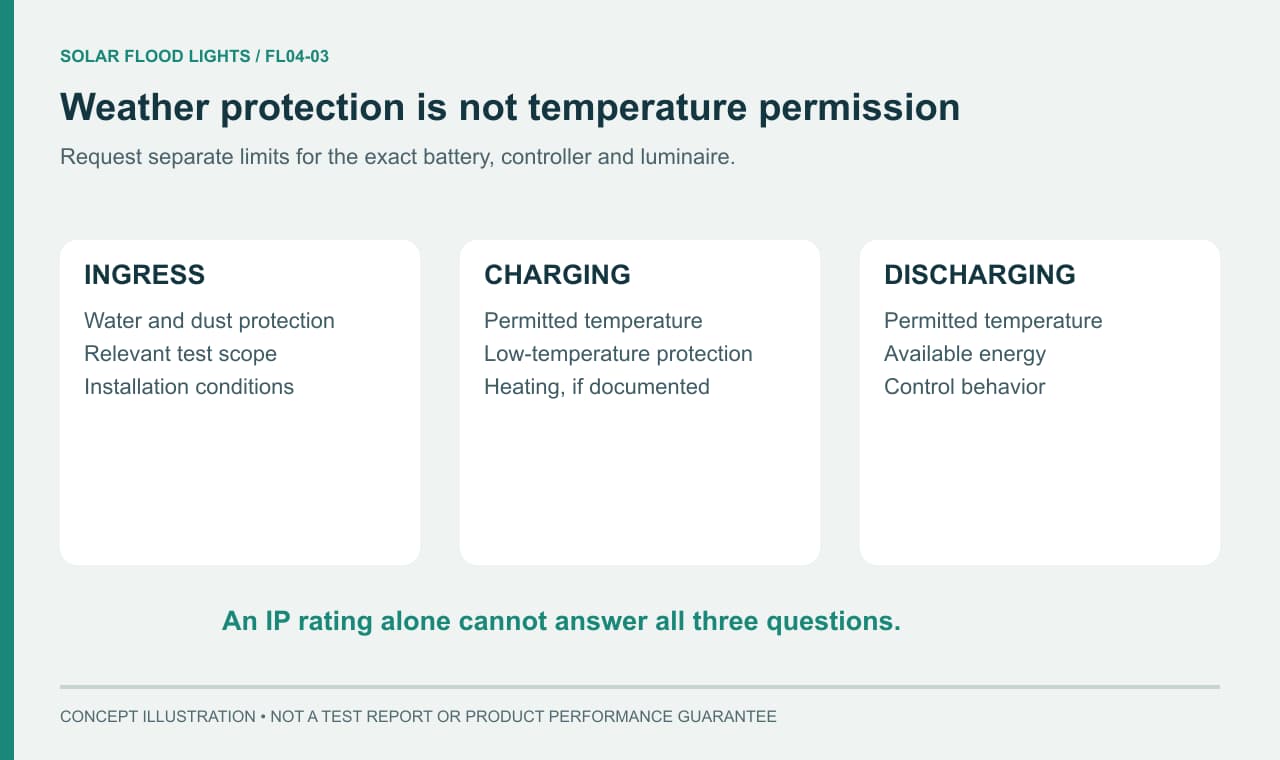
Check the permitted temperature ranges for operation, battery charging, and storage as separate items. A statement that a lamp can operate in cold weather does not by itself establish that its battery can accept charge at the same temperature. Battery chemistry, protection settings, and the complete product design matter.
Manufacturer documentation illustrates this distinction: Victron's Lithium Smart battery operating instructions specify different permitted conditions for charging and discharging. Those conditions apply to that battery system, not to an unrelated flood light. For your installation, obtain the limits for the exact supplied battery and controller arrangement, including any documented low-temperature protection.
Consider where the battery actually sits. An integrated battery inside the light and a battery in a separate enclosure may experience different surroundings. Ask which temperature the published limit refers to and how the product manages conditions outside that limit. Do not attempt to defeat a charging restriction or add a homemade heater to make the system operate.
An IP Rating Does Not Establish Battery Temperature Limits
An ingress-protection rating concerns protection against specified entry of solids and water. It does not state the battery's charging-temperature range, guarantee that snow cannot cover the panel, or confirm that a mounting bracket suits a particular wind exposure. These are different checks requiring appropriate product information.
For any weather-exposed installation, keep water ingress, temperature, panel obstruction, and mounting suitability as separate questions. A label saying “outdoor” cannot answer all four. Where a product has more than one enclosure or connector, verify which components the published protection description covers and how the instructions require connections to be completed.
Apply the same separation in hot conditions: verify the upper operating and charging limits, where the temperature is defined, and the behavior of any documented protection. An outdoor or IP label is not proof of heat tolerance or corrosion resistance. If coastal exposure is part of the brief, request material and environmental evidence for the exact enclosure, brackets, and connectors rather than treating the water-ingress rating as a corrosion test.
What Can You Adjust During Extended Low-Sunlight Periods?
Improve Panel Exposure, Maintain Cleanliness, and Reassess Lighting Hours or Modes
First inspect the conditions around the installed panel. Remove loose surface contamination only by the method allowed in the instructions and only when safe access is available. Arrange competent assistance for an inaccessible panel. Do not scrape ice with sharp tools, use unsuitable chemicals, or climb into a hazardous position to restore charging.
Next review whether the panel can be relocated within the approved mounting and cable arrangement. Moving it away from recurring shade may address a more basic limitation than changing the lamp's settings. Confirm the proposed route before moving hardware, and document the new position so later performance observations can be compared meaningfully.
Finally, review the lighting schedule. If the application permits it, a supported timer or lower background level can reduce consumption. Motion-triggered brightness may suit an intermittently used entrance, but heavy traffic can keep triggering it and reduce the anticipated saving. Make a deliberate choice about the service you can reduce; do not quietly compromise lighting that the site needs throughout its occupied hours.
Confirm Electrical Compatibility Before Changing Components
A larger-looking panel or an extra battery is not automatically a compatible upgrade. The charging input, electrical ratings, battery specifications, connectors, and controller behavior must match the approved system. Even a physically matching plug does not establish compatibility.
Ask the supplier whether an approved alternative configuration exists for the identified shortfall. Describe the site and intended operating pattern, and request the complete compatible configuration in writing. Avoid improvised parallel connections, battery substitutions, or modifications to sealed assemblies. If no suitable upgrade is available, compare another complete system or a different power supply.
Use this record to turn a vague concern about cloudy weather into specific checks:
| Site check | What to observe | Risk to assess | Next verification step |
|---|---|---|---|
| Panel exposure | Obstructions and shadows at different observed times | Daily input may fall short despite a bright-looking site | Review the location and seasonal shade with the installer |
| Local difficult season | Cloudy periods, seasonal sun path, longer required nights | A favorable trial may not represent the demanding period | Request the recommendation's seasonal assumptions |
| Nighttime demand | Mode, occupied hours, motion activity, later-night output | Consumption may exceed the assumed schedule | Agree on the service that must be maintained |
| Temperature | Expected conditions at the battery location | Charging may be restricted even while lighting operates | Check exact charging and operating limits |
| Panel condition | Dirt, leaves, or snow obstructing the surface | Available light may not reach the cells | Plan safe, manufacturer-approved maintenance |
| Repeatability | Behavior over successive charging and lighting cycles | Initial stored energy may conceal a recurring deficit | Keep a weather-and-operation log |
When Should You Reconsider the Power Supply?
Persistent shade, no acceptable panel location, or a strict continuous-output requirement can make another power supply more appropriate. The decision should follow the lighting task. If a location must remain reliably illuminated at a defined performance level, reducing brightness until a solar system lasts longer may fail the original requirement.
Assess a grid-powered or other professionally designed supply where appropriate, including installation feasibility and the site's continuity requirements. A hybrid arrangement is an option only where the actual product and system design support it; do not assume that a standalone solar light can accept an additional power source.
Before requesting a recommendation, assemble the location, panel-position photographs, shade observations, difficult-season conditions, required lighting hours, and permitted changes in output. Ask the supplier to state the conditions behind the proposed performance and agree how an on-site trial will be assessed. This gives both parties a clear way to decide whether solar suits the site.
Frequently Asked Questions
Can a Solar Flood Light Work Properly Under Trees?
The light itself may be mounted near trees if the installation is suitable, but the panel needs a separately assessed exposure. Branches and leaves can cause recurring or changing shade. Check whether an approved separate-panel position provides useful sunlight, and assess seasonal foliage rather than relying on one clear patch observed during a visit.
How Many Hours of Sunlight Does It Need Each Day?
Use the exact model's charging requirements and the supplier's site assessment. Daylight duration alone is insufficient because sunlight intensity, orientation, obstructions, temperature restrictions, and the chosen nighttime schedule affect the result. Ask what conditions accompany any quoted charging time, rather than treating it as a universal daily requirement.
Can Solar Flood Lights Stay On Through Several Rainy Nights?
Only when usable energy and charging over that sequence support the required output and hours. Check the initial charge, successive weather conditions, dimming stages, and motion activity together. A light remaining faintly on is not evidence of the required illumination. Ask for a configuration-specific multi-night record rather than assuming that any solar flood light has a fixed rainy-day reserve.
Do Solar Flood Lights Charge on Cloudy Days?
A solar panel can receive diffuse sunlight on a cloudy day, but that does not establish enough charging energy for the planned night. Cloud conditions, shading, panel position, charging limits, and demand all matter. Assess repeated days and nights: some charging can occur while the battery's starting energy still declines from one evening to the next.
Do Solar Flood Lights Need Direct Sunlight or Is Daylight Enough?
Daylight does not guarantee sufficient daily energy, and a panel's ability to collect diffuse light does not make persistent shade a suitable design assumption. Assess the model's charging requirements against the actual panel exposure and lighting schedule. Seek an approved position with useful sunlight through the difficult season rather than judging the site only by how bright it looks to the eye.
Can High Temperatures Affect Solar Flood Light Charging?
Charging suitability depends on the permitted limits for the exact battery, controller, and complete product. Strong sunshine does not prove that temperatures at the equipment stay within those limits. Confirm what the published temperature range refers to and what happens outside it. Do not cover the panel, bypass protection, or improvise cooling modifications as a substitute for an approved installation.