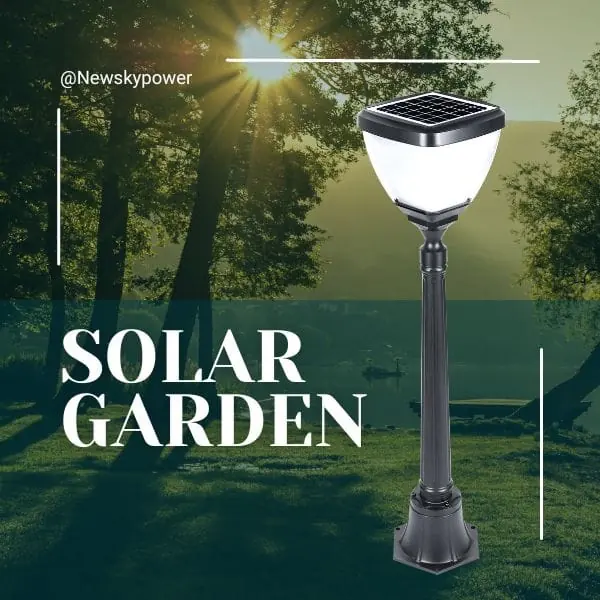


Solar lighting for hotels and resorts should follow the guest journey and the operating schedule. Map arrivals, routes to rooms, courtyard activities and guest-room windows before selecting fixtures. Then check whether the proposed positions, documented modes and available solar energy can support the required tasks without creating avoidable conflicts.
A coordinated daytime appearance is only part of the decision. A path used by late arrivals has different needs from a terrace after service ends. A light that looks attractive from reception may be directly visible from a bed or balcony. These relationships deserve their own review rather than a single product recommendation for the whole property.
The example below is a hypothetical hospitality layout. It is intended to help owners, designers and operations teams prepare a brief and a sample review. It is not a customer case, a completed design or a promise of improved occupancy, security or guest satisfaction.
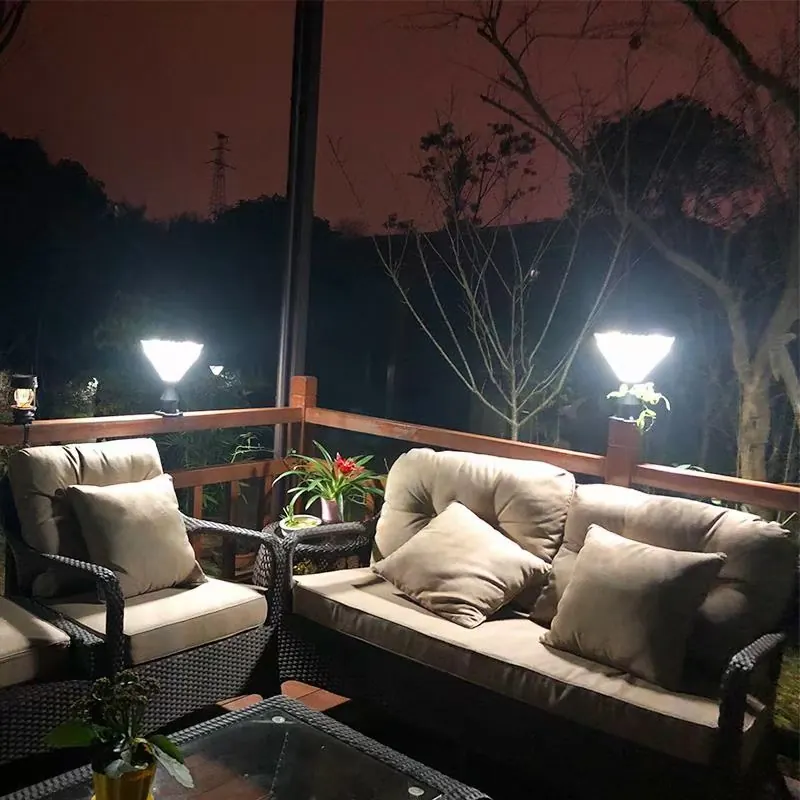
Map Guest Arrival and Walking Routes
Trace the route beyond reception
Follow the journey from the arrival point to reception and onwards to rooms and shared facilities. Record turns, surface changes, pauses with luggage and route choices that may not be obvious to a first-time visitor. Include staff movements where they overlap with guest routes, without assuming they have the same operating period.
Identify existing lighting and what it currently serves. Proposed solar fixtures may supplement a route rather than replace every nearby light. A decorative element beside an entrance should not silently inherit the responsibility of illuminating steps, a crossing or an emergency route.
Set up a consistent example
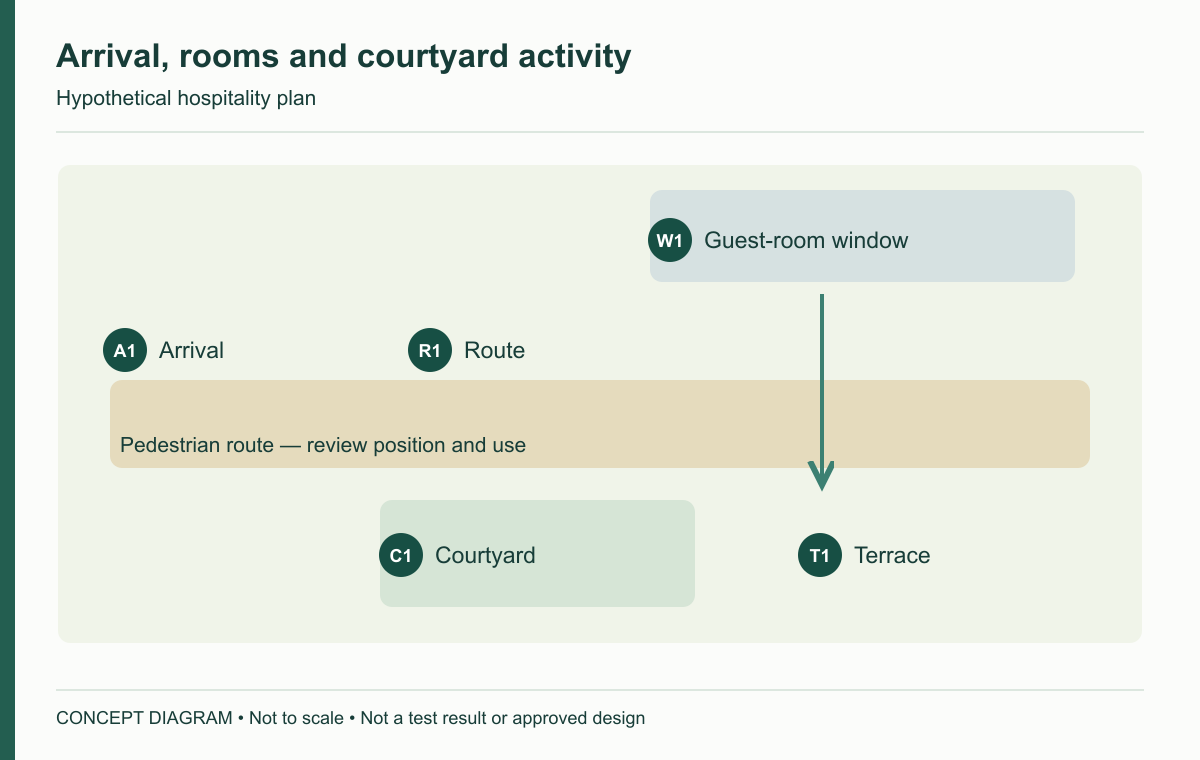
Assume A1 is a guest arrival route, C1 a courtyard seating area, R1 the route to rooms, and W1 the relevant guest-room window line. A terrace T1 overlooks part of C1. These identifiers will be used in the route plan, operating matrix and feedback record.
The example does not specify a country, room count, fixture quantity or timetable. An island resort, a Southeast Asian hotel, an Australian property or a European or North American site can use the same record structure while supplying its own geometry, operating needs and environmental information.
Separate Service, Activity and Quiet Hours
Write requirements before choosing a mode
Ask operations staff when each area is used: normal arrivals, late arrivals, restaurant or event activity, quiet hours and staff service. Record the task that remains during each period. “Quiet” does not necessarily mean unused, and a route towards rooms may remain necessary after courtyard seating closes.
Do not invent a universal switch-off time or assume a motion sensor can determine whether a route is no longer needed. A visitor standing still, reading a sign or waiting for another guest presents a different task from someone simply passing a sensor. The project team should describe the acceptable behaviour before discussing a product’s controls.
| Example area | Operating question | Lighting requirement to confirm | Product question |
|---|---|---|---|
| A1 arrival | Are late arrivals expected? | What must remain visible during arrival and waiting? | Which documented mode supports that task? |
| R1 rooms | Does access continue through quiet hours? | What route visibility remains necessary? | Are permitted dimming and transition behaviours suitable? |
| C1 courtyard | When does seating or service end? | Which activities remain afterwards? | Can the confirmed controls match the agreed need? |
| W1/T1 views | Which occupied spaces overlook the lights? | What unwanted views or changes require review? | What documented optical or control options exist? |
Keep a time requirement separate from a runtime claim
The matrix describes what the hotel needs, not what an untested product will deliver. A long required period must be evaluated against the selected configuration and relevant charging conditions. Do not equate an advertised dusk-to-dawn function with continuous full-power output.
If seasonal operation changes, record which season the brief covers. A winter closure in one property does not describe another property’s year-round needs. A tropical location does not remove weather and shading questions, just as an Australian address does not identify a single solar or temperature condition.
Check Guest-Room and Terrace Sightlines
Add a section through the occupied spaces
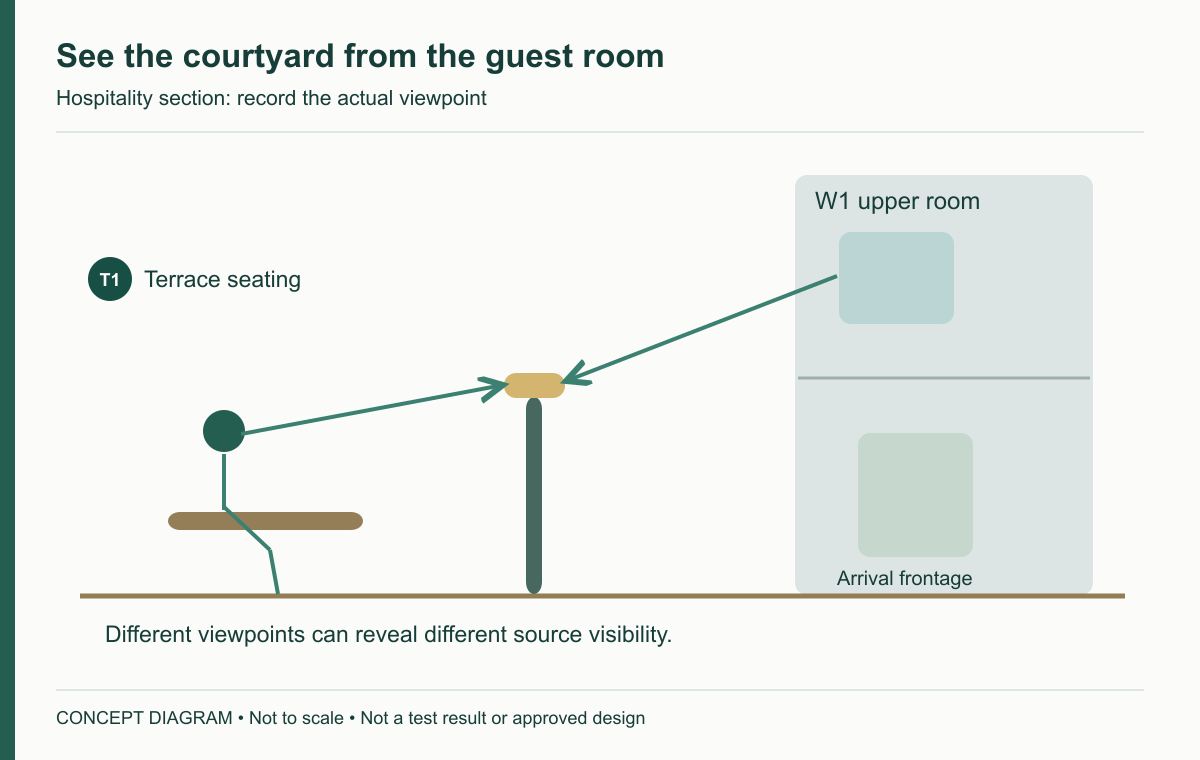
Draw the relationship between R1, the proposed source, W1 and T1. Mark the view while walking, sitting on the terrace and occupying the relevant room position where access is agreed. This is a diagram of viewing relationships, not a light-distribution calculation or an instruction about universal mounting heights.
Record whether the source is directly visible and whether light reaches unintended surfaces. Where a candidate supports triggered brightening, observe that transition as well as its steady condition. A still photograph can miss a change that is important to an occupied room.
Explain the first placement trade-off
Moving a candidate away from W1 may improve a room-facing view while changing its ability to serve R1 or its access to sunlight. Moving it towards planting may conceal part of the source but create shading and service problems. Keep these consequences together in the record.
Possible adjustments include a different position, a documented distribution option or a supported shielding arrangement. They must be assessed with the actual candidate. Warm-white light alone cannot guarantee that rooms will be unaffected, and a concept sketch cannot demonstrate a reduction in complaints.
For a general framework, the DarkSky and IES principles encourage attention to purpose, targeting and control. Applying those ideas is a design process, not proof that a fixture or hotel has obtained an environmental approval.
Coordinate Fixture Appearance and Light Colour
Compare a family of forms, not assumed shared performance
Record the building’s scale, existing fixtures and the visual relationship between different areas. A coordinated scheme may use low-level, wall-mounted and pole-mounted forms without requiring identical construction. Similar names or finishes do not prove shared batteries, controls, photometry or spare parts.
The solar bollard lights range and solar wall lights range offer different mounting forms to investigate. Compare them against the relevant installation surface, panel exposure and sightlines. A wall position near a building can be convenient for one task while unsuitable for solar collection.
Review light colour alongside the existing scene
Ask which light-colour options are actually supplied for the candidate configuration, and whether selection is made at manufacture or by an approved user control. Do not assume that a selectable option on one model exists across the range or that two products will appear identical because their descriptions use the same colour term.
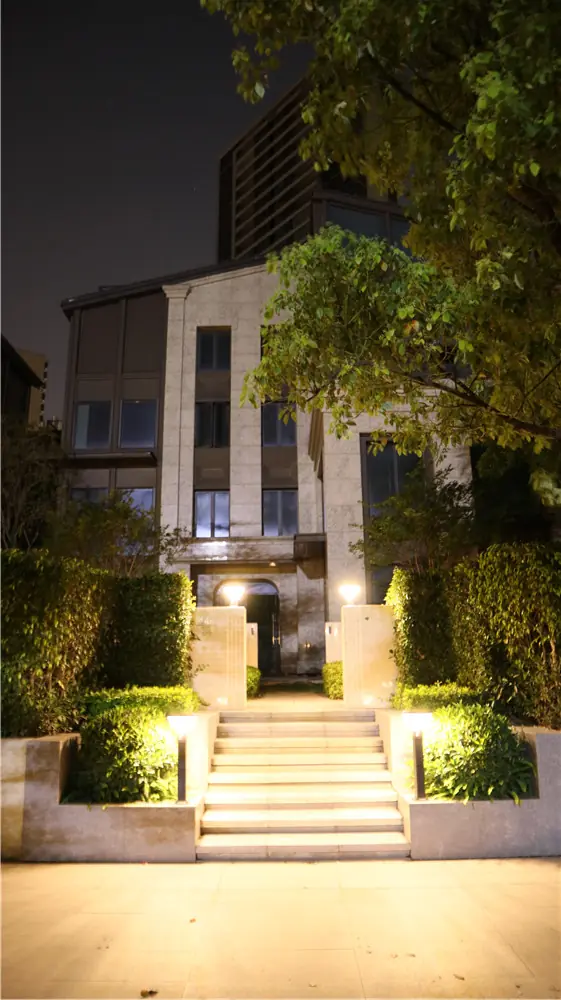
During the sample review, view the candidate with the existing lighting that will remain in operation. Record the settings and surrounding conditions. Changing the sample’s position, camera exposure and adjacent lights at the same time makes a visual comparison difficult to interpret.
For locations where a pole assembly is relevant, review solar pole-light configurations separately. Confirm whether the pole, arms and accessories are included and what maintenance method is required. Appearance should remain connected to a deliverable and serviceable configuration.
Match Operating Modes to Night-Time Needs
Describe permitted states and transitions
List whether each area needs a baseline level, permits dimming or has a supported triggered state. Then ask for the actual programme or operating description. Avoid inventing timing sequences, reset methods, networking or remote-control functions because they would be convenient for hotel operations.
The second trade-off concerns R1 during quiet hours. A triggered increase might serve moving guests, but repeated transitions near W1 could be undesirable. A steadier supported mode might avoid those transitions while requiring a different energy assessment. The right enquiry examines both the guest task and the documented system, rather than declaring one mode universally best.
Review the difficult operating conditions
For each proposed mode, request the conditions supporting any runtime statement: relevant charging opportunity, starting state, demand and observation or test method. Where that information is missing, record a question rather than an assumed performance value. One successful evening cannot establish a season’s operation.
If a particular island site has difficult resupply, include service contacts and approved replacement identification in the operating discussion. If it has coastal exposure, seek relevant evidence rather than treating “resort” as a corrosion classification. Seasonal cold, where applicable in Europe, North America or elsewhere, requires its own model-specific charging and operating checks.
The operating plan should also say what happens when a lighting issue affects guest access. Operations staff should follow the property’s established procedures and escalate technical faults appropriately. This guide does not replace emergency systems, specialised safety assessments or underwater lighting design.
Review Samples with Operations Staff
Agree the observations before the trial
Invite the people who manage late arrivals, housekeeping or maintenance, together with the relevant designer. Agree on fixed viewpoints, the candidate configuration, operating states and the activities to observe. Record what was not tested as carefully as what was seen.
| Area and viewpoint | Observation condition | Finding to record | Proposed change | Reviewer and recheck |
|---|---|---|---|---|
| A1 approach | Agreed arrival and waiting activity | Route and stopping-point observations | To propose from evidence | Named person and condition |
| R1 path | Confirmed operating state | Direction changes and transitions | To propose from evidence | Named person and condition |
| W1 room view | Agreed access and surrounding lights | Visible source or unwanted changes | Position, optics or supported mode to assess | Named person and condition |
| T1 seated view | Recorded seating direction | Relationship with C1 and R1 | To propose from evidence | Named person and condition |
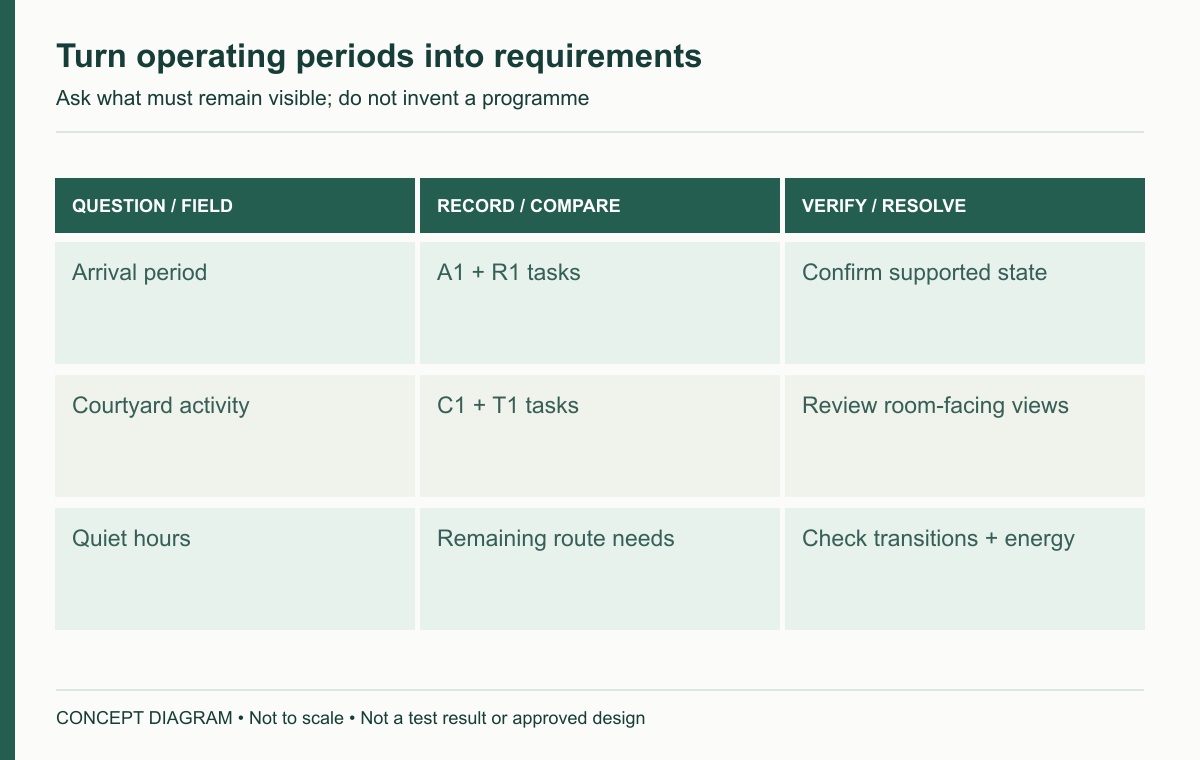
Close the loop rather than collecting opinions alone
Write a finding in a form that someone else can investigate: location, condition, observation and proposed next step. “Too bright” without a viewpoint or state is difficult to act on. A record identifying a directly visible source from W1 during a specified transition is a clearer basis for review.
After a change, repeat the relevant observation under recorded conditions. Retain the earlier record rather than replacing it with a new photo. If an unresolved technical question remains, identify the appropriate supplier or project reviewer; do not reinterpret uncertainty as a passed sample.
Give operational feedback a clear route
Hospitality lighting decisions often involve more than one department. Reception may notice a late arrival problem, housekeeping may receive a room-view comment, and maintenance may identify an access limitation. Assign a shared location reference so these observations reach the same review record. A resort pathway issue should not disappear into a general note about the hotel’s exterior appearance.
Keep the latest hotel courtyard lighting plan with the operating requirements and sample configuration. Before changing a mode or replacing a fixture, identify the affected guest task and the observations that need repeating. Solar lighting near guest rooms should be reviewed with those rooms’ actual sightlines, not only from the courtyard below.
Frequently asked questions
Should a hotel courtyard use constant or motion-activated lighting? Divide the property by arrival, access and activity needs, then compare supported modes. One setting for the entire hotel may overlook quiet-hour views or routes that remain in use.
Will warm-white lighting avoid disturbing guest rooms? Not by itself. Position, distribution, source visibility, operating state and surrounding light also matter. Review them from the relevant occupied viewpoints.
What should a hotel record during a sample trial? Record the candidate version, areas, viewpoints, conditions, operating states, findings, proposed changes and recheck responsibility. Keep untested performance separate from observed behaviour.
To prepare a supplier discussion, provide the courtyard plan, room-facing sections, arrival and activity requirements and details of lighting that will remain. Those inputs make the sample review specific to the property’s operations rather than a demonstration of a lamp in isolation.
For an overview of fixture types, site conditions and selection priorities, see our garden and courtyard lighting guide.