


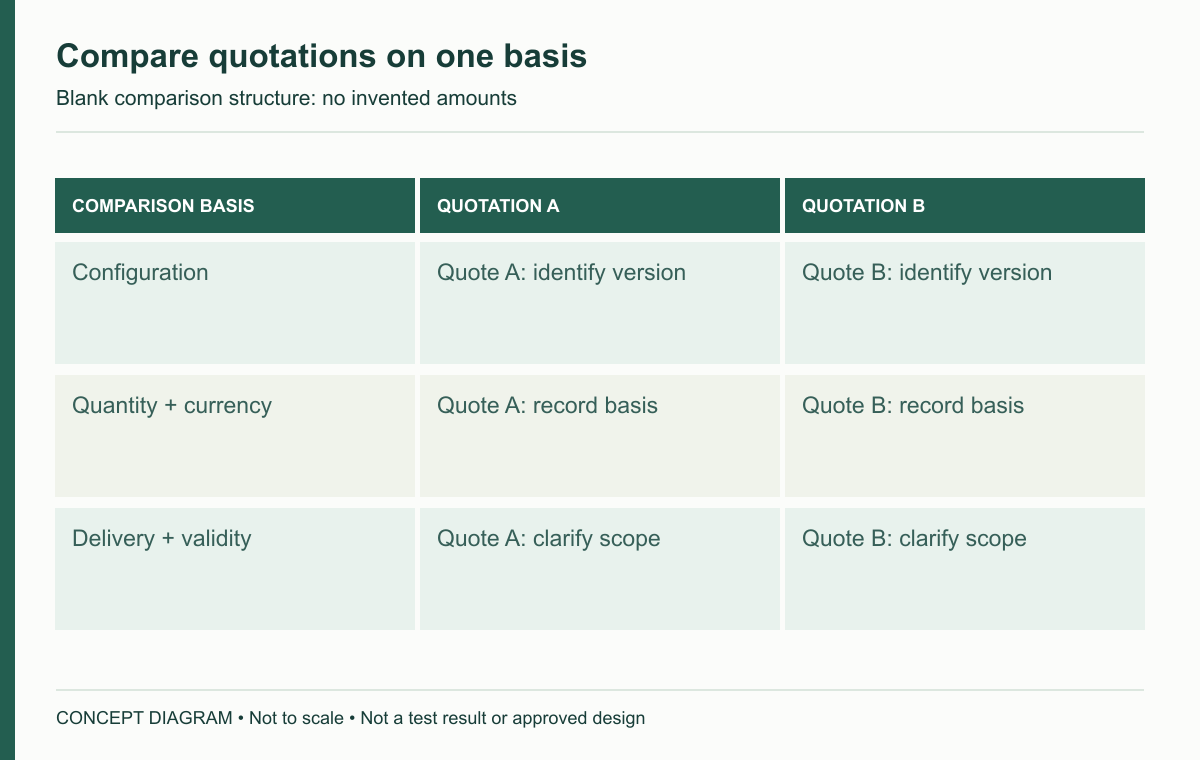
A useful solar lighting quotation comparison starts by putting offers on the same basis. Match the configuration, quantity unit and delivery scope before discussing price. If one quotation includes a head only and another includes a pole assembly, their unit prices do not yet describe the same purchase.
An unmentioned item should be marked for clarification. It is not automatically included, free or a zero cost. The comparison should show what each supplier is offering, where the differences matter and what written answers are needed before the buyer can decide.
This guide is for buyers who have received quotations for garden or courtyard lighting. It provides a scope-comparison method, not a market-price list, contract interpretation or promise about freight, lead time or warranty. The worksheets can be used without inventing prices or commercial terms.

Compare Quotations on the Same Configuration Basis
Establish the identity of each offer
Record the supplier, quotation reference, issue date and quotation validity. Keep the original document and its attachments together. An updated email may clarify an item, but it should be connected to the offer it changes so the final comparison does not mix unrelated versions.
Identify the full model, configuration, light-colour option, supported mode and any accessories affecting the supplied assembly. Products that look similar may have different components or operating arrangements. The model family name alone is not enough to establish the same configuration.
Align quantity and pricing units
Check whether the quoted quantity refers to heads, complete sets, cartons or another stated unit. A multi-head assembly may be priced by assembly or by individual head. Record the unit explicitly before comparing extensions or totals.
If offers use different quantities, ask for comparable quantities or retain the difference visibly. Do not rank their unit prices as if volume and scope were identical. Likewise, record currencies separately; any later conversion requires a stated source and date rather than an invented exchange rate.
| Comparison basis | Quotation A | Quotation B | Clarification needed |
|---|---|---|---|
| Reference and validity | Enter exact document | Enter exact document | Which revision governs the offer? |
| Model and configuration | Enter full identity | Enter full identity | Are options and versions comparable? |
| Quantity and unit | Enter the quoted basis | Enter the quoted basis | Head, set or another unit? |
| Currency and amount | Copy the actual value | Copy the actual value | No conversion until the basis is defined |
| Attachments | List relevant documents | List relevant documents | Are specification and scope references consistent? |
Check Fixtures, Poles and Accessories Separately
Break a complete kit into documented supply items
List the head, pole, arms, adapters, relevant fixings and other agreed accessories. Identify how panels, batteries and controls are included in the supplied configuration. A product image is not a bill of materials, even when it shows all the parts the buyer expects to receive.
The solar courtyard light category and solar pole-light category represent useful starting points for distinguishing fixture-only and assembly enquiries. The actual quotation must still define what is included for the selected version.
Use explicit scope states
Use clear states such as included, separately quoted, excluded and awaiting clarification. Retain the supplier’s exact supporting reference. If a pole is not mentioned, mark it awaiting clarification instead of treating its absence as a complimentary item or a confirmed exclusion.
For a hypothetical comparison, offer A may expressly cover a fixture while offer B lists a fixture and support. The first question is not which supplier is cheaper; it is whether both can provide a documented price for the scope the project actually requires. No invented amounts are needed to demonstrate that mismatch.
Check interfaces between supplied components
If different parties provide heads, poles or adapters, record who confirms compatibility and the applicable drawings. A low equipment price can be difficult to interpret when the interface responsibility is unresolved. The quotation comparison should expose that gap without attempting to approve the structure itself.
For a low-level part of the project, compare solar bollard configurations against the relevant mounting and supply list. Do not assume that a fixed-base appearance means every anchor or foundation-related item is included.
Separate Supply, Installation and Site Work
Follow the scope beyond the carton
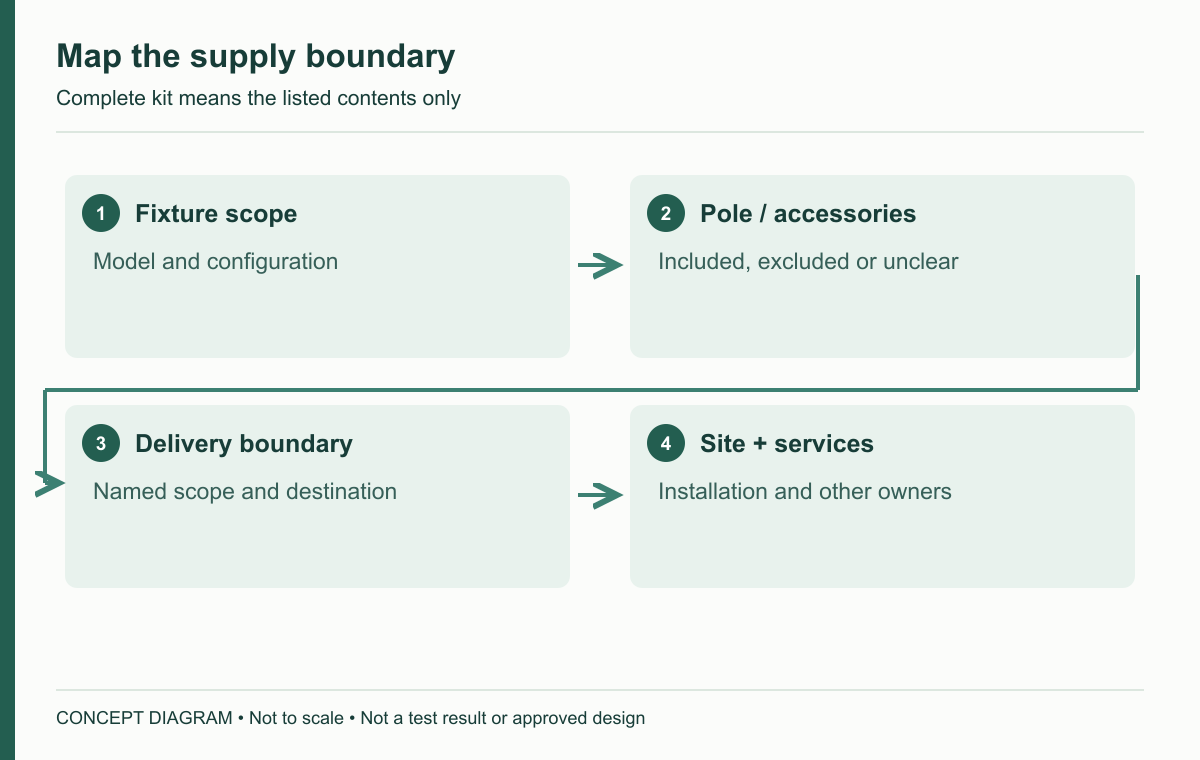
Distinguish equipment supply, transport to the stated handover point, assembly, installation and site restoration. Where an existing system is being replaced, add the relevant old-equipment removal and authorised electrical or structural work. The fact that the new fixture is solar-powered does not make those activities disappear.
Record who provides each item and who is responsible for completion or acceptance. A supply-only offer can be legitimate, but it should not be compared with an installation-inclusive offer as though their totals describe the same obligation. Missing responsibilities should be clarified before an order relies on them.
| Scope item | Supplier provision | Other responsible party | Evidence or open question |
|---|---|---|---|
| Equipment | Exact listed configuration | Buyer reviews identity | Approved scope reference |
| Delivery | Stated destination or handover point | Recipient arrangements | Written delivery description |
| Assembly and installation | Included, excluded or unresolved | Relevant contractor | Defined work scope |
| Existing-system treatment | Explicitly stated or unresolved | Appropriate qualified personnel | Site-specific requirements |
| Restoration and handover | Explicitly stated or unresolved | Project-assigned party | Acceptance and document requirements |
Keep professional interpretation with the right people
This worksheet records scope; it does not determine legal liability, tax treatment or a construction method. Ask the relevant commercial, logistics and project personnel to resolve those matters in the actual documents. A blog checklist should not turn an ambiguous trade term into a contractual promise.
If one proposal assumes reuse of an existing pole, show that assumption beside the relevant review requirement. If another includes a new support, identify the difference. The comparison should not hide unresolved reuse behind a single installation line.
Review Packaging, Transport and Delivery Terms
Connect packing information to the quoted quantity
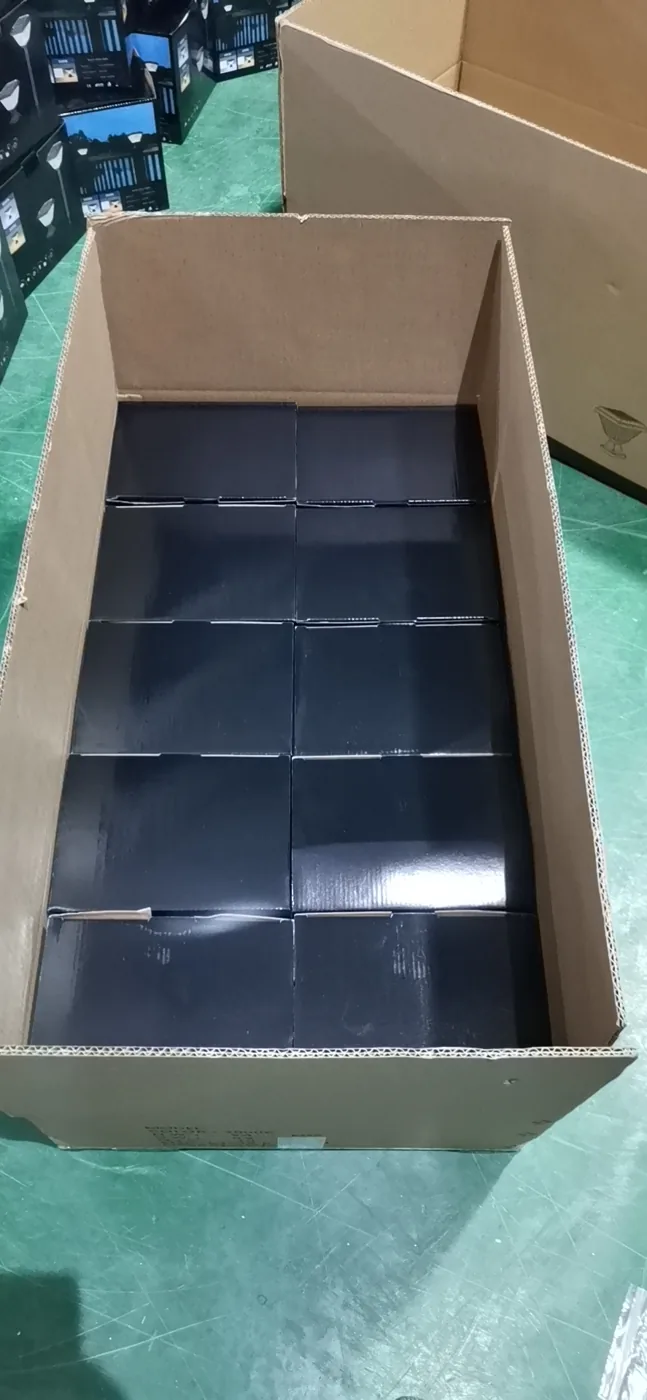
Record packaging units, stated package counts and the relationship between cartons and supplied items. Long pole sections, fixtures and accessories may be packed differently. Ask which documents will identify the parts on receipt and whether they correspond to the quotation’s quantity basis.
Real packaging photographs can help explain visible arrangements, but they do not prove that a new order uses the same packing or contains the same configuration. Use the current offer and confirmed packing information as the basis of comparison, with authorised images only where appropriate.
State the actual destination and handover point
For an island order, mainland arrival and final-site delivery may be different scope items. Ask what the quotation actually covers and which onward arrangements remain with the buyer. Do not assume that a port or regional destination name includes the final transfer to a remote property.
Southeast Asian, Australian, European and North American orders likewise need their exact destination and delivery arrangement recorded. Geographic labels do not determine one standard freight cost, transit time or set of import requirements. Refer technical trade and customs questions to the appropriate professionals using the actual documents.
Keep timing as a documented condition
Record the stated timing and what it depends on, such as configuration confirmation or other conditions expressly included in the offer. Do not copy a generic website statement into the comparison as the order’s guaranteed lead time. If the offer has expired or its conditions have changed, request an updated version.
A packaging or destination change can affect the quotation’s comparability even if the product itself stays the same. Keep the revised scope and reply together so that the final decision refers to a coherent offer rather than a collection of favourable fragments.
Compare Warranty, Spares and Service Scope
Read beyond the number of years
Compare the stated covered items, period, conditions, claim process and service route. Record who is expected to provide evidence, who authorises an action and how related transport or service costs are addressed in the actual terms. Do not infer these details from the headline warranty duration.
One offer may describe coverage more clearly than another without necessarily offering broader coverage. Ask for clarification before ranking them. A general marketing page does not automatically establish the terms for a particular order, configuration or destination.
Confirm the identity and availability of spares
Ask which parts are supported, their references and the relevant compatibility information. Do not assume visually related models use interchangeable batteries or controllers. Record the supplier’s current response about availability and any conditions; do not replace it with an invented stock commitment.
For a remote location, the route for identifying and obtaining an approved part may matter alongside the initial equipment cost. That consideration should be described as a project requirement, not translated into a universal spare quantity or a guaranteed response interval.
Avoid scoring unsupported information
A numeric supplier score can look precise while resting on undefined assumptions. If the evidence is incomplete, use a difference-and-clarification record instead of assigning arbitrary weights. The buyer can then judge the relevant trade-offs after the offers are made comparable.
Price remains important, but it should be read against the confirmed equipment, delivery and service scope. The lowest unit amount may or may not be the most suitable offer once those facts are known. The worksheet’s purpose is to make the basis visible, not to predetermine the winner.
Use a Comparison Sheet to Request Clarification
Make every difference actionable
| Comparison item | Quotation A reference | Quotation B reference | Difference and decision effect | Clarification request | Reply version |
|---|---|---|---|---|---|
| Configuration | Enter actual source | Enter actual source | State the unresolved difference | Request the same defined configuration | Record written reply |
| Supplied components | Enter listed items | Enter listed items | Identify missing or different scope | Ask for an itemised schedule | Record written reply |
| Quantity basis | Enter unit and quantity | Enter unit and quantity | Explain why totals are not comparable | Request a common basis | Record written reply |
| Delivery and site work | Enter stated coverage | Enter stated coverage | Identify unassigned work or transfer | Ask who provides each item | Record written reply |
| Warranty and spares | Enter applicable terms | Enter applicable terms | Identify uncovered questions | Request specific order terms | Record written reply |
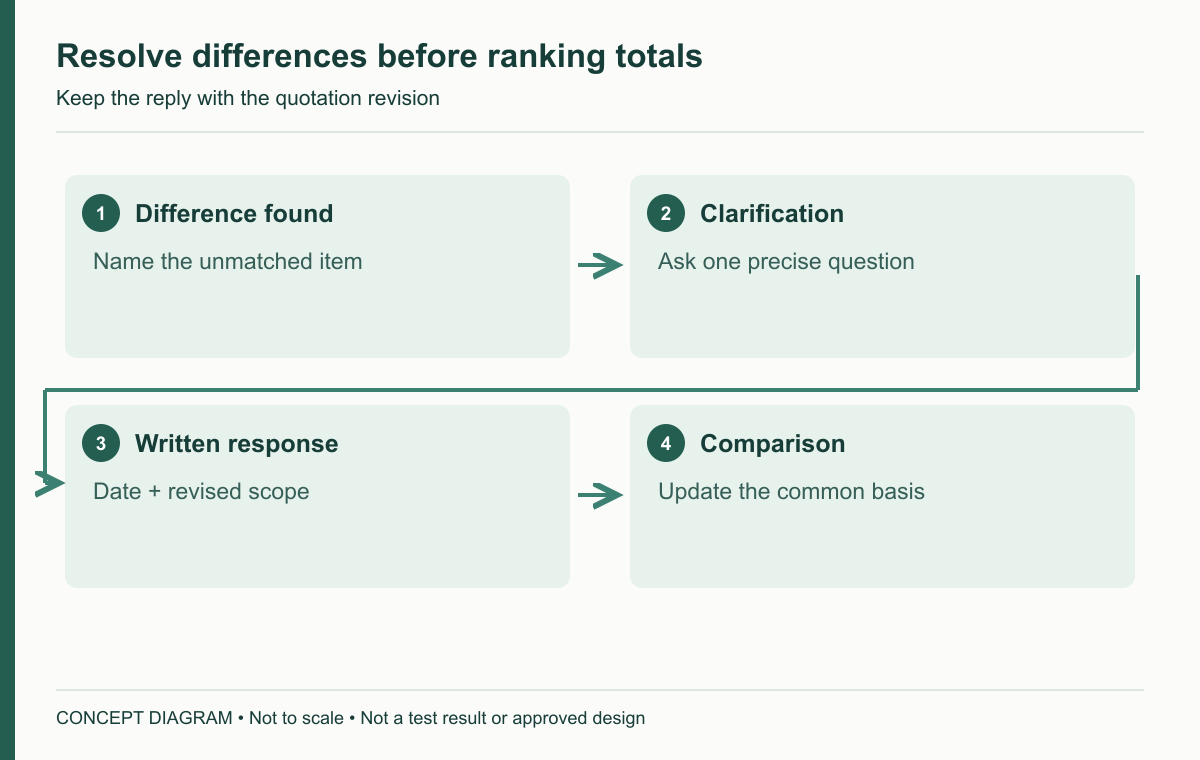
Copy values only from authorised, current documents. Blank fields in this template are not zeros. If a real commercial example is shared for review, remove customer contact details and other non-public information that is not necessary to understand the comparison.
Keep one final comparison version
After replies arrive, update the comparison and retain the earlier offers. Mark which questions are resolved and which remain open. The purchasing decision should refer to the same document set that the order will use, including any accepted changes.
Do not confuse this step with preparing the initial project brief or evaluating a physical sample. Those records answer different questions. Quotation comparison begins with actual offers and asks whether their commercial and technical scope can be compared fairly.
Frequently asked questions
Is the lowest unit price always the best quotation? No. First align configuration, quantity, delivery, site work and service scope. An apparently lower amount may represent a different purchase; it may also be competitive once the scope is confirmed.
Does an unmentioned pole count as included? No assumption should be made. Ask for an explicit component list and scope statement. Unmentioned is a clarification status, not a free item or an automatic zero.
How should different warranty periods be compared? Read the covered parts, conditions, claim process and related responsibilities together. Do not compare years alone or extend the supplier’s written terms.
When ready, send the configuration and scope questions with the relevant quotation references. A concise request for comparable versions is more likely to resolve the decision than asking for a lower price before the differences are understood.
For an overview of fixture types, site conditions and selection priorities, see our garden and courtyard lighting guide.