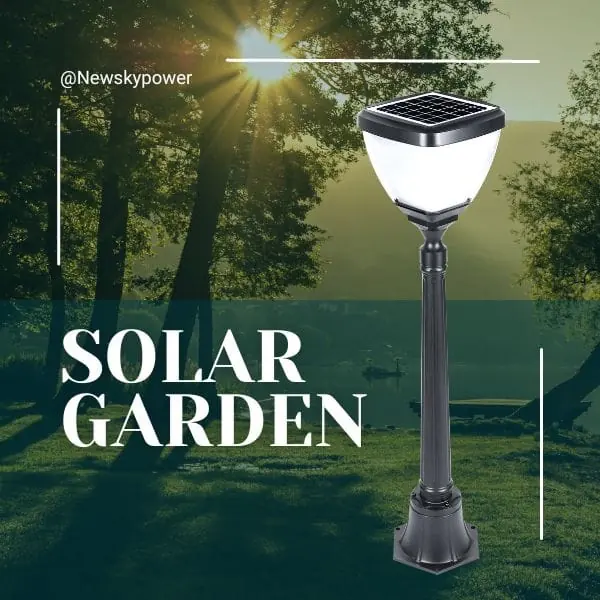


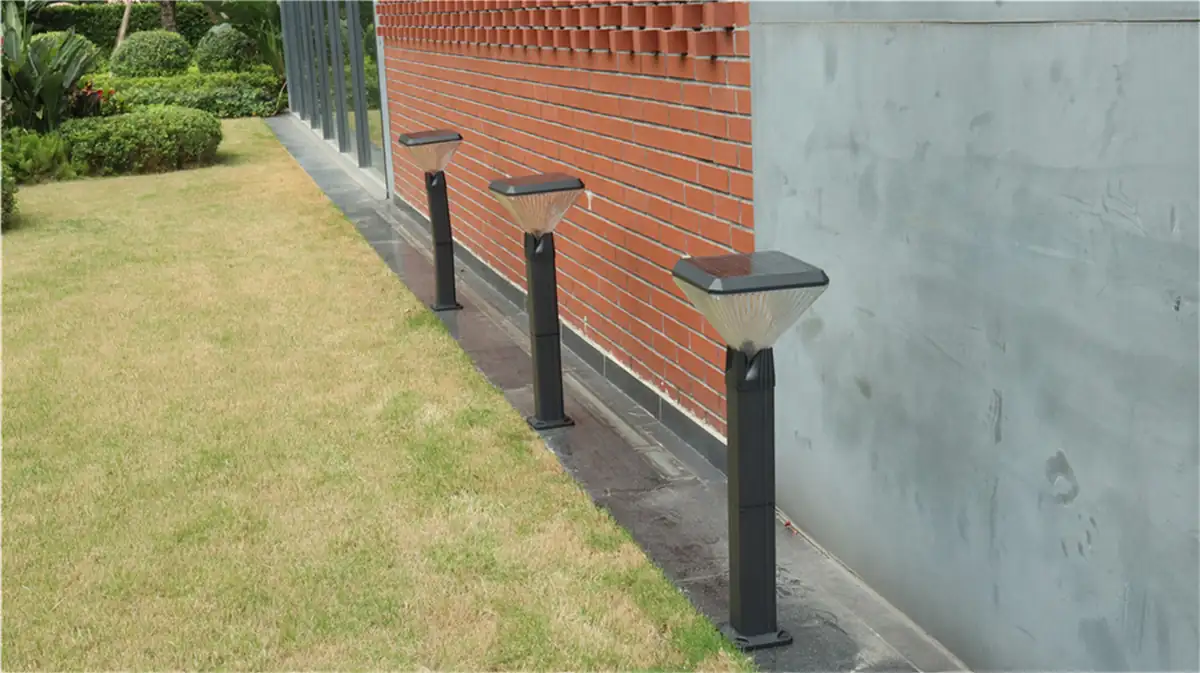
Solar lighting and low-voltage wired lighting suit different site conditions. Solar lights must collect and store enough daytime energy for the intended night load. Low-voltage systems need compatible power equipment, cabling and installation. Start with sunlight, existing infrastructure and operating needs, then compare the complete installation and maintenance scope. A mixed yard can reasonably use different systems in different zones.
What each system includes
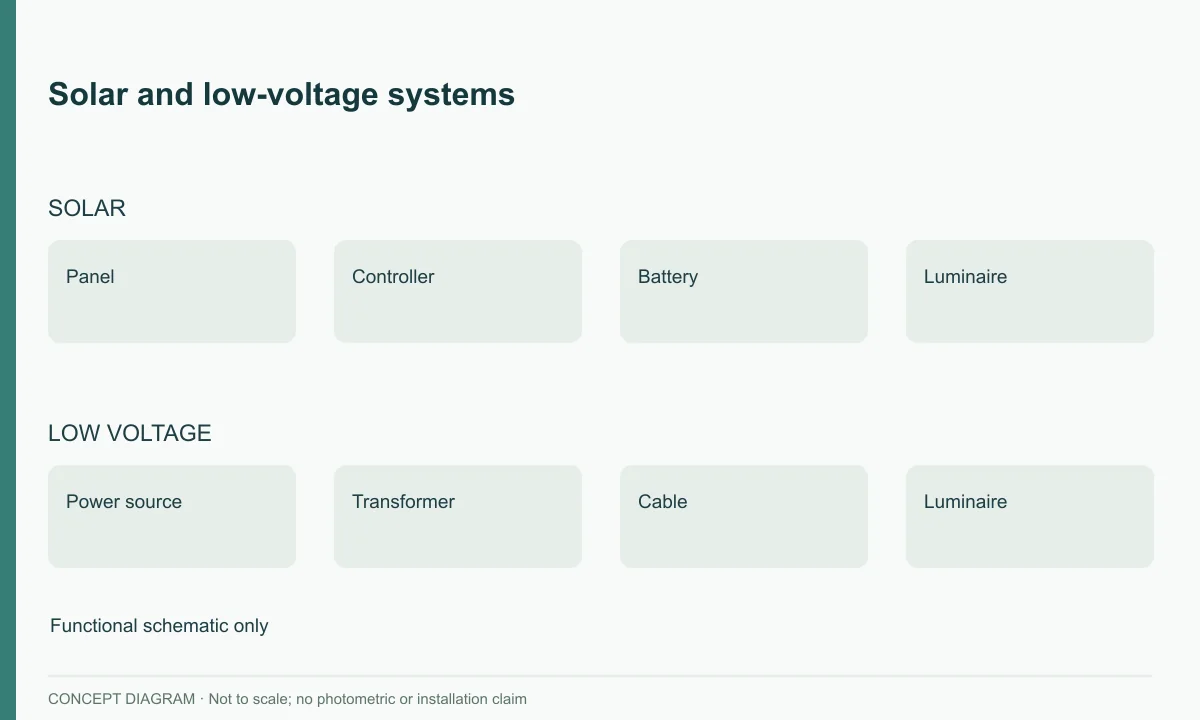
An independent solar light combines a photovoltaic panel, battery, controller and luminaire. “Off-grid” does not mean battery-free. A low-voltage landscape system uses compatible luminaires, cables, connectors and a transformer or power supply suited to its electrical design. Low voltage does not make every installation task suitable for an unqualified person; this article does not provide mains or wiring instructions.
The comparison should include the whole system boundary. For solar, that means the charging surface, energy storage, control program, mounting parts and safe service access. For low voltage, it means the luminaires, power supply, cable route, connectors, controls and connection to an appropriate source. Comparing a solar fixture price with only a wired luminaire price leaves out different parts of each solution.
For a broader assessment of suitability, read about the benefits and limitations of solar garden lights.
Check sunlight and existing power first
Observe open ground, tree shade, walls and roof overhangs across the day and relevant seasons. For wired options, record power-source locations and existing cables, but do not assume that old equipment is reusable without inspection. Solar may reduce supply cabling in remote zones; wired lighting may be a better starting point in persistently shaded zones with suitable infrastructure.
Make a simple site map before choosing. Mark sunny zones, persistent shade, existing power equipment, hard surfaces, planting that may change and routes where trenching or restoration would be disruptive. Then label each item as confirmed, estimated or unknown. This prevents “solar is easier” or “wired is more reliable” from becoming an unsupported site-wide assumption.
If your yard already has wiring, inspect before choosing
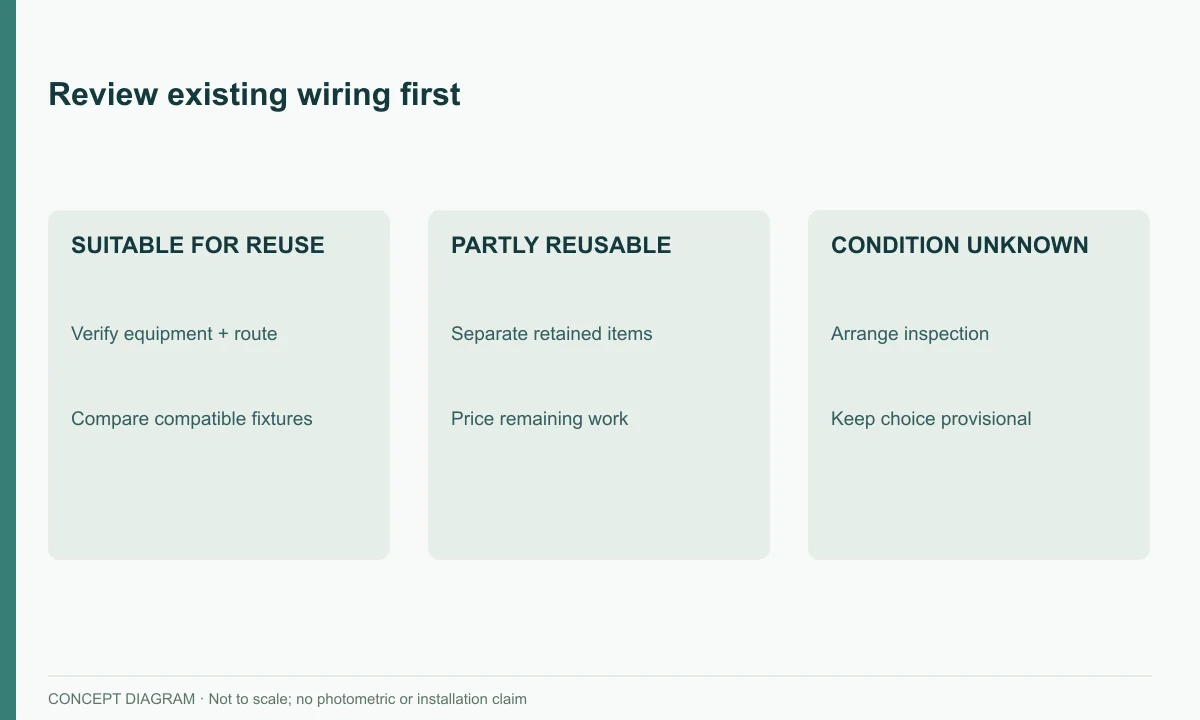
Existing wiring can change the comparison, but only when its condition and suitability are known. Ask a qualified person to identify the supply equipment, cable routes, connection condition and compatibility with the proposed fixtures. An unused cable emerging from the soil is not enough information to price a reusable system.
There are three practical branches. If the existing installation is suitable for reuse, compare the cost and disruption of compatible replacement fixtures with a complete solar alternative. If only part can be reused, separate retained equipment from replacement work. If suitability is unknown, keep the wired option provisional until inspection resolves it. This prevents the existing infrastructure from being counted as free usable equipment before anyone has checked it.
Compare installation cost at the same boundary
For each option, list equipment, mounting work, cable or foundation work, access, landscape reinstatement and commissioning. Add who supplies labour and who accepts the work. A quote that excludes restoring paving may look attractive until that separate task is added. A solar quote that includes only a luminaire also leaves the mounting and service arrangements unresolved.
Keep recurring work in a separate table. Panel cleaning, vegetation checks, battery-related service and inspection of mounts apply to solar arrangements as appropriate to the model. Wired arrangements have their own luminaire, power-supply and connection responsibilities. The frequency and price should come from the site and service proposal; neither system is automatically maintenance-free.
Compare light tasks and operating hours
Short evening use, route guidance and continuous overnight duties impose different demands. The power source alone says nothing about distribution or useful light on the target surface. Solar sizing must connect available charging energy to the actual mode and load; wired lighting still needs suitable luminaires and controls.
Write a schedule for each zone. Include the required start and end period, whether dimming is acceptable, whether occupancy-based changes are appropriate and what happens during low-use hours. A decorative border needed for two evening hours should not automatically use the same decision as an entrance expected to remain available through the night.
Compare installation scope and site impact
| Scope item | Solar option | Low-voltage wired option |
|---|---|---|
| Energy supply | Panel, battery and controller at or near the light | Compatible power supply and cable network |
| Ground work | Mounting/base work; usually no supply trench between independent lights | Cable routes, connections and landscape reinstatement may be required |
| Shaded location | Requires a verified charging strategy or another solution | Can operate if the electrical design and installation are suitable |
| Coordination | Model, solar access, mode and mounting | Luminaire, supply, cable, controls and qualified installation |
“No supply cable between independent solar lights” does not mean no foundation, fixing, commissioning or maintenance.
Include maintenance and replacement in total cost
Compare purchase, accessories, installation, site restoration, energy where applicable, inspections, cleaning and component replacement over the same period. Solar systems need panel and battery-related checks; wired systems need power-supply, connection and cable checks. Without dated, like-for-like quotations, do not claim a payback period or saving percentage.
Use a lifecycle worksheet rather than a single purchase-price column:
| Cost or responsibility | Solar questions | Low-voltage questions |
|---|---|---|
| Initial equipment | Which mounting, control and energy-storage parts are included? | Which supply, cable, connectors and controls are included? |
| Site work | What mounting, foundation or commissioning work remains? | What routing, connection and landscape restoration remain? |
| Routine care | Who cleans panels and checks operation? | Who inspects luminaires, supply equipment and connections? |
| Replacement | Which version-specific parts and instructions are available? | Which compatible luminaires, drivers or supply parts are serviceable? |
Compare the same study period and assign each action to an owner. Where costs are not known, keep the cell open instead of inserting an assumed figure.
Choose by scenario or combine systems by zone
| Condition | Start by evaluating | Still confirm |
|---|---|---|
| Sunny remote path | Independent solar | Seasonal solar access, mode, mounting and optical data |
| Shaded patio with suitable existing infrastructure | Low-voltage wired | Equipment condition, design and installation scope |
| Large yard with mixed conditions | Different systems by zone | Consistent appearance, controls and maintenance responsibility |
Combining systems means assigning different zones to different systems—not wiring an integrated solar light into a low-voltage circuit unless its manufacturer explicitly supports it.
A mixed scheme also needs visual and operational coordination. Record desired colour appearance, switching behaviour, maintenance access and the person responsible for each zone. Test the transition between zones after dark so a well-lit wired area does not make the adjacent solar route appear unexpectedly dark. The two systems can coexist without pretending they are electrically interchangeable.
See the solar-light selection guide and the solar pathway light range. Submit site photos, shade observations, existing-infrastructure information and night-use requirements before choosing.
Example: divide a residential yard into three zones
Imagine a patio with suitable existing low-voltage equipment, a sunny path beyond the current cable route and a shaded entrance under a canopy. This is a hypothetical decision exercise. The owner wants the patio for evening use, the remote path for route guidance and the entrance available during its required operating period.
The patio starts with a reuse assessment because suitable infrastructure may already serve it. The remote path starts with a solar-access and fixture review because extending the cable route would create additional work. The shaded entrance needs its own power and optical decision; the sunny path’s result cannot be transferred under the canopy.
| Zone | First information to collect | Candidate approach | Open question |
|---|---|---|---|
| Patio | Condition and capacity of existing equipment | Compatible low-voltage replacement | Is the retained system suitable? |
| Remote sunny path | Seasonal solar access and night duty | Independent solar pathway lights | Can the chosen configuration meet the duty? |
| Shaded entrance | Required hours, available power and mounting | Suitable wired or supported solar arrangement | Can the panel receive adequate input? |
| Zone transition | Viewing direction, output and control timing | Coordinated appearance across systems | Does one zone become a visual dark gap? |
A mixed scheme is not a failure to choose a winner. It recognises that different parts of the same yard can have different constraints. Keep controls and maintenance understandable for the operator, and avoid assuming every zone must use the same housing or power source.

Compare the complete evening experience
Power supply is only one part of landscape lighting. A system can be electrically workable yet have poor distribution, an intrusive source or an awkward transition near a gate. Compare each candidate against the same night task and repeat the observation when surrounding house lights are in their normal state.
For independent fixtures, inspect the solar bollard range alongside pathway forms to compare installation options. If winter operation matters, include the site’s seasonal conditions in the discussion; the winter-use guide introduces that separate review. Neither source replaces checking the particular model and actual operating schedule.

Finish the comparison with a one-page recommendation for each zone: preferred approach, reason, information still needed, installation owner and maintenance owner. If the existing wiring passes inspection, use that evidence in the choice. If it does not, revise the cost comparison before selecting equipment. This produces a decision that can be explained even when the cheapest initial fixture is not the chosen system.
FAQ
Are solar landscape lights always cheaper? No; compare the same supply, installation and maintenance scope.
Does shade always require wired lighting? No, but actual charging conditions and supported product structures must be evaluated.
Can both systems be used in one yard? Yes, as separate zones with coordinated light appearance and maintenance.