

Choosing between all-in-one, all-in-two and split solar street lights starts with the site’s lighting task, solar exposure, installation resources and maintenance plan. Compare how each layout accommodates the required panel, battery and luminaire.
An all-in-one system keeps the main components in one compact assembly. An all-in-two, also called a semi-integrated solar street light, separates the solar panel from the lamp assembly. A split system separates more of the main components and gives the designer greater freedom over their position and size.
Quick Comparison: All-in-One vs All-in-Two vs Split Solar Street Lights
| Decision factor | All-in-one | All-in-two / semi-integrated | Split |
|---|---|---|---|
| Basic structure | Solar panel, LED, battery and controller form one compact assembly | LED, battery and controller are grouped in the lamp; the solar panel is separate | Luminaire, solar panel and battery system are arranged as separate components |
| Field installation | Usually the fewest parts and connections | Requires mounting and connecting a separate panel | Usually requires the most component positioning and field connections |
| Panel direction | Follows the orientation allowed by the integrated assembly | Can be adjusted independently from the lamp | Can be positioned independently within the project design |
| Configuration flexibility | Best within the physical limits of the integrated housing | More freedom for panel sizing and orientation | High flexibility for energy storage, panel layout and service access |
| Maintenance access | The complete assembly is compact, but service may require access at the luminaire | Separate panel and lamp simplify some component-level checks | Components can be serviced separately, although the system has more connections to inspect |
| Shipping and packaging | Compact and easy to count as a complete unit | More packages and larger panel dimensions | Project-specific packaging; separate components require careful labeling |
| Typical fit | Standardized roads, communities, paths and projects that value fast installation | Roads and commercial projects that need independent panel orientation or more sizing flexibility | Larger or highly customized road projects and sites with specific component-placement requirements |
This table describes the architecture, not a guaranteed performance level. Two products with the same structure can perform very differently if their solar panels, batteries, optics, controllers or operating programs are different.
What Is an All-in-One Solar Street Light?
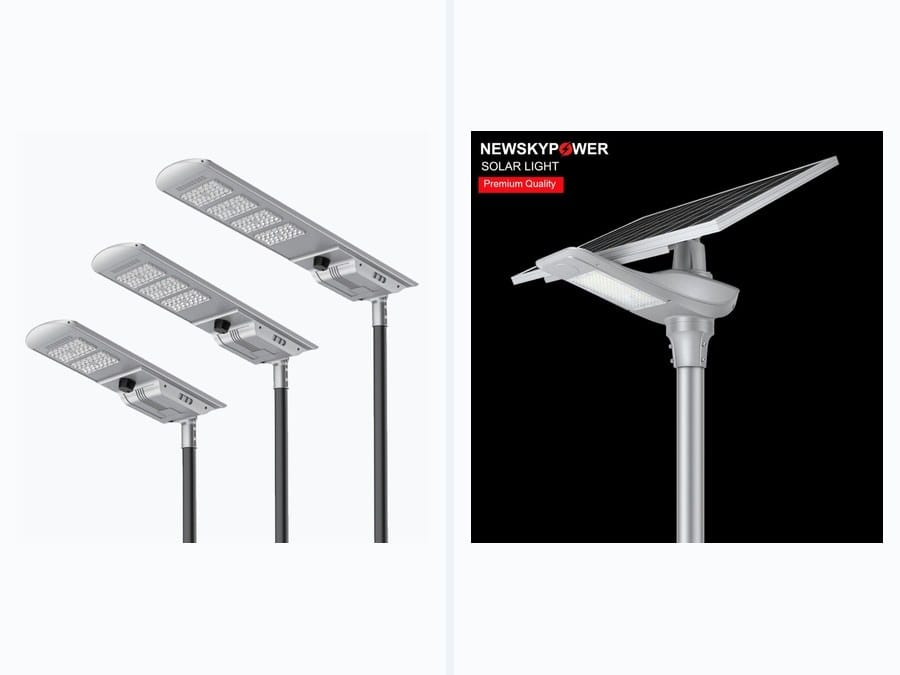
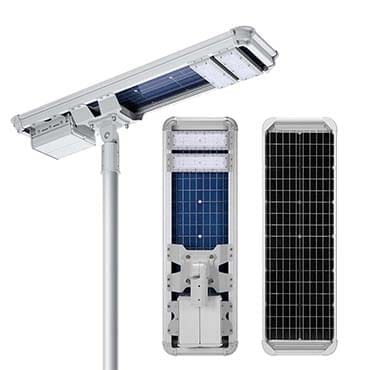
An all-in-one solar street light integrates the solar panel, LED module, battery and controller into one compact unit or closely coupled assembly. The installer normally mounts the lamp and bracket to the pole, sets the required angle and completes the commissioning checks.
Main advantages
Fewer separate parts simplify packing, transport and installation.
Limited field wiring can reduce installation time and connection errors.
A standardized structure is convenient for multi-site projects with similar road conditions.
The compact appearance works well in communities, parks, paths and many commercial settings.
Main limitations
The solar panel and lamp share the same overall mounting arrangement. This can limit independent panel orientation on roads where the lamp must face one direction but the best solar exposure lies in another. Housing dimensions can also limit how much panel and battery capacity fits into a compact product.
These are design constraints, not automatic disadvantages. A correctly sized all-in-one product can still serve many road and public-space applications. Review the available all-in-one solar street lights only after confirming the project load and solar resource.
Best-fit applications
Consider this layout when a compact assembly and fewer field connections suit repeated installations with adequate solar exposure.
What Is an All-in-Two Solar Street Light?
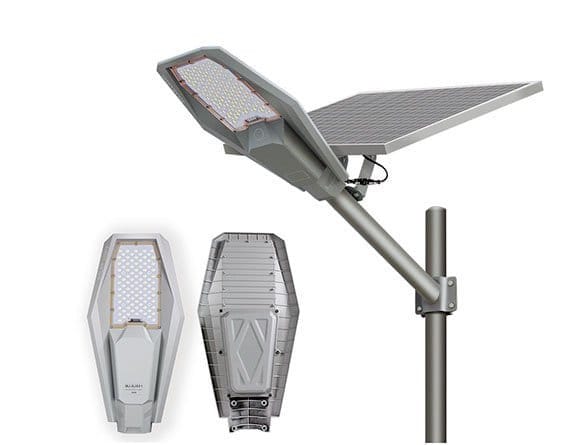
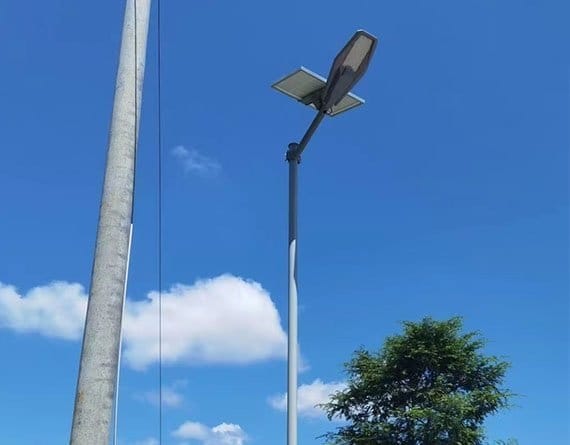
An all-in-two solar street light divides the system into two main assemblies. The LED, controller and battery are integrated into the lamp, while the solar panel is mounted separately. The term semi-integrated solar street light usually refers to this arrangement.
Main advantages
Installers can aim the solar panel independently from the light distribution within the approved bracket, cable and structural limits.
The separate panel provides more freedom when selecting panel size.
The battery remains integrated with the lamp, so the system has fewer separate enclosures than many split designs.
The structure balances installation convenience with project-level configuration flexibility.
Main limitations
The installer must mount and connect the separate panel. That adds a cable route, connectors and installation checks. The panel also creates its own wind-exposed area, so the pole, bracket and foundation must suit the final configuration.
Request the matching component and bracket drawings before treating a separate-panel appearance as confirmation of the complete supplied layout.
Best-fit applications
Consider this layout when the preferred panel direction differs from the lamp direction, or panel sizing needs more room.
What Is a Split Solar Street Light?
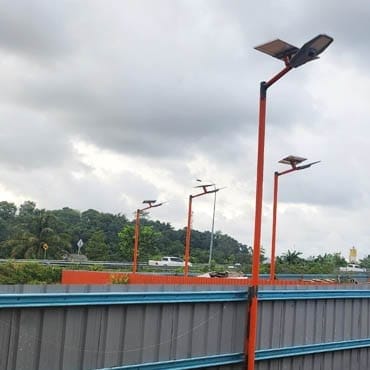
A split solar street light arranges the luminaire, solar panel and battery system as separate components. The battery may sit in a dedicated box or another serviceable position, depending on the product and project design. Because layouts vary, buyers should request a component diagram before comparing quotations.
Main advantages
Designers can size and position the principal components with greater freedom.
The panel angle and orientation can be optimized independently from the luminaire.
Separate components can support project-specific batteries, panels, optics and operating programs.
Service teams can replace individual components without replacing the complete luminaire.
Main limitations
A split system normally needs more brackets, cables and connections. Installation quality therefore has a larger influence on waterproofing, polarity, cable protection and long-term reliability. Separate panels and enclosures also affect wind load, packaging and site coordination.
Explore the current split solar street light range as a starting point, then confirm the final configuration for the project location.
Best-fit applications
Consider this layout when component placement, energy capacity or maintenance access calls for separate assemblies.
Detailed Comparison by Project Decision Factor
Installation time and field wiring
Use the field-connection comparison above to plan the crew, access equipment and commissioning work. Check pole alignment, fasteners and every connection using a documented solar street light installation guide.
Solar-panel orientation and shading
An integrated panel follows the unit’s mounting position. All-in-two and split systems allow independent panel orientation, which can help when the road direction, nearby buildings or trees restrict solar exposure. The site survey should check shading across the year rather than only at midday on the installation date. Independent adjustment remains limited by the approved bracket, wiring and structural design.
Energy capacity and operating profile
Architecture alone does not determine nightly runtime. Compare the LED’s actual operating power, dimming schedule, solar-panel wattage, battery voltage and ampere-hours, usable energy and controller settings. Projects that need long operating hours or several backup nights may benefit from the sizing freedom of an all-in-two or split system. A correctly engineered all-in-one system can also meet demanding requirements when the site and product allow it.
For climate-related sizing, read how solar street lights work on cloudy and rainy days.
Battery temperature and service access
Battery life depends on chemistry, cell quality, depth of discharge, charge control and operating temperature. Integration level affects where the battery sits and how technicians reach it, but no architecture guarantees longer battery life. Ask the supplier to show the battery location, replacement procedure and thermal design.
Wind load, poles and foundations
A separate solar panel adds wind-exposed area above the pole. Compact all-in-one units also create wind load, especially when the panel has a broad surface. Engineers should verify the complete luminaire, bracket, panel, pole and foundation for the local design wind conditions. Do not compare the lamp head in isolation.
Shipping and packaging
For large orders, request carton dimensions, weights, loading plans, component labels and a spare-parts list. Match those details to the site’s unloading and storage arrangements.
Maintenance and spare parts
An integrated design reduces the number of exposed connections, while a split design may make individual components easier to replace. The practical result depends on pole access, connector quality, wiring diagrams and local technician skills. Before ordering, confirm which parts can be replaced, where they are installed and how faults are diagnosed. The solar street light maintenance and troubleshooting guide explains the main checks.
Project customization
Split systems usually offer the widest layout flexibility. All-in-two products provide a useful middle ground. All-in-one products favor standardization and fast deployment. Buyers should still compare the actual available configurations because manufacturers define product families differently. “Modular” refers to assembly or serviceable component arrangements; it does not by itself identify one of these three architectures or establish a quality ranking.
Which Type Fits Different Applications?
Residential and community roads
All-in-one systems are often practical when pole heights and lighting requirements are moderate, installation must be simple and the integrated panel receives good sunlight. All-in-two systems are useful when trees or building orientation requires a separately aimed panel.
Rural roads and remote areas
Any of the three structures can work. The better choice depends on logistics, local installation skills, security, spare-parts access and the required backup nights. Review the specific planning factors for solar street lights on rural roads and remote sites.
Municipal streets and highways
Do not select an architecture only from a wattage label. Municipal and highway projects need road geometry, target illuminance or luminance, uniformity, optics and an energy calculation. All-in-two and split systems often provide useful configuration freedom, while suitable all-in-one systems may work for defined road classes. See the guide to commercial solar street lights for road projects.
Parking lots and industrial sites
These sites may need wider spacing, higher poles or longer operating schedules. Panel orientation and maintenance access can strongly influence the decision. The commercial solar parking lot light guide explains how pole height and coverage affect selection.
Low-sunlight or seasonally shaded locations
Independent panel orientation can be valuable, but it does not replace an energy calculation. The supplier should use the project location, worst-season solar resource, load profile and backup-night requirement to size the panel and battery. If the site cannot collect enough energy, changing the product architecture alone will not solve the problem.
A Step-by-Step Selection Process
Use one procurement record to connect the site conditions to the supplier’s evidence. Complete the steps in order, then ask shortlisted suppliers to explain why their proposed complete configuration suits the project.
| Step and site input | Evidence to request | Design choice affected |
|---|---|---|
| Define the lighting task: road width, pole position, spacing, lighting criteria and hours | Matching photometric file and layout calculation | Optics, mounting geometry and required output |
| Evaluate the site: location, seasonal sunlight, shading and wind | Solar-resource basis and permitted bracket/structural arrangement | Panel placement, tilt and mounting structure |
| Set the energy target: operating stages and required backup period | Actual power schedule, panel rating, battery Wh and usable-energy assumptions | Panel and storage configuration, recovery charging |
| Review installation resources: lifting, wiring and commissioning capability | Parts list, installation instructions and commissioning checks | Feasible architecture and site work scope |
| Plan maintenance: component location and access | Service procedure, replaceable-parts list and spare-parts availability | Serviceable layout and maintenance provision |
| Compare lifecycle cost on the same scope | Itemised equipment, poles, brackets, freight, installation and replacement assumptions | Total project cost, not a ranking based on architecture alone |
| Request project-specific proposals | Versioned configuration and explanation of design limits | Final technical review before ordering |
For the infrastructure cost boundary, see solar vs grid-powered street lighting costs. That guide is not a measured price comparison between these three solar-light structures.
Common Misunderstandings
“All-in-one is always cheaper”
The purchase and installation cost may be competitive, but price depends on component quality, size, pole requirements, shipping and service scope. Compare like-for-like system specifications.
“Split solar street lights are always more powerful”
A split layout offers more sizing freedom, but performance still depends on the selected components, optics and control program.
“Higher advertised wattage means a better system”
Advertised watts do not show actual nighttime power, useful light on the road or energy balance. Ask for verified lumens, photometric files and the operating schedule.
“Integrated products require no maintenance”
Every outdoor solar lighting system needs inspection. Panels can collect dirt, fasteners can loosen and batteries or electronic components can eventually require service.
“One architecture works in every climate”
Temperature, rain, wind, salt exposure, dust and seasonal sunlight vary by location. The complete system must match the actual environment.
Frequently Asked Questions
Is an integrated solar street light the same as an all-in-one light?
The terms are often used interchangeably for products that combine the main components in one compact assembly. Check the component diagram because manufacturers may use the terms differently.
What is an all-in-two solar street light?
It combines the LED, battery and controller in the lamp while using a separate solar panel. It is also commonly called a semi-integrated solar street light.
Which solar street light type is best for highways?
There is no universal answer. The project team should select the structure after completing photometric design, energy sizing, wind-load review and maintenance planning.
Which type is easiest to maintain?
All-in-one systems have fewer exposed connections. Split systems can make individual components easier to access or replace. The easier option depends on the pole layout, service method and available spare parts.
Which type works best in low-sunlight areas?
All-in-two and split designs provide more freedom to orient and size the panel. Even so, the final choice must come from worst-season solar data and an energy calculation.
Can the solar-panel angle be adjusted independently?
It can usually be adjusted independently on all-in-two and split systems, within the permitted bracket angles, wiring route and structural limits. On an all-in-one unit, the available adjustment depends on the bracket and product design.
Choose the Architecture After Defining the Project
All-in-one, all-in-two and split solar street lights solve different installation and maintenance problems. A compact system can simplify deployment. A semi-integrated system can improve panel-positioning freedom. A split system can support extensive customization. The best choice is the one whose complete configuration matches the site.
To request a comparison, send the project location, road width, pole height, pole spacing, lighting hours, backup-night target and maintenance preference. Newskypower can then recommend a suitable structure and configuration for further technical review.