

Are solar garden lights worth it? They can be a practical choice when a site has useful sunlight, the lighting task is realistic and the product is matched to the required operating time. Their main advantage is independent solar power, which may reduce the need for a grid connection, supply cabling and trenching. Their limitations include shade, seasonal changes, battery ageing and the need for regular inspection.
The right answer therefore depends on the location and the job. A garden marker, a residential walkway and a public access route do not have the same lighting requirements.
1. The Short Answer
Solar garden lights are often worth considering for gardens, pathways, courtyards, entrances and landscape areas where installing a power cable would be inconvenient. They are especially useful when each light can receive enough sunlight and the owner accepts that performance changes with weather, season, temperature and operating mode.
They may be a poor fit for heavily shaded positions, sites requiring guaranteed high output for long nights, or projects with strict lighting criteria but no project-specific calculation. In those cases, a different product configuration, a split solar system, a wired solution or a mixed design may be more appropriate.
2. Benefits of Solar Garden Lights – and the Conditions Behind Them
Independent energy can reduce supply wiring
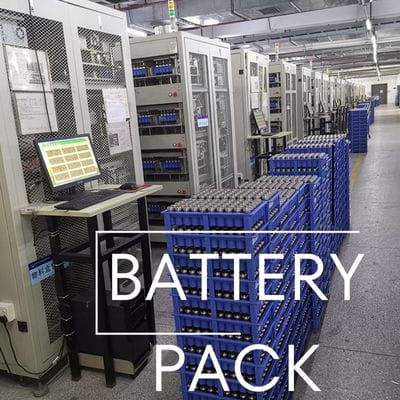
A solar panel converts sunlight into electricity during the day. A rechargeable battery stores energy, and the luminaire uses that stored electricity at night. An off-grid solar light does not need a grid-supply cable, but it still depends on a battery and electrical components.
Where conditions are suitable, this arrangement can reduce the need for grid connection, cable runs and trenching. This can be valuable in an established garden, a remote landscape area or a site where adding underground power is difficult.
However, reduced supply wiring is not the same as no installation work. A fixture may still need a foundation, pole, wall fixing, mounting hardware and safe access for future maintenance.
Flexible placement within solar and structural limits
Because the light does not need to follow a grid cable route, designers may have more flexibility in choosing positions. That flexibility is still limited by solar exposure, the actual area requiring light and the need for secure mounting.
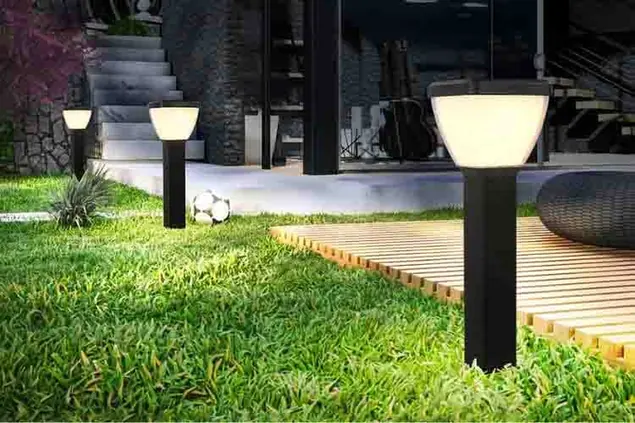
A stake light can suit soft ground, while a bollard or pole-top light generally needs a stable base or pole. The panel must not be placed in persistent shade simply because that position is convenient for the lamp.
Useful visibility and landscape atmosphere
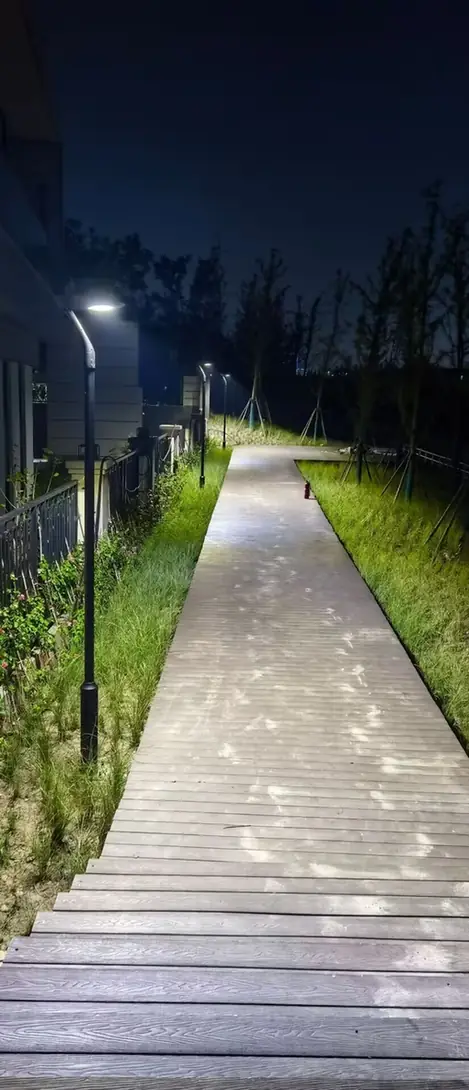
Solar garden lighting can help people see route edges, entrances, planting zones and changes in level. It can also add visual structure and atmosphere after dark. Warm or cool light, fixture form and distribution can all influence the appearance of the space.
These benefits are conditional. A product photograph does not prove that a site meets an illuminance requirement, and adding a light does not automatically prove that accidents will be reduced. Projects with measurable safety or lighting obligations need a suitable layout and supporting data.
No electricity bill for grid consumption at the fixture
An independent solar light does not draw normal operating energy from the grid. This may reduce grid electricity use for that light. It does not mean the total project is free: the buyer still pays for the product, installation, foundations where needed, inspections, cleaning and future component replacement.
Without a defined wired alternative, local labor rates, energy price and maintenance plan, it is not reasonable to promise a payback period or a fixed saving percentage.
3. Limitations and Maintenance Responsibilities
Shade and low-sun periods reduce available energy
Trees, buildings, walls and eaves can reduce the energy reaching the panel. Seasonal sun paths matter as well. A location that performs well in summer may receive less useful solar energy in winter, while longer nights increase the amount of energy the light is asked to supply.
Consecutive low-sun days can also affect operation. The result depends on the starting charge, usable battery energy, load and program; there is no universal number of backup nights for every solar garden light.
Cold and heat need product-specific checks
Temperature affects batteries and other electronic components. Buyers should check the permitted charging, discharging and storage ranges for the actual product rather than assuming that an IP rating or a battery chemistry name guarantees winter performance.
Batteries age
Rechargeable batteries lose performance over time and through use. The rate depends on chemistry, operating conditions, charge and discharge limits, temperature and product design. Replacement intervals vary by model and operating conditions.
Before buying, confirm whether the battery is replaceable, whether replacement must be completed by trained service personnel and which approved part is required. Do not open a sealed fixture unless the manufacturer’s instructions permit it.
Maintenance is low, not zero
Solar garden lights still need inspection. Typical tasks include checking whether plants create new shade, keeping the panel reasonably clean, checking that the fixture remains securely fixed, and looking for damaged housings or seals. The appropriate cleaning method and interval depend on the product and environment.
4. Good-Fit and Poor-Fit Scenarios
Solar garden lights are often a good fit when:
- useful sunlight reaches the proposed panel position;
- the lighting task and operating time are clearly defined;
- the fixture can be securely installed;
- reduced supply cabling provides a practical benefit;
- periodic inspection and cleaning are possible;
- the buyer can verify product specifications and warranty terms.
Use extra caution when:
- the site is shaded for much of the day;
- long winter nights combine with weak solar input;
- the project needs high output for a fixed duration every night;
- the site has strict illuminance, uniformity or compliance requirements;
- the environment is unusually cold, hot, coastal, humid or corrosive;
- maintenance access is difficult;
- the product documentation does not state the battery, operating limits or supported modes.
5. Buying Checklist
Before choosing a product, collect these inputs:
- Application: route marking, general landscape lighting, entrance lighting or a measurable task.
- Location: project city, proposed position, seasonal shade and panel orientation.
- Night requirement: target operating time, acceptable dimming and any lighting criteria.
- Energy system: panel rating, battery voltage and amp-hours, nominal watt-hours, controller and operating program.
- Light information: lumens, distribution data, color temperature and recommended mounting range.
- Installation: base, pole, interface, fasteners, foundation and access requirements.
- Environment: rain exposure, dust, temperature, coastal conditions and possible impact.
- Maintenance: cleaning instructions, replaceable parts, battery policy and warranty process.
If you are still comparing product forms, use our guide on how to choose solar garden and courtyard lights. It separates pathway, bollard, pole, courtyard, pillar and wall-mounted options by location and mounting method.
6. Frequently Asked Questions
Do solar garden lights need batteries?
Yes. In a typical standalone solar light, the panel generates electricity and a rechargeable battery stores energy for nighttime use. Product designs vary, so the exact battery and controller should be confirmed from the model documentation.
Are solar garden lights cheaper than wired lights?
They may reduce grid connection, cabling or trenching work, but total cost depends on the fixture, mounting, foundations, installation, maintenance and replacement needs. Compare complete project scopes rather than only purchase price.
Do solar garden lights require maintenance?
Yes. They normally need periodic checks for shade, dirt, secure fixing and physical damage. Batteries also age. Follow the maintenance and replacement instructions for the specific model.
Are solar garden lights suitable for safety lighting?
They may improve visibility when properly selected and arranged, but the product category alone does not prove that a required illuminance or safety standard is met. Use project-specific lighting data when compliance matters.
Are solar garden lights worth it in winter?
They can work in winter when the system is matched to local solar conditions, temperature and night requirements. Winter performance should be evaluated separately; see Do Solar Lights Work in Winter? for a practical checklist.