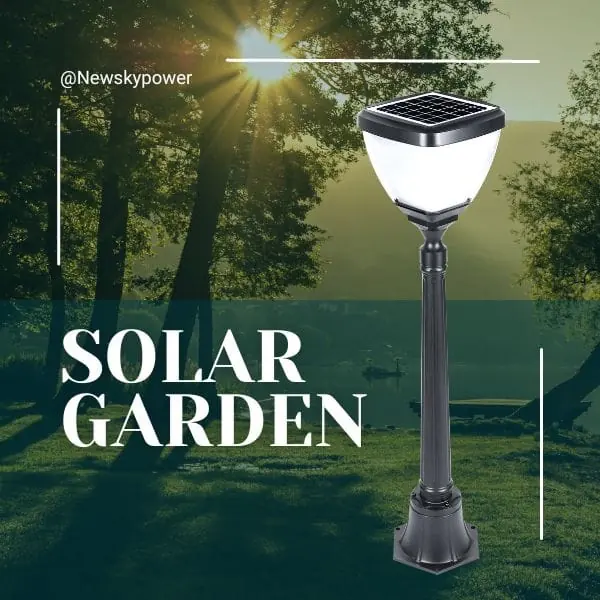


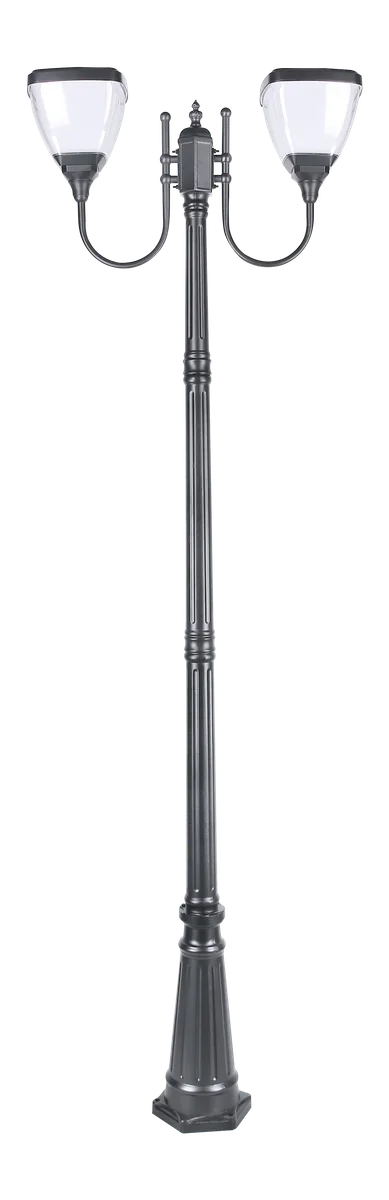
The first question in a solar pole light kit versus post-top light comparison is whether the project has a pole that may be reusable. Even then, reuse is only a possibility until the interface, pole condition and structural requirements have been checked. A “kit” in a product name does not prove that the pole, foundation parts, installation or every fixing is included. The quotation and bill of materials must state the supply scope.
Define pole kits and fixture-only options
A pole-light package may show a luminaire, pole, arms or decorative fittings as one visual assembly. A post-top option is primarily the luminaire that mounts to the top of a compatible pole. Neither name is a complete purchasing specification.
Ask the supplier to identify the luminaire, pole sections, arms or adapters, fasteners, base-related parts, controls, packaging and any service included. Also distinguish a post-top fixture from a pillar light: a fixture for a pole interface is not automatically suitable for mounting on a wall or gate pier.
Choose a purchasing route for the site
| Existing project condition | Practical RFQ route | Main evidence needed |
|---|---|---|
| New site with no poles | Ask for a clearly itemised pole-light package | Component list, pole data, mounting concept and responsibility split |
| Existing poles may remain | Ask for fixture-only and compatible-adapter options | Interface drawing, pole survey and structural review |
| Poles will come from another supplier | Separate fixture and pole quotations with one interface schedule | Coordinated dimensions, tolerances and named responsibility |
The cheapest-looking line item is not necessarily the lowest project cost. A fixture-only price may exclude the pole and adaptation work; a complete-looking package may still exclude foundations, transport, assembly or installation.
Use one comparison boundary for every offer. If Supplier A quotes a fixture only and Supplier B quotes a fixture, pole and packing, first separate the common components from the exclusions. Then assign each omitted task to the customer, installer or another supplier. This makes price differences explainable without assuming that either purchasing route is inherently cheaper.
Confirm what the quotation includes
Use the same checklist for every supplier:
| Component or service | Included | Separate | To confirm |
|---|---|---|---|
| Exact post-top luminaire and version | ☐ | ☐ | ☐ |
| Pole, sections and decorative arms | ☐ | ☐ | ☐ |
| Interface adapter and normal fasteners | ☐ | ☐ | ☐ |
| Base-related parts or templates | ☐ | ☐ | ☐ |
| Packing list and assembly instructions | ☐ | ☐ | ☐ |
| Freight, site assembly and installation | ☐ | ☐ | ☐ |
| Spare parts and after-sales documents | ☐ | ☐ | ☐ |
Do not tick the table from a marketing image. The supplier should return a version-specific list.
Check an existing pole before reuse
Collect photographs of the complete pole, the top interface, base and any visible damage. Record which diameter or dimension was measured and where, instead of writing one number without an object. Ask for a drawing that identifies internal and external mating dimensions, tolerances, connection method and cable or control considerations if applicable.
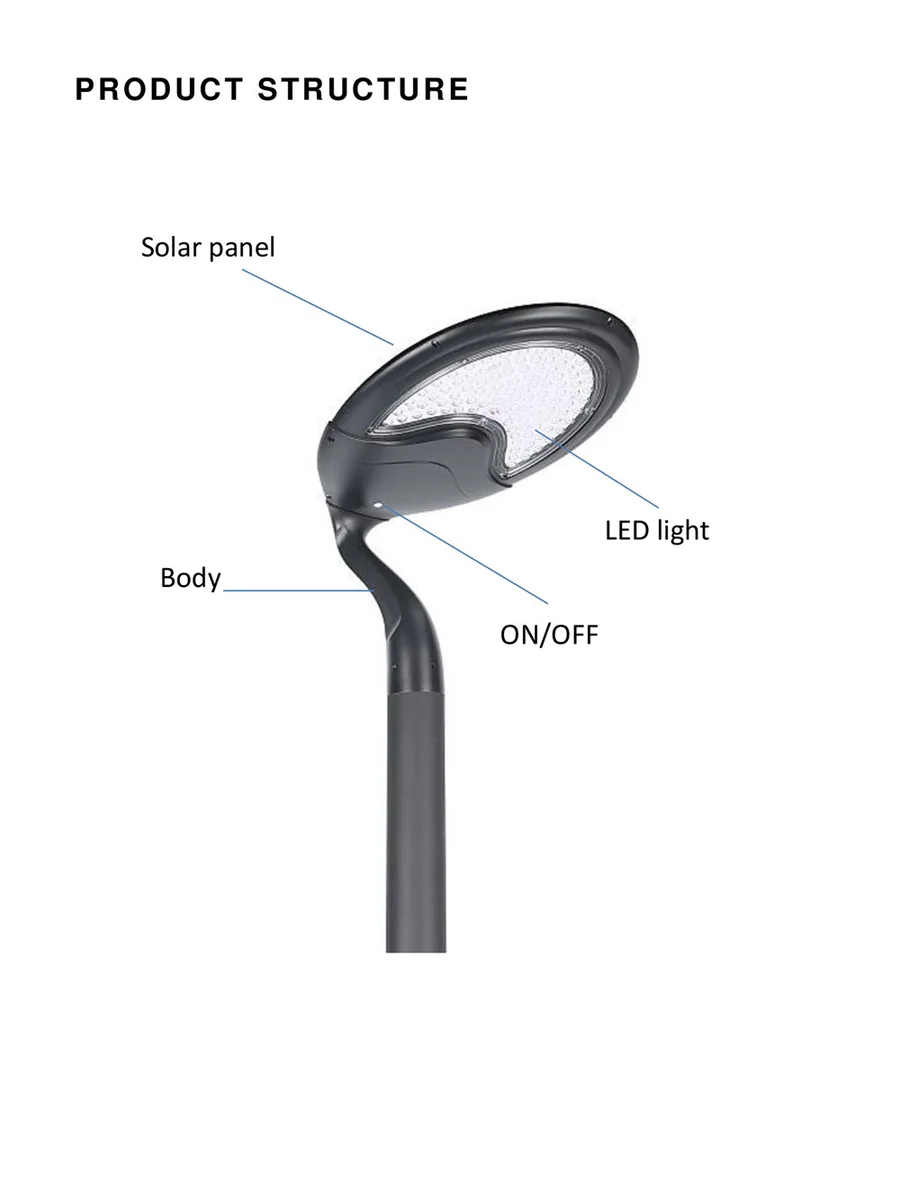
A fixture that can physically slide onto a pole has not automatically passed a structural assessment. Pole condition, wind exposure, loading, foundation and local requirements remain project responsibilities.
Build one interface record for an existing pole
A pole-mounted retrofit begins with a record that both the luminaire supplier and the site team can read. Give each pole a location ID, identify whether drawings exist, and distinguish dimensions taken from a drawing from dimensions measured on the actual pole. Include photographs showing the complete assembly, top connection and base. A close-up without a location or orientation is difficult to connect to the rest of the project.
Ask the fixture supplier to mark the mating surfaces on an assembly drawing. Ask the pole or structural specialist to review the proposed arrangement against the actual site. These are related but different decisions: the interface must connect as intended, and the supported assembly must be suitable for its loads and condition.
Separate measured facts from a proposed adapter
An adapter can be a useful proposed component, but “adapter available” is not a complete approval. Record which side connects to the luminaire, which side connects to the pole, what drawing defines each interface and who supplies the fasteners. Any departure from the reviewed assembly needs to return to the responsible reviewer.
If a group of old poles looks identical, do not assume every top has the same condition or geometry. Repairs, corrosion, previous fittings and undocumented changes can differ between locations. The project team should decide what survey coverage is appropriate. In the RFQ, describe the available survey rather than describing all existing poles as compatible.
| Record field | Useful entry | Incomplete entry |
|---|---|---|
| Pole identity | Location P-04, drawing reference, survey date | “The old pole” |
| Dimension | Named surface, measurement position, method | An isolated diameter |
| Interface proposal | Drawing revision and responsible parties | “Fits most poles” |
| Condition | Recorded findings and review status | “Looks fine” |
| Decision | Accepted arrangement or unresolved item | “Should work” |
Assign delivery, assembly and maintenance responsibilities
Confirm how the goods are packed, whether poles arrive in sections, who checks the delivery, who assembles each joint and who approves the installed work. If one party supplies the fixture and another supplies the pole, name who owns the interface drawing and resolves mismatches.
Maintenance planning also matters. Ask whether external switches or service points are safely accessible, which parts are replaceable under the manufacturer’s instructions, and what identification should remain on the installed product. Do not assume a few visible screws mean that untrained users can service internal batteries or controls.
The handover documents should match the delivered version. At minimum, retain the itemised packing list, interface drawing, assembly instructions, product identification and the party responsible for each unresolved site item. If a replacement luminaire may be needed later, record the interface and version now rather than relying on the appearance of the installed head.
Example: compare two offers for the same courtyard
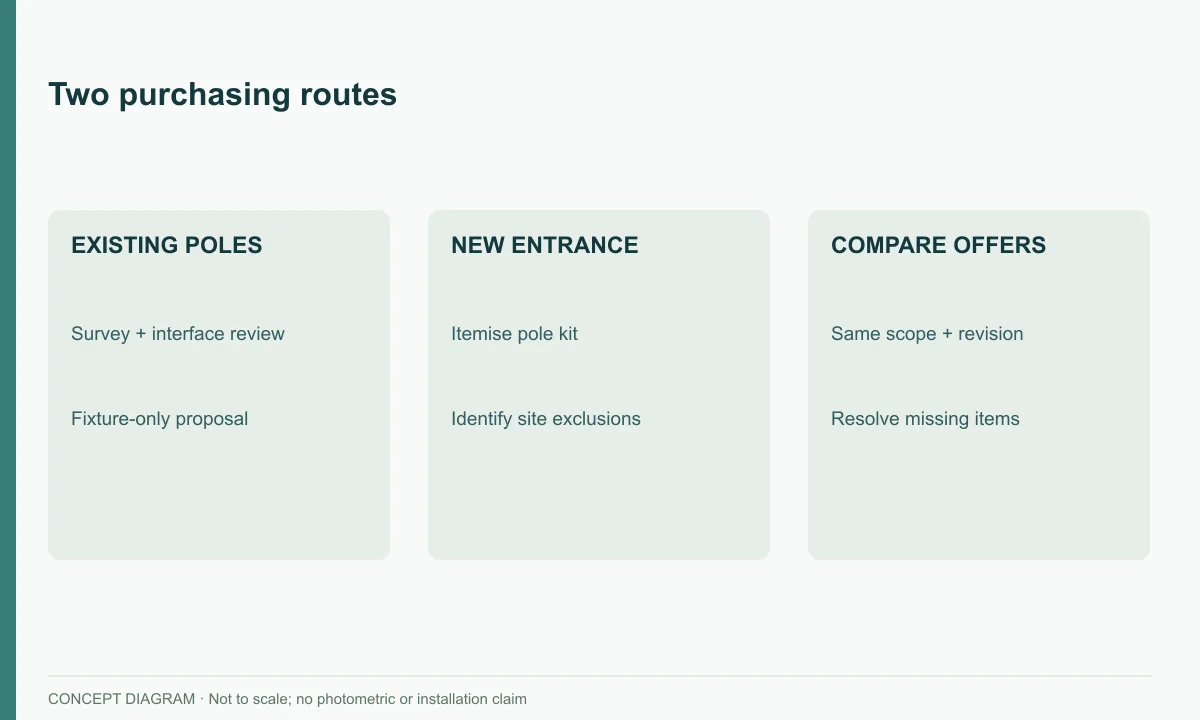
The following purchasing example is hypothetical. A site has a group of existing poles whose reuse has not yet been approved, plus a new entrance without poles. The buyer asks for two separate zones: fixture-only options for the existing area and an itemised pole kit for the new entrance. Quantities remain provisional until the layout and survey are reviewed.
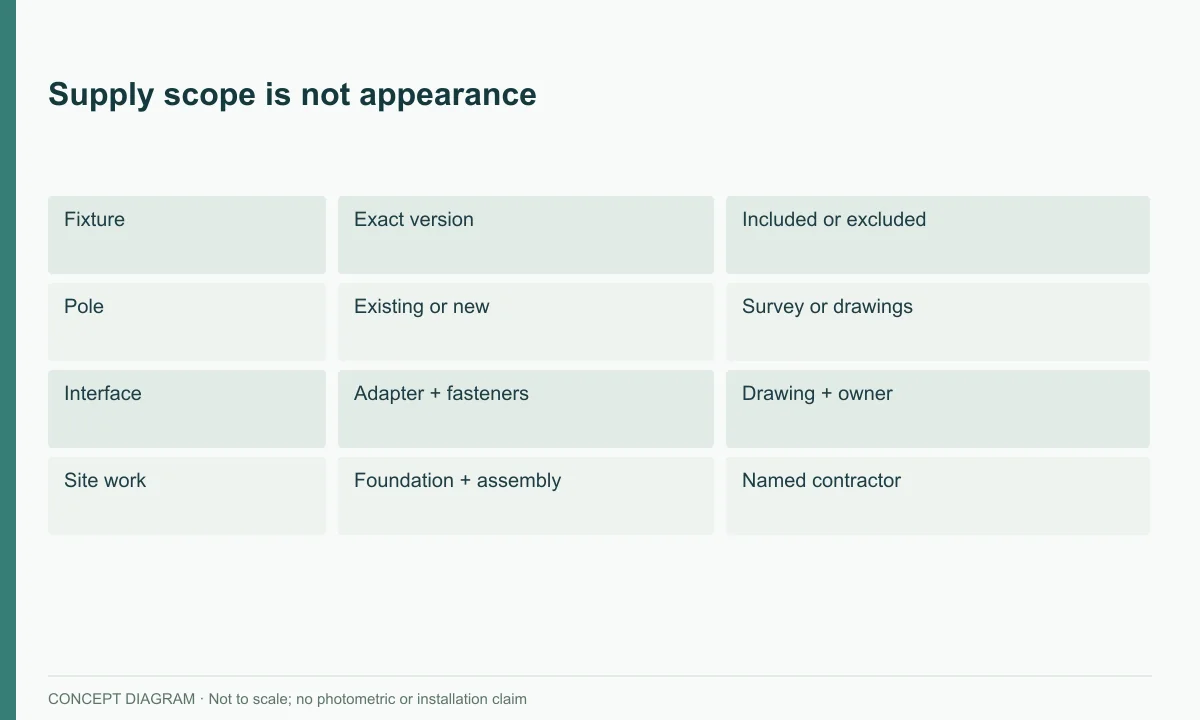
Supplier A sends a fixture-only offer for both zones. Supplier B includes poles for the new entrance but leaves adapters and site installation outside its price. Comparing the totals immediately would mix different supply boundaries. The buyer first prepares the table below.
| Item | Existing-pole zone | New-entrance zone | Owner of confirmation |
|---|---|---|---|
| Luminaire and program | Exact version required | Exact version required | Buyer and fixture supplier |
| Pole | Reuse subject to survey | New supply requested | Site team and pole supplier |
| Adapter | Subject to interface review | Include or mark excluded | Supplier coordinating the interface |
| Foundation and site work | Condition review required | Local design and installation required | Project team |
| Packing and assembly records | List supplied pieces | Identify sections and assembly documents | Supplier |
| Freight and installation | Quote or explicitly exclude | Quote or explicitly exclude | Buyer and contractor |
The table makes the next enquiry specific. Supplier A is asked to price or exclude the new poles. Supplier B is asked to clarify adapters and provide the relevant drawing. Both are asked to identify packaging, transport and site services on the same basis. The example does not establish which supplier is cheaper; it shows how to make the prices comparable.
The SCL-008 courtyard-light project story provides an existing application reference for a post-top product. It can help frame a discussion about the fixture form and project questions. Its photographs are not a packing list for your order or approval to reuse your poles.
Turn product examples into an RFQ checklist
The solar pole light range shows complete pole-form examples, while the solar courtyard light range includes post-top fixture forms. Use these pages to identify a route, then request the exact version and itemised scope rather than copying a category-page description into a purchase order.

For a useful quotation, send the site status, required components, photographs or drawings, delivery destination and the party responsible for installation. If an existing pole is involved, include its condition and measured interface information. The yard-light selection guide provides the wider product-type context.
Resolve differences before accepting delivery
A clear quotation is only the first checkpoint. When goods arrive, reconcile the model labels, quantities, included hardware and packing list with the accepted schedule. Record missing or substituted items before site assembly proceeds. A packing count confirms what arrived; it does not confirm interface suitability or completion of the installation.
For separate purchases, one named person should hold the latest interface drawing and distribute revisions to both suppliers and the installer. Otherwise, a luminaire revision can be accepted by one party while a pole is manufactured to an older drawing. Keep drawings attached to the order record rather than depending on screenshots in a message history.
Use the supplier’s quality-control overview to identify the documentation questions to ask, then request records applicable to the ordered version. A general description of factory checks does not establish that a particular batch, adapter or assembled pole was tested to your project requirements.
What a useful handover contains
Retain the approved supply schedule, delivered product identification, relevant assembly drawings, installation responsibility, control instructions and a list of spare or replaceable parts supported by the supplier. Record unresolved site issues with owners and dates. This allows the operator to distinguish a missing component, a configuration question and a service request later.
When sending the enquiry through the supplier contact page, attach the site status and interface record rather than only a picture of the desired style. Ask for separate replies to commercial scope and technical open items. The purchasing route is ready to proceed when those replies describe the same assembly and each remaining task has an owner.
Frequently asked questions
Does a solar pole light kit always include the pole?
No. “Kit” is not a reliable bill of materials. Confirm the exact included items in the supplier’s quotation and packing list.
Is a similar pole diameter enough to confirm fit?
No. The measurement object, mating dimensions, tolerances, connection details, pole condition and structural requirements must be checked.
Is buying the fixture and pole separately always cheaper?
Not necessarily. Compare the same scope, including adapters, packing, freight, assembly, installation, coordination and maintenance support.