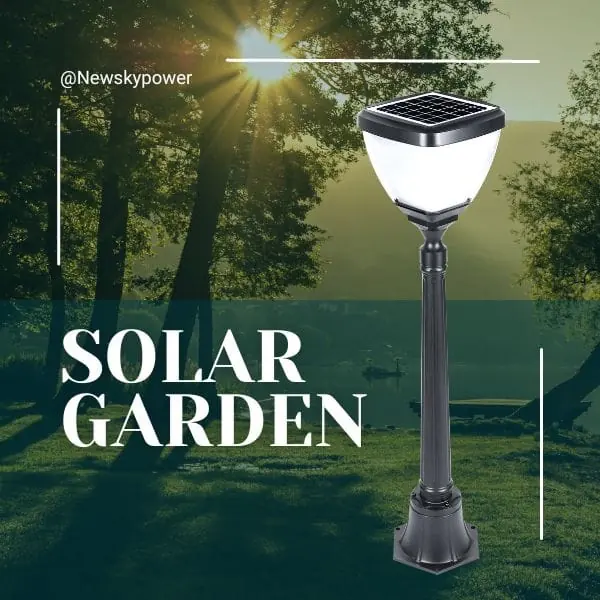


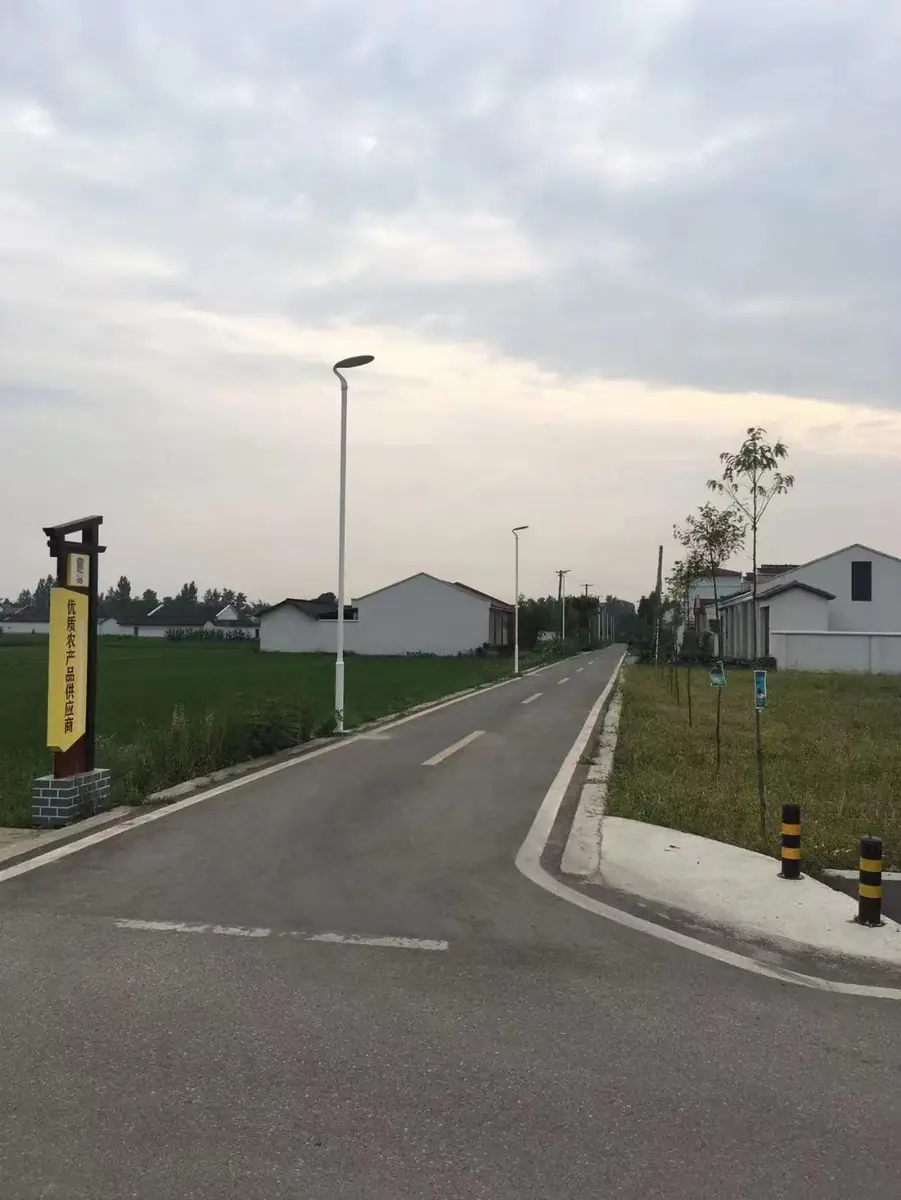
A model name and quantity are rarely enough for a commercial solar garden-light quotation. Provide location, use areas, dimensions, proposed positions, solar access, lighting tasks, operating schedule and supply boundaries. Mark facts, estimates and unknowns separately so the supplier can return a checkable configuration rather than fill gaps with assumptions.
Describe the project and lighting task
State country/city, site type and the zones involved: paths, entrances, seating areas or landscape edges. Identify any location expected to provide necessary pedestrian lighting. Vehicle roads and regulated areas require their own project criteria. If illuminance is unknown, describe the task and request professional evaluation instead of inventing a number.
Name the decision makers and responsibilities as well as the physical site. The buyer may control commercial terms, while a landscape designer defines appearance, a local engineer reviews foundations or poles, and the operator owns maintenance. A supplier cannot resolve conflicts between these roles if they are hidden. List the person responsible for approving the layout, optical performance, product finish, structural interface and final supply scope.
Describe success in observable terms. Examples include recognising a path edge from both directions, identifying an entrance during the required hours, or maintaining an agreed control program. Do not replace a regulated requirement with a visual preference; where codes or client standards apply, name the document and the party responsible for interpretation.
Provide plans, dimensions and photographs
Mark route width/length, entries, curves, level changes, planting and candidate light IDs. Label dimensions as measured, estimated or unknown. Photograph existing poles, bases and maintenance access with location references; ordinary photos do not replace a structural survey.
Provide three photo types for each relevant zone: a wide view showing context, a closer view showing the proposed mounting area, and a daytime view showing the panel’s surrounding sky and obstructions. Include a scale or referenced dimension where appropriate, but do not use perspective photographs as precision measurements. Keep filenames connected to plan IDs such as P-03 or C-07.
If no final layout exists, distinguish “customer candidate positions” from “supplier proposal.” Ask the supplier to return a marked plan and identify every assumption. This avoids a quotation that silently treats an illustrative product count as an approved design quantity.
Record solar access and environment
Provide site location, design season, tree/building shade, temperatures and special exposure such as corrosion or flooding risk. List weather-protection needs separately; IP65 alone does not define corrosion, immersion, low-temperature charging or service life.
Record environment inputs in separate fields:
| Input | Customer information | Evidence or status |
|---|---|---|
| Solar access | Time-based shade and relevant season | Photos, site plan, study or unknown |
| Temperature | Expected operating and charging conditions | Project data/source |
| Water exposure | Rain, irrigation, drainage and possible standing water | Site observation/design |
| Corrosive exposure | Coastal, industrial or chemical conditions if relevant | Project classification/source |
| Wind and structure | Location and mounting concept | To be reviewed by responsible professional |
| Maintenance access | Ground-level reach, equipment route and exclusions | Site plan/operations input |
Avoid converting these inputs into a product guarantee. They allow the supplier and project team to identify what must be checked and which evidence is still missing.
Define operating targets and supply scope
State required hours, whether dimming is acceptable and whether sensing is appropriate. Ask the supplier to return the proposed program and verification conditions.
Express operating needs by time block and lighting task rather than writing only “all night.” For example, the entrance may require one operating state during arrival hours and another later, while a decorative edge may be permitted to reduce output earlier. If sensing is considered, define the intended response and site context, then verify that the proposed model actually supports it. Do not add PIR or remote-control requirements by assumption.
| Field | Customer input | Supplier reply | Owner/open item |
|---|---|---|---|
| Site, zones and lighting tasks | ______ | Review/assumptions | ______ |
| Plan, dimensions and light IDs | ______ | Proposed layout/data needed | ______ |
| Solar access and design season | ______ | Energy-sizing basis | ______ |
| Hours and acceptable modes | ______ | Control program/test basis | ______ |
| Fixture, pole, adapter and base scope | Required/available/TBC | Itemised supply | ______ |
| Quantity and destination | ______ | Quote basis | ______ |
| Documents, sample and spares | ______ | Available/version | ______ |
Existing-pole dimensions must identify the measured object. Request a version-matched interface drawing before approving compatibility.
The supply-scope row should be expanded into a version-specific schedule before an order. Separate luminaires, poles, arms, adapters, fasteners, base-related items, controls, packaging, spares, drawings, testing documents, freight, site assembly and installation. Mark each as included, excluded, customer-supplied or unresolved. Product photography and the word “kit” are not substitutes for this schedule.
Complete procurement and service inputs
Record estimated quantity, destination, requested delivery date, sample need, applicable requirements, labels/language and spares. These are customer requests, not supplier promises. Ask for exact model/version, component specifications, bill of materials and applicable supporting documents. Do not assume price, MOQ, lead time, warranty, customisation or certification.
A filled project brief for a residential community
A commercial solar garden lighting specification is the project’s organised set of inputs and requirements. The word “commercial” does not establish a certification, guaranteed output or universal product grade. A useful project-based brief describes what the installation must do, what the customer knows and what the supplier must propose.
The following residential-community example is hypothetical. It illustrates the format and does not describe a Newskypower customer or completed installation.
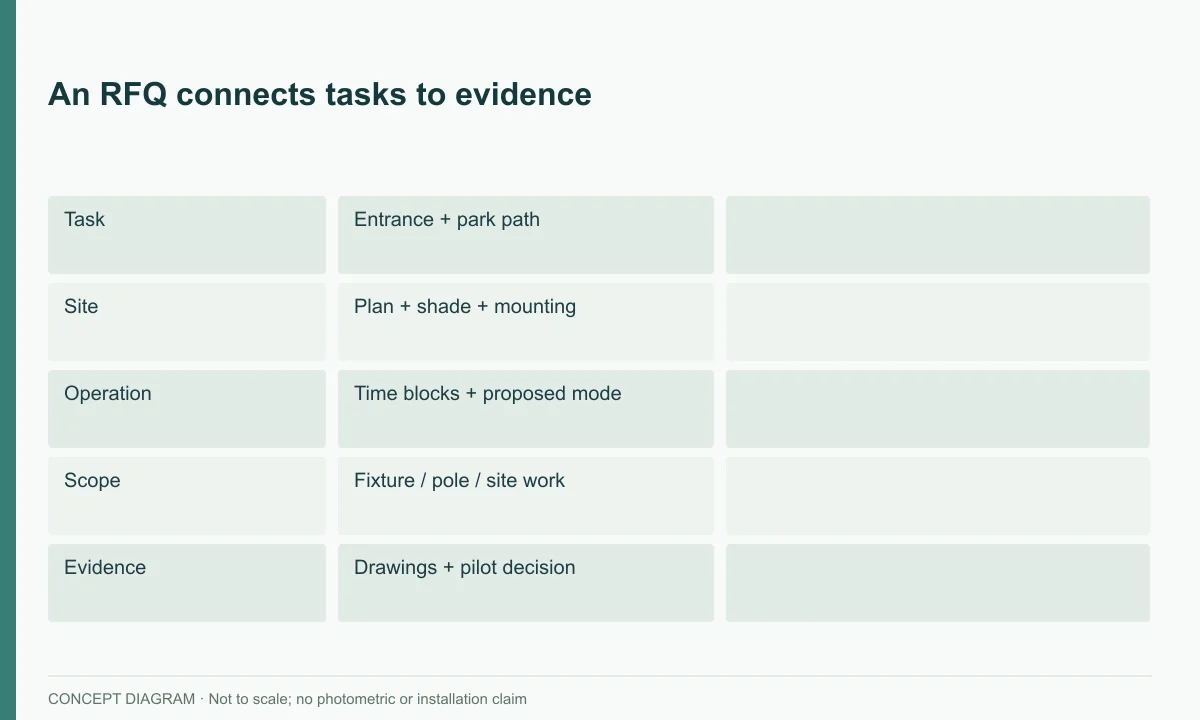
| Brief field | Example customer entry | Required supplier or project response |
|---|---|---|
| Application | Community entrance and adjoining park pathway | Treat entrance and path as separate task zones |
| Location | Actual city and site coordinates to be supplied | Identify location-dependent information still needed |
| Use | Recognise entrance and follow the pedestrian route | Propose how each task will be evaluated |
| Existing assets | Some poles present; condition unverified | Define survey and interface information required |
| New zone | No poles at the entrance | Itemise a pole kit and list site-work exclusions |
| Operating hours | Entrance required throughout the agreed period; path schedule to be confirmed | Return a proposed time-block program for review |
| Shade | Trees beside the path; observation incomplete | Request time-based photographs and seasonal evidence |
| Quantity | Provisional until plan review | Separate budget quantity from accepted layout quantity |
| Documents | Drawings, instructions, labels and applicable evidence required | Identify available versions and open items |
| Acceptance | Sample and site review to be agreed | Propose records, responsibilities and decision criteria |
This brief is useful even though some fields remain open. It prevents a supplier from treating an unknown pole as approved, a provisional quantity as final or an unspecified schedule as permission to select any program. The response should retain those distinctions.
Compare quotations on the same basis
Create a compliance table rather than selecting the lowest total first. For each supplier, record the offered model/version, deviations from the brief, assumed quantities, supply exclusions, document status and open technical questions. Separate base offer, optional items and site work. A lower price may simply contain a narrower scope; a higher price may still include unneeded items. Normalising the boundary makes the commercial comparison intelligible.
Ask suppliers to identify substitutions explicitly. A different battery, panel, optical distribution, pole material, control program or finish can change performance, interface and maintenance. “Equivalent” should be supported against the project’s relevant fields, not accepted as a standalone description.
Send a document set that can be reconciled
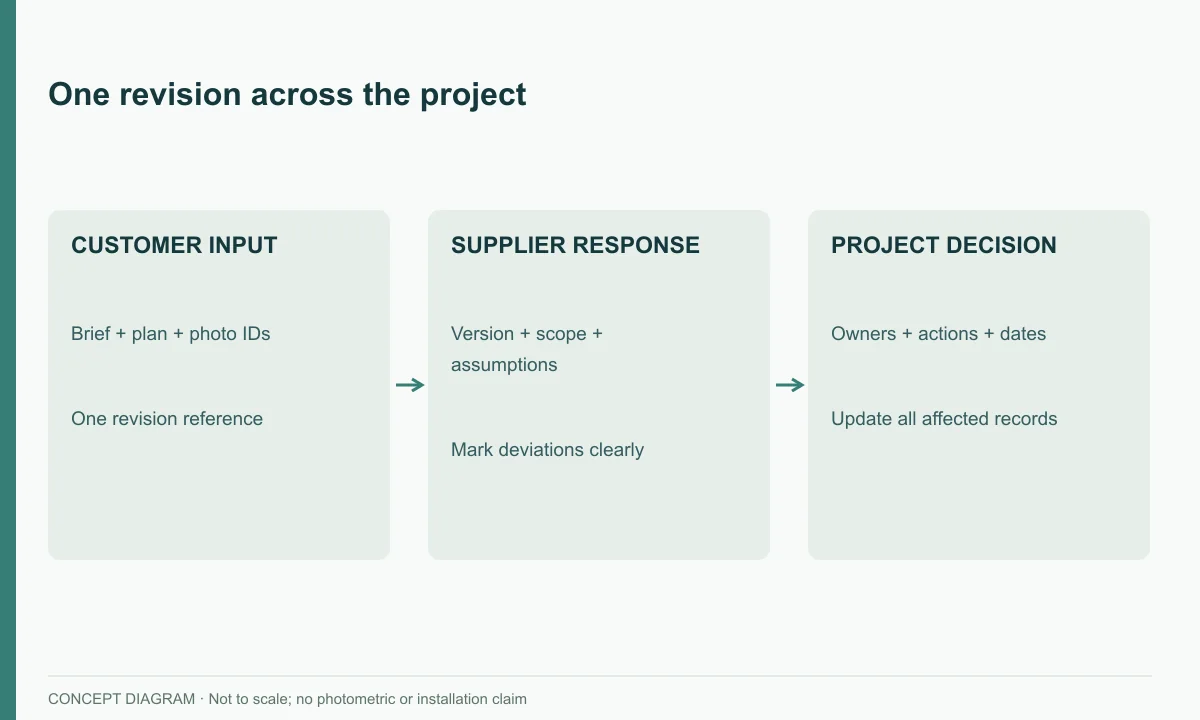
Use one revision reference for the brief, marked plan, photo list and component schedule. If the plan changes, identify which light IDs, quantities and interfaces change with it. The supplier should return a reply against that same revision so comments do not become detached from the current layout.
Keep fixture-only and pole-kit requirements on separate lines where they serve different zones. The former can omit a new pole but still require an approved interface; the latter can include a pole while excluding foundations or installation. Neither label settles the full supply scope. Ask the supplier to state exclusions in the quotation rather than leaving them in informal correspondence.
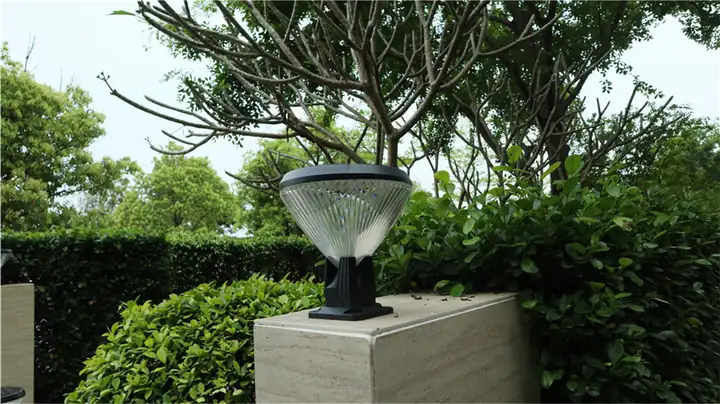
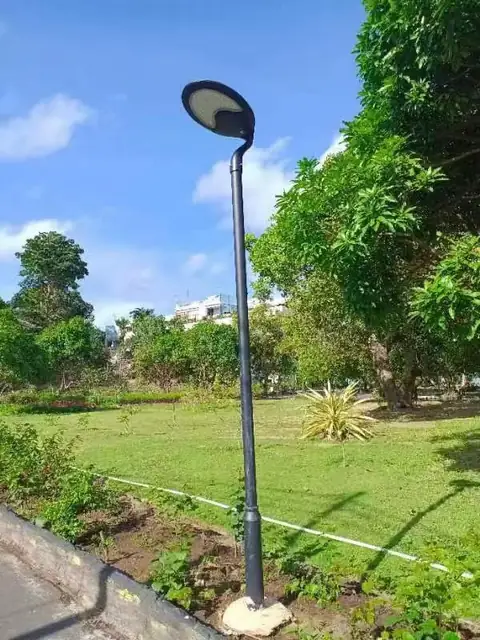
The SCL-008 courtyard project story is an application reference that can help explain the intended fixture form. Attach the project’s own plan and requirements alongside any reference image so the supplier does not mistake visual inspiration for a technical specification.
Plan a sample or pilot when the risk justifies it
A sample review can check appearance, version identification, assembly information, control behaviour and document quality. A site pilot can add checks for solar access, light distribution, operating schedule and maintenance access under recorded conditions. Define acceptance items before the sample arrives; otherwise the review may become an informal photograph session with no decision rule.
| Pilot record | What to capture |
|---|---|
| Product identity | Exact model, version, labels and supplied components |
| Installation context | Position, height, orientation and responsible installer |
| Daytime input | Dates, shade, weather and charging conditions |
| Night operation | Mode, time blocks, visible changes and observations |
| Optical verification | Task points and measurement method if required |
| Decision | Accepted, revise and retest, or reject—with reasons |
Do not present one pilot as proof for a different location, season, configuration or quantity. State what the pilot did and did not validate.
Define documents, handover and service
Before order placement, list the required drawings, instructions, product identification, bill of materials, applicable declarations or reports, packing information and spare-parts response. At handover, link the delivered version and light IDs to those records. Assign who keeps the documents, who performs routine external inspection and who contacts the supplier when diagnosis or replacement is needed.
Warranty, certifications, lead time and customisation are not generic attributes. Request the exact scope, issuing party, applicable model/version, exclusions and supporting document, then review them against the project requirement. Keep any unresolved item visible in the commercial and technical record.
Review the solar pole and courtyard light ranges, then submit the completed brief with drawings. Existing examples may help with context, but they do not prove another project’s quantity, height, lux or supply scope.
Close the RFQ with an action list
At the end of the review, list the unresolved decisions rather than simply asking for a revised total. Typical items include confirming the existing-pole survey, approving the operating program, reviewing optical data, agreeing a sample test and identifying who supplies site works. Give each item an owner and a required response, with dates set by the actual project team.
For evidence planning, review the supplier’s quality-control overview and request documents applicable to the quoted model and scope. For a broader comparison of visible settings, use the garden-light application gallery. Both are discussion resources; project acceptance still depends on the agreed requirements and relevant records.
Submit the brief and revision-controlled attachments through the project enquiry contact. A useful supplier reply should let you identify the proposed assembly, its operating basis, its supply exclusions and the next unresolved decisions without reconstructing them from several messages.
FAQ
Is quantity alone enough? It may support a rough conversation, not a verified configuration.
What if required lumens are unknown? Describe the task and site; request optical evaluation.
Must every field be complete? No—mark unknowns and assign who will resolve them.
For an overview of fixture types, site conditions and selection priorities, see our garden and courtyard lighting guide.