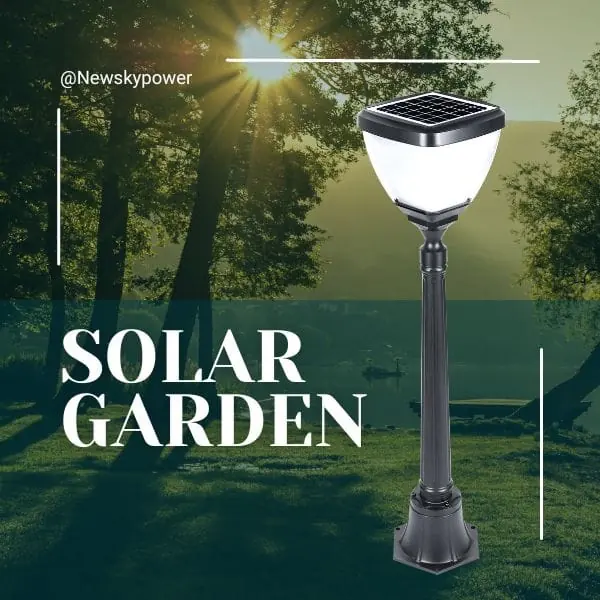


Solar landscape light specifications become useful only when the model, configuration, units and operating conditions are clear. A large wattage in a product title does not tell you how brightly a path will be lit, and a large battery capacity does not by itself promise a long night of lighting. Start with a dated specification sheet, separate the components, and compare like-for-like information.
This guide explains how to read those fields and build a practical comparison worksheet. It is particularly useful when several quotations describe apparently similar solar bollard lights or solar pathway lights in different ways.
Identify the Model and Configuration
Define the item before comparing the numbers
Record the full model code, specification revision and quotation date. Add the number of heads, mounting form, battery option, panel arrangement and controller option. If two quotations share a series name but use different batteries, they are two configurations, not one interchangeable item.
For commercial comparisons, attach the supplier’s confirmed configuration to the quotation. “Confirmed” should mean a particular document and date, not merely that somebody recognised the model name. Keep the sample label or reference number with that record, so the sample can be compared with the item eventually supplied.
A useful first question is: does every field describe the same complete fixture? One sheet may show a head without its pole; another may include the pole and fixing kit. Neither presentation is inherently wrong, but mixing them changes the purchase comparison.
Put each quantity in its own column
Create separate columns for LED power in W, solar panel wattage in W, voltage in V, capacity in Ah, nominal battery energy in Wh and luminous flux in lm. Preserve the supplier’s original wording alongside the normalised value. A blank field should remain a question, not become an estimated specification.
Use the SLL-002 product page as a route to the relevant product family, then request the dated configuration you intend to buy. A live marketing page helps identify a product; it does not replace an agreed supply document.
LED Power vs Solar Panel Power
Two wattages, two different jobs
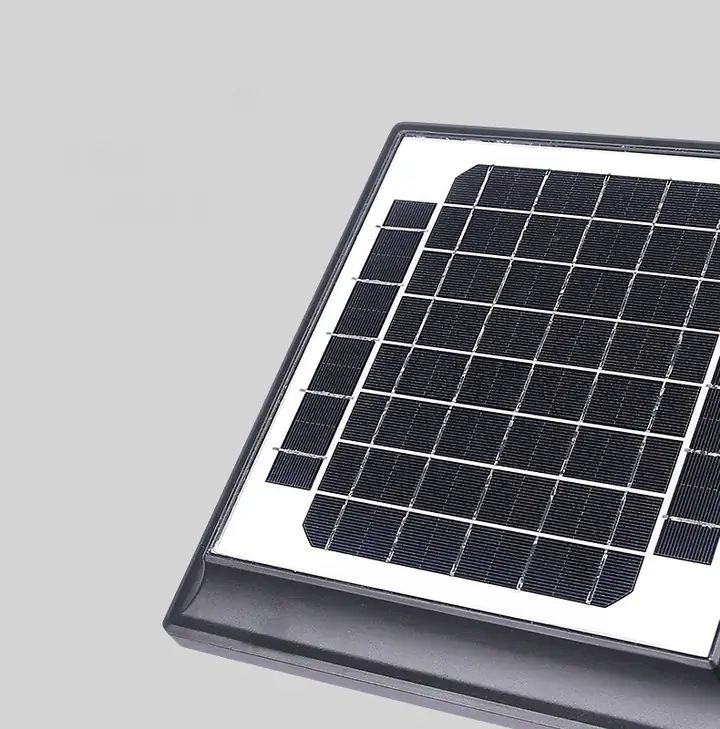
Rated LED power describes a lighting-side electrical rating whose exact boundary must be stated. It might refer to an LED assembly, a driver’s output or another declared condition. Solar panel wattage describes a generating component under its stated rating conditions. It is not the amount of power the light continuously receives throughout the day.
Actual LED operation may change with a selected mode or control schedule. Likewise, the energy collected over a day depends on exposure and operating conditions. You cannot substitute a panel’s rated W for a fixture’s electrical demand, or treat a headline LED wattage as a measurement of delivered light.
Ask the supplier to define each power field. Is it rated or measured? At which operating state? Does it include controller losses? Is it per-head or total system? If the answer is not stated, put “definition required” in the comparison column.
Read an ambiguous quotation constructively
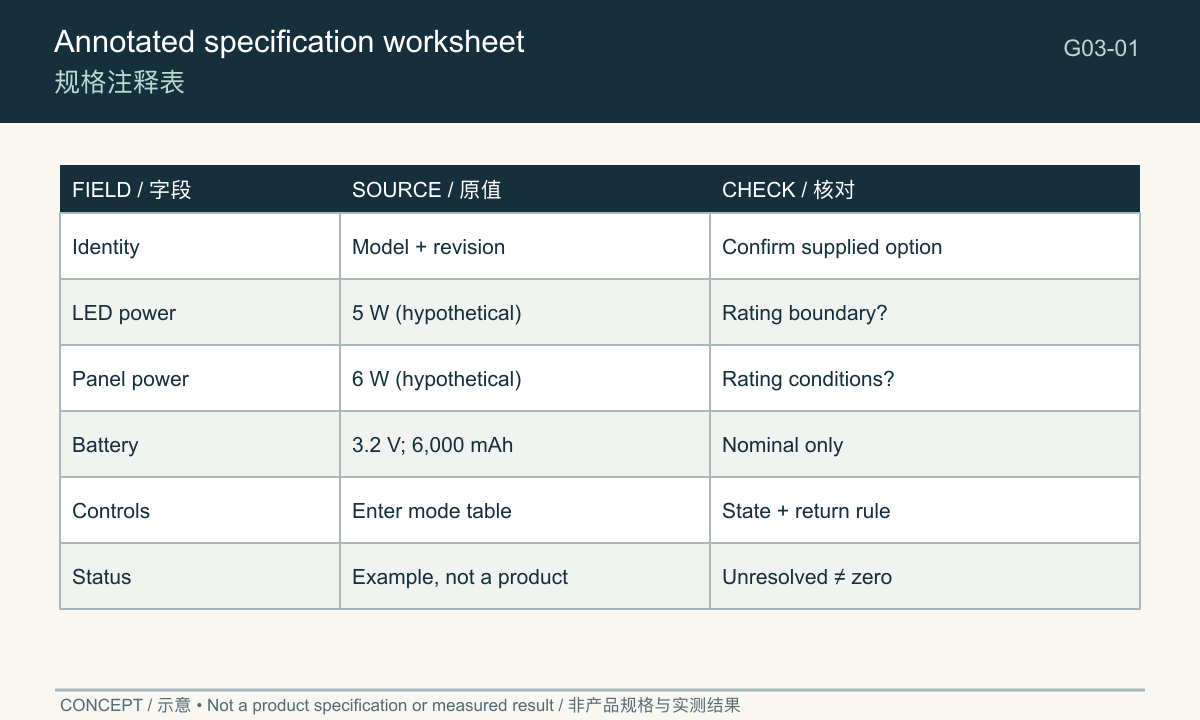
Suppose a hypothetical quotation lists “LED: 5 W” and “panel: 6 W”. These numbers describe different parts; they do not establish a spare 1 W available all night. They also do not establish a charging time, because hours of effective collection and the charging process are missing.
Instead of rejecting the quotation, ask for the panel rating conditions and the fixture’s input power in each mode. Request a clear distinction between maximum capability and the normal operating setting. Those answers help compare systems without pretending that two isolated wattages describe a complete energy balance.
When reviewing solar bollard light options, keep the physical form in view too. Panel placement and mounting surroundings can differ even where headline power figures match.
What Lumens Do and Do Not Tell You
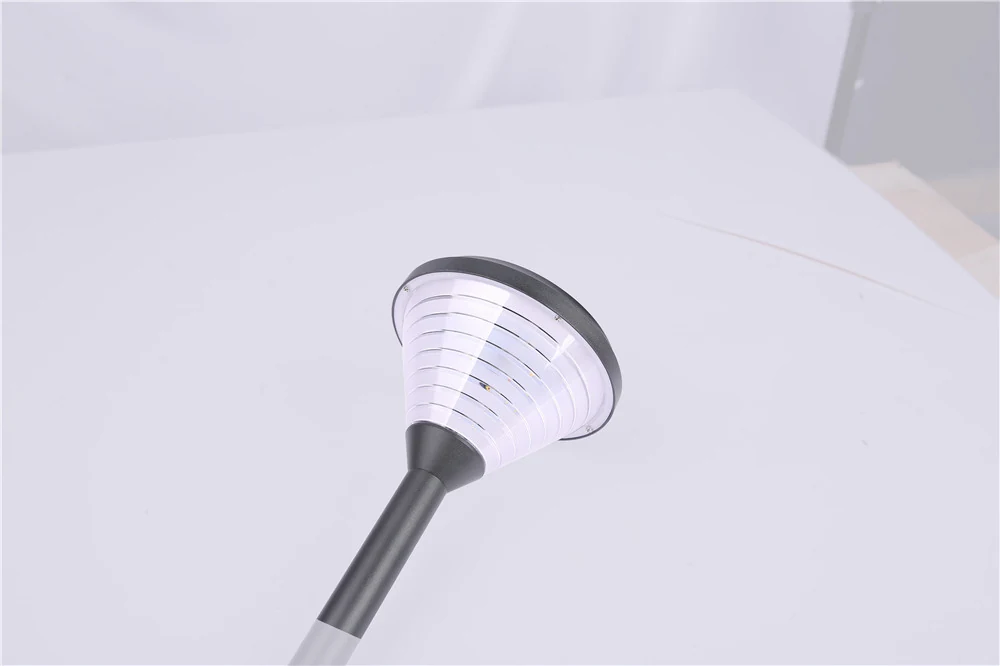
Lumens describe luminous flux: the quantity of visible light emitted, not the illumination at a particular paving stone. Two fixtures with the same declared lumens can distribute light differently. Mounting position, optics, shielding and the surrounding surfaces influence what a person actually sees.
Before comparing values, ask whether the figure is for an LED component or the complete luminaire. Then check whether it is per head, the sum for a multihead configuration, or output in a particular mode. Do not compare one fixture’s initial high state with another fixture’s lower overnight state as though they were equivalent.
More lumens do not mean longer runtime
A larger lumen number is not a battery endurance rating. It does not identify battery energy, the electrical power required at that output or the controller’s schedule. A fixture may offer a brighter short-duration state and a lower background state. The two outputs need to be connected to their operating conditions.
Similarly, lumens alone cannot establish coverage, uniformity or visual comfort. A bright visible diffuser can attract attention while leaving a nearby step poorly revealed. For a purchasing decision, use declared output to understand the product, then use an appropriate layout assessment or sample to answer the site question.
Make the comparison question precise: “What is the complete luminaire output in the operating mode we will use?” This is more useful than asking which light has the largest lumen number. Keep the broader location and fixture decision within your yard lighting selection process.
Reading Battery Capacity in Wh
Convert the units before comparing capacity
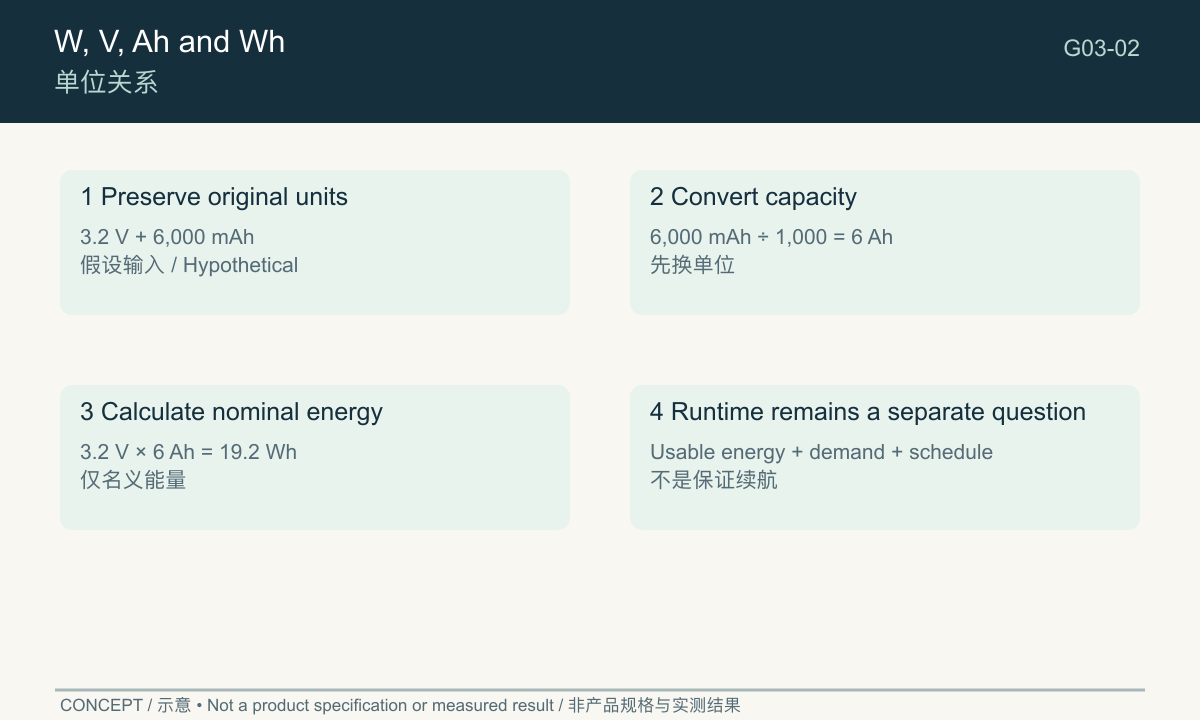
The nominal energy calculation is:
Wh = nominal voltage in V × capacity in Ah
Convert mAh to Ah first by dividing by 1,000. In a hypothetical example, a 3.2 V, 6,000 mAh pack has 6 Ah of capacity and 19.2 Wh of nominal energy. Another hypothetical pack rated 3.7 V and 5,000 mAh has 5 Ah and 18.5 Wh.
These examples explain the calculation only; they are not specifications for a named product. Comparing 6,000 with 5,000 mAh without considering voltage hides part of the information. Keep both original fields in your record so that the conversion remains auditable.
Nominal energy is not usable runtime
The multiplication does not account for discharge limits, conversion losses, temperature effects, battery condition or the controller’s decisions. Nor does it tell you whether the battery begins a particular evening fully charged. These are separate questions.
Avoid dividing nominal Wh by a headline LED wattage and presenting the result as promised hours. Even a simple energy estimate needs the relevant electrical demand, usable energy assumptions and operating schedule. A dim-to-bright mode requires information about time in each state, not just its brightest output.
Battery chemistry is another field to record, but it is not a substitute for matching an approved pack. The battery chemistry comparison can provide background for that discussion; replacement compatibility still requires model-specific confirmation.
Why Operating Modes Matter
A mode description connects output with time and control behaviour. “Constant”, “scheduled dimming” and “motion sensor” are useful starting categories, but they are not complete test conditions. Two lights described as motion-sensor products may have different background states and different ways of returning to them.
For each offered mode, request the following information:
| Field | What to record | Why it matters |
|---|---|---|
| Activation | Darkness condition, manual selection or another stated trigger | Defines when the schedule begins |
| Background state | Off, dim or another declared level | Describes operation without an event |
| Event state | Trigger and higher output, if supported | Separates normal and triggered operation |
| Return behaviour | Timer or other model-specific rule | Defines how the event ends |
| Overnight changes | Scheduled reductions or other controls | Prevents a single output value being applied to every hour |
| Test setting | Selected mode and stated preparation | Makes a result interpretable |
Compare the same state, not just the same label
For a hypothetical sample comparison, place the two units in the intended modes and record what happens before, during and after an approach. Note surrounding light and the initial charging preparation. This establishes what was observed under that trial; it does not become a universal runtime claim.
If a supplier reports “up to” a duration, ask which mode and test conditions produced it. A long duration with occasional bright events is not directly comparable with continuous operation at a stated output. Preserve both claims with their conditions rather than averaging them into a misleading headline.
Control details can be as important as a larger component. A specification comparison should therefore include the usable modes, not treat the controller as an unnamed accessory.
Compare Specifications with a Checklist
The worksheet below deliberately separates known values from unanswered questions. Copy it for each candidate and identify the source revision above the table. The illustrative numbers remain hypothetical, while the empty rows are intended for your own confirmed configuration.
| Field | Original value | Normalised value | Definition or condition | Comparable now? | Clarify | Cannot infer |
|---|---|---|---|---|---|---|
| Battery example | 3.2 V; 6,000 mAh | 6 Ah; 19.2 Wh nominal | Hypothetical rated pack | Arithmetic only | Usable energy and pack identity | Guaranteed runtime |
| LED power | Enter source wording | W | Component or fixture; operating state | Only after definition | Measurement boundary | Delivered light |
| Panel power | Enter source wording | W | Panel rating conditions | Conditional | Panel configuration | Daily collected energy |
| Light output | Enter source wording | lm | Complete fixture or per-head; mode | Conditional | Report and state | Coverage or comfort |
| Controls | Enter mode names | State sequence | Activation, event and return | Compare behaviour | Exact version | Identical overnight output |
| Supplied assembly | Enter included parts | One complete configuration | Heads, pole/base, accessories | After scope agrees | Excluded items | Installation suitability |
Turn the worksheet into three decisions
First, identify information that can be compared directly after normalising units. Second, separate fields needing a supplier definition. Third, list questions that require a sample, drawing or test report rather than another sales description.
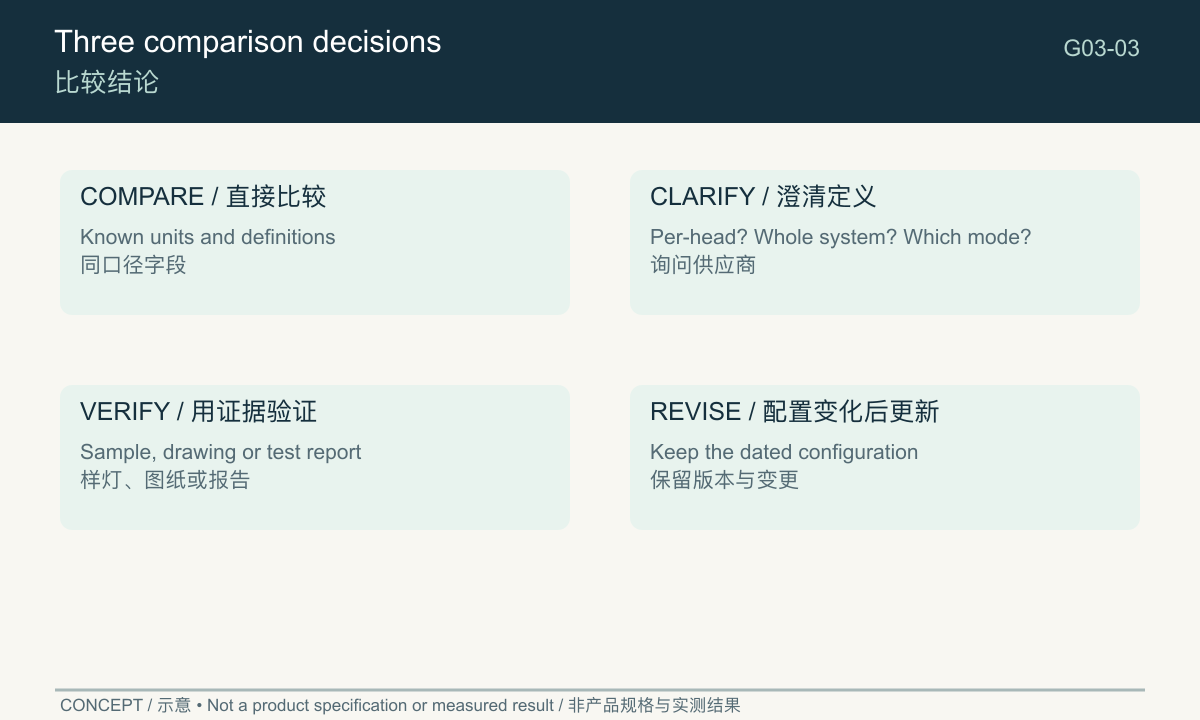
This approach also makes revisions easier to control. If the supplier changes the battery or controller, update those rows and reconsider the affected conclusions. Do not keep an old runtime statement beside a new component list without checking whether the evidence still applies.
For your next enquiry, send the full model references, dated sheets and completed comparison questions. Request answers against the same configuration. A smaller, well-defined set of solar landscape light specifications is more useful than a long list of numbers whose meanings change from one quotation to the next.
Frequently asked questions
Is higher solar panel wattage always better?
Not as a stand-alone purchasing rule. Compare the generating component with the whole system, its mounting exposure and the intended demand. A larger label does not resolve a shaded location.
Can two batteries with equal Wh be treated as interchangeable?
No. Equal nominal energy does not establish compatible voltage, chemistry, protection, connectors, dimensions or charging controls. Energy comparison and replacement approval are different tasks.
What should I do when a supplier leaves a field blank?
Record the gap and ask a targeted question. Continue comparing the supported fields, but do not convert the missing information into an assumed advantage or disadvantage.
For an overview of fixture types, site conditions and selection priorities, see our garden and courtyard lighting guide.