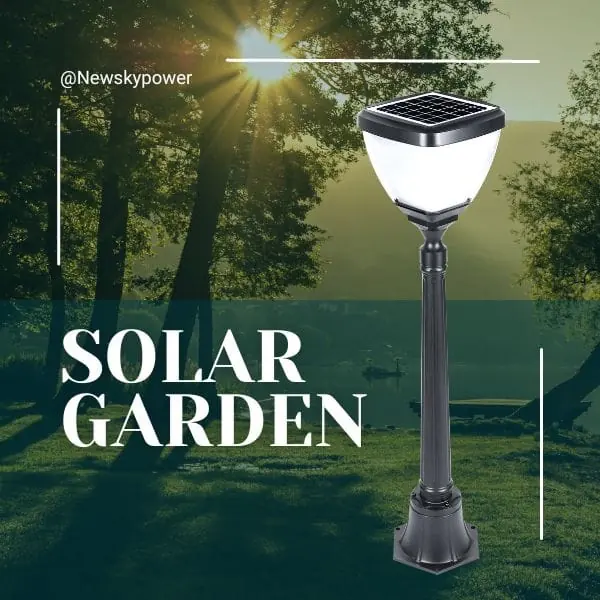


Solar lighting for park pathways should be planned around walking, stopping and maintenance—not simply a line of equally spaced fixtures. Map the routes and seating first, then check tree cover, opening periods, seated sightlines and access for landscaping work. Each proposed position needs both a lighting purpose and a workable solar location.
A park can contain sunny open ground beside a deeply shaded path. A fixture that looks unobtrusive while walking may sit directly in a seated visitor’s view. The most useful planning document therefore combines a layout with reasons for selecting, moving or rejecting candidates.
This guide uses a hypothetical pedestrian-only park area to demonstrate that process. Vehicle interfaces, emergency functions and other specialised requirements remain separate project questions. The example does not establish public-project approval for a product or claim measured performance at a real park.
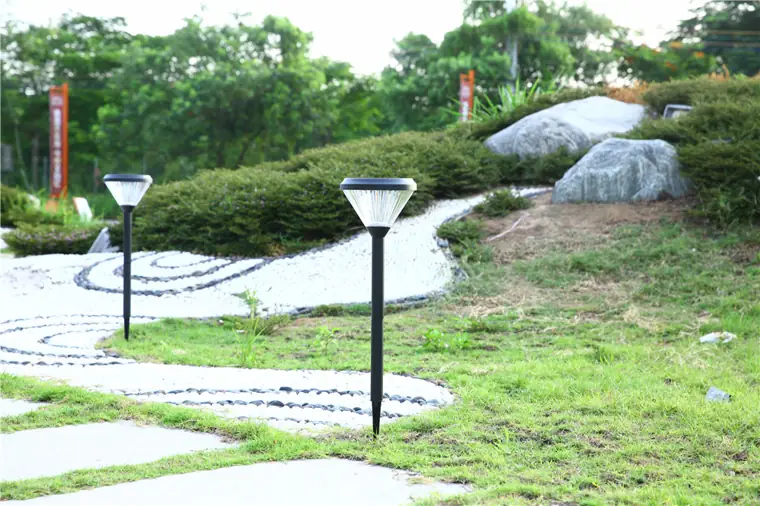
Separate Paths, Seating and Landscape Nodes
Give each activity its own description
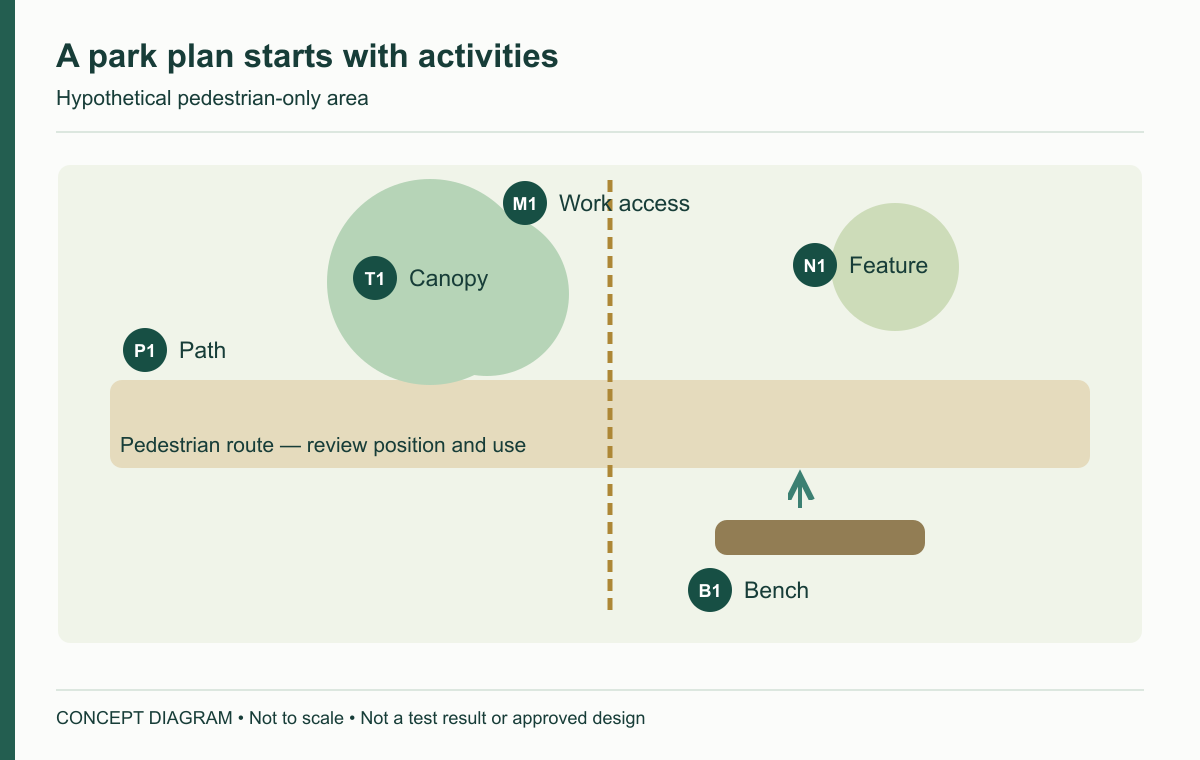
Trace the main walking line and mark junctions, surface changes and places where visitors pause. A continuous path P1 may connect a seating area B1 and a landscape node N1, but those spaces do not require the same visual emphasis. Decorative illumination of planting should not be counted automatically as functional path lighting.
Record whether a route is part of an essential connection, a discretionary loop or access to a facility. That distinction helps the operator describe when it is actually needed. It also prevents a proposed decorative scheme from quietly taking responsibility for a route it has not been designed to serve.
Define the example before drawing fixtures
Assume P1 passes a mature canopy T1, B1 faces towards a planted edge, and a maintenance route M1 crosses near the seating area. N1 is a small landscape feature rather than a circulation route. The positions are hypothetical and carry no dimensions, fixture quantities or illumination results.
Place activities and constraints on the first drawing, then add candidate locations. Starting with product icons can make an arbitrary arrangement appear settled too early. The purpose of this drawing is to help the team ask what must be observed, not to resemble a completed lighting design.
Record Opening Hours and Walking Needs
Separate public, event and maintenance use
Ask the operator which paths remain in use during public opening, after events and during maintenance. Record variations rather than assuming one closing time describes every night. Staff access, through-routes and temporary activities may continue when a visitor facility has closed.
Do not infer that every light can switch off as soon as the park closes. Confirm the remaining tasks and applicable project requirements. Conversely, do not assume a decorative node needs the same operating period as a required connection. The schedule should state a need that can be reviewed, not invent a control programme for an unselected fixture.
Convert time requirements into questions for suppliers
List the required periods, whether dimming is acceptable and what must remain visible during transitions. Then ask which documented configurations can address those needs under the site’s relevant solar conditions. The label dusk-to-dawn does not establish full-output operation throughout the night.
For a park in Southeast Asia with changing weather and vegetation, identify the conditions under which the required schedule will be assessed. For seasonal operation in parts of Europe or North America, record the actual operating season and whether winter access remains necessary. Australian and island locations also need their own schedule and solar-resource assessment rather than a regional shortcut.
Check Tree Cover, Growth and Solar Access
Observe the panel position through relevant conditions
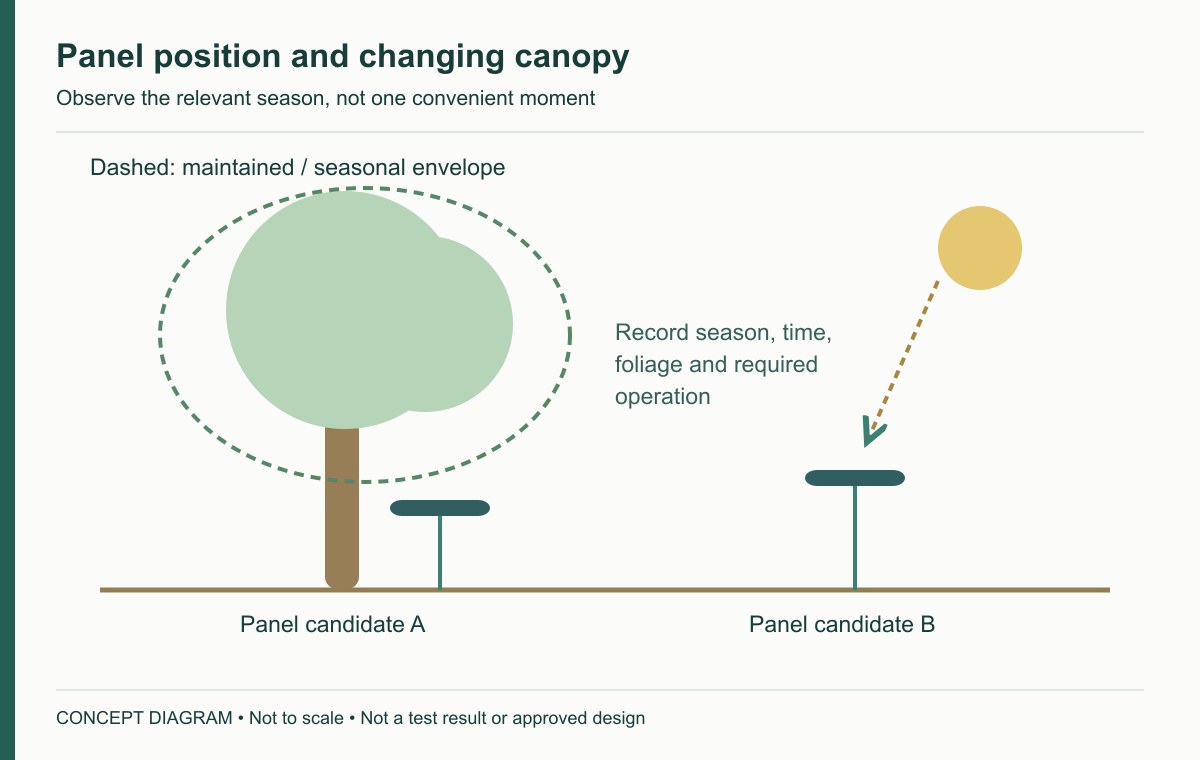
Mark existing trees, the maintained mature canopy and proposed panel positions. Record the dates and times of observations. A single midday photograph can reveal an obstruction at that moment, but it cannot describe the entire charging opportunity across seasons.
Compare current foliage with the condition expected after growth or seasonal change. Ask the landscaping team which canopy assumptions are realistic. If trees are protected or managed under a separate plan, do not assume pruning is available merely because it would simplify the lighting proposal.
Compare alternatives without promising a solution
At the hypothetical T1/P1 interface, moving a candidate towards a more open area may improve panel exposure but change its relationship with the walking task. Retaining the original location may simplify visual alignment while leaving the solar question unresolved. Record both sides of this first trade-off.
A remote panel is another possible enquiry only when the selected system supports that configuration. It introduces its own mounting, routing and maintenance questions; it is not a universal remedy for a shaded integrated light. If no candidate can meet the verified site requirement, retain an alternative lighting approach for evaluation.
The solar radiation basics overview provides background on the changing solar resource. For practical selection, combine that principle with the actual panel position, operating demand and model information. Do not infer year-round charging from the fact that the park is in a generally sunny country.
Review Light Positions from Seated Eye Level
Walk towards the bench, then sit down
Mark the direction visitors face at B1 and the approach from P1. During a permitted sample review, observe from both positions. A source concealed from a standing approach may become directly visible once someone sits. Changes in path level and the bench’s orientation should remain part of the same record.
Describe what is visible rather than assigning a glare rating from a photo. Record the source, the surface of interest and any unwanted view beyond the intended area. The team can then investigate a changed position, documented optical option or supported shielding arrangement.
Preserve the reason behind a proposed move
The second trade-off is between a visually comfortable candidate position and practical access. Moving a low-level fixture behind planting might change a seated view, but foliage could obstruct it or make cleaning harder. Moving it towards the path might simplify access while creating another obstruction or sightline issue.
Do not solve this with a universal bollard height. Compare the actual geometry and distribution with the seating and route tasks. Review solar bollard light forms as candidates, then request the relevant model information. The category alone does not establish suitability beside every bench.
The DarkSky and IES principles encourage purpose-led, targeted outdoor lighting. Apply that general approach while separately checking the park’s requirements; neither a concept section nor a warm-coloured source proves an ecological outcome or the absence of disturbance.
Allow for Maintenance and Landscaping
Draw the work routes as well as visitor routes
Ask how mowing, irrigation, plant replacement and routine observations are carried out. Mark M1 where personnel and permitted equipment need access. Check whether a candidate obstructs those activities, is hidden by planting or requires a service method the operator cannot provide.
Keep ordinary external checks distinct from work on elevated fixtures, structures, electrical equipment or batteries. The maintenance plan should identify who can observe an issue and who can carry out the subsequent work. It should not quietly assign all tasks to the person who empties bins or trims planting.
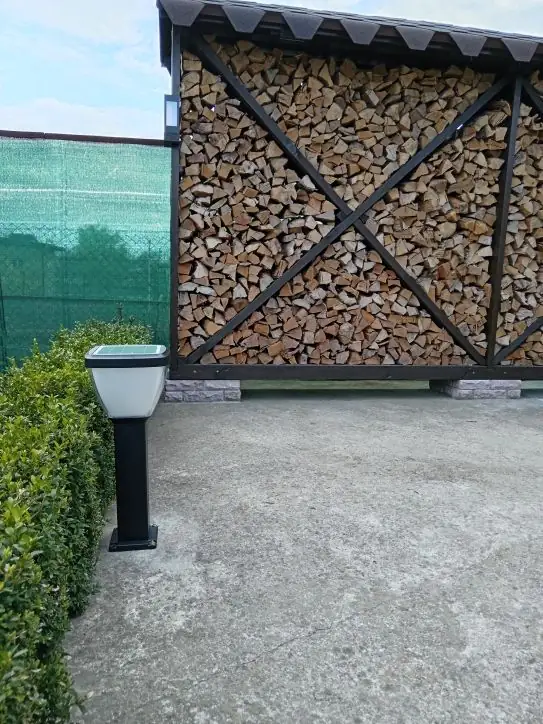
Consider supply access without prescribing stock levels
An island park or remote site may need particular attention to identifying parts and arranging service visits. Record the available service route, confirmed part versions and who initiates a request. Do not fill the plan with an invented spare percentage or a guaranteed delivery interval.
Where a site has coastal exposure, ask for evidence addressing the actual product and conditions. Where seasonal cold is relevant, confirm the appropriate operating and charging information. Rain, temperature, corrosion and structural exposure are different questions; no single material description answers all of them.
Avoid treating stake lights as automatic public-path products
The solar pathway light range includes forms worth distinguishing during early research. A stake-mounted option still needs assessment of stability, ground conditions, visitor movement, maintenance and the specific instructions. Ease of relocation does not establish suitability for a shared functional route.
If a temporary planting display uses a decorative candidate, keep that purpose separate from the path-lighting responsibility. A photo showing an attractive display cannot demonstrate that the same fixture provides the required route visibility or meets the project’s other conditions.
Explain Fixture Choices with a Layout
Link the plan to a decision worksheet
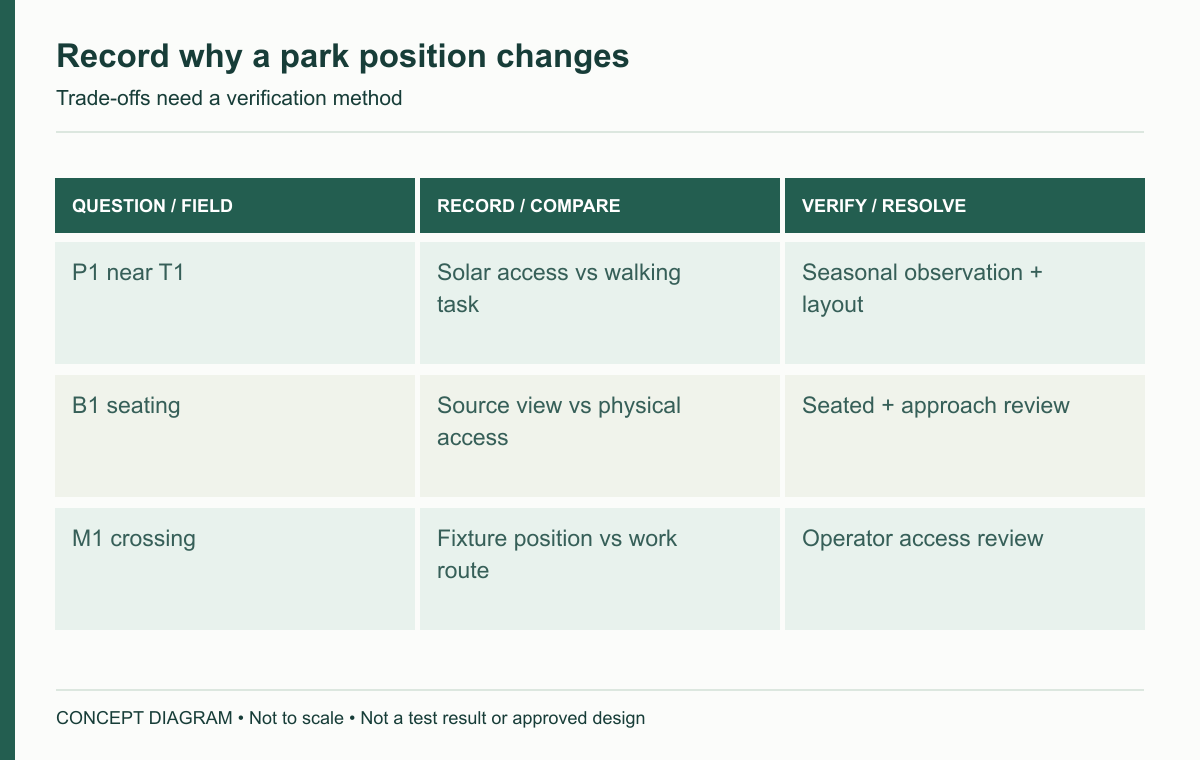
Use the same P1/B1/N1/T1/M1 identifiers in the drawing and table. The table should make rejected options understandable, not simply list the product finally requested. Include a verification method so that the next person knows how a tentative choice becomes a reviewed proposal.
| Example area | Activity and constraint | Candidate decision | Verification needed |
|---|---|---|---|
| P1 near T1 | Walking route with canopy influence | Compare original and more open positions | Seasonal panel exposure and lighting layout |
| B1 seating | Seated view towards planting | Compare position and documented distribution | Agreed seated and approach observations |
| N1 feature | Decorative landscape interest | Keep separate from route responsibility | Purpose, operating period and surrounding views |
| M1 crossing | Landscaping and service movement | Keep required access workable | Operator review of work route and maintenance method |
Make the next review reproducible
Record the candidate model and configuration, observation positions, dates, weather and relevant operating state. If a product, bench direction or maintained planting envelope changes, identify which decisions need reviewing again. Without that connection, a later team may repeat the original trial under different conditions and believe the results are directly comparable.
The published SCL-008 park-pathway case offers a separate application reference. Its images and product context do not supply the tree, bench or maintenance facts in this hypothetical example. Use it to frame further questions, not to label the concept plan as an existing installation.
Carry the landscape assumptions into the handover
Park seating area lighting depends on features that may change after the lighting review. Record the mature tree canopy assumed at T1, the maintained planting edge at B1 and the landscaping access needed at M1. Give seasonal shading observations a date and viewing position so they can be compared with later conditions. These records explain the proposal without pretending that a concept plan predicts future performance.
When comparing solar park lights, keep the role of each candidate explicit. Solar pathway lights, solar bollard lights and taller fixtures may serve different tasks; their category names do not decide the layout. Send the plan and its assumptions with the supplier enquiry, and ask the operator to identify changes that should trigger another review. This makes the handover useful to both procurement and the people caring for the park.
Frequently asked questions
Which solar lights should be considered near park benches? Begin with the seated view, approach, mounting surface, panel exposure and maintenance access. Compare documented candidates against those conditions rather than choosing one model for every seating area.
Can solar lighting work in a park with many trees? Assess each panel position and required operating task. Some positions may be feasible and others unsuitable. Tree cover is not a reason for an automatic yes or no, and partial light does not guarantee an entire night’s operation.
Can stake lights be used on public park paths? Only after the specific use, stability, access, maintenance and model requirements are reviewed. Decorative use and functional path lighting are different responsibilities, even when products appear similar.
A useful park brief combines the route plan, tree and seating information, operating periods and maintenance routes. It explains why candidates are being considered and what evidence is still needed before a layout is accepted.
For an overview of fixture types, site conditions and selection priorities, see our garden and courtyard lighting guide.