


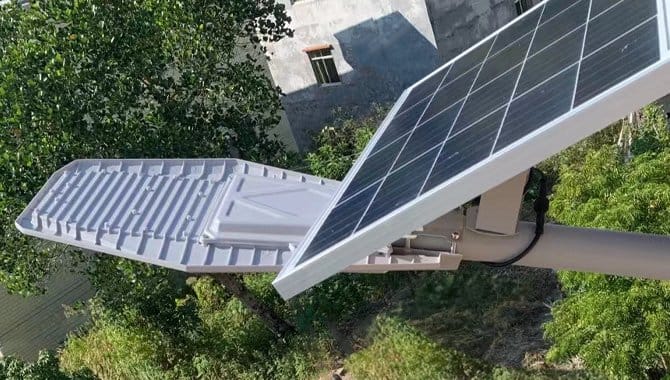
As the name suggests, an all-in-two solar street light is made up of two main parts. One part integrates the battery, controller, and LED light source within the lamp head. The other part is the separate solar panel. This arrangement is also called a semi-integrated solar street light; check the component layout on the supplier’s drawing because product names can vary.
Advantages of All-in-Two Solar Street Lights
1. Flexible installation
A separate panel can allow its direction and tilt to be set independently of the LED lamp’s lighting direction. This helps the installer seek suitable sunlight exposure while aiming the light at the road.
Adjustment is limited by the supplied bracket, pole and structural design, cable routing, nearby obstructions, and site conditions. Confirm the permitted mounting positions and angles in the installation manual. A separate panel does not mean it can be rotated or tilted freely in every installation.
2. More room for solar panel capacity
A separate panel is less constrained by the dimensions of the lamp head, which can provide more options for panel size and rated power. At the same irradiance and conversion efficiency, a larger collecting area can produce more electrical power. Increasing area does not, by itself, increase conversion efficiency: efficiency describes the proportion of incoming solar power converted into electrical power.
Compare rated panel power in watts, panel area, and efficiency under the same stated test conditions. Also check whether the controller, battery charging limits, bracket, and pole can accommodate the proposed panel. Actual daily charging depends on sunlight, orientation, shading, temperature, and system losses, as well as rated power.
3. Wide application range
All-in-two systems can be considered for roads, parking lots, squares, communities, and industrial parks where separate panel mounting is useful. Suitability for a large road or highway requires a complete lighting, energy, and structural design. The layout alone does not establish compliance with road-lighting requirements.
Check road width, pole spacing, optical distribution, maintained lighting levels and uniformity, local solar resource, operating schedule, and maintenance access before choosing the structure.
The Disadvantages of All-in-Two Solar Street Lights
1. Large size
The solar panel may be larger than the lamp body. Separate components and mounting hardware can increase packaging volume and handling work. Compare actual packed dimensions and weights, and include the panel’s wind loading in the pole and foundation design.
2. Complicated installation
The separate panel must be mounted and connected to the lamp assembly. Compared with a compact all-in-one design, this can add alignment, cable routing, and connector-sealing work. The actual installation effort depends on the supplied kit and site access.
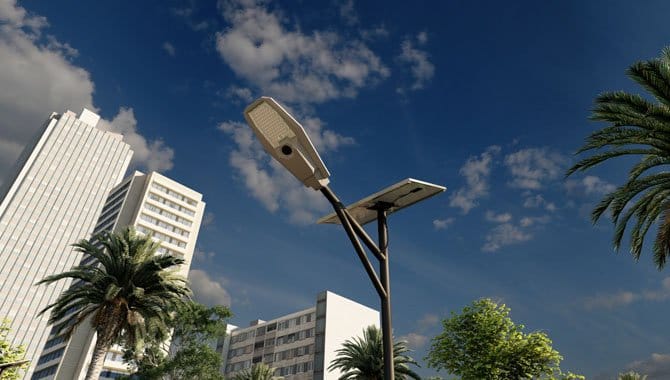
All-in-two solar street lights have both advantages and disadvantages. Compare the complete installation and maintenance requirements in this guide to all-in-one, all-in-two and split solar street lights before choosing the architecture for a project.
FAQ About All-in-Two Solar Street Lights
Are all-in-two solar street lights better than all-in-one models?
It depends on the project. All-in-two models may offer more freedom in panel size and positioning; an all-in-one assembly can reduce field assembly work. Compare the offered models and the site’s requirements.
Are all-in-two solar street lights difficult to install?
The separate panel adds mounting and connection tasks. Review the assembly instructions, access needs, and cable protection before estimating installation time.
How do I choose an all-in-two solar street light?
Define road width, pole layout, required lighting performance, local sunlight, operating modes, and backup needs. Check photometric calculations and an energy balance, then confirm that the bracket, pole, battery, and controller support the proposed configuration.