


In developed countries such as the United States, Europe, and Japan, outdoor lighting projects are undergoing subtle yet tangible transformations, primarily driven by technological advancements and heightened environmental awareness. In recent years, labor costs have continued to rise, construction timelines have been repeatedly compressed, and project owners have demanded reductions in maintenance expenses over the project’s lifespan.
Within this reality, traditional monolithic light poles are beginning to appear somewhat “cumbersome”—not only structurally, but also in terms of cost and efficiency. Precisely for this reason, modular light poles (Modular / Split Light Pole) are increasingly being adopted by municipal authorities and contractors for outdoor solar lighting projects, even becoming the preferred option—pole for solar street lights.


What core issues does the modular light pole actually solve?
When first encountering the term “modular light pole,” many mistakenly assume it simply involves breaking down traditional poles into sections. In reality, its core solution lies not in the “structural form” itself, but in enhancing efficiency throughout the project lifecycle. From a project lifecycle perspective, modular street light poles represent a systematic solution designed around three key objectives: faster installation, more efficient transportation, and more controllable maintenance costs.
Compared to traditional monolithic poles, they typically feature:
- Standardized pole sections that can be flexibly divided based on height requirements
- Bolted or specialized structural connections lower technical barriers for installers
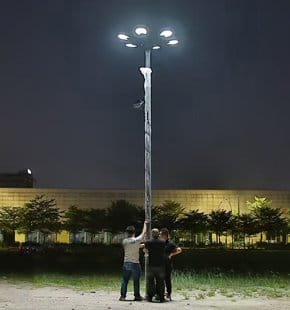
- Easy installation, light pole, rapid on-site assembly eliminates the need for large crane rentals
- Individual modules can be independently disassembled and replaced
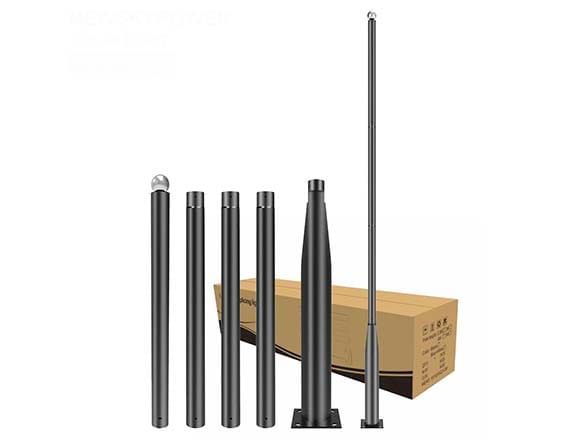

In essence, its core advantage lies not only in streamlined installation but, more importantly, in being engineered not for one-time installation but for long-term, stable operation.
Why are modular light poles particularly well-suited for developed countries?
1. High labor costs make efficiency a core competitive advantage
In developed countries, labor expenses are often the most challenging aspect to control in lighting projects. More complex installations require specialized personnel and higher compensation. The advantages of modular light poles include:
- Clear installation processes with minimal technical requirements
- Significantly reduced construction time compared to traditional poles
- No reliance on large lifting equipment
What does this mean? Contractors can accomplish the same workload with fewer personnel and in less time. This is particularly relevant in North America and Europe.
Moreover, the modular structure substantially simplifies post-installation maintenance. Should components fail or require upgrades, only the relevant module needs replacement—eliminating the need to dismantle or reinstall the entire pole. This “plug-and-play” design further compresses operational costs, making it particularly suitable for high-labor-cost environments.
Additionally, modular poles align better with stringent local environmental and sustainability standards. Their disassemblable and recyclable nature supports circular economy principles, reducing resource waste and construction carbon emissions. Consequently, they gain easier adoption in developed nations with clear policy direction and strong green awareness.
Finally, standardized components facilitate large-scale, systematic smart streetlight deployment for city administrators. Whether adding sensors, 5G micro-stations, or charging stations, the modular design reserves flexible space for future functional expansions. This “one-pole-multiple-uses” flexibility precisely meets developed countries’ demands for efficient, intelligent, and sustainable urban infrastructure development.
2. More Transport-Friendly, Especially Suitable for Cross-Border Projects
For international projects, transportation is never merely a “minor issue” but a critical factor directly impacting costs, timelines, and feasibility. Modular light poles feature a split-design that delivers significant advantages in logistics:
- The modular structure drastically reduces packaging volume
Minimizing space requirements per shipment and facilitating compatibility with various logistics modes. Second, optimized packaging dimensions greatly enhance container utilization, increasing average loading capacity by 20%-30% and effectively reducing shipping costs.
- Segmented transportation minimizes individual unit length and weight
Simplifying loading/unloading while lowering damage risks from vibration and impact during long-distance sea or land transport. Modular design also enables products to adapt more flexibly to local warehousing systems, facilitates regional redistribution and last-mile delivery, and significantly enhances supply chain responsiveness and adaptability.
Modular light poles are gaining increasingly widespread adoption in smart city projects across Europe—such as Germany and the Netherlands—as well as in municipal lighting upgrades throughout North America.

3. Maintenance has finally moved beyond the costly decision-making model of “entire pole replacement.”
Traditional light poles, once damaged, often necessitate full-pole replacement—a process that is not only costly and time-consuming but may also disrupt traffic. Modular light poles offer a more flexible solution: only the damaged segment needs replacement without compromising the overall structure, significantly boosting maintenance efficiency. For municipal and public facility managers, this long-term controllability often proves more valuable than the initial purchase price.
4. Greater Flexibility for Diverse Applications—Light Pole For Outdoor Lighting
Modular light poles have extensive application scenarios, as detailed in the article “Seven Common Applications of Modular Light Poles in Developed Markets.”
As a manufacturer, we prioritize long-term partnerships. For clients in developed markets, supplier selection goes beyond price comparison. Key considerations include consistent quality, seamless communication, and sustained delivery capability. As a direct manufacturer, we focus on real-world project performance and continuously refine structures and details based on overseas project experience.

Final Thoughts
The adoption of modular light poles is not driven by trends or marketing.
It is driven by reality.
The widespread adoption of modular light poles in developed countries is not a fleeting trend. It effectively addresses numerous pain points in outdoor lighting scenarios: high labor costs, tight construction schedules, and significant long-term maintenance pressures. If you’re planning an outdoor lighting project and looking for a practical, future-ready pole solution, modular light poles are worth considering.
We’re happy to share technical details, drawings, or samples for evaluation.NEWSKYPOWER aspires to be one of your top choices in your planning.


