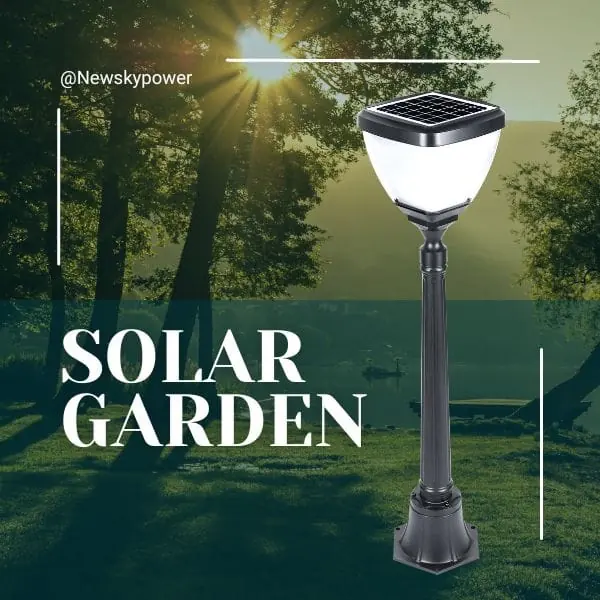


Sectional light poles are worth considering when a site needs a steel lighting support that can travel in shorter sections and be assembled at its destination. Pedestrian paths, courtyards and residential grounds are useful starting points. The final choice still depends on the required mounting height, the light fitting, wind exposure, foundation and access for installation.
Here, sectional or modular light pole means a pole body assembled from separate lengths. It does not mean a telescopic mast or a smart pole with built-in cameras, communications or charging equipment. This guide uses NEWSKYPOWER SP pole specifications to explain seven potential applications and the questions that decide whether each one is a sensible fit.
Start with the pole version, not the site label
A description such as “garden pole” identifies a use, not a complete specification. Two poles with similar names can produce different completed heights. The regular SP-5M is listed at 4.65 m after assembly; the separate SP-5MF full-height version is listed at 5 m. Likewise, SP-6M is listed at 5.72 m and SP-6MF at 6 m. Confirm the required height and reference point before selecting a model.
The regular SP parameter sheet lists a 76 mm upper tube and 114 mm bottom tube. These dimensions are useful when starting a compatibility check, but they do not confirm that any luminaire clamp, arm or adapter will fit. The fixture drawing and fastening arrangement also matter.
The documented bolted version uses overlapping sections aligned and secured with bolts. Select it as a complete specified assembly. Adding an extra section later changes the pole and is not a substitute for reviewing its structural suitability. Begin with the sectional light pole range, then request the drawing for the proposed version.
A seven-site selection matrix
| Potential site | Information to provide | Why consider sectional construction? | Limit to resolve before ordering |
|---|---|---|---|
| Pedestrian paths | Path width, lighting layout, fixture and nearby windows | Shorter packages may suit restricted access routes | Pole height alone does not establish coverage or glare control |
| Gardens and courtyards | Planting, finishes, luminaire mount and ground conditions | Sections can be moved through planned access openings | Do not assume a paved surface provides an adequate foundation |
| Residential grounds | Repeated locations, layout, maintenance access and model schedule | Defined pole sets can support consistent purchasing and spare records | Similar appearance does not prove spare-section interchangeability |
| Small parking areas and entrances | Vehicle routes, impact exposure, fixture layout and delivery access | Compact delivery may help a constrained property | Check vehicle protection and project requirements; this is not a high-mast solution |
| Campus and facility pedestrian zones | Foot traffic, opening hours, service access and lighting requirements | Sections may be easier to stage near distributed work areas | Public use does not remove structural or electrical approval requirements |
| Small solar lighting sites | Full light/panel assembly, weights, wind area and energy-system layout | Pole and lighting equipment can be specified as separate packages | Panel and bracket loads require a complete structural check |
| Phased developments | Each stage's location, foundation and reuse plan | Shorter sections can be stored and allocated by stage | Relocation requires a new site check, not just reassembly |
These are application checks, not records of completed NEWSKYPOWER installations. The scene images below illustrate lighting contexts and do not identify the installed poles as SP models.
1. Pedestrian paths: check visibility and mounting height together
For buyers comparing modular pedestrian light poles, a useful first question is what people need to see along the route. A footpath, a crossing and a building entrance need different lighting layouts. Give the lighting designer the path width, obstacles, positions available for foundations and the selected fixture's photometric information.
Then compare the proposed mounting height with the pole's completed height and the arm arrangement. Do not choose the tallest available pole simply to reduce the number of fixtures. That choice also changes the lighting geometry and structural inputs.
Shorter pole sections may be useful where access is through gates or along established landscaping. Measure the route and plan handling before delivery; sectional construction does not by itself establish a safe crew size or eliminate lifting equipment.
2. Gardens and courtyards: coordinate the pole with the landscape
Garden lighting often places a pole close to trees, seating, planting beds and building façades. Record those features before settling on the finish or fixture style. A tidy installation requires the base, access to fasteners and any cable route to be considered alongside the visible pole.
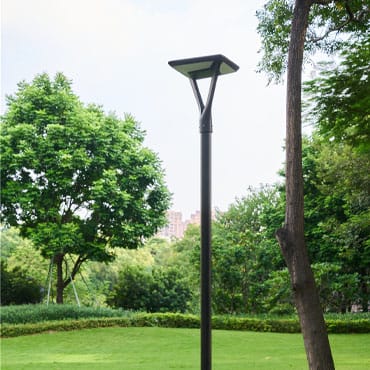
Garden lighting reference from the existing article; the pictured pole is not identified as an SP installation.
A sectional pole can be considered when moving a long one-piece item through the property would be difficult. It still needs an appropriate supporting foundation. Pavers, asphalt or a thin decorative slab should not be treated as proof that anchors can be installed safely. Use the garden light pole selection page to start a product discussion, and provide the site and fixture details with the request.
3. Residential grounds: make repeat orders and maintenance traceable
Residential compounds may contain entrance paths, small gardens and shared outdoor areas with different lighting requirements. Create a location schedule instead of ordering one generic height for the whole site. List the pole version, completed height, finish, lamp arm and fixture at each position or group of positions.
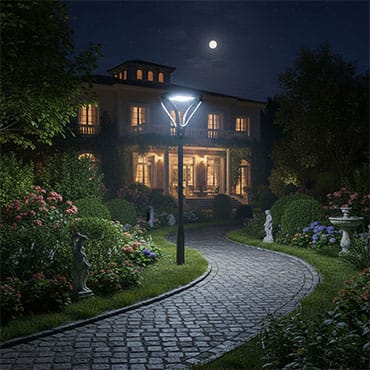
Outdoor lighting reference retained from the original article; no SP model or project performance is claimed.
For maintenance, retain the assembly drawing and the order's component identifiers. A damaged section may be replaceable only after the supplier confirms compatibility and the remaining assembly has been assessed. Different revisions or joint types should not be mixed because their paint and diameter look similar. The residential light pole page provides the appropriate next product-selection step.
4. Small parking areas and entrances: separate lighting from impact protection
A private parking area or property entrance may have restricted delivery space, but it also has vehicle movements. Mark reversing routes, parking boundaries and possible impacts when proposing pole positions. A lighting pole is not a vehicle barrier.
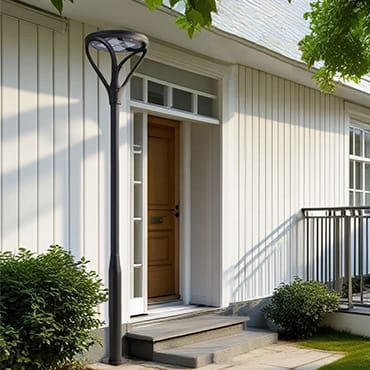
Property lighting context from the existing article; suitability of an SP pole requires a separate site review.
Check completed height, fixture layout and the applicable project requirements before comparing pole prices. Large commercial parking areas, major roads and high-mast layouts can require structures outside the documented SP range. A convenient carton size cannot compensate for an unsuitable structure or lighting layout.
5. Campus and facility pedestrian zones: plan installation around access
Walkways between buildings, landscaped rest areas and facility entrances can have different delivery and working-hour restrictions. Identify where packages can be unloaded, where sections can be staged without obstructing people, and how the assembled pole will be positioned.
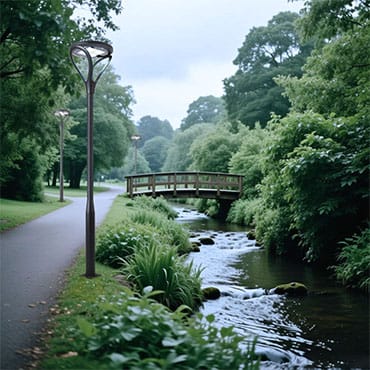
Scene reference only; the existing scene illustration does not establish SP model compatibility or a verified installation outcome.
The useful advantage to assess is the ability to transport and stage shorter components. It is not a promise of installation without machinery. The contractor should choose the handling method from the complete assembly, site access and work plan. Where mains-powered luminaires are specified, include the electrical connection and earthing design in the project scope.
6. Small solar lighting sites: specify the whole mounted assembly
A solar installation needs more information than the lamp's weight. A separate panel, its bracket and the arm position change what the pole carries and how the wind acts on it. Send drawings, dimensions and weights for the complete proposed arrangement, including any battery box attached to the pole.

Solar lighting scene retained as context; it is not evidence that the pictured system uses the SP pole or matches a proposed configuration.
The SP sheet's listed load value is not a project wind rating. A structural assessment needs the relevant loading conditions and foundation as well. The pole body also does not determine battery runtime or solar charging performance. Review the solar light pole options with the full fixture and panel arrangement, rather than treating a pole-only quotation as a complete solar lighting system.
7. Phased developments: define storage and reuse before buying
A development delivered in stages may benefit from receiving and storing pole sets separately. Label each set by the approved version and intended location, keep small parts together, and protect joint areas and finishes during storage.
Relocation is a different question. Before reusing a pole, inspect the existing sections and connections and assess the new location, mounted equipment and foundation. Dismantling a structure does not make it automatically suitable for another site. Avoid promising a movable, temporary lighting system when the proposed product is a foundation-mounted pole.
For dispersed sites, our remote-site specification and delivery article provides a related planning route. Confirm the current shipping arrangement against the selected version rather than assuming that all pole sets share one carton.
Turn a possible application into a usable enquiry
Send NEWSKYPOWER the site type and location, quantity, required completed height, light fitting drawing, panel or other attached equipment, and delivery constraints. Add site wind requirements and foundation information when available. Identify which information still needs the project designer's input.
Use the SP split pole details to identify the model family and the light pole manufacturer enquiry page to request a version-specific proposal. If both sectional and one-piece construction are viable, compare them using the pole construction and project-cost discussion.
The three reasons to pause selection are straightforward: the required structure is outside the documented range; the fixture and loading inputs are incomplete; or the foundation and installation method have not been resolved. Solve those issues before treating a site label as a product recommendation.
For the complete selection process, see our modular light pole buying guide covering height, joints and delivery checks.
FAQ
1. What is a sectional light pole?
It is a pole body supplied in lengths that are joined to form the specified assembly. The documented SP bolted version uses overlapping joints secured with bolts. It is not a telescopic mast.
2. Are modular pedestrian light poles suitable for every pathway?
No. Check the lighting layout, completed height, fixture, wind requirements and foundation. Restricted access may make shorter sections attractive, but it does not establish suitability on its own.
3. Does a model named SP-5M provide a completed height of 5 m?
The regular SP-5M is listed at 4.65 m. The separate SP-5MF version is listed at 5 m. Confirm the supplied version and drawing before specifying mounting height.
4. Can I install a sectional pole directly on paving or asphalt?
Do not select anchors from the surface appearance. The supporting foundation and anchorage need to suit the structure and ground conditions; paving or asphalt alone does not demonstrate that.
5. Can an SP pole support a solar panel and light?
The full proposed arrangement must be checked, including dimensions, weights, mounting positions and wind area. A listed weight limit alone cannot approve a panel-and-light configuration.
6. Are sectional poles also smart poles?
Not necessarily. “Modular” can describe either joined pole sections or functional equipment modules. Cameras, communications and charging systems are not implied by the SP sectional structure.
7. Can damaged sections be replaced individually?
Ask the supplier to confirm the exact replacement part and assess the rest of the assembly. Retain the model, order and drawing references; do not mix visually similar sections from different versions.
8. Do these poles always eliminate cranes or lifting equipment?
No. Shorter sections affect delivery and handling, but the installation method depends on the assembled pole, attached equipment, access and the contractor's work plan.
9. Can one pole specification cover an entire residential development?
Only if the relevant locations share suitable design conditions. A location schedule helps identify differences in height, fixtures, exposure, foundation and maintenance access before ordering.
10. What should I send to request a suitable pole proposal?
Provide location, site type, quantity, required completed height, fixture and accessory drawings, available loading requirements, foundation information and delivery access. State whether you need a pole body or a complete lighting package.