

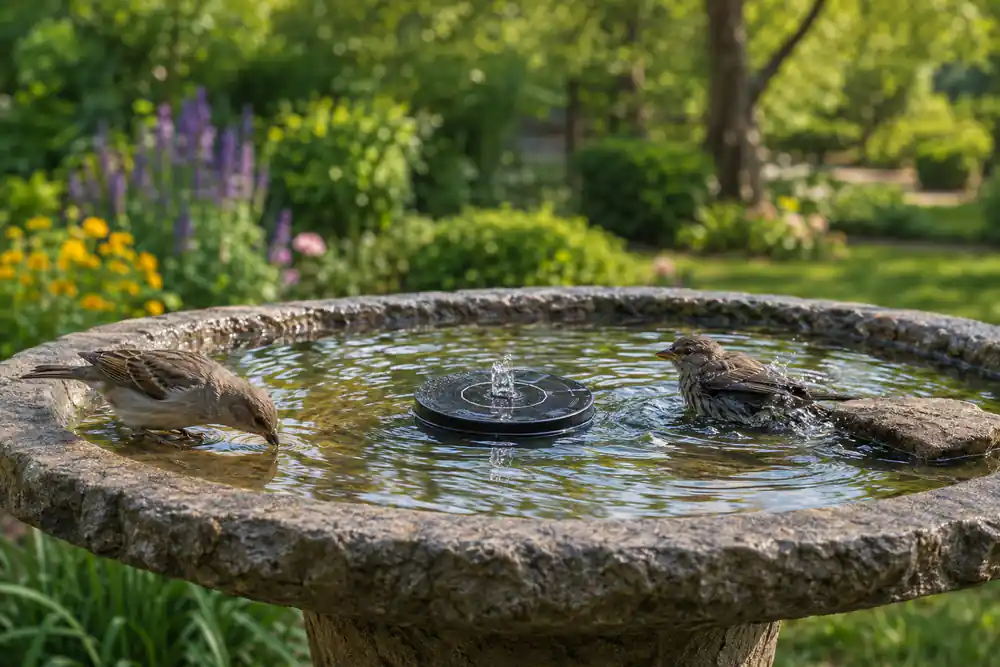
Illustration of the operating or setup concept; not a measured performance test or a guarantee of wildlife behavior.
Yes, many birds like bird bath fountains, especially when moving water is gentle, shallow, clean, and easy to approach. The sound and reflected movement can make water easier to notice. However, a tall forceful spray, slippery deep bowl, exposed location, or unfamiliar new object may cause birds to hesitate.
So, do birds like bird bath fountains more than still baths? There is no universal preference for every species or individual bird. A fountain can make water easier to notice, but it does not keep that water fresh by itself. Basin design, water depth, footing, cleaning and visibility of approaching predators deserve more attention than maximum spray height.
Can a Bird Bath Fountain Attract Birds? Why Moving Water Helps
Birds need water for drinking and bathing, including species that rarely visit seed feeders. Cornell Lab guidance notes that many birds are attracted to the sight and sound of moving or dripping water. Ripples catch light, while a soft trickle can be detected from beyond the immediate view of the basin.
This helps explain why people asking do birds like moving water often see activity around drippers, bubblers, and low fountains. Movement can improve discoverability; it does not guarantee immediate use. Birds still assess whether the water looks shallow, whether they can stand securely, and whether they can escape quickly.
Fountain Patterns Birds Are More Likely to Accept
A gentle bubbler, low dome, short single stream, or light surface ripple is usually easier to approach than a tall multi-jet display. Lower patterns leave calm areas for drinking and bathing and reduce water loss from the bowl.
The ideal pattern depends on the basin. Keep the landing area well inside the rim and preserve open water around the fountain disc. If birds approach but do not enter, remove the decorative nozzle for a few days and test the quietest low-flow setting.
A bird friendly fountain does not need to run continuously. Consistent access to clean, shallow water and safe footing is more important than a dramatic effect.
Why Birds May Avoid a New Fountain at First
Birds often treat a new object or sound cautiously. A dark floating disc, moving nozzle, changing spray, reflective panel, or recently moved bath can make the setup unfamiliar. Some birds may watch from a branch for several days before approaching.
Give them time and avoid changing several features each day. Start with a low flow, keep the basin in a stable location, and let normal backyard activity continue. If no birds visit after one to two weeks, reassess water depth, cleanliness, visibility, nearby cover, and whether the spray is too strong.
Do not assume the fountain is the only cause. Seasonal movement, local species, predators, pets, construction noise, and other water sources can all change visitation.
Use Bird-Friendly Water Depth and Footing
Cornell recommends water no deeper than about 1 inch (2.5 cm) at the edges and a maximum of about 2 inches (5 cm) in the middle, with a gradual slope. Shallow access helps small birds judge and enter the water.
The NEWSKYPOWER fountain models covered here need at least 3 cm (about 1.2 inches) of operating water depth, maintained at or above 3 cm while running. This pump requirement is separate from the birds’ shallow access. Use a sloped basin or stable footing only where the setup can meet both requirements without blocking the intake. If it cannot, choose a different basin or fountain combination. Stones should be stable, easy to remove, and positioned so they do not deflect spray outside the bowl.
Rough stone, textured ceramic, or non-slip perches offer more confidence than a steep smooth wall. Avoid loose objects that can roll or trap feet.
Place the Bird Bath Where Birds Feel Safe
Birds benefit from an open view of approaching threats and nearby branches where they can land, wait, and preen. Nearby cover should not be so close or dense that a cat or other predator can hide at the rim. Keep pets away from the bath during active hours.
Placement creates a special challenge for an integrated solar fountain. Cornell recommends shade during hot months when possible, while the built-in solar panel needs useful sunlight. A workable compromise is morning sun with afternoon relief, or an open-sky location near but not directly under vegetation. A separate-panel pump gives more flexibility because the panel and bowl can occupy different light conditions. This describes an alternative design; confirm availability and compatibility with the supplier rather than assuming it is an option for the listed floating models.
Avoid placing the bath directly beneath feeders or heavy branches. Seeds, droppings, and leaves quickly foul the water and pump.
Keep the Water Clean and the Spray Contained
Fresh water matters even when a pump is circulating it. Empty and scrub the basin regularly, remove visible debris, and for these NEWSKYPOWER models, refill before the operating water depth falls below 3 cm. Moving water does not replace cleaning.
Use a low spray that returns to the bowl. A bird bath fountain that attracts birds but empties itself creates an unreliable water source. During hot or windy weather, check the level more often and switch to a bubbler if necessary.
Clean the panel, intake, filter, impeller, and nozzle according to the product instructions. A weak uneven spray can startle birds and may indicate debris or trapped air.
How Long Does It Take Birds to Adjust?
Some birds may investigate within hours, while others need days or weeks. There is no guaranteed timeline. Keep the bath clean, filled, and in the same place so birds can learn that it is dependable.
You can make the transition easier by operating the fountain at a low setting and leaving a calm section of water. Do not add food, fragrance, dyes, or unnecessary chemicals to lure birds. Natural stones and nearby native plants provide a more appropriate visual context.
Record visits at different times instead of judging only one afternoon. Morning and late-day activity may be easier to miss.
Common Mistakes When Trying to Attract Birds
Using the tallest nozzle. A high spray may waste water and leave little calm space.
Making the whole basin deep. The pump may need depth, but birds still need shallow entry and footing.
Placing the bath beside predator cover. Nearby branches are useful; a hiding place at the rim is not.
Expecting instant results. Birds need time to notice and evaluate a new feature.
Treating circulation as cleaning. Pumps move dirty water unless the basin is emptied and scrubbed.
A Practical Display Checklist for Garden Retailers
Use a retail demonstration to show how the fountain fits a bird bath, rather than to promise a particular wildlife result. Show the usable basin area around the disc, a low spray that returns to the bowl and a visible shallow entry. State whether the bowl is included in the offer; an attractive demonstration basin should not imply a supplied accessory.
Photograph the actual nozzle and configuration offered to the customer. Do not use a high spray in a large display basin as evidence that the same pattern fits a smaller bowl. A short setup card can explain sunlight, refill checks and cleaning without filling the front of the packaging with technical language.
Keep wildlife claims modest. A bird in a photograph is not proof that every buyer will attract that species, and a staged illustration is not a product trial. Describe gentle moving water and the conditions for a usable bird bath instead of “guaranteed bird attraction.” If customers ask why birds have not visited, start with the setup and surrounding conditions rather than diagnosing a faulty pump.
For an assortment review, use the basin size and water-depth checklist to assess the bowl and the solar fountain buying guide to select the product configuration. Retailers can then compare the available fountain range; keep nozzle choice, basin fit and the intended display consistent across the product description and the supplied instructions.
Observe the Setup Without Overinterpreting It
A useful observation note records the date, time, basin location, nozzle and visible behavior: approaching, drinking, bathing or leaving. It does not need to label every visit as a response to the fountain. Change one practical feature at a time, such as reducing the spray, so that the owner can see whether access becomes easier.
Do not repeatedly approach the bath to obtain a photograph. Leave open water when using stones and make sure any added footing cannot move into the pump intake. If the selected pump cannot operate while a suitable shallow approach remains available, the combination needs changing; a more powerful fountain will not solve that mismatch.
For spray leaving the rim, follow the nozzle and centering checks. For an explanation of the solar panel and pump, see how solar bird bath fountains work. These checks address the equipment and basin, while bird visits remain dependent on local conditions.
Make the Fountain Easy to Trust
The useful answer to “do birds like bird bath fountains?” is yes—many birds respond to visible, gently moving water—but the fountain must still function as a safe bird bath. Shallow access, stable footing, clean water, contained spray, and good escape visibility come first.
Give birds time to adjust and watch what they actually use. A quiet bubbler in the right basin often serves birds better than the tallest available spray.
Frequently Asked Questions
Does the sound of a fountain attract birds?
A soft trickle or drip can help birds notice water. Loud splashing is not necessary and may be less suitable in a small shallow bath.
Are solar fountains safe for birds?
They can be appropriate when the water is shallow and clean, footing is secure, spray is gentle, and all parts are intact. Follow product instructions and remove damaged equipment.
Will hummingbirds use a bird bath fountain?
Some hummingbirds may investigate fine mist or moving water, but behavior varies. Do not promise visits from a particular species; provide shallow, gentle options.
Should the fountain run all day?
No. Birds can use the bath when the pump is off. Direct-drive solar fountains naturally vary with sunlight, while battery models may provide limited buffering.
Why do birds drink but not bathe?
The water may feel too deep, footing may be slippery, or the spray may occupy too much space. Add secure shallow access and reduce the flow.
Does a retail photograph prove a fountain will attract that bird species?
No. It shows one scene, not a repeatable wildlife outcome. Product images should accurately show the offered fountain and basin arrangement without promising a particular species or visit frequency.
Is the pump’s operating depth the same as a bird’s standing depth?
No. For these NEWSKYPOWER models, maintain a pump operating depth of at least 3 cm (about 1.2 inches). The birds still need separate shallow access and secure footing. The bird-bath guidance of approximately 2.5 cm at the edge and up to 5 cm in the center is not the pump’s minimum-depth specification. A basin that cannot accommodate both needs is unsuitable for that combination.
Can a fountain replace regular water changes?
No. Movement does not remove contamination. Refill and clean the bath regularly and sooner when the water becomes dirty; maintain the pump according to its instructions.
What should a garden retailer show in a demonstration?
Show a contained low spray, stable shallow access, the actual supplied nozzle and the bowl dimensions. Make clear whether the basin is part of the offer or a display prop.
Where should a buyer start when choosing compatible fountain models?
Start with the basin’s usable diameter and depth, the available sunlight and the intended water pattern. Use these requirements to compare fountain configurations before choosing a presentation image.