

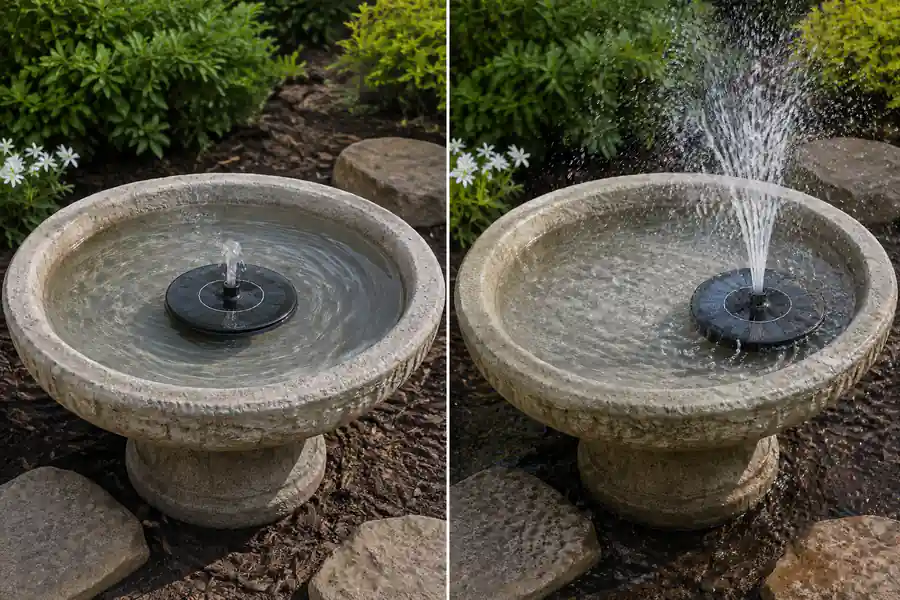
Illustration of contained spray and overspray; not a measured performance comparison.
To learn how to stop a solar fountain from spraying water out, begin with three quick changes: use the lowest or narrowest nozzle, center the floating disc, and reduce exposure to wind. If water still leaves the basin, test a gentle bubbler without the decorative nozzle where the model instructions allow it. These changes usually preserve more water than simply refilling the bowl more often.
A solar fountain losing water is not always defective. The spray may be too wide for the bowl, the floating disc may drift toward the rim, or wind and evaporation may remove water faster than expected. The best solution treats the pump, nozzle, basin, and location as one system.
For retailers and distributors, this is also a compatibility check to perform before pairing a fountain with a bird bath or preparing a product demonstration. A clear setup card should explain which nozzle and bowl combination was used, so an attractive display does not become an unrealistic promise for every customer.
First, Identify Why Water Is Leaving the Basin
Watch the fountain for several minutes in calm weather and again when a breeze arrives. Water can escape in four common ways:
- A tall or wide spray lands beyond the rim.
- The disc drifts to one side, leaving no landing space for the spray.
- Water hits stones or the inner wall and ricochets outward.
- Wind carries droplets away before they fall back into the bowl.
Mark the normal water level and check it after one hour. Also inspect the ground around the bath. A wet patch on one side suggests directional overspray; an even decline with little wet ground may point more toward evaporation or bird activity.
Solar Fountain Spray Too High? Lower It First
When a solar fountain spray is too high, choose the supplied nozzle that produces the lowest contained pattern. Test without the decorative nozzle only if the model instructions permit it. A low bubbler creates visible movement without throwing droplets far from the center. If the product has several spray heads, compare them at the same sunlight level because changing sun can otherwise confuse the test.
Do not choose a nozzle only because it looks dramatic in a close product photo. A narrow single stream or low dome often works better in a shallow bird bath than a broad multi-jet pattern. The correct spray lands comfortably inside the rim even after a light sideways shift.
Panel wattage does not equal safe spray height. Pump flow, nozzle restriction, sunlight, water depth, and wind all affect the result. Published spray height should be treated as a reference range, not a guarantee for every basin.
Keep Solar Fountain Centered With Stabilizing Arms
To keep a solar fountain centered, use the stabilizing arms supplied for that model, if included, and check their fit against the usable inside diameter. Adjust them so the disc can move slightly without reaching the rim. Arms that are too tight may jam against a curved bowl; arms that are too short may not prevent drifting.
If the product has no suitable arms, use a manufacturer-approved tether or anchor point. Do not drill the waterproof housing, block the solar cells, or tie a line around the pump intake. Avoid loose metal weights, sharp wire, adhesives that can leach into water, or small parts that birds might contact.
The basin should also be level. A tilted bowl creates a shallow side where the fountain can ground and a deep side where it tends to drift. Correcting the stand or base may solve repeated movement without modifying the fountain.
Match the Fountain to the Bird Bath Bowl Size
A floating disc needs more than enough room to fit. The bowl must also provide landing space around the selected spray pattern and clearance for stabilizing arms. Measure the usable inside diameter at the normal waterline, not the decorative outer diameter. The bird-bath size and water-depth guide explains the measurements to collect before comparing models.
Small bowls generally need a bubbler or short single stream. Medium bowls can often contain a narrow spray when the disc stays centered. Wider bowls allow more patterns, but wind can still carry a tall spray beyond the rim. If the lowest setting cannot stay inside the basin, the pump and bowl are a poor match.
For the NEWSKYPOWER fountain models covered here—AS01A, AS10B, SP33D and SP32D—maintain at least 3 cm (about 1.2 in) of water at the pump location. Do not allow the operating depth to fall below 3 cm. Measure at the pump, not only at the deepest point in the bowl, and maintain the necessary pump clearance. This operating-depth requirement does not remove the need for shallow, accessible edges for birds. A sloped bowl or secure stones can provide footing while the fountain remains in the deeper center.
Account for Wind, Heat, and Bird Activity
Test the fountain during the actual hours it will operate. Afternoon wind may be stronger than morning wind, and warm dry weather increases evaporation. Birds also splash water while bathing. A setup that lasts all day in mild weather may need a lower spray during hot or windy periods.
Move the bath behind a windbreak that does not shade the solar panel. A fence, open lattice, or vegetation positioned at a distance may help, but dense nearby cover can shade the panel or give predators a hiding place. If the site cannot avoid wind, use a bubbler rather than a fine spray.
Prevent Low-Water Operation
Check the level daily until the refill rate is predictable. Never assume that a model includes dry-run or low-water protection unless its documentation confirms it. For these NEWSKYPOWER models, keep the intake submerged and the water depth at least 3 cm (about 1.2 in) throughout operation; do not use a possible automatic stop as a substitute for checking water.
When the level falls, the pump may draw air, pulse, make noise, or stop. Refill before the intake becomes exposed. If rapid loss continues after lowering and centering the spray, choose a larger reservoir or a lower-output fountain instead of relying on frequent emergency refills.
Common Fixes That Can Create New Problems
Adding heavy objects directly on the disc. This can block solar cells, distort flotation, or interfere with the intake.
Using glue or permanent sealant. It may complicate cleaning and can introduce unknown materials into bird water.
Moving the bath into deep shade to escape wind. A direct-drive fountain may then slow or stop because the panel loses useful light. See the cloudy-weather and shade explanation before changing the location.
Overfilling the bowl. A high waterline leaves less room for bird splashing and can make small waves cross the rim.
Keep the Water Inside the Bird Bath
The most reliable way to stop a solar fountain from spraying water out is to combine a low contained spray, a centered disc, adequate bowl clearance, and a sheltered but sunny location. Test one change at a time and monitor the level under real wind and heat.
If the smallest pattern still empties the bowl, the basin is too small or the fountain output is too high for that application. Choose a better-matched combination rather than treating constant refilling as normal.
A Nozzle and Basin Record for Retailers and Distributors
When evaluating a sample, keep the fountain model and nozzle combination together in the record. A result from one AS01A, AS10B, SP33D or SP32D setup should not be copied to another model simply because both are floating fountains. Photograph the actual parts supplied, including any centering accessories, before testing.
| Record item | What to measure or photograph | Why it helps |
|---|---|---|
| Model and sample identification | Model label, batch reference if available, nozzle photograph | Allows the supplier to identify the combination |
| Basin geometry | Usable inside diameter, pump-location water depth, rim shape | Distinguishes fit from decorative outside size |
| Initial setup | Starting waterline, disc position, fitted accessories | Makes another trial easier to repeat |
| Conditions | Date, observation time, sunlight, wind, selected operating mode | Avoids comparing different weather as if it were a product difference |
| Water return | Where droplets land and whether the disc drifts | Identifies the practical cause of loss |
| End observation | Waterline, water added, ground wetness, elapsed time | Separates a short observation from an all-day claim |
Change one item at a time. Compare nozzle patterns under similar conditions, then check the selected pattern during the site's normal operating hours. Agree the observation period and acceptance criteria with the supplier before evaluating a batch. Do not intentionally run the pump dry as an acceptance test.
If water continues to fall with the pump switched off, inspect the basin separately for a leak and consider evaporation. A fountain trial alone cannot prove a cracked bowl or guarantee a fixed refill interval. If the pump pulses as the water falls, use the fountain troubleshooting checklist to separate low-water symptoms from a hardware fault.
Turn the Result Into a Useful Setup Card
A retailer's card can show the model, the tested bowl dimensions, the recommended nozzle from that sample, how to fit approved centering accessories, and where to check the water level. Include a low-spray photograph taken in the actual setup. Identify the observation conditions rather than labelling the image “works in every bird bath.”
Keep setup advice separate from replacement-part promises. Ask the supplier to confirm the matching nozzle and accessory references, availability, and ordering conditions before listing them as spare parts. Similar-looking fittings are not evidence of interchangeability.
For an existing NEWSKYPOWER fountain, check nozzle and basin compatibility by sending the model, usable bowl diameter, water depth, nozzle photo and a short video of the spray. Begin the message with “Compatibility support.” For another brand, use that supplier's model instructions and support channel.
For a new assortment, consult the solar fountain buying guide and available fountain range. A bulk-order enquiry should identify the models, quantities, target market and any matching-basin, packaging or instruction-card requirements. This gives the purchasing discussion a different starting point from an existing user's water-loss complaint.
Related Solar Fountain Guidance
The fountain working-principle guide explains why sunlight and nozzle choice change the flow. Use it alongside the size and troubleshooting guides when preparing training for a new sales or support team.
Frequently Asked Questions
Why does my floating solar fountain keep moving to the edge?
Wind, water movement, a tilted basin, or inadequate stabilizing arms can push it sideways. Level the bowl and adjust compatible arms before adding any tether.
Can I run the fountain without a nozzle?
Many compact pumps can produce a low bubbler without a decorative spray head, but follow the product instructions. This is often the simplest way to reduce water loss.
Will a larger bird bath stop overspray?
It provides more landing space, but only if the spray height and wind exposure remain reasonable. A larger basin does not correct an unstable disc or an excessively tall jet.
How often should I refill the bird bath?
There is no universal schedule. Check it daily at first and more often during hot, dry, or windy weather. For the NEWSKYPOWER models covered here, maintain at least 3 cm (about 1.2 in) of water at the pump and refill before the operating depth falls below 3 cm.
Should I reduce the solar panel power?
Do not cover part of the panel as a routine flow control because uneven shading can cause unstable operation. Use a lower nozzle, supported flow setting, or better-matched pump instead.
What should a distributor record before reporting water loss?
Provide the model, basin measurements, nozzle used, starting and ending water levels, test duration and weather. Include a video showing the whole basin so the supplier can see drift and where the spray lands.
Does a wet patch prove that the fountain is leaking?
No. Overspray, splashing, a basin leak and spilled refill water can leave similar marks. Compare the setup with the fountain off and then running, without allowing the pump to operate below its required water level.
Can one nozzle recommendation cover a whole product range?
Not without checking each model and bowl combination. Fitting dimensions and spray patterns can differ. Request compatible part references and repeat the sample check for the combination being sold.
What should appear in a retailer's product photograph?
Show the actual model, the included accessories and a spray pattern contained by the displayed basin. State relevant setup conditions; do not present a tall spray in a small bowl as a universally suitable arrangement.
Should a water-loss support request include an order quantity?
An existing-product support request needs the model and setup evidence first. A new procurement enquiry should separately include target market, quantities, candidate models, matching-basin plans and packaging requirements.