

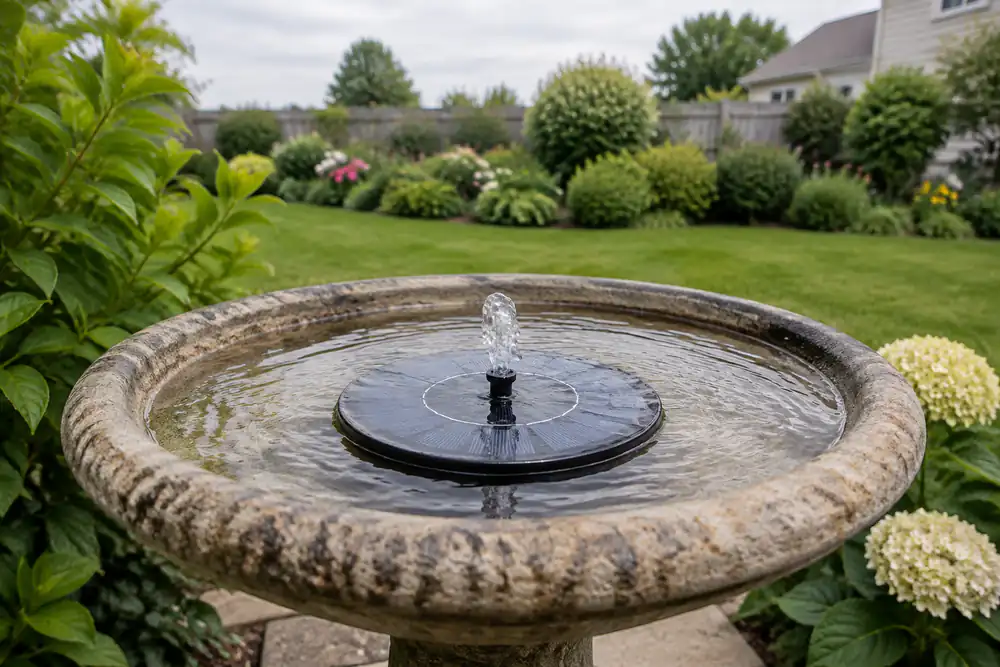
Illustration of the operating or setup concept; not a measured performance test or a guarantee of wildlife behavior.
Yes, some solar bird bath fountains can operate in bright cloudy weather, but performance usually drops as available light decreases. A direct-drive fountain may slow down, pulse, or stop when clouds cover the sun. A model with a charged battery can smooth out short changes in light, but it cannot provide unlimited operation in deep shade.
So, do solar bird bath fountains work on cloudy days? The answer depends on light reaching the panel, whether the fountain is direct-drive or battery-buffered, and pump and LED demand. “Cloudy” may still mean a bright sky with diffuse light, while a roof, wall, or tree can block most useful light.
Solar Fountain Cloudy Weather Performance: What to Expect
Photovoltaic cells can use direct and diffuse solar radiation. The U.S. Department of Energy explains that atmospheric conditions scatter sunlight and reduce the direct component. Bright overcast may provide some usable energy, while thick cloud can reduce it sharply.
A compact pump needs minimum voltage and current to run steadily. Light cloud may lower the spray, changing cloud may cause intermittent operation, and dark storm clouds may push output below the operating threshold.
This is why solar fountain cloudy weather performance is variable. The same fountain can behave differently by time, season, and panel cleanliness.
Why a Direct-Drive Solar Fountain Only Works in Direct Sunlight Reliably
A direct-drive fountain sends current from the solar panel directly to the motor. It normally has no stored-energy reserve to keep the pump at the same speed when sunlight falls. Bright sun produces stronger flow; passing cloud can weaken it; shade or night stops it.
Changing flow is expected in a simple direct solar system. Newskypower's AS01A/AS10B models represent this category and suit users who value simple daytime movement over weather buffering.
If a new solar fountain only works in direct sunlight, confirm whether it is direct-drive before assuming a fault. Test whether it starts when the clean panel receives strong, unobstructed sun and the pump has enough water.
How Battery Backup Changes Cloudy-Day Performance
A battery-equipped fountain can store part of the energy collected earlier. When a cloud passes, the controller may draw from that reserve instead of making the pump depend only on current panel output. The result can be steadier flow or a limited evening display.
Battery backup remains conditional. Several cloudy days, low winter sun, panel dirt, temperature, battery age, pump load, and LED use can all reduce charging or runtime.
Newskypower lists battery and LED features for SP33D and SP32D. For an order specification, confirm charging conditions, the supported night mode and pump/LED runtime for the selected version. Battery presence alone does not establish a fixed evening operating time.
Bright Overcast, Partial Shade, and Deep Shade Are Different
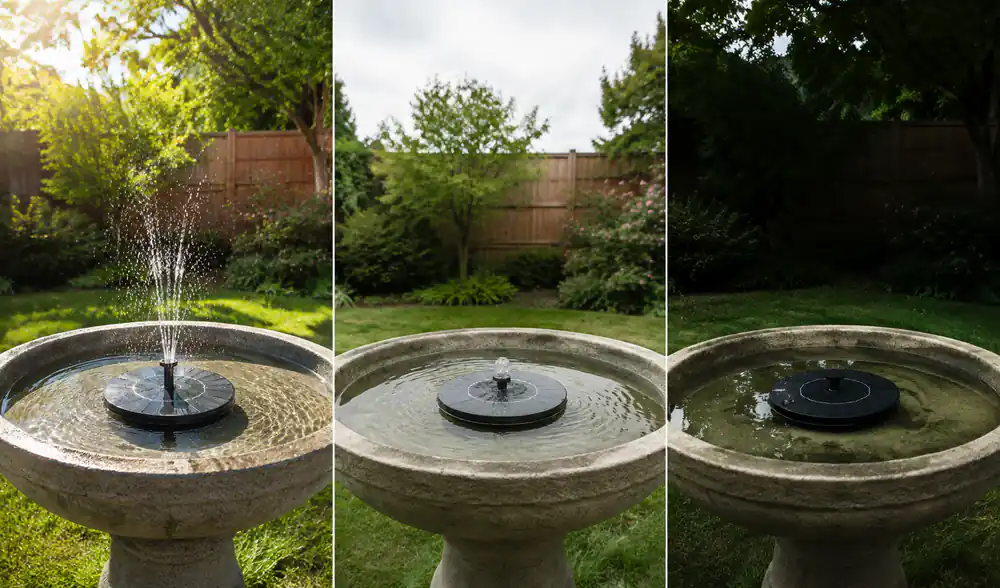
Illustration of the operating or setup concept; not a measured performance test or a guarantee of wildlife behavior.
| Light condition | What reaches the panel | Typical direct-drive behavior | Possible battery-model behavior |
|---|---|---|---|
| Bright direct sun | Strong direct and diffuse light | Strongest and most stable flow | Runs and may have energy available for charging, depending on control logic |
| Bright overcast | Mostly diffuse, reduced light | Lower, pulsing, or intermittent flow | May remain steadier if useful charge is available |
| Passing tree shadow | Part of the panel is blocked temporarily | Flow may drop or stop abruptly | Battery may bridge a short interruption |
| Deep shade under a roof or dense canopy | Very little useful light reaches the panel | Usually stops | May run only from previously stored energy until that reserve is depleted |
| Night | No solar input | Stops | Runs only if the model and selected mode support stored-energy operation |
A solar fountain in shade cannot be judged by human vision, which adapts to low light. A building or dense canopy usually restricts the panel more than thin cloud across an open sky.
If the Fountain Stops Under Clouds, Check These Items
Before treating cloudy-day behavior as a fault, test the complete system:
- Identify the operating type. Confirm whether the fountain is direct-drive or has a battery and controller.
- Move it into strong direct sun. A direct-drive pump should be assessed under the light conditions it was designed to use.
- Clean the whole panel. Pollen, dust, mineral film, bird droppings, and leaves can reduce the light reaching small cells.
- Check the water level. For the NEWSKYPOWER fountain models covered here, use at least 3 cm (about 1.2 inches) of operating water depth and keep the water depth at or above 3 cm throughout operation. Refill before it falls below this minimum and keep the intake submerged. This is the requirement for this product range, not a universal depth for all solar pumps.
- Remove the nozzle temporarily. A restricted nozzle or dirty intake can make weak-light operation look worse.
- Clean the intake and impeller. Algae, feathers, and mineral deposits increase the load on a small pump.
- Allow adequate charging time. For a battery model, test again after sufficient direct-sun charging rather than assuming a short cloudy period filled the battery.
If it still fails in strong sun, possible causes include a blocked impeller, loose connection, damaged panel, depleted battery, controller problem, or motor fault.
Improve Placement, Panel Angle, and Cleaning
Choose an open location where the integrated panel receives direct sun during the hours when you want the fountain to run. Check the site in the morning, at midday, and in the afternoon. A place that appears sunny at noon may be shaded by a wall or tree for most of the day.
An integrated floating panel cannot be aimed independently. Keep its entire surface exposed and prevent stabilizing arms, plants, or the rim from shading it. If the bath must stay in partial shade, a separate-panel design can place the panel in sun while the pump remains in the bowl. This describes an alternative design; confirm availability and compatibility with the supplier rather than assuming it is an option for the listed floating models.
Clean the panel with water and a soft cloth according to the product instructions. Avoid abrasive tools that may scratch the surface. Also keep the spray low enough to stay inside the basin: water loss can lower the operating depth even when sunlight is adequate.
When an Electric Fountain Pump Is the Better Choice
Choose an outdoor-rated electric system when the fountain must run at a predictable flow in deep shade, through long cloudy periods, or on a fixed schedule. It may also be a better fit when continuous sound or water movement is more important than cordless installation.
Use equipment approved for the intended wet outdoor location and follow its safety instructions. The practical question is whether variable sunlight-driven operation matches the site and expectations.
A Sample Check for Retailers and Distributors
A useful cloudy-weather sample check separates three questions: can the pump run in the available light, can the battery bridge a short interruption, and can the panel replenish the energy used? These are different outcomes. A fountain still running after it enters shade may simply be using an earlier charge.
Use the same basin, water depth and nozzle when comparing samples. Record the model and version, test date, location, panel condition and starting battery condition. If the product has no charge indicator, describe the preparation procedure instead of inventing a percentage. Record wind and visible weather changes; a phone photograph alone does not measure solar input.
| Check | Record before starting | Observe | Use in the purchasing decision |
|---|---|---|---|
| Direct sun baseline | Clean panel, operating depth of at least 3 cm, nozzle and mode | Start-up and stable or changing flow | Establish the normal reference before diagnosing weak-light behavior |
| Passing cloud | Same setup and known charging preparation | Lower flow, intermittent flow or stop/restart | Explain ordinary weather response in the product listing |
| Short shade interval | Battery preparation and pump/LED mode | Whether stored energy maintains operation | Compare buffering under an agreed procedure |
| Evening operation | Prior charging conditions, selected mode, start time | Pump and light behavior, stop time | Support only the runtime statement demonstrated under those conditions |
| Return to sun | Whether the fountain stopped and current settings | Recovery or required user action | Prepare an accurate troubleshooting instruction |
Agree any pass/fail limits with the supplier before sample approval. Repeat the relevant checks rather than treating one sunny afternoon as proof for an entire selling season. Keep the observations attached to the exact sample; a change of battery, controller or nozzle can require a new check.
Translate Performance Into Accurate Product Information
A direct-drive listing can explain that flow varies with sunlight and that stopping under cloud does not automatically indicate a fault. A battery listing should identify the supported mode and the charging conditions for any runtime statement. Avoid unqualified phrases such as “works in all weather,” “permanent shade operation” or “all-night fountain.”
For a customer complaint, ask for the model, nozzle, water level, a photograph of panel exposure and a short video in direct sun. Use the fountain troubleshooting guide when the unit still fails under suitable conditions. Keep that support request separate from a bulk-order inquiry.
For a new range, compare the battery and direct-drive configurations first, then use the solar fountain buying guide to connect performance expectations with basin fit, packaging and sample approval. When requesting model performance information, include the target market, intended daylight or evening use, candidate model and expected order quantity.
Do Solar Bird Bath Fountains Work on Cloudy Days? Final Answer
Solar bird bath fountains can work under bright cloud, but direct-drive models usually slow, pulse, or stop as light falls. Battery-backed models can smooth short interruptions only when they have collected useful charge. Deep shade remains a poor charging location for either design.
Match the fountain to the site rather than relying on a broad “works on cloudy days” claim. Check the daily sun window, keep the panel and pump clean, and choose battery support or an electric alternative when predictable operation matters. See the current options in the Newskypower solar fountain range.
Frequently Asked Questions
Will a solar bird bath fountain run on an overcast day?
It may run in bright overcast conditions because photovoltaic cells can receive diffuse light, but the spray may be lower or intermittent. Thick clouds can reduce output below the pump's operating threshold.
Why does my solar fountain stop every time a cloud passes?
It is probably a direct-drive model with no stored-energy buffer. The pump responds immediately when panel output falls. Confirm the design before assuming there is a fault.
Can a battery model charge while it is cloudy?
Some charging may occur under bright cloud, depending on available light and control logic. Do not assume there is enough surplus energy for a full charge while the pump runs.
Will a solar fountain work under a tree?
Intermittent leaf shadows may cause unstable flow, while dense canopy shade can stop a direct-drive pump. A battery may bridge short interruptions but will eventually discharge if the panel cannot collect enough energy.
Does cleaning the solar panel really make a difference?
Yes. On a compact fountain, even a small layer of pollen, mineral film, or debris reduces the limited panel area available to collect light. Cleaning cannot overcome deep shade, but it removes an avoidable source of weak output.
Should I choose a battery or an electric pump for a shaded bird bath?
A battery solar fountain may suit occasional shade and variable operation. For dependable daily flow in persistent deep shade, an appropriately rated electric pump is usually the more predictable option.
What should a buyer record in a cloudy-day sample comparison?
Record the exact model, charging preparation, basin depth, nozzle, pump/LED mode, panel exposure and observed weather. For the NEWSKYPOWER models covered here, maintain at least 3 cm (about 1.2 inches) of water depth during each check. Use the same setup for comparisons and agree the acceptance conditions before approving an order.
Does a fountain running in shade prove that it charges there?
No. A charged battery can temporarily run the pump with little current solar input. Separate the observation of operation from evidence of replenishing the battery.
Can retailers promise all-night operation from the battery capacity?
No. Capacity alone does not establish runtime. Any time claim needs the specified battery version, charging preparation and operating mode, including whether the LEDs are on.
What information helps a supplier recommend a model?
Send the target market, available daily sunlight, basin dimensions, daytime or evening use, candidate models and expected quantity. State whether the request concerns a new order or support for an existing unit.