

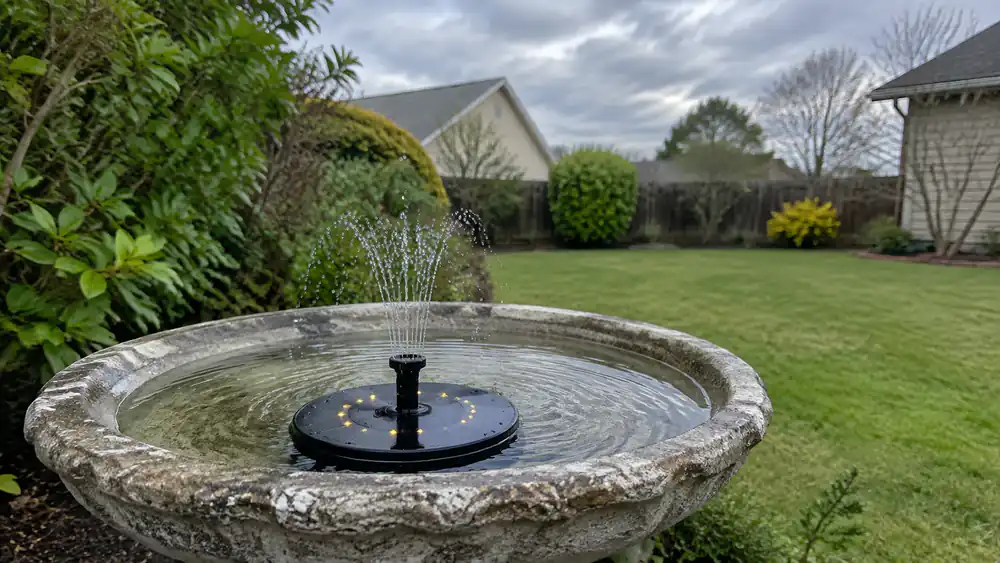
Illustrative garden scene; not a recorded cloudy-weather test of SP33D or SP32D.
A solar bird bath fountain with battery backup can give a retail assortment a distinct evening or illuminated option. For a wholesaler or purchasing team, however, the decision is not simply whether a larger battery sounds better. It is whether the selected configuration supports the experience described on the package, under conditions that the customer can realistically provide.
The battery is a buffer, not an unlimited second power source. It must first receive enough solar energy, and useful runtime depends on the charge collected, pump demand, LED use, control mode, temperature and battery condition. Compare the complete system, then verify the sample and the wording you intend to sell with it.
This guide concerns compact floating fountains for bird baths and decorative bowls. For the wider assortment decision, start with the solar fountain buying guide.
When Does Battery Backup Make Sense for a Retail Assortment?
Consider a battery configuration when limited evening use or decorative LEDs are part of the product proposition, or when the specified controller supports operation through short changes in light. This offers a different feature set from a simple daylight fountain, but also requires clearer charging instructions and battery-related support.
Consider a direct-drive option when customers primarily want daytime water movement in reliable sun, without a night-lighting promise. Flow changing with sunlight should be explained as normal operating behavior, not hidden until a support complaint arrives.
| Assortment decision | Direct-drive option | Battery + LED option |
|---|---|---|
| Main product experience | Water movement while sufficient sunlight is available | Supported pump and lighting modes using collected energy |
| Cloud or shade message | Flow may weaken or stop | Limited operation may be possible if charged and supported by the controller |
| Evening message | No stored-energy promise | State the actual mode and qualified runtime |
| Support preparation | Sunlight, water level, nozzle and cleaning guidance | The same guidance plus charging, controls and battery-service information |
| Quotation comparison | Confirm the supplied fountain and accessory set | Also confirm the battery and lighting configuration |
Avoid assuming a fixed price difference or profit advantage. Obtain quotations for the actual models, packaging and quantities. Battery supply documentation, retail instructions and service arrangements should form part of that comparison.
How a Solar Fountain With Battery Handles Changing Light
A direct-drive fountain sends the available panel output to the pump. Bright sun may produce normal flow; a passing cloud may weaken or stop the spray. A battery model adds stored energy, but its behavior depends on the controller. Some modes may use the battery, reserve energy for lighting, or respond differently to changing light.
Confirm whether the chosen model charges while pumping, how its evening mode starts, and whether a user action is required. Do not transfer a switching sequence from another fountain to the model being purchased. See the cloudy-weather and shade checks for a practical way to describe the use conditions.
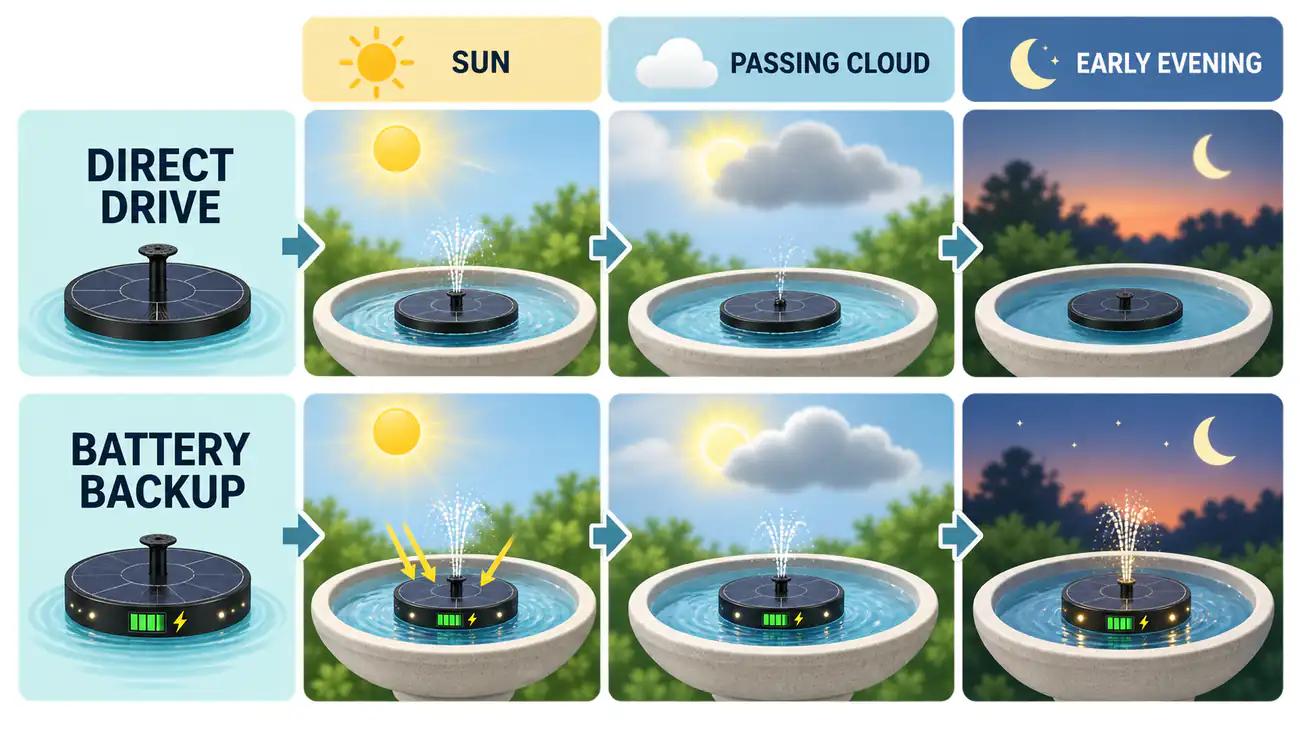
Operating-concept illustration. The battery icon is explanatory, not a product display. The image does not establish a particular model’s appearance, runtime or switching behavior.
Several poor charging days, shade across the panel or a dirty panel can leave little stored energy. A battery cannot provide indefinite operation in permanent shade. It also cannot correct an unsuitable basin, a clogged intake or excessive overspray.
Compare SP33D and SP32D by Configuration
The table uses published NEWSKYPOWER specifications. These are model references for sample selection, not independent measurements or a claim that the two models were tested under identical conditions.
| Item | SP33D | SP32D |
|---|---|---|
| Listed disc diameter | 16 cm | 16.5 cm |
| Monocrystalline panel | 3.5 W | 3.5 W |
| Listed lithium battery | 1,200 mAh | 1,800 mAh / 3.7 V |
| Lighting | 8 LEDs, 7 colors | 32 RGB LEDs |
| Nozzles | 7 | 7 |
| Listed spray height | 10–20 inches | 10–18 inches |
| Listed night backup | 4 hours | 4 hours |
| Principal comparison | Light presentation and operating modes | RGB presentation and operating modes |
Both pages list DC brushless motors and four stabilizing arms. Check the arm range against the intended basin. These NEWSKYPOWER fountains require a minimum operating water depth of 3 cm (about 1.2 inches); keep the operating depth at or above 3 cm throughout use. Neither disc size nor spray height establishes a universal compatible bowl diameter.
Use the two configurations to discuss the desired visual effect, not to declare one automatically better. More LEDs change the presentation and may change energy demand. They do not prove a longer illuminated display. Likewise, the common 3.5 W panel rating does not mean the systems have identical charging behavior.
What Does Battery Capacity Tell a Buyer?
mAh describes charge capacity, not energy by itself. For a nominal energy calculation, multiply battery voltage by capacity in amp-hours. SP32D's listed 3.7 V and 1,800 mAh give 3.7 × 1.8 = 6.66 Wh of nominal energy. That calculation is not a runtime test or the energy available at the pump.
SP33D's published capacity is 1,200 mAh; obtain its battery voltage before comparing nominal energy. Do not assume the voltage from SP32D. Even when nominal Wh is known, usable energy depends on controller limits, conversion losses, battery condition and the combined pump/LED load.
A buyer comparing runtime should request the battery specification, the active operating mode and a defined test method. Do not divide nominal Wh by panel watts to claim either charging time or running time: panel rating, charging power and operating load describe different parts of the system.
Evaluate the Four-Hour Night-Backup Reference
The product pages list four hours of night backup. Before using this figure in a retail listing, establish the conditions: charging period, sunlight, starting charge, water level, nozzle, pump mode, LED mode, temperature and the criterion for “finished.” A light remaining visible is not necessarily the same as the pump continuing to produce an acceptable spray.
For sample evaluation, agree on a record such as this:
| Stage | What to record | Why it matters |
|---|---|---|
| Sample identification | Model, label, supplied accessories and version | Makes observations traceable to the product ordered |
| Charging | Date, sun/shade exposure, duration and whether the pump was operating | Defines how energy was collected |
| Starting state | Charge indication if available, selected mode and water level | Avoids comparing different starting conditions |
| Run observation | Nozzle, LED mode, pump behavior and timestamps | Distinguishes light operation from useful water flow |
| End condition | Pump stop, light stop or another agreed criterion | Gives the runtime figure a consistent meaning |
| Repeat observation | The same method on further occasions | Shows variation instead of relying on one favorable demonstration |
Keep the results with the approved sample. These are proposed purchasing checks, not a claim that a particular test has already been performed. If the sample does not support the proposed sales statement, change the statement or the selected configuration before approving packaging.
Check Water Containment Before Comparing Evening Effects
Battery operation can make an unsuitable spray last longer; it does not make the basin wider. Match the disc, stabilizing arms, water depth and spray landing area together. Start with a low nozzle and refill before the operating water depth falls below 3 cm.
Use the birdbath size and water-depth checklist when selecting a basin or preparing a compatibility chart. For water leaving the bowl, follow the nozzle and centering checks. Do not promise that a battery feature reduces the need for refilling or cleaning.
Prepare Battery Documentation, Instructions and Service Questions
Before committing to a bulk order, request battery identification and the product documents needed for the intended destination and shipping route. Ask which current documents apply to the actual supplied battery and assembled product. A website statement or a document for another configuration is not enough to establish the documentation for your order.
The operating instructions should explain first use, control behavior, sunlight needs, water checks, cleaning and storage according to the model instructions. Confirm whether any parts are intended for user replacement. Do not advertise a removable battery or tell customers to open a sealed housing without the manufacturer's procedure.
Agree on how a distributor should report declining runtime: model and batch information, purchase date, photos, charging conditions and mode used. Confirm available service parts and commercial terms rather than assuming a fixed battery life, replacement schedule or warranty. For routine dirt and blocked nozzles, use the cleaning guide; for unresolved operation problems, use the troubleshooting guide.
Keep Retail Wording Consistent With the Sample
A useful description identifies the model and explains the condition behind the benefit. For example: “Battery-supported evening lighting; operating duration depends on prior solar charging and selected mode.” A quantified claim should use the agreed model-specific test conditions alongside it.
Avoid “works all night,” “runs in permanent shade,” or “larger mAh guarantees longer runtime” unless the exact claim is supported for the supplied configuration and conditions. Do not describe the controller as automatic in every situation simply because the product has a battery.
Compare the package, online listing, instruction sheet and supplier quotation together. If each describes a different operating mode, the sample has not yet become a clear purchase specification.
Compare Battery Fountain Configurations for Your Order
Use the inquiry entry in the NEWSKYPOWER solar fountain range and include SP33D or SP32D, destination market, quantity, preferred lighting effect, expected use conditions and sample requirements. Add the documentation, instruction language and packaging information you need.
Return to the main buying guide if you are still deciding how battery models fit beside the daylight range. A technical support request should instead include the existing model and observed symptoms, rather than being presented as a new order.
Frequently Asked Questions
1. Is battery backup worth including in a wholesale assortment?
It can be when limited evening operation or LEDs provide a relevant product choice. Compare the intended benefit, sample behavior, documentation and service requirements with the daylight alternative; do not decide from battery size alone.
2. Will a battery-powered birdbath fountain work on cloudy days?
It may continue for a limited time if it has enough stored energy and the controller permits that mode. Continued cloudy conditions can reduce charging and eventually exhaust the reserve.
3. Can SP33D or SP32D run all night?
The published night-backup figure is four hours, not an all-night guarantee. Confirm charging and mode conditions and check the selected sample before making a retail runtime statement.
4. Does a larger mAh number always mean longer runtime?
No. Compare voltage, nominal and usable energy, pump and LED load, controller behavior and test conditions. A larger charge-capacity number is not a complete runtime comparison.
5. Can SP33D and SP32D be compared in watt-hours?
SP32D's published 3.7 V and 1,800 mAh calculate to 6.66 Wh nominally. Obtain SP33D's battery voltage before making the equivalent calculation. Neither value, by itself, predicts usable spray duration.
6. Does the battery charge while the fountain pumps?
Ask for the selected model's charging and operating logic. Do not assume simultaneous charging or energy allocation from another product, and record the actual mode used in a sample evaluation.
7. Can end users replace the battery?
Confirm the model-specific service instructions. Do not promise routine user replacement or recommend opening a sealed electrical housing without an authorized procedure.
8. Does battery backup make a fountain better for birds?
The battery mainly changes operating continuity and lighting possibilities. Shallow access, stable footing, clean water and a contained gentle spray remain the important birdbath considerations.
9. What should accompany a battery sample request?
Specify the model, market, quantity, lighting preference and intended use. Request operating instructions, battery identification, applicable product documents and the conditions behind any runtime figure.
10. What should a distributor do when runtime becomes shorter?
First record charging conditions, modes, water level and cleanliness. For these NEWSKYPOWER fountains, keep at least 3 cm of operating water depth; a battery does not remove that requirement. Follow the model's maintenance instructions and send the supplier a traceable support record if the issue persists. Do not assume every short run is a defective battery.