


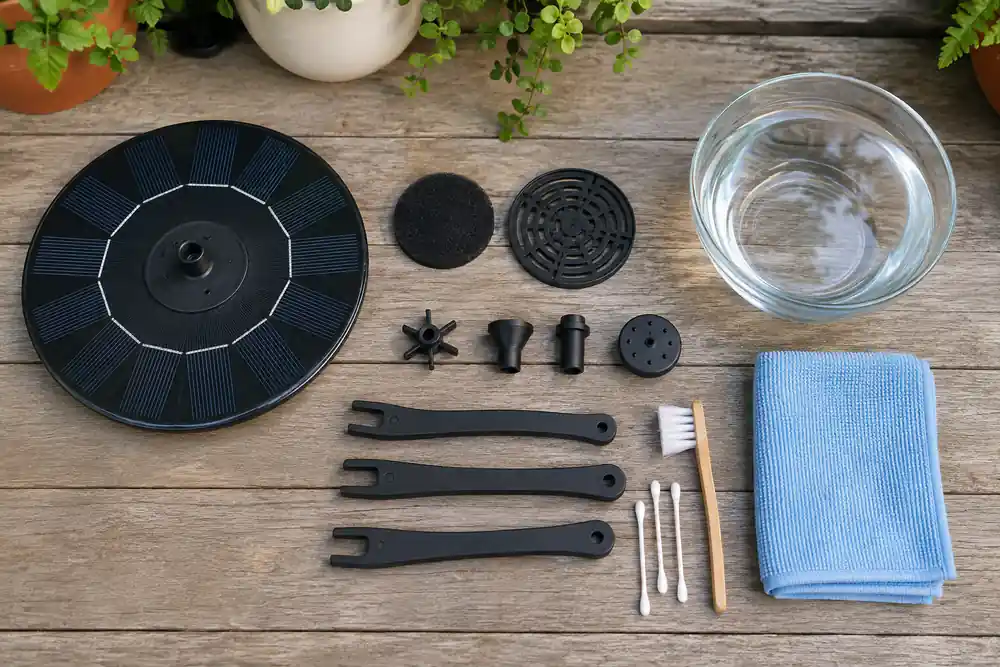
General cleaning illustration. It does not identify the parts that may be removed from a particular model.
To learn how to clean a solar fountain pump, use a simple sequence: stop the power, remove the fountain from the bird bath, rinse loose debris, clean only the user-serviceable intake, filter, impeller, nozzle, and panel, then rinse and reassemble. Never work on a pump while the panel is powering it.
Regular bird bath fountain maintenance protects both water quality and pump performance. Feathers, pollen, algae, mineral scale, and leaves can restrict a small impeller quickly. Cleaning also gives you a chance to inspect water level, cracked parts, and blocked openings before they cause a complete stop.
Retailers and distributors can use this sequence to explain routine care, but the service limits must come from the exact model manual. A useful support sheet distinguishes what a customer may rinse, what may be removed, and when the unit should be referred to the supplier.
How Often Should You Clean a Solar Bird Bath Fountain?
Check the water every day or two during hot weather and whenever many birds use the bath. Remove visible leaves and feathers immediately. Empty and scrub the basin at least weekly for mosquito control; the CDC includes bird baths in its weekly container-cleaning advice.
The pump may need cleaning more often during pollen season, algae growth, hard-water deposits, or heavy bird activity. A weak, uneven, or noisy spray is a useful signal. Do not wait for the pump to stop completely.
Supplies to Use and Products to Avoid
Prepare clean water, a soft cloth, a small soft brush, cotton swabs, and a shallow tray for removable parts. Keep the model instructions nearby so you know which covers, filters, and impeller parts are designed to come off.
For the bird-bath basin, Audubon recommends nine parts water to one part vinegar and avoiding synthetic soaps or cleansers. Rinse thoroughly before refilling. For the pump and solar unit, use only methods allowed by the manufacturer; vinegar or descaler should never be allowed to soak a battery, controller, cable connection, or unknown seal.
Avoid abrasive pads, metal brushes, high-pressure spray, bleach mixtures not specified by the product maker, household insecticides, essential oils, and oily cleaners. Residue can affect birds or damage plastics, coatings, seals, and the panel surface.
Clean Solar Bird Bath Fountain Components in Seven Steps
1. Shut Down and Remove the Fountain
Stop the pump using the shutdown procedure in the model instructions. For a direct-drive model, covering the entire solar panel with an opaque towel or moving it out of light can stop solar power reaching the pump. For a battery-equipped model, covering the panel alone may not stop the pump because the battery stores energy. Confirm the pump has stopped before putting fingers or a brush near moving parts.
Lift the fountain gently and keep track of nozzles, stabilizing arms, filter pieces, and covers. Do not pull a separate-panel pump by its cable. Pour out the old bird-bath water and remove loose debris from the basin.
2. Clean the Solar Panel
Rinse off loose dust and pollen, then wipe the panel with clean water and a soft cloth. Dried bird droppings or mineral spots may need time to soften rather than aggressive scraping.
Inspect for cracks, cloudy areas, lifted edges, or water trapped where the manual says it should not be. Cleaning restores exposed surface area, but it cannot repair physical or electrical damage.
3. Clean the Intake and Filter
Remove the intake cover or filter only as shown in the instructions. Rinse away leaves, feathers, hair, algae, and sediment. Use a soft brush to clean slots without enlarging them.
If the fountain uses filter foam, rinse it gently in clean water. If it remains compressed, torn, or blocked after washing, ask for the compatible replacement specified for the model. Do not substitute dense material that starves the pump of water.
4. Clean the Impeller Chamber
The impeller is the small rotating part that moves water. Open a cover only if the exact model manual identifies it as user-serviceable. Remove the impeller only if that procedure is explicitly shown, noting its direction and any shaft, cap, or washer. If the manual does not show impeller removal, limit cleaning to the approved accessible parts and ask the supplier for guidance.
Rinse sludge and solar fountain pump algae from the chamber and magnet with a soft brush or cotton swab. Mineral buildup may require a manufacturer-approved mild descaling method. Never bend a ceramic shaft or force an impeller that is held by a part you have not identified.
Before reassembly, the impeller should turn freely without visible debris. A cracked magnet, worn shaft, or damaged blade may require a replacement part rather than more cleaning.
5. Clean the Outlet and Nozzles
Separate the nozzle pieces and rinse them from both directions. Soak only removable non-electrical pieces when the instructions allow it. Use a soft brush or wooden toothpick cautiously; metal wire can enlarge a jet opening and change the spray pattern.
Check the outlet tube for algae or mineral scale. A clear pump with a blocked nozzle can still produce a weak, sideways, or uneven spray.
6. Scrub and Rinse the Bird Bath
Scrub the basin, rim, and any stones or perches. Pay attention to the waterline and textured surfaces where biofilm collects. Discard the dirty water away from feeders and places where birds gather.
Rinse until no cleaning odor or visible residue remains. Refill with fresh water. For the NEWSKYPOWER AS01A, AS10B, SP33D and SP32D fountains covered here, restore at least 3 cm (about 1.2 in) of water at the pump location. Maintain that minimum throughout operation and refill before the depth falls below 3 cm. Preserve shallow access for birds separately; the pump operating depth is not a recommendation for the entire bird-bathing area.
7. Reassemble and Test
Reinstall only the parts you were permitted to remove, following the model's assembly order. Do not force clips or overtighten small plastic parts. Place the unit in the water before uncovering the panel or switching it on.
If water does not appear immediately, stop and release trapped air by tilting the submerged pump gently. If permitted by the instructions, test first without the decorative nozzle. Once flow is stable, reinstall a low spray pattern that stays inside the basin. Use the spray-containment checks if droplets continue to fall outside the rim.
Reduce Algae, Debris, and Mineral Buildup
Place the bird bath away from heavy leaf fall and avoid positioning it directly beneath feeders, while maintaining suitable sun for the solar panel. Keep the water fresh, remove debris promptly, and use a low spray that does not constantly deposit hard-water droplets on the panel.
Do not depend on chemical additives as a substitute for cleaning. For hard water, more frequent rinsing or using water recommended by the manufacturer may reduce scale. Never add a chemical merely because it is marketed for ponds; a small bird bath has different volume and wildlife exposure.
Signs That Cleaning Is Not Enough
Cleaning may not solve a cracked panel, damaged cable, failed controller, swollen or depleted battery, broken shaft, or worn motor. Stop using the product if insulation is damaged, a sealed housing opens, parts overheat, or water enters a location that should remain dry.
If the clean, submerged pump still fails in strong sunlight, use the fountain troubleshooting guide, record the model and completed checks, and contact the supplier. Do not open sealed battery or electronic compartments simply to continue diagnosis.
A Safe Cleaning Routine Keeps the Fountain Useful
To clean a solar fountain pump safely, remove power first, separate only approved parts, use gentle tools, and rinse thoroughly. A short routine performed before flow becomes weak is easier than clearing a fully blocked impeller.
Clean water, an open intake, a free impeller, and an exposed solar panel support reliable operation without introducing unnecessary chemicals into a bird bath.
A Model-Specific Maintenance Sheet for Distributors
Prepare the sheet from the sample supplied for the order, not from a generic exploded-view drawing. Photograph the external intake, the identified service cover, and the permitted removable parts with their names. Keep sealed electronic and battery areas visibly separate from customer-maintenance steps. If a part's service status is unclear, obtain the supplier's written instruction before adding a removal step.
For each model, the sheet should state the safe shutdown method, the cleaning method, the reassembly order and the point at which the customer should stop and request support. Translate these instructions consistently with the approved source, especially negative instructions such as “do not immerse” or “do not remove.” A language change must not change the permitted service scope.
| Item to confirm before approving the order manual | Record to keep |
|---|---|
| Product identity | Model, version and matching sample or order reference |
| Permitted cleaning access | Supplier-confirmed photograph and instructions for each serviceable part |
| Power isolation | Procedure for the selected direct-drive or battery-equipped design |
| Cleaning materials | Approved methods for the basin, pump parts and panel separately |
| Reassembly and restart | Order of parts, at least 3 cm (about 1.2 in) of operating water depth for the NEWSKYPOWER models covered here, and restart steps |
| Escalation | Damage signs and information required for supplier review |
These are preparation checks, not a claim that every model has the same removable filter or impeller. For AS01A, AS10B, SP33D and SP32D enquiries, quote the exact name on the supplied product or order and ask for the corresponding document.
Agree Spare Parts and Keep a Short Service Record
Before promising a maintenance kit to customers, ask which nozzles, filters, intake covers or pump assemblies are available for the ordered version. Confirm the part reference, compatibility, approved fitting method, who may carry out replacement, order conditions and availability. Do not sell a visually similar part as a confirmed substitute.
A service record can be short: model and batch reference if available; complaint; water and light conditions; photograph before cleaning; parts actually cleaned; restart result; and any damage found. Keep the customer's original symptom separate from the support team's conclusion. “Weak flow improved after cleaning” is useful evidence; “all weak-flow returns are caused by dirt” is not.
For sample approval, ask a colleague to follow the maintenance sheet, then check whether they can reassemble the permitted parts and restart the sample correctly. Record unclear steps and resolve them with the supplier. Do not open sealed compartments, introduce chemicals or force a blockage to create a demonstration fault.
Request the Right Kind of Support
For an existing NEWSKYPOWER product, request model-specific maintenance information. Start the message with “Maintenance support” and include the model, order reference if available, photographs and the cleaning steps already completed. For another brand, request its own service instructions rather than assuming a NEWSKYPOWER procedure applies.
For a new bulk order, discuss manuals and spare parts and identify the target market, candidate model, expected quantity, required languages and proposed support items. Confirm the commercial terms during the quotation process. The fountain buying guide and available model range provide the next step for selecting the assortment.
Related Maintenance and Product Knowledge
Use the fountain working-principle guide when training staff to distinguish the panel, pump and battery functions. The bird-friendly fountain guide explains access and gentle flow, while the mosquito and water-care article explains why running a fountain does not replace regular basin maintenance.
Frequently Asked Questions
Can I clean a solar fountain pump without taking it apart?
You can rinse the exterior and intake, but debris often collects behind the intake cover and around the impeller. Open only the sections identified as user-serviceable in the manual.
Is vinegar safe for a solar bird bath fountain?
Diluted vinegar is commonly used for bird-bath basins, followed by thorough rinsing. Its use on pump parts depends on materials and instructions. Keep it away from batteries and electronics.
How do I clean algae from a tiny impeller?
Stop power, remove the service cover and impeller as instructed, then use clean water, a soft brush, and cotton swabs. Do not scratch the magnet or bend the shaft.
Why is the spray still weak after cleaning?
Check direct sunlight, trapped air, nozzle restriction and battery charge. For the NEWSKYPOWER models covered here, water at the pump must be at least 3 cm (about 1.2 in) deep throughout operation. A worn impeller or motor may need service if all external conditions are correct.
Can I use dish soap in the bird bath?
Audubon advises avoiding synthetic soaps and cleansers because residue may affect bird feathers. Use its diluted-vinegar basin method or the product maker's approved procedure, then rinse completely.
Can the same cleaning sheet be supplied with every model?
Only if the permitted procedures and parts actually match. Confirm the model and version, shutdown method and serviceable components before reusing a sheet. A general illustration is not a substitute for a model manual.
Does a battery-equipped pump stop when its panel is covered?
Not necessarily. Stored battery energy can still power the pump. Use the model's shutdown procedure and confirm moving parts have stopped before handling them.
What should a distributor ask about replacement filters or nozzles?
Ask for exact part references, compatible models, approved fitting instructions and ordering conditions. Confirm availability before offering a spare-parts kit to customers.
What should be recorded if cleaning does not restore flow?
Record the model, water level, light conditions, parts cleaned and result after reassembly. Send photos or a short video and stop further dismantling unless the supplier provides an approved service procedure.
How can a buyer check whether the maintenance instructions are usable?
Have a colleague follow them with the approved sample. Check that the shutdown, allowed cleaning, reassembly and restart are clear. Correct missing or ambiguous steps before approving the order's instructions.