

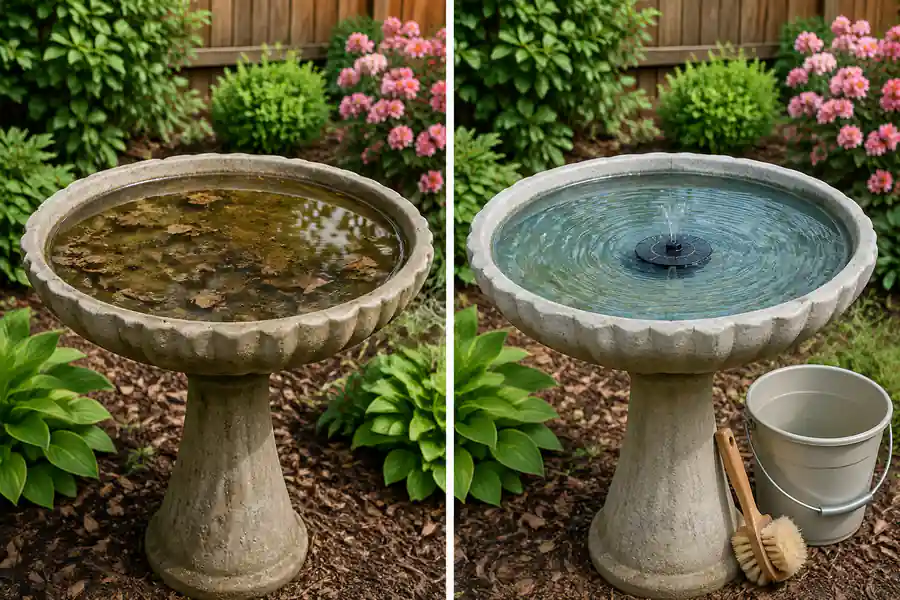
Illustration of the operating or setup concept; not a measured performance test or a guarantee of wildlife behavior.
Solar bird bath fountains may make the water surface less attractive for mosquito egg laying while they are running, but they do not guarantee a mosquito-free bird bath. The pump may stop at night, in shade, or under clouds; calm corners can remain; and eggs can adhere near the waterline. Regular emptying, scrubbing, refilling, and removal of other standing water are still required.
So, do solar bird bath fountains keep mosquitoes away? Treat moving water as one supporting measure, not complete control. The CDC recommends emptying and scrubbing bird baths and other water-holding containers once a week because removing water alone may leave eggs attached to container surfaces.
Why Mosquitoes Use Still Water
Mosquitoes need water for their immature stages, but species differ in where and how they lay eggs. Small protected containers around homes can become breeding sites when water remains long enough. Bird baths, flowerpot saucers, buckets, clogged gutters, toys, and tarps all deserve attention.
A still surface and sheltered edge can make a container suitable. Water movement can reduce calm surface area, but a fountain does not clean the basin wall or remove eggs and organic material. This is why moving water mosquito prevention must be combined with physical maintenance.
When a Solar Fountain Can Help
A low bubbler or contained fountain can create ripples across much of a small bird bath. While the pump runs, that disturbance may make the surface less suitable for egg laying than completely stagnant water. It also keeps the water visually active for birds.
For a useful fountain setup, check these points:
- Water movement reaches most of the basin rather than only the center.
- The pump operates during much of the time the bath contains water.
- Leaves, algae, and debris are removed before they create calm pockets.
- The basin is still emptied and scrubbed on schedule.
The goal is not the tallest spray. A gentle pattern that circulates the surface and stays inside the rim is more useful than a high jet that rapidly empties the bowl.
Why Daytime Movement Is Not a Complete Solution
Direct-drive solar fountains slow or stop when useful sunlight falls and normally stop at night. Battery models may provide limited operation from stored energy, but runtime depends on charging and mode. Neither design should be described as providing continuous mosquito control.
Even during operation, the area behind stones, beneath debris, near a clogged intake, or along an uneven waterline may remain calm. A weak or stopped pump can leave the bath stagnant for long periods.
This is the central limitation behind searches for bird bath fountain mosquitoes: owning a fountain does not eliminate the maintenance that prevents the basin from becoming a breeding container.
Empty and Scrub the Bird Bath Weekly
The CDC home mosquito-control guidance includes a weekly routine of emptying and scrubbing water-holding items such as bird baths. This is not an instruction to leave dirty bird-bath water unchanged for a week: refresh it sooner when it becomes soiled, and follow local public-health advice.
Use this sequence:
- Switch off and isolate the fountain as instructed for that model. Covering the panel alone may not stop a battery-powered pump.
- Remove the pump and user-removable accessories.
- Empty the old water away from bird feeding areas.
- Scrub the basin, rim, stones, and textured surfaces.
- Rinse thoroughly and refill with fresh water.
- Clean the pump intake, filter, impeller, nozzle, and panel as instructed.
- Reinstall the pump and confirm that water moves across the basin.
Audubon recommends a bird-bath cleaning mixture of nine parts water to one part vinegar and advises avoiding synthetic soaps or cleansers. The pump and solar components should only be cleaned with methods approved for their materials.
Keep Mosquitoes Out of Bird Bath Water Between Cleanings
To keep mosquitoes out of a bird bath, remove debris when it appears and refresh water more often during hot weather. Check that the fountain is not blocked and that the water level stays above the pump requirement. The NEWSKYPOWER fountain models covered here require at least 3 cm (about 1.2 inches) of operating water depth. Keep it at or above 3 cm during operation and refill before it drops below this minimum. Do not infer low-water protection from the presence of a solar panel or battery.
Keep the spray inside the basin. A fountain that empties the bowl creates puddles nearby, which defeats the purpose. Level the bird bath and use a low pattern that reaches the surface without throwing fine droplets into surrounding containers or vegetation.
Also inspect the entire yard weekly. The CDC lists many common water holders beyond bird baths. Cleaning one fountain will not solve mosquitoes developing in a bucket, saucer, gutter, toy, tire, tarp, or uncovered storage container.
Safe Mosquito Management Around Birds
Physical source reduction is the first choice for a small bird bath: empty, scrub, refill, remove debris, and eliminate nearby standing water. These steps avoid turning the bird bath into a chemical treatment container.
Do not add household insecticide, bleach, dish soap, essential oils, or an unlabeled pond product to water used by birds. If a water container cannot be emptied and requires larval control, in the United States use only an EPA-registered product labeled for that site and follow its directions. In other markets, follow the applicable local authority and product-label requirements. A typical bird bath is usually easier to empty and scrub.
Keep pets and children in mind as well as birds. “Natural” does not automatically mean safe at an unknown concentration.
Common Mosquito Myths
“Any movement kills mosquito larvae.” Water movement may discourage egg laying, but it is not a treatment guarantee and may not reach every area.
“A solar fountain runs all the time.” Direct-drive products depend on sunlight, and batteries have limited stored energy.
“Changing water is enough.” Scrubbing the inner wall and waterline helps remove attached eggs and biofilm.
“A stronger spray provides better control.” Excessive spray wastes water and may create nearby puddles. Broad gentle surface movement is more practical.
“The bird bath is the only source.” A small hidden container elsewhere in the yard can hold enough water to matter.
Balance Mosquito Prevention With Bird-Friendly Design
The bath still needs shallow access and secure footing. Cornell Lab recommends about 1 inch (2.5 cm) at the edge and no more than about 2 inches (5 cm) in the center, with a gradual slope. Stable stones can provide shallow standing areas but must be removed and scrubbed because debris collects around them.
Use a low fountain pattern that leaves calm drinking space without leaving the entire surface stagnant. Keep the bath visible to birds and away from dense predator cover, heavy leaf fall, and feeder debris.
Clean water supports both goals: a healthier bird resource and fewer opportunities for mosquitoes.
Keep Retail Claims Separate From Maintenance Advice
Retailers and distributors can describe the visible water movement and the specified solar operating mode. Do not turn these features into a claim that a fountain kills larvae, repels adult mosquitoes or prevents mosquito-borne disease. Battery backup is an energy feature, not evidence of pest-control efficacy.
A practical instruction card should explain how to stop the exact model, remove user-serviceable parts, empty and scrub the basin, rinse it, and restart safely. Keep the maintenance reminder beside the operating instructions so a customer does not assume that a running pump removes the need to clean. Where a photograph shows a clean flowing bath, do not label it as a measured “before and after mosquito test” without actual evidence.
If a customer reports mosquitoes, ask about water replacement, basin cleaning and nearby standing water; do not automatically offer a stronger fountain as the solution. For an equipment problem, collect the model, operating conditions and a short video and use the fountain troubleshooting guide. Public-health or pesticide questions should follow local authority and product-label guidance, rather than a pump sales promise.
Make the Maintenance Routine Easy to Follow
A maintenance log can be simple: date the water was emptied, whether the rim and removable stones were scrubbed, whether the intake was clear, and whether the fountain restarted in suitable light. These entries document care, not a laboratory measure of mosquito control. Do not use the absence of visible insects on one visit as proof that a product prevents breeding.
For a store display, assign someone to check the water and equipment before opening. If the display is taken out of use, empty the bowl and other water-holding accessories instead of leaving a stopped fountain in standing water. When demonstrating a battery model, show the actual off procedure; blocking sunlight may leave stored-energy operation active.
For model-specific steps, use the pump cleaning and maintenance guide. Check bird-friendly access and basin size and operating depth together before choosing a display bowl. The solar fountain buying guide and current fountain range cover configuration selection; neither should be used as evidence of mosquito-control performance.
Use Movement and Maintenance Together
The accurate answer to “do solar bird bath fountains keep mosquitoes away?” is that moving water can help reduce attractive stagnant conditions while the pump operates, but it is not complete prevention. Solar operation changes with light, and calm or dirty areas can remain.
Keep a gentle flow across the basin, then empty and scrub the bird bath weekly. Clean the pump, control overspray, and remove all other standing water nearby. That combined routine is more reliable than any claim that a fountain alone prevents mosquitoes.
Frequently Asked Questions
Will moving water kill mosquito larvae already in the bird bath?
Do not rely on the pump to kill larvae. Empty and scrub the basin, rinse it, and refill with fresh water. Also inspect nearby containers.
How often should bird-bath water be changed?
The CDC recommends emptying and scrubbing water-holding containers such as bird baths once a week. More frequent refreshing may be appropriate in hot weather or heavy use.
Does a battery solar fountain provide better mosquito prevention?
It may extend movement beyond current sunlight when charged, but it still has limited runtime and cannot replace weekly maintenance.
Can I add vinegar to the water and leave it there?
Use diluted vinegar as a basin-cleaning method, then rinse thoroughly. Do not leave a cleaning solution as the birds' drinking and bathing water.
Are mosquito dunks safe for a bird bath?
In the United States, use a pesticide or larvicide only if its EPA-approved label allows that site and follow the label exactly. Elsewhere, follow local requirements and the specific label. For a small bird bath, weekly emptying and scrubbing is usually the simpler first approach.
Can the fountain create mosquito puddles outside the bowl?
Yes. Overspray can collect in saucers, low spots, tarps, or containers. Reduce the spray and remove any nearby standing water.
Can a retailer label a solar fountain as a mosquito repellent?
A water-moving feature is not proof of repellency or disease prevention. Describe the specified fountain function and provide cleaning guidance; do not substitute a sales claim for evidence of pest-control performance.
Is a weekly scrub the same as changing water only once a week?
No. Weekly scrubbing is a maintenance routine, not permission to keep soiled water. Refresh dirty water promptly and follow the care guidance appropriate to the location and use.
Does covering the solar panel always stop the pump for cleaning?
No. A battery model can continue using stored energy. Follow its actual off and isolation procedure before handling the pump or putting hands near moving parts.
What should be included in a distributor’s maintenance card?
Include the model-specific stop procedure, emptying and scrubbing steps, refill checks, removable parts and a clear reminder that water movement does not replace cleaning. For the NEWSKYPOWER models covered here, specify a minimum operating water depth of 3 cm (about 1.2 inches), maintained while the pump runs. Direct pesticide questions to local authority and label guidance.