

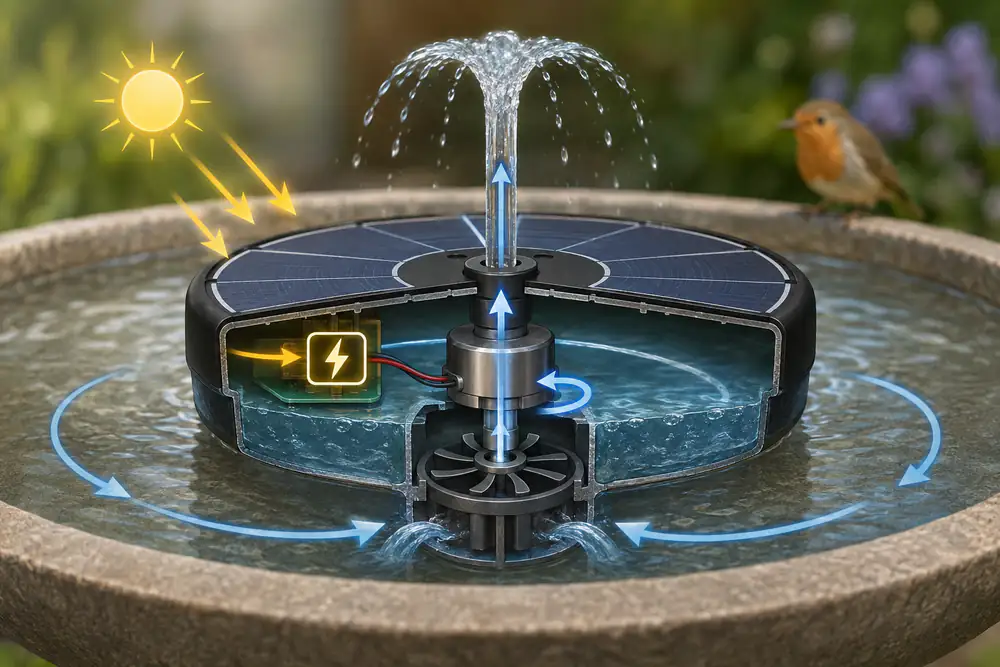
Illustration of the operating or setup concept; not a measured performance test or a guarantee of wildlife behavior.
How do solar bird bath fountains work? A photovoltaic panel converts light into electricity, a small DC motor turns an impeller, and the impeller draws water from the basin and pushes it through a nozzle. The water falls back into the same bowl and circulates again. Some models run directly from current sunlight; others add a rechargeable battery and controller.
No household water connection is needed because the fountain recirculates basin water. No grid wiring is needed for a self-contained solar model. However, water is still lost through evaporation, wind, and bird splashing, so the basin must be refilled and cleaned.
What Is a Solar Bird Bath Fountain?
A solar powered bird bath combines a shallow basin with a compact solar fountain pump. The pump creates ripples, a bubbler, or a decorative spray that may help birds notice the water. Floating models integrate the panel and pump in one disc; separate-panel models connect a submerged pump to a panel placed nearby.
The term describes the power source, not guaranteed behavior. A direct-drive fountain depends on current light and stops at night. A battery-equipped fountain may store some energy, but its runtime still depends on charging, mode, temperature, battery age, and load.
Solar Fountain Pump Explained: The Main Components
Understanding five parts makes the system easier to choose and maintain:
- Solar panel: Photovoltaic cells convert light into direct-current electricity. Output changes with sunlight intensity, panel angle, temperature, dirt, and shade.
- Controller: Simple direct systems may provide basic power regulation. Battery models use additional control logic to manage charging, discharge, lighting, and protection functions.
- DC motor and impeller: The motor spins the impeller, which creates water flow through the pump chamber.
- Intake, filter, and outlet: Water enters through the intake, debris may be caught by a filter, and pressurized water exits toward the nozzle.
- Nozzle: Different openings change the spray pattern and restriction. A taller or wider pattern can increase water loss.
Across solar-fountain designs, batteries, LEDs, stabilizing arms and separate-panel cables may be present. This is a component overview, not a supplied-parts list for every model. Do not infer a remote control, water sensor or dry-run protection from the words “solar fountain.”
How Water Circulates Through the Bird Bath
When enough electricity reaches the motor, the impeller rotates and draws water into the pump. The outlet directs it upward through a tube or nozzle. Gravity returns the spray to the basin, allowing the same water to circulate repeatedly.
The system does not create water. Evaporation, wind, and birds gradually reduce the level. If the intake draws air, flow may become weak, noisy, or intermittent. The NEWSKYPOWER fountain models covered here require at least 3 cm (about 1.2 inches) of operating water depth. Maintain at least 3 cm throughout operation and refill before the depth falls below it. A fountain can fit inside a bowl yet still be unsuitable if its intake cannot stay submerged.
The basin should still offer shallower bird access. Cornell Lab recommends about 1 inch (2.5 cm) at the edge and no more than about 2 inches (5 cm) in the middle, ideally with a gradual slope.
What Happens When Sunlight Changes?
The U.S. Department of Energy explains that photovoltaic systems can use direct and diffuse solar radiation, but clouds reduce the available resource. A compact pump makes that change visible: spray may rise in strong sun, become lower under thin cloud, pulse as clouds pass, or stop in deep shade.
A dirty or partly shaded panel can produce similar symptoms. With an integrated floating disc, the panel lies close to horizontal and cannot be aimed separately. The entire surface should remain exposed during intended operating hours.
Changing flow does not automatically mean the pump is broken. Test direct-drive products in strong unobstructed sun before starting a mechanical diagnosis.
Direct-Drive Versus Battery-Backup Operation
Direct-drive: Panel power goes directly to the motor. The design is simple and has fewer energy-storage parts, but flow follows current sunlight closely.
Battery backup: The controller stores some collected energy in a rechargeable battery. Stored energy may smooth short cloud interruptions or support an evening mode, but the pump can use energy faster than weak light replaces it.
Newskypower's AS01A/AS10B products represent direct-drive daytime operation, while SP33D and SP32D include batteries and LEDs. Compare their supported modes and charging requirements in the battery-backup configuration guide. For a runtime comparison, use the same preparation, nozzle and lighting mode rather than comparing battery capacity alone.
Battery models add an energy-storage component whose condition changes with use. Confirm service access, replacement policy and approved maintenance with the supplier for the exact version; do not open a sealed housing based on a generic guide.
Floating Versus Separate-Panel Designs
| Design | How it is arranged | Main advantage | Main limitation |
|---|---|---|---|
| Floating integrated disc | Panel, pump, and nozzle float together | Simple placement with no external cable | Bowl and panel must share the same sunlight; disc needs clearance |
| Separate-panel pump | Pump stays in water while a cable reaches a nearby panel | Panel can be placed in better sun or adjusted separately | Cable, connector, and panel placement add setup and maintenance points |
A floating design suits an open sunny basin and quick installation. A separate panel is useful when the bird bath should remain in partial shade but a nearby location receives sun. This describes an alternative design; confirm availability and compatibility with the supplier rather than assuming it is an option for the listed floating models. Always use the configuration intended by the manufacturer rather than modifying wet-location wiring.
What Nozzles and Stabilizing Arms Do
Nozzles change water shape by restricting and directing the outlet. A small opening may create a taller jet but can clog more easily; removing the decorative nozzle may create a low bubbler. Start with the pattern most likely to stay inside the bowl.
Stabilizing arms limit a floating disc's movement toward the rim. They must fit the usable inside diameter and should not jam against a curved wall. Current Newskypower model pages list multiple nozzles and four stabilizing arms, but compatibility still depends on the basin.
Benefits and Limitations
Benefits
- Cordless installation for integrated models
- Moving water without a household water connection
- Simple seasonal setup
- Choice of bubbler or spray patterns
- Optional battery and LED features
Limitations
- Direct-drive flow changes with sunlight
- Batteries provide limited, condition-dependent storage
- Small intakes and nozzles need regular cleaning
- Wind and tall spray can empty a shallow bowl
- The pump needs operating depth while birds need shallow access
Solar is most useful when variable daytime operation is acceptable. It is not automatically the best choice for deep shade, fixed scheduling, or uninterrupted flow.
Basic Setup and Maintenance
Measure the bowl, provide at least 3 cm (about 1.2 inches) of water for the NEWSKYPOWER models covered here, and begin with the lowest nozzle. Place the panel in direct sun, keep the spray inside the rim, and use compatible stabilizing arms. Refill before the intake is exposed.
Stop power before handling the pump. Clean the panel with water and a soft cloth, remove debris from the intake, and clean the user-serviceable filter and impeller according to the manual. Empty and scrub the bird bath regularly even though water is circulating.
Before freezing weather, follow the manufacturer's storage instructions. Ice can block the impeller or damage housings and seals.
Who Should Choose a Solar Bird Bath Fountain?
It is a good fit for users with useful sunlight who accept weather-dependent flow and want simple movement without fixed wiring. A battery model may suit those who value short cloud buffering or limited evening lighting.
Choose an outdoor-rated electric pump instead when the basin stays in deep shade or requires predictable scheduled flow. Choose a simple still bird bath when regular pump maintenance is not practical; clean water and safe depth matter more to birds than powered movement.
Read the Specification Without Mixing Different Measurements
For a new purchasing team, several familiar-looking numbers can describe different things. Keep the component, unit and test condition together when comparing supplier sheets.
| Term | What it describes | What to ask before comparing |
|---|---|---|
| Solar panel power, W | A panel rating under stated measurement conditions | Which panel and rating conditions apply to the offered version? |
| Pump input power, W | Electrical demand of the pump in a stated operating condition | Is it measured with the proposed nozzle and operating mode? |
| Flow rate, L/h | Volume passing through the pump per unit time | At what lift height and with which outlet arrangement? |
| Maximum head | A pump lift limit under specified conditions | Is it being confused with visible spray height? |
| Spray height | The observed water pattern above the outlet | Which nozzle, light condition and water level produced it? |
| Battery capacity, mAh or Ah | Electrical charge capacity at a specified voltage | What voltage, battery specification and mode apply? |
| Runtime, hours | Time under a particular preparation and load | How was it charged, and were the pump and LEDs both operating? |
A higher panel wattage does not by itself state pump power, spray height or evening runtime. Likewise, maximum head and maximum flow should not be assumed to occur together. Request the conditions behind the numbers instead of copying the largest value into a retail headline.
Build a Model-Specific Training Sheet
Use one sheet for each offered configuration. AS01A/AS10B are the direct-drive examples in this range; SP33D/SP32D are battery-and-LED examples. Confirm the current quotation and supplied instructions before treating a shared feature as standard across the order.
Separate three columns: included in this version, available only if quoted, and requires confirmation. List the pump and panel identity, battery and LED functions, supplied nozzles, stabilizing parts, operating depth and user-serviceable items. Leave uncertain optional functions unpromised until the supplier confirms them in writing.
The training sheet should make three limits easy to explain: sunlight affects direct-drive flow; stored energy is finite; circulation does not replace refill and cleaning. For an in-store demonstration, record the selected nozzle and bowl size alongside any video so the display can be reproduced honestly.
Then connect the explanation to the buyer’s next task. The buying guide covers configuration selection, the cloud and shade checks address variable sunlight, and the troubleshooting guide helps distinguish an unsuitable setup from a fault. Compare actual products through the solar fountain range after those requirements are clear.
How Solar Bird Bath Fountains Work in Practice
The simple answer to “how do solar bird bath fountains work?” is a loop: light becomes electricity, the motor turns an impeller, and basin water moves through a nozzle before falling back. Sunlight, water level, cleanliness, and basin fit determine how well that loop performs.
Buy the operating mode that matches the site rather than the most dramatic spray. Compare current direct-drive and battery-equipped options on the Newskypower solar fountain page.
Frequently Asked Questions
Does a solar fountain store energy automatically?
Only if it includes a battery and charging controller. A direct-drive panel sends current power to the pump and normally stops without useful light.
Does the fountain need a hose?
No. It recirculates water already in the basin, but you must replace water lost through evaporation and splashing.
Why does the spray change height?
Sunlight, nozzle restriction, pump cleanliness, water depth, and wind all affect visible spray. Changing height is normal for many direct-drive models.
Can it work in shade?
Deep shade usually provides too little power for direct drive. A battery can only use previously stored energy and must later receive enough light to recharge.
Do moving fountains keep the bird bath clean?
No. Circulation does not remove droppings, algae, mineral deposits, or mosquito eggs from basin surfaces. Regular emptying and scrubbing remain necessary.
Is panel wattage the same as pump power?
No. Panel rating describes the generation component, while pump input power describes a load. Ask which component each value refers to and under what conditions it was measured.
Is maximum head the same as spray height?
No. A pump lift limit and a visible nozzle pattern are different measurements. Compare nozzle, water level, available power and measurement conditions when evaluating a spray-height claim.
Does every solar fountain have low-water protection?
No such function should be assumed from the product name. Ask for model-specific documentation and operating instructions. For the NEWSKYPOWER fountain models covered here, keep the operating water depth at or above 3 cm (about 1.2 inches), regardless of any protection feature.
Can the battery be replaced by a customer?
That depends on the actual product version and service instructions. Confirm authorized access, compatible parts and the supplier’s procedure; do not open a sealed housing on the strength of a generic online tutorial.
What should accompany a sample sent to a purchasing team?
Request the exact model identification, configuration sheet, nozzle and accessory list, operating-depth instructions and an agreed charging/operation check. This lets technical staff and sales staff describe the same product.