

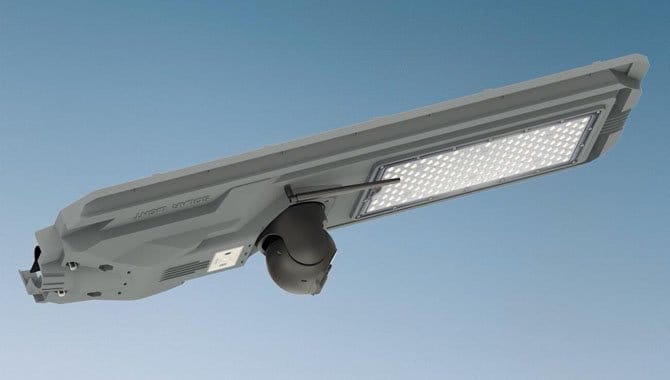
A solar street light with a CCTV camera combines outdoor lighting and site monitoring on one pole. It can simplify deployment where grid power or cabling is difficult, reduce separate mounting components and support remote site awareness. Select the lighting, camera, network and storage as one system, with an energy budget covering their full operating schedules.
Buyers who need lighting and site monitoring in one system can explore our solar street light with CCTV camera range before comparing connectivity, storage and energy requirements.
What Is a Solar Street Light with a CCTV Camera?
It is an integrated outdoor system that combines an LED luminaire, solar panel, battery, controller and CCTV camera on a shared support structure. During the day, the solar panel charges the battery. The lighting usually operates at night, while the camera and communication equipment may also operate during daylight, potentially throughout a 24-hour period. Calculate daily energy from each device’s actual operating schedule, including daytime monitoring, rather than assigning the nighttime lighting hours to every load.
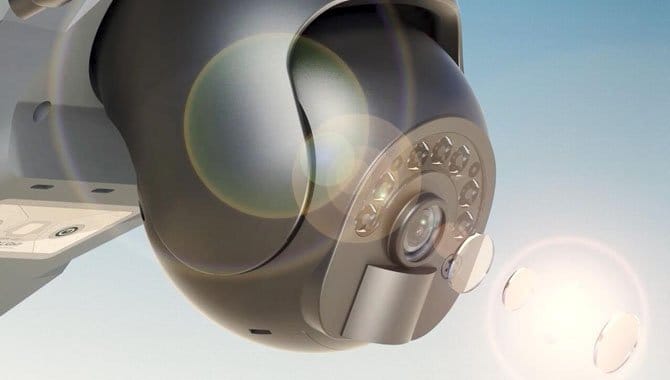
Specify the required camera view, recording mode, local storage and remote-access method. Options may include 4G or Wi-Fi communication and microSD, NVR or cloud storage, depending on the model. The procurement checklist below brings these choices and their supporting evidence together.
Five Practical Benefits
1. Combined Lighting and Site Monitoring
The system places illumination and a visible camera at the same location. This can support remote site awareness, incident review and visible deterrence at gates, yards, roads and other outdoor areas. It does not guarantee the prevention of theft or intrusion, so it should form part of a wider site-security plan where the risk level requires one.
Motion-triggered lighting and camera event recording are separate functions. Confirm whether they use separate detection settings, whether the two functions are linked and what happens to recording when the lamp dims.
2. Easier Deployment Where Grid Power Is Difficult
Because solar power is generated on site, the system can be practical for remote or developing locations where trenching, grid connection or long cable runs are difficult. Installation requirements still depend on the pole foundation, solar access, mounting height, local wind conditions and the communication method selected for the camera.
3. Remote Monitoring When Connectivity Is Available
For remote viewing, alerts or footage review, match the camera platform to the site’s network coverage. Projects needing cellular communication can review a 4G solar street light with CCTV camera and confirm its camera, SIM and platform options with the supplier.
4. Fewer Separate Mounting Components
Using a shared pole can reduce the need for a second camera pole, a separate power supply and some site wiring. The result may be a more compact installation with fewer independent devices around the site. This can simplify planning, but total cost still includes the battery and solar capacity, communication charges, storage, platform services, maintenance and any replacement parts.
5. Flexible Use Across Outdoor Projects
Shared-pole systems can serve access roads, industrial yards, farm entrances, parking areas and temporary sites. Plan the light distribution and camera view together, then confirm the operating schedule and low-sunlight energy requirement.
What Buyers Should Check Before Ordering
A useful quotation should be based on project conditions rather than nominal lamp wattage alone. Confirm the following items before selecting a system:
| Procurement question | Evidence to request from the supplier |
|---|---|
| Can the camera and lens cover the required view in daylight and darkness? | Offered camera/lens specification, resolution, field of view, fixed or pan-tilt functions, low-light method and representative footage under stated conditions. |
| Will the selected communication method work at the site? | Supported 4G bands or Wi-Fi requirements, site signal check, SIM compatibility, data-use assumptions and remote-platform access requirements. |
| How will footage be stored and retrieved? | Supported microSD, NVR or cloud arrangement; continuous/event recording settings; retention estimate with its image-quality assumptions; retrieval procedure. |
| What is the complete daily energy demand? | A device-by-device schedule with power in each active/standby state, hours per day and total Wh/day, including the LED, camera, communication module, controller and any heater or night-vision equipment. |
| Can the battery and panel support the agreed schedule? | Calculation using local design-month solar resource, usable battery energy, seasonal conditions, low-sunlight autonomy and recovery charging while loads continue to operate. |
| Is the complete installation suitable for the environment? | Applicable enclosure/protection documentation, surge protection, operating-temperature limits, corrosion provisions and pole/foundation wind-load design. |
| Who controls data and system access? | Account and permission arrangements, password-management and data-retrieval instructions, service responsibilities, and information needed to check local privacy and project requirements. |
The battery and solar panel must cover the combined daily load of the lamp and monitoring system. A camera or communication module that operates continuously can materially change the required battery capacity. Calculate daily energy as the sum of power in watts multiplied by operating hours for each device and state; document where consumption is measured so conversion losses are included once. The principles in low-sunlight autonomy planning apply, but the camera and communication loads must be included separately. For more background on component life and maintenance planning, see our guide to solar street light lifespan.
Suitable Applications
Choose a mounting point that provides both a clear camera view and useful illumination. When monitoring is unnecessary, a conventional commercial solar street light may simplify installation and maintenance.
For parking projects, the commercial parking lot lighting design guide explains illumination layout and coverage. Camera views and recording requirements need their own review alongside that lighting plan.
Common Limitations and Trade-offs
Remote viewing may become unavailable when mobile or Wi-Fi coverage is weak, even though local lighting and recording may continue if the selected system supports them. Trees, buildings, dust and seasonal weather can also reduce solar charging or obstruct the camera view. Continuous recording generally uses more storage than event-based recording at comparable image settings. Its effect on energy depends on whether event mode actually reduces camera, processor or communication power; saving fewer video files does not by itself prove lower daily consumption.
An integrated design uses fewer separate components, but maintenance planning remains important. Buyers should confirm how the camera, battery, controller and communication module can be accessed or replaced. The lowest initial price is not always the lowest total cost of ownership once data, storage, platform fees and service visits are included.
When comparing a solar street light with CCTV camera price, ask each supplier to mark the following items as included, optional or excluded. Separate the initial purchase from ongoing charges:
| Quote component | Initial or one-time items to clarify | Ongoing or replacement items to clarify |
|---|---|---|
| Light and camera | Luminaire, camera/lens, controller, communication hardware and mounts. | Replacement parts and service coverage. |
| Solar panel and battery | Offered capacities, brackets, protection and interconnecting cables. | Battery replacement and other component replacement when needed. |
| Pole and foundation | Pole, anchor assembly, civil works and site-specific design. | Inspections and repairs. |
| Installation and setup | Transport, installation, commissioning, network setup and user training. | Site visits and technical support outside included coverage. |
| SIM and data | SIM supply and activation, if applicable. | Data plan, renewal and responsibility for managing the account. |
| Storage and platform | Local storage hardware, recorder or platform setup, as applicable. | Cloud storage, software subscriptions, licenses and retention-related charges. |
| Maintenance | Initial spares and any prepaid service included in the quotation. | Cleaning, inspection, labor, travel and replacement storage media as needed. |
Buyer FAQs
Can the camera be viewed from a mobile phone?
It may be possible when the selected camera supports a compatible app or platform and the site has adequate network coverage. Confirm the communication method, supported operating systems, user permissions and any recurring service costs before ordering.
Does every system record video at night?
No. Night recording depends on camera sensitivity, infrared or supplementary lighting, recording settings, storage capacity and available battery energy. Ask the supplier to confirm the night-recording method for the proposed model.
How should the battery and solar panel be selected?
Use the device-by-device daily Wh schedule described above, including any 24-hour camera or communication load. Check seasonal generation, usable battery energy and recovery charging against that combined demand.
Can solar street light cameras work without Wi-Fi?
Some configurations can. A supported local-storage camera may record without an internet connection, while a compatible 4G configuration may provide remote access without Wi-Fi if mobile coverage and a working data service are available. With no usable network, remote viewing or alerts may be unavailable even if local recording continues. Confirm offline behavior and footage retrieval for the exact camera and storage configuration.
Is an integrated unit always cheaper than separate lighting and CCTV?
Not necessarily. A shared pole and reduced cabling may lower some installation costs, but buyers should compare total ownership costs, including communication, data, storage, platform services, maintenance and replacement components.
Request a Project Configuration Review
Explore our solar street lights with CCTV cameras and send us your project location, installation height, lighting and recording schedules, network conditions and storage requirements for a preliminary configuration review.