

How We Helped a Korean Customer Solve a Mountain Road Bridge Lighting Challenge
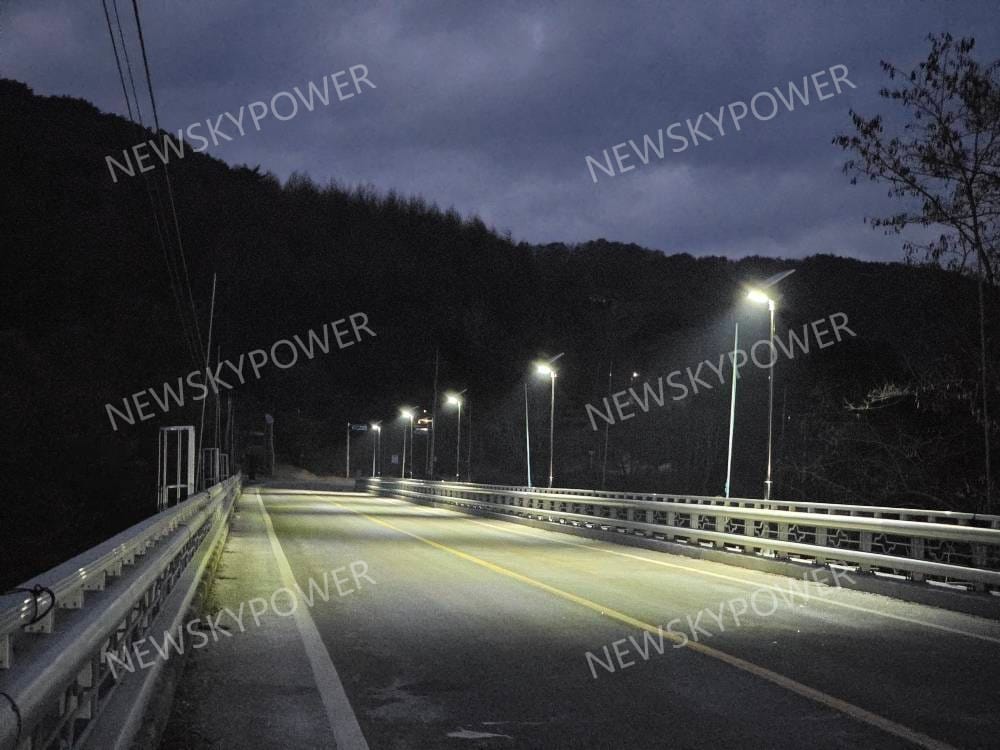
NF-60W solar street light project installed on a mountain road bridge in South Korea
This project started from an inquiry from our customer in South Korea. The customer was looking for a reliable lighting solution for a mountain road bridge. The location was far away from the city area, and installing traditional AC street lights would require additional cable construction, higher installation costs, and more complicated maintenance work in the future.
After discussing the project details with the customer, we found that the main requirement was not only brightness. The customer needed a solar lighting system that could operate reliably throughout the year, especially during cloudy and rainy weather. For projects such as solar street lights for mountain roads, bridges, and remote areas, system reliability is always the key factor. Once a lighting system fails in a remote location, maintenance becomes much more expensive because workers need transportation, tools, and sometimes lifting equipment to complete repairs.
Based on our experience, we recommended an off grid solar lighting solution instead of a traditional wired lighting system.
For a comparable bridge project, the purchasing decision has two parts: delivering useful light to the road and keeping the energy system serviceable at a remote site. A nominal LED wattage answers neither question on its own. The layout, solar exposure, nightly output schedule and access for future maintenance need to be considered together.
Project Analysis and Why We Recommended NF-60W Solar Street Light
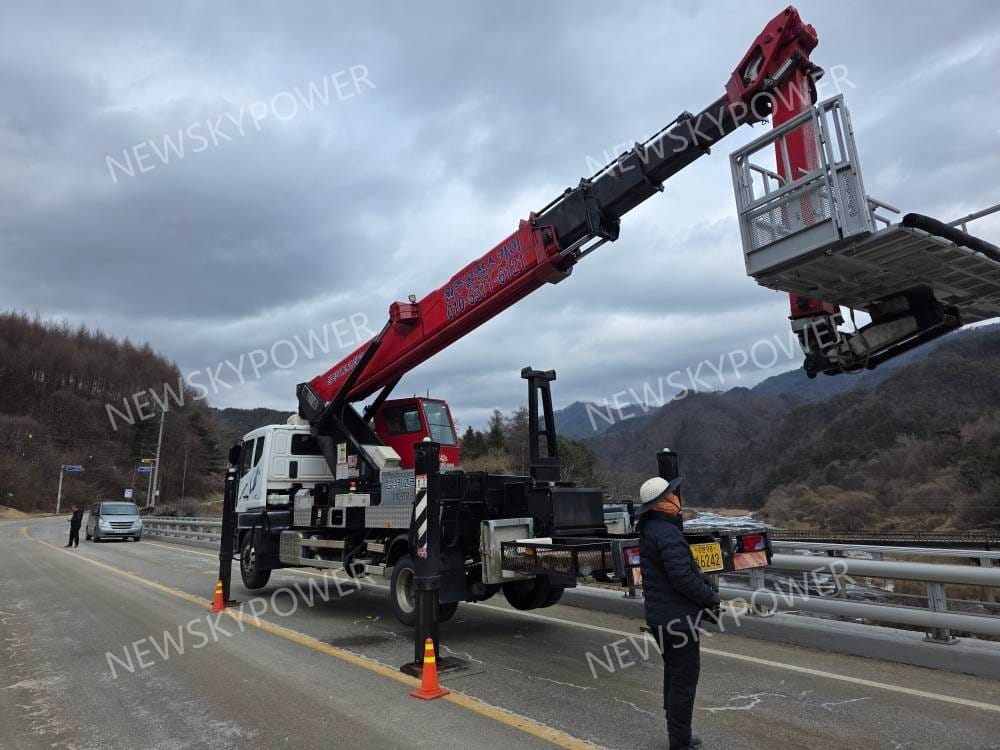
Installation process of NF-60W semi integrated solar street lights
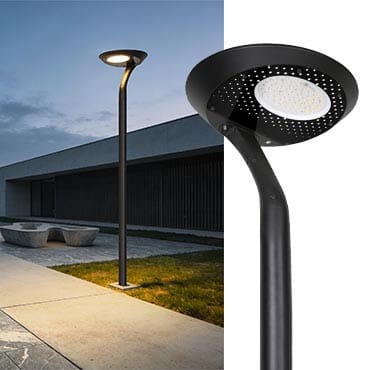
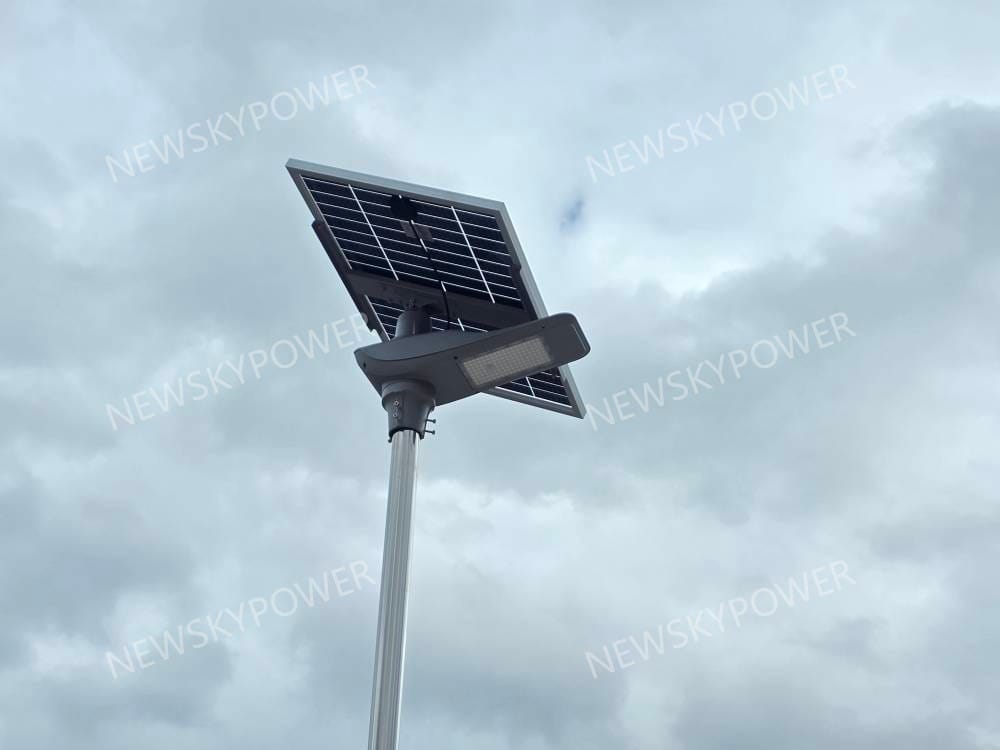
The model selected for this South Korea project was the NF-60W semi integrated solar street light. Its documented configuration combines a 120W/18V solar panel, a 36Ah/12.8V LiFePO4 battery and an MPPT controller with a nominal 60W LED luminaire. These component ratings provide a starting point for an energy assessment; they do not describe one fixed nightly operating program.
For solar lighting for remote roads, start with the road width, pole positions and lighting criteria. Use the luminaire’s photometric file to assess the distribution at the proposed mounting height and spacing. Then calculate the energy required by the chosen output schedule and check it against local solar conditions. A larger battery cannot correct a poorly aimed luminaire, and extra LED power cannot compensate for insufficient winter charging.
A bridge also creates a practical maintenance question: can a crew reach the luminaire, battery and controller without obstructing the route for an extended period? Include the access method, replaceable components and spare-part arrangement in the purchasing discussion, alongside the initial equipment price.
Technical Advantages of NF-60W Semi Integrated Solar Street Light
Match battery capacity to the lighting schedule
The published 12.8V × 36Ah battery rating corresponds to 460.8Wh of nominal stored energy. As an illustration, a constant 60W electrical load for 10 hours would require 600Wh before system losses. That example exceeds the nominal battery energy, so the listed components cannot support an assumption of 10 hours at a constant 60W from one full battery charge. It is a sizing illustration, not the operating program of this installation.
For a dimmed program, calculate each time period separately and add the energy: electrical power × hours for each stage. Allow for controller consumption, conversion losses, the usable battery range and temperature. For several nights of reduced solar input, assess both the reserve needed during the cloudy period and the charging available afterward. This is how a rainy-weather requirement becomes a configuration to verify, rather than an unexplained number of backup days.
Check the panel position and service requirements
The panel’s adjustable position is useful when setting solar orientation independently of the road-lighting direction. For a mountain road or bridge, check seasonal shading from terrain and nearby structures at each proposed position. Review mounting and wind-load requirements with the pole and bridge attachment, and provide access for cleaning and inspection.
An MPPT controller and LiFePO4 battery are parts of the energy system; the quotation should identify the exact controller program and battery protections. Ask separately about low-temperature charging limits, discharge limits and any temperature-control provision. An overall luminaire working-temperature label does not define all battery charging conditions.
Installation Experience of Solar Street Lights in South Korea
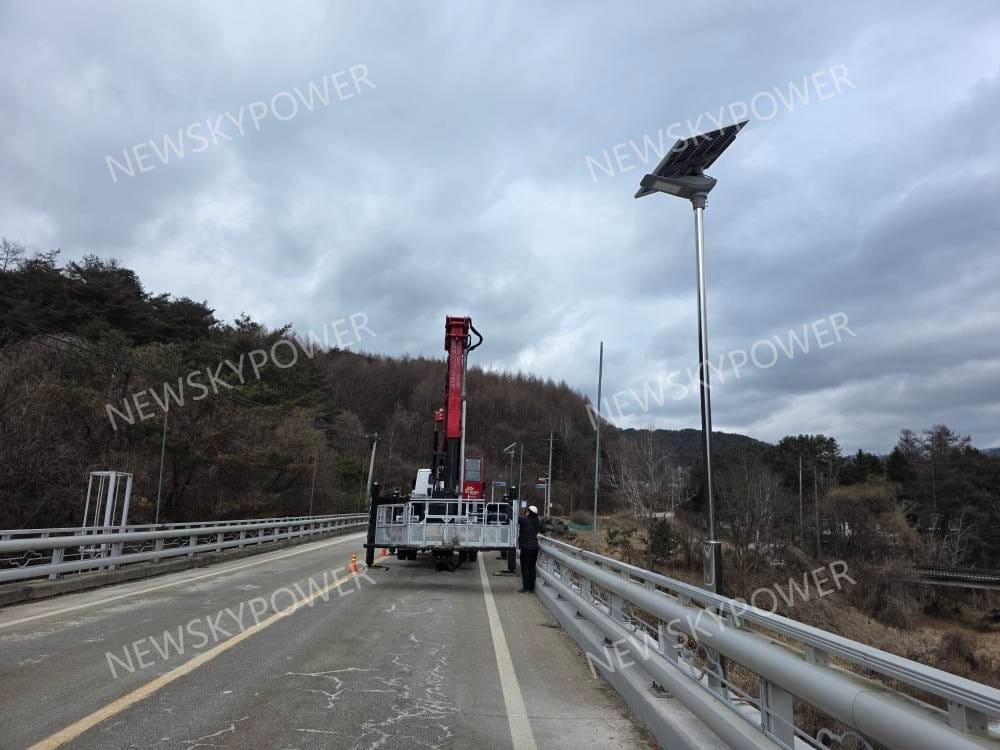
Professional installation of solar street lights on South Korea mountain bridge
The existing installation record describes the use of lifting equipment along the bridge. For a similar installation, coordinate the lifting position and any access restrictions before fixing the final pole layout. Solar power removes the requirement for a grid-supply connection to each light, while mounting, structural checks, electrical connections within the system and commissioning remain part of the work.
During commissioning, check the panel orientation, luminaire aiming, controller settings and automatic switching. Record the agreed operating schedule so the installer and the owner are testing the same requirement. The night-time check should cover the road surface and transitions between lighting points, rather than only whether each lamp turns on.
Project Results: Installation and Night-time Observations
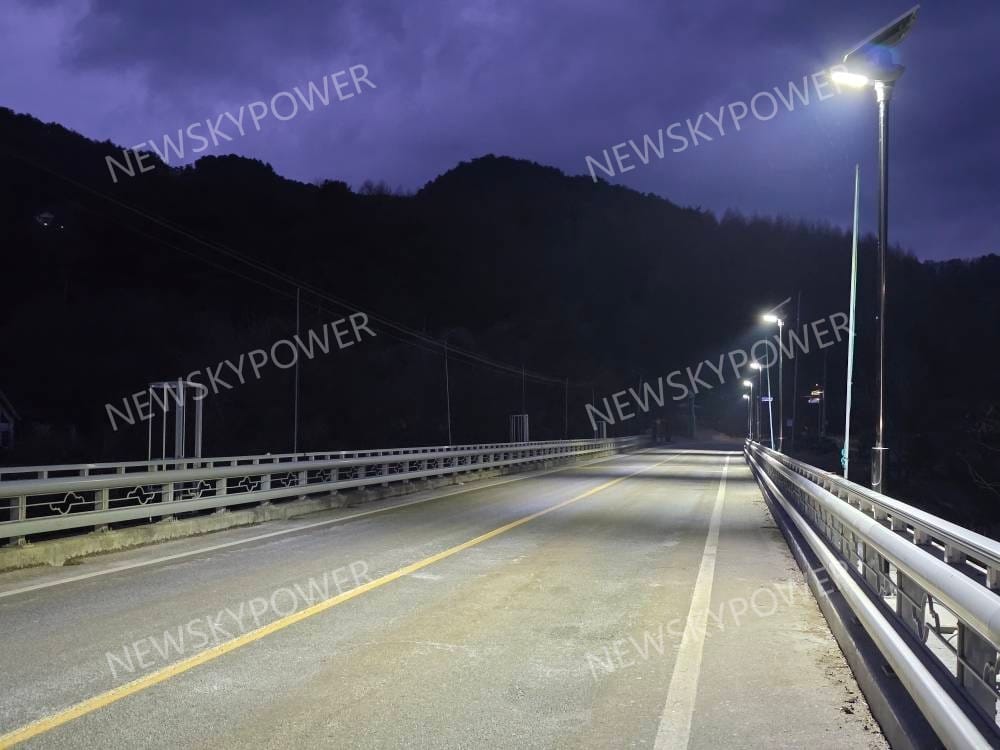
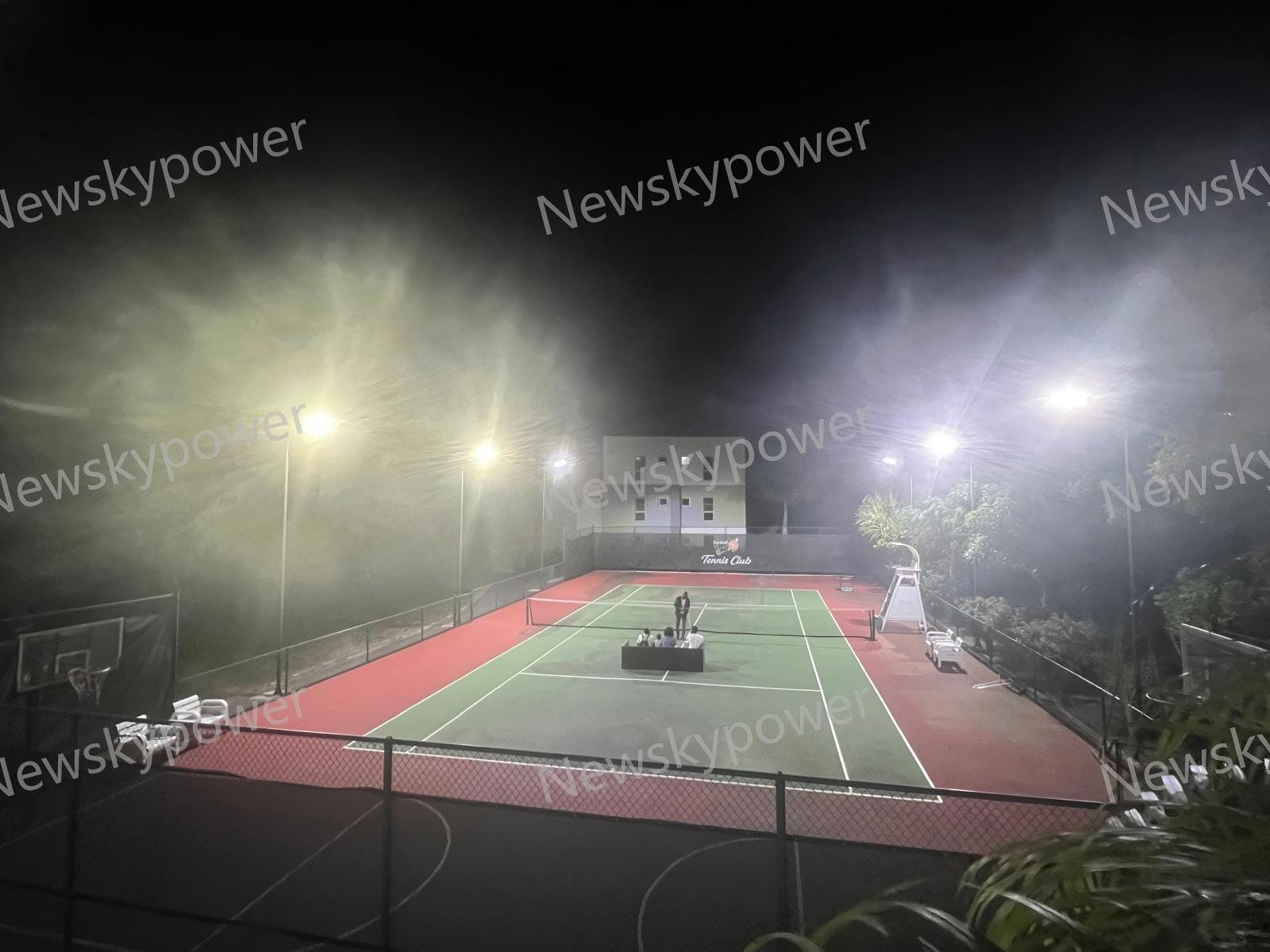
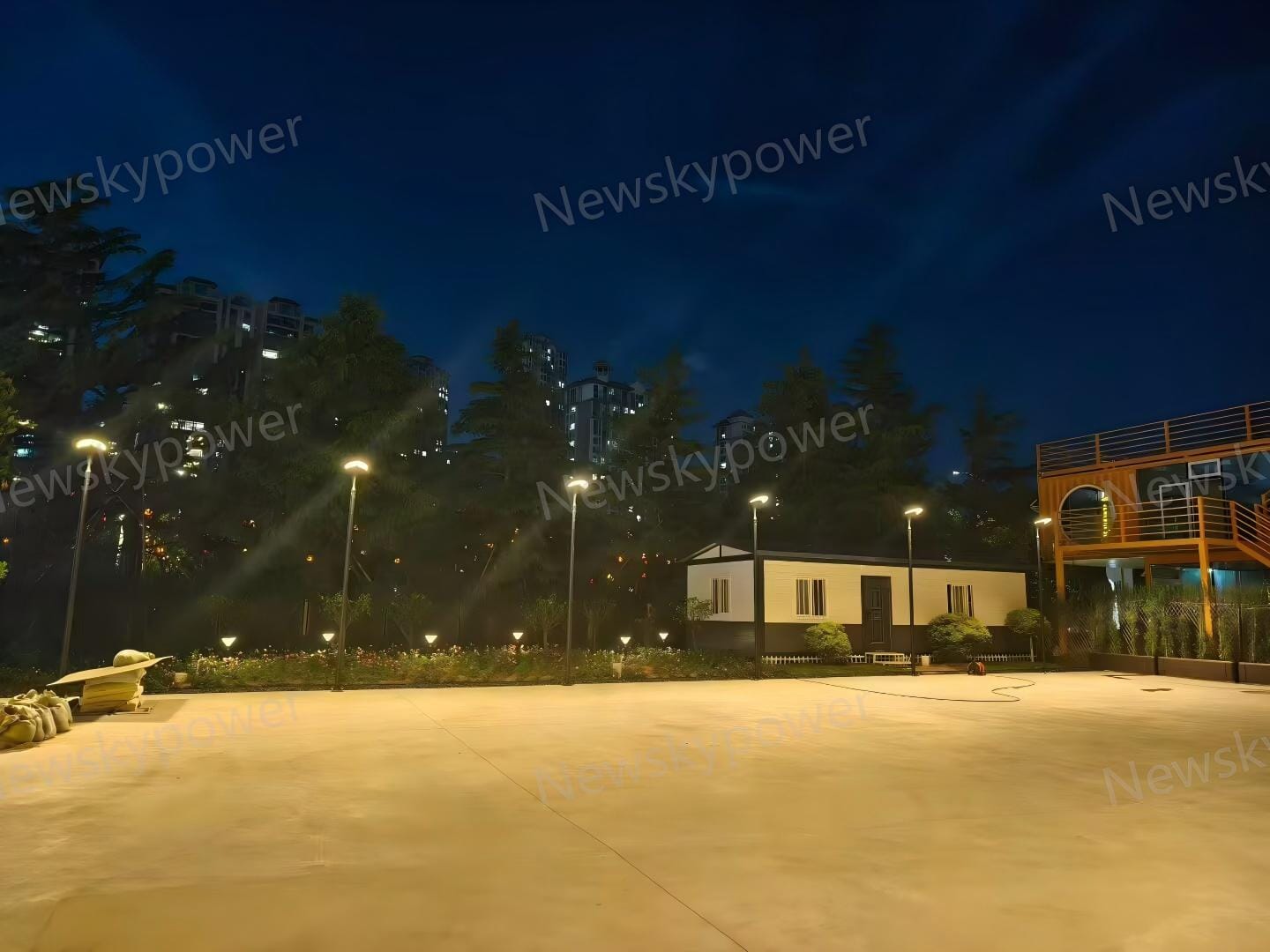
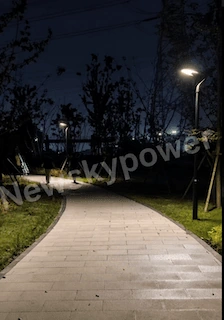
Night lighting effect of NF-60W solar street lights
The project record presents the NF-60W installation on the South Korean mountain bridge and includes a night image. This gives prospective buyers an example of the model’s application on a remote route. A night photograph is useful for showing the setting, but measured illuminance and uniformity require a lighting calculation or site measurements.
For an acceptance check on a comparable project, agree on the lighting criteria, operating hours and reduced-sunlight requirement before ordering. Keep the commissioning results and controller program with the equipment records. These make subsequent maintenance and performance comparisons more useful than a general statement that a site looks brighter.
NF-60W Solar Street Light Technical Specifications
The following component values are listed in the project’s published product information. They should be matched to the quotation and supplied version for a new order.
| Item | Published configuration | Selection relevance |
|---|---|---|
| Model | NF-60W semi integrated solar street light | Match the exact ordered version |
| Rated luminaire power / luminous flux | 60W / 10,200lm | Use the photometric file to check the road layout |
| Solar panel | 120W / 18V monocrystalline | Assess site-specific daily charging and shade |
| Battery | 36Ah / 12.8V LiFePO4 | 460.8Wh nominal; usable energy depends on operating conditions |
| LED source | SMD3030 | Component designation; not a site lighting result |
| Controller | MPPT | Define and record the output schedule |
| Color-temperature options | 3000K / 4000K / 6500K | Confirm the ordered option |
| Housing / ingress protection | Die-cast aluminum / nominal IP65 | Match the applicable documentation and installation details |
| Lighting control | Automatic dusk-to-dawn with dimming | Define hours and output for every stage |
The published 180lm/W figure relates to the LED entry; it should not be substituted for a verified whole-luminaire efficacy value. The listed 60W and 10,200lm values correspond arithmetically to 170lm/W, and the test scope should be checked when comparing products. For a rainy-weather requirement, request the energy calculation with its solar input, starting charge, night length and dimming assumptions.
Planning a Similar Off-Grid Solar Bridge Lighting Project
Send NEWSKYPOWER the project location, road or bridge width, proposed pole height and spacing, and photos showing nearby shade. Include the required nightly operating hours, whether scheduled dimming is acceptable, and the applicable lighting criteria. Describe how installation and maintenance crews can access the site.
With those inputs, the discussion can focus on the NF-series configuration, lighting layout, solar exposure and maintenance provisions appropriate to your project. For an overview of the product range, visit NEWSKYPOWER.