


A solar rechargeable fan may advertise a battery capacity and a long operating time, but those figures answer different questions. Capacity describes the battery; runtime describes a complete fan operating under particular conditions. For an importer comparing offers, the useful question is whether the stated runtime covers the speed and functions customers will actually use.
This guide explains how to read battery information and request a comparison that can support a buying decision. To shortlist available configurations, use the solar fans with battery collection.
How long does a solar fan last on one charge?
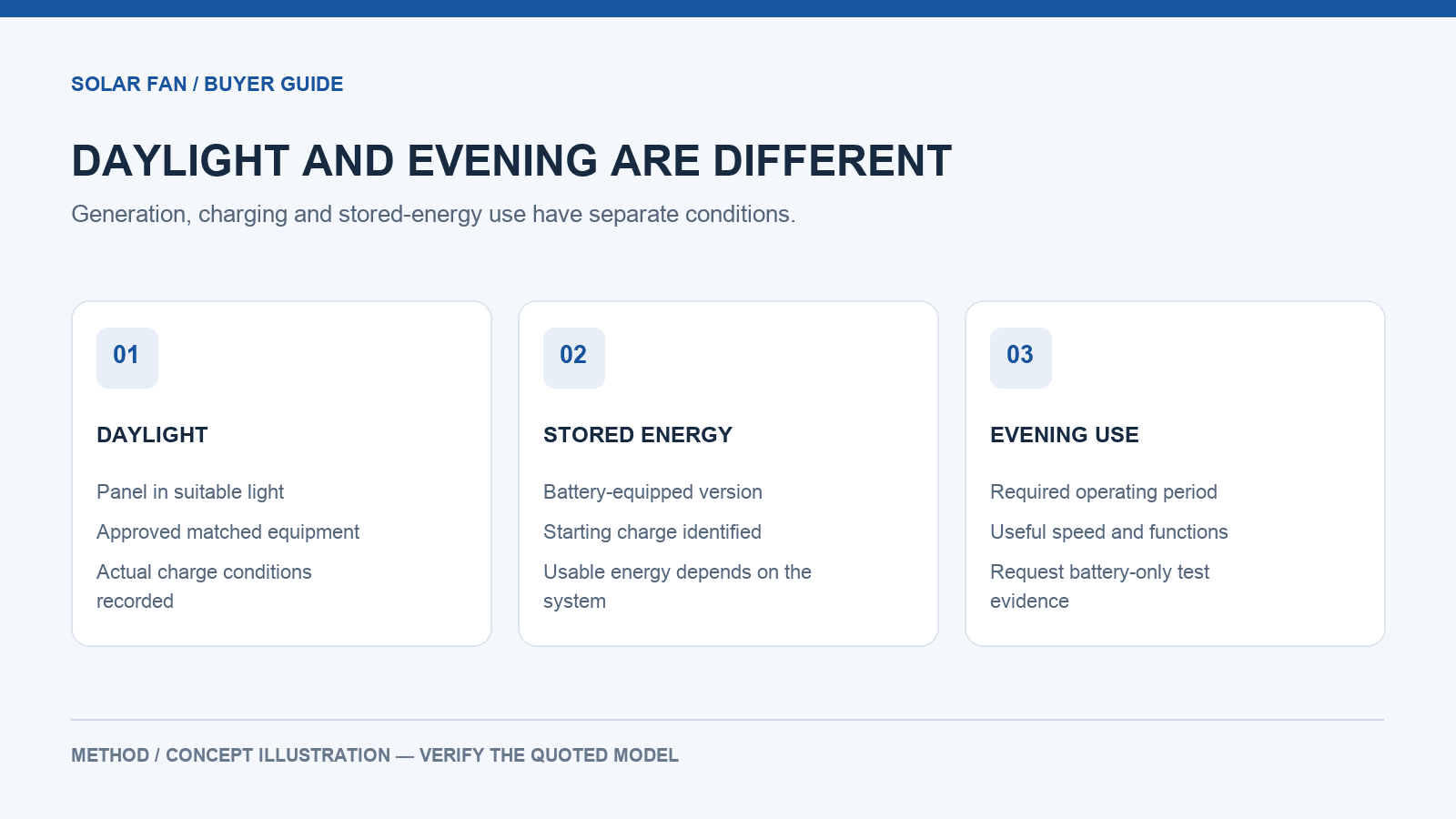
There is no useful universal answer in hours. First decide whether “last” means one battery discharge or the product's service life. For daily runtime, ask for the exact fan version, starting charge, speed, enabled functions and end condition. For service life, ask about maintenance and replacement arrangements instead. Mixing those questions can make a battery-life claim sound more precise than it is.
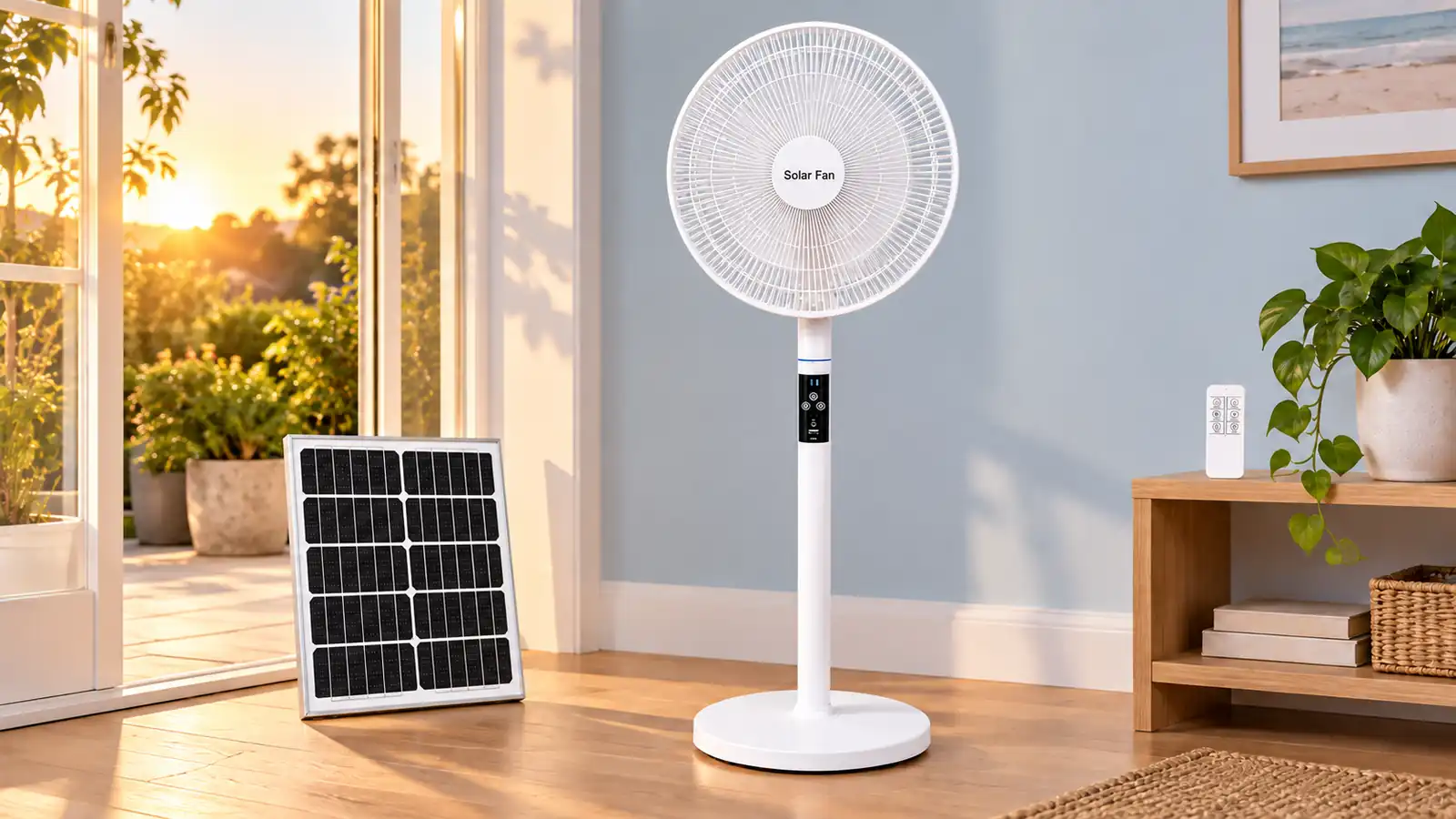
A battery-powered solar fan can operate after sunset when its design includes stored energy and the battery has sufficient charge. A directly solar-powered fan without storage behaves differently. The Department of Energy's storage explanation describes the underlying distinction between generation and stored energy. It does not establish the runtime of an individual fan.
For a customer's evening routine, write down the intended start time, end time and speed before comparing offers. If the fan also supplies a light or charges a device, include that in the requested test. A fan-only headline result cannot establish how long the combined routine will last.
Read voltage and capacity together
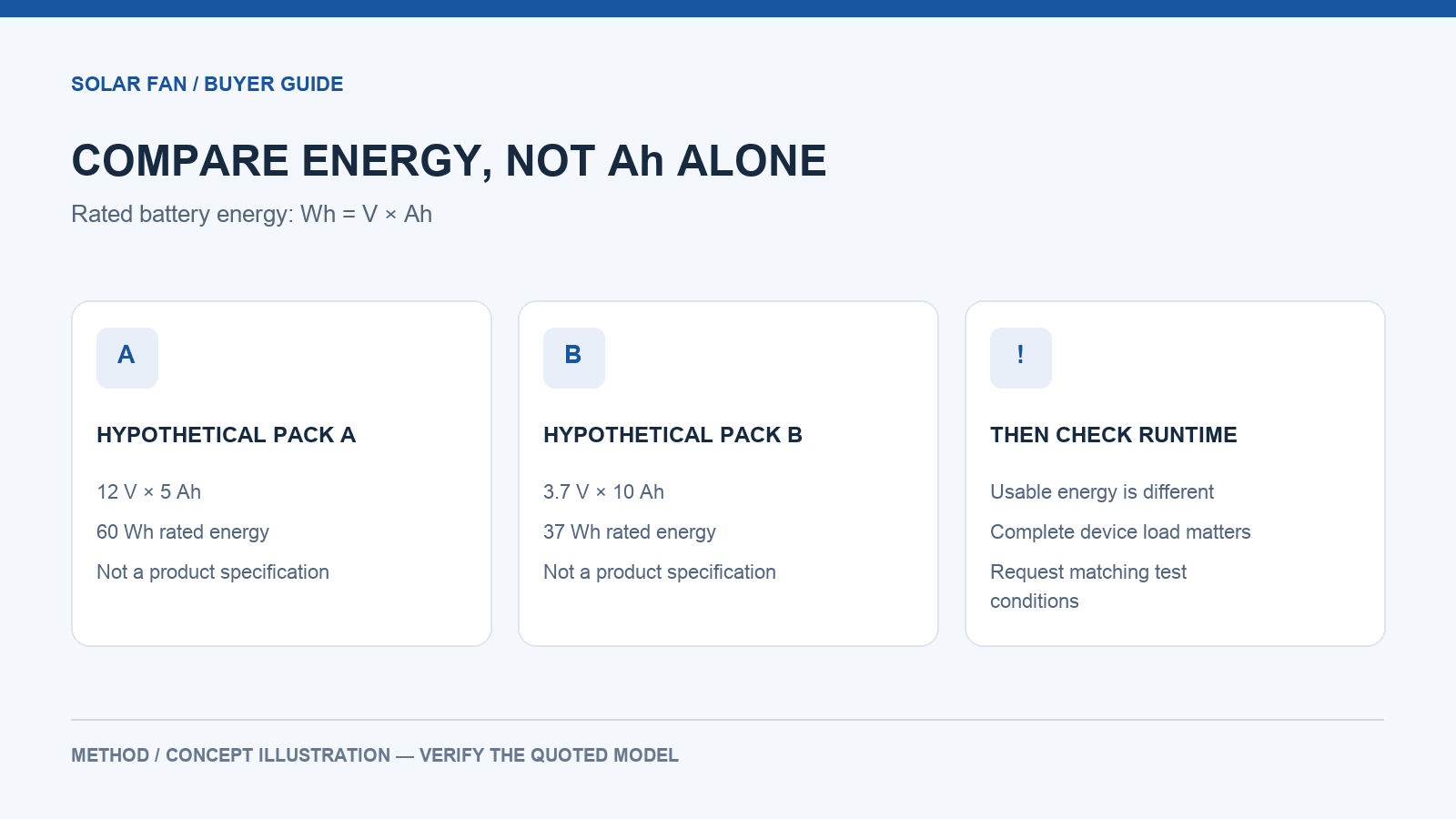
Ask for the complete battery pack's nominal voltage, amp-hour capacity and rated watt-hours. Wh = V × Ah, and Ah = mAh ÷ 1,000. The FAA battery guidance explains this conversion; it is used here only for the calculation.
Do not compare mAh alone when voltage differs. As a purely mathematical example, 5 Ah at 12 V represents 60 Wh, while 10 Ah at 3.7 V represents 37 Wh. These are hypothetical battery ratings, not NEWSKYPOWER fan specifications. The smaller Ah number in this example represents more rated energy.
Check that voltage and capacity refer to the same pack. A capacity expressed at an individual-cell voltage should not be multiplied by a different assembled-pack voltage. When a quotation is unclear, ask the supplier to identify the rating basis rather than trying to reconstruct it from an advertising image.
Use an energy estimate as a question, not a performance promise
The idealized calculation is energy divided by power. Suppose, purely for illustration, that 48Wh of usable energy is available and the complete device draws a constant 8W. The arithmetic gives six hours. At a constant 12W it gives four hours. These are hypothetical teaching figures, not NEWSKYPOWER specifications or measured results.
The difficult part is establishing the usable energy and actual device load. A rated battery capacity is not the same as energy delivered through the complete system. The controller, discharge limit, operating conditions and changing demand matter. If only rated battery Wh is known, do not label the resulting division a verified runtime.
Use the estimate to ask better questions: “What was the measured average load at this setting?”, “Was charging disconnected?” and “What endpoint was used?” Ask the supplier to show the measured result beside the battery rating. That provides a more useful basis for purchasing than adding an unexplained safety factor to a headline number.
Separate rated energy from measured runtime
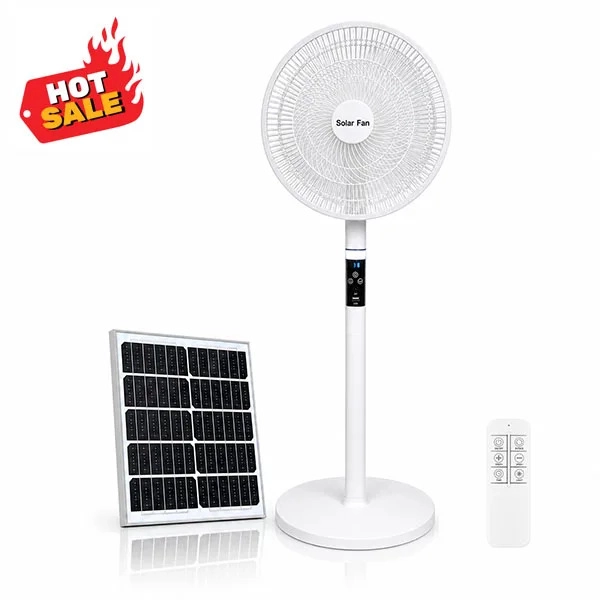
Watt-hours measure energy; watts measure power. Dividing rated Wh by an assumed constant load in W gives an idealized duration. It does not account for the usable discharge window, conversion losses or changes in the fan's demand. It should not replace a runtime record for the offered version.
The same fan can have different results at different speeds. Where supported, oscillation, lighting or device charging may add to the load. Compare fan-only operation separately from combined functions, and record whether a charger or solar panel remained connected during the test.
Ask for a repeatable runtime record
Use the following fields for every shortlisted sample. It is a blank checklist, not a published test result.
| Record | Details needed |
|---|---|
| Sample identity | Model, version, sample number and specification date |
| Battery | Pack voltage, Ah and Wh, with the rating basis |
| Starting condition | Starting charge and the charging procedure used |
| Operating settings | Speed, oscillation, light and any other enabled function |
| Power connection | Battery-only, or charging connected during operation |
| Result | Start/end time, stopping criterion and test environment |
A supplier's longest result can be useful, but only if its settings are clear. For a distributor selling into markets with frequent power cuts, a higher-speed or mixed-function result may be more relevant than the longest low-speed result.
A repeatable solar fan runtime test
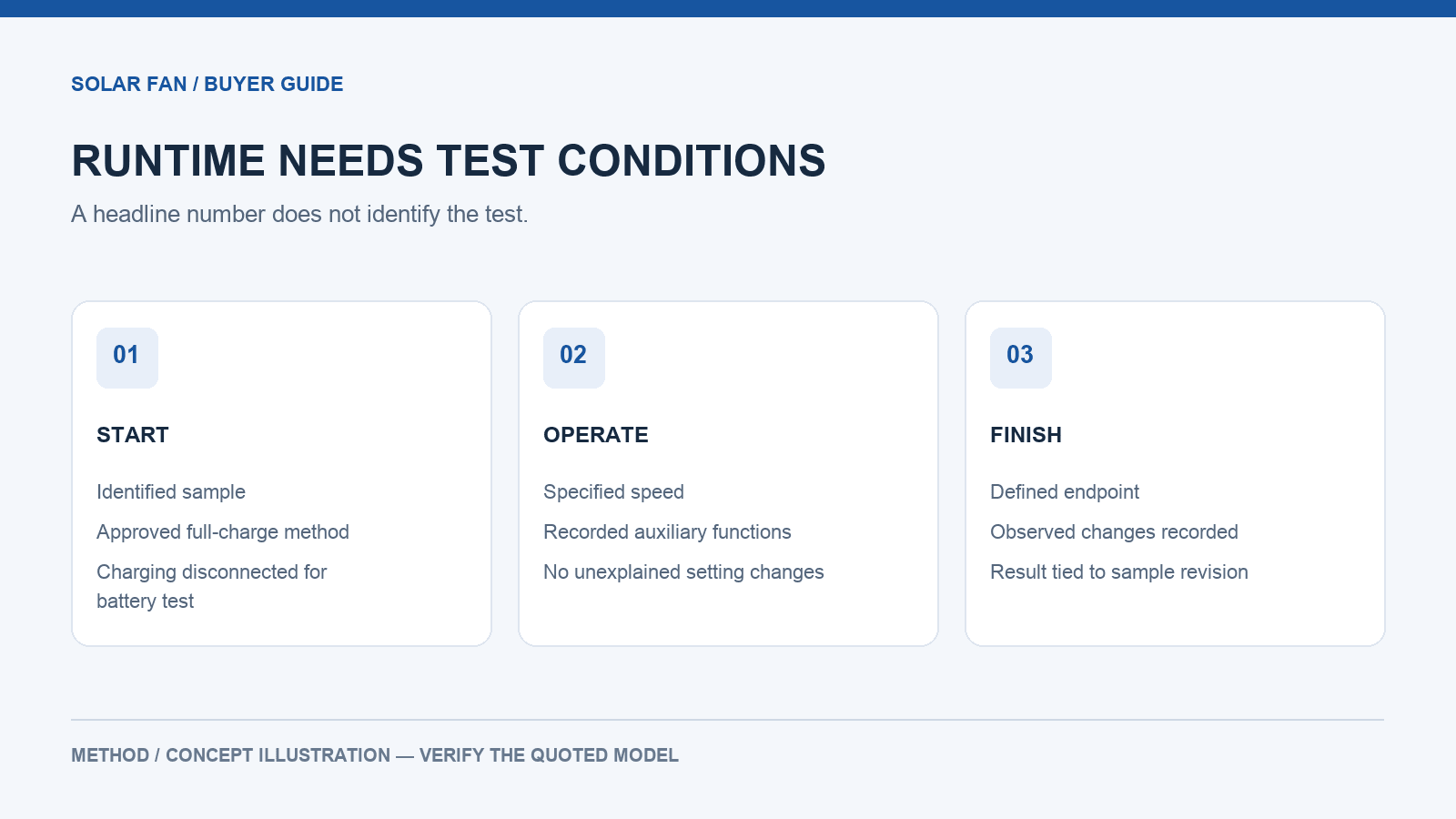
Identify the sample and charge it using the approved equipment and the model's full-charge indication. Record the procedure, ambient conditions and starting state. Disconnect charging when the aim is to measure battery-only operation. Set the speed and functions, start the record and avoid changing settings during the run.
Define the endpoint before testing. Automatic stop, low-battery indication and airflow falling below an agreed requirement are different endpoints. Record which one is used. If brightness or speed changes during discharge, note when the change happens rather than recording only the final shutdown time.
Repeat at the settings relevant to the market. Keep a separate result for a practical evening routine if it includes changing speeds. Record the sequence so another person can reproduce it. Do not combine partial tests from different samples into a single “all-night” result.
| Test condition | Why it must be recorded |
|---|---|
| Sample and specification revision | Identifies the tested battery and fan combination |
| Charging source and full-charge criterion | Defines the starting point |
| Speed and auxiliary functions | Defines the electrical load |
| Charging connected or disconnected | Separates replenished energy from stored energy |
| Environment and endpoint | Makes results comparable and interpretable |
Compare charging separately
A solar panel's rated watts do not tell you exactly how many hours a battery takes to charge. Sunlight, shade, panel position, the matched charging arrangement, starting charge and operation during charging all matter. Ask for the conditions behind a charging-time statement.
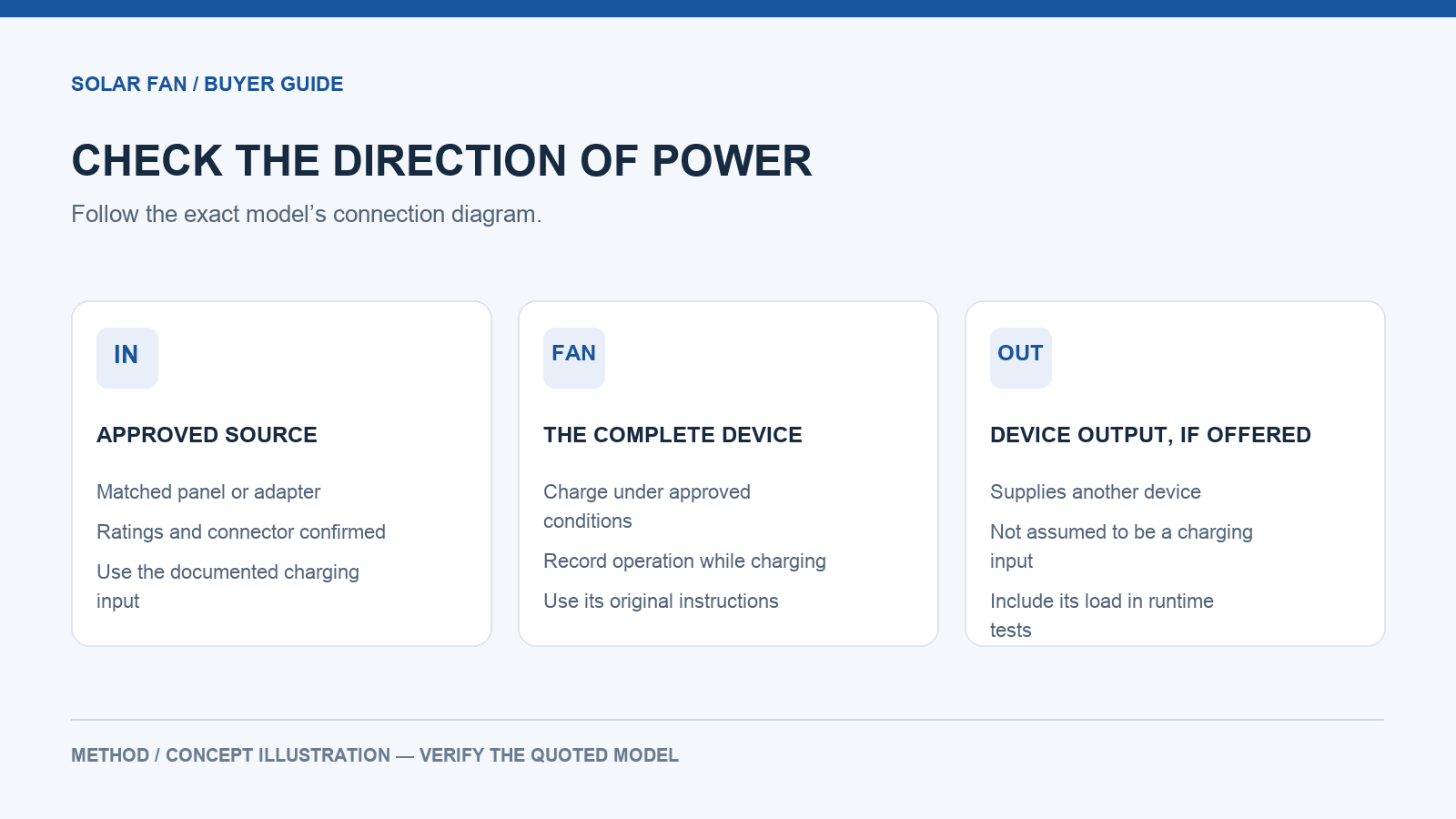
Follow the supplied instructions for the approved panel, adapter and input port. A plug that physically fits does not establish electrical compatibility. Solar charging and mains-adapter charging should be recorded as different procedures.
How to check solar fan charging time
Charging time is a separate purchase question. A panel's rated wattage describes its output under specified conditions; it is not a guaranteed charging power throughout the day. Shade, changing sunlight, orientation and the matched charging circuit affect the energy reaching the battery. Starting with a partly charged battery also changes the time observed.
Ask for the approved panel and adapter ratings, input connection and allowed charging conditions. Keep a solar test separate from an adapter test. Record whether the fan runs while charging, because operating demand can change the net energy stored. Follow the model instructions rather than treating every DC socket as an interchangeable input.
If customers need evening use after a cloudy day, discuss a compatible alternative recharge plan where the chosen model supports one. Do not assume USB charging, a car charger or an arbitrary larger panel is supported. Confirm compatibility for the supplied version before making those features part of the order.
Battery replacement belongs in the buying decision
Ask how replacement batteries are identified and whether replacement is intended for a technician or end user. Voltage, chemistry, connector, physical fit and charging compatibility must match the approved arrangement. A larger capacity written on a replacement listing does not make it compatible with the fan.
For distributor service, keep the model revision, original battery details and supplier replacement reference with the order documents. Request the storage and recharge guidance supplied for that battery version. Availability and replacement terms should be confirmed directly; a replaceable design does not by itself establish that a particular spare is in stock.
Turn the comparison into an enquiry
The T919 solar fan page is a model-level next step for buyers considering a standing format. Read its specification and controls, then request a result for the exact quoted configuration; a battery figure from another model is not a substitute.
For a rechargeable solar fan quotation, send the model, quantity, destination country, required plug, intended hours of use, preferred speed and required auxiliary functions. Ask for battery V/Ah/Wh, matched charging equipment and a runtime record on that basis. Send your battery and charging requirements so the offer can be checked against a defined use case.
Battery and charging questions
Can a solar fan work without sunlight?
A model with a sufficiently charged battery may operate from stored energy under its approved settings. A direct-solar design without storage is a different system. Confirm which arrangement the quoted model uses.
Does more battery Ah always mean more hours?
No. Compare complete battery-pack voltage and rated Wh, then request runtime at the same useful operating settings. Different fans can draw different power.
Can I calculate charging time from panel watts alone?
No. You also need the battery's starting state, matched charging arrangement, actual conditions and whether the fan is operating during charging.
Why is a fan-only test different from running the light too?
Additional enabled functions can use stored energy. Request the combined-use result for the actual version instead of assuming the fan-only time applies.
What should a battery-runtime enquiry include?
State the model, evening operating period, speed, required functions and charging sources. Ask for battery V/Ah/Wh and a test record with a defined endpoint. Compare available configurations in the solar fan with battery collection.