


Solar fan selection starts with where the airflow is needed and where the product will be placed. A floor-standing fan, a tabletop fan and a foldable fan can all offer rechargeable operation, but their everyday setup and storage requirements differ. For importers and distributors, the right format also depends on how customers carry, assemble and display it.
Use this comparison to define the format first, then compare the exact battery, charging kit and controls of each shortlisted model. A format name alone does not establish airflow, noise or runtime.
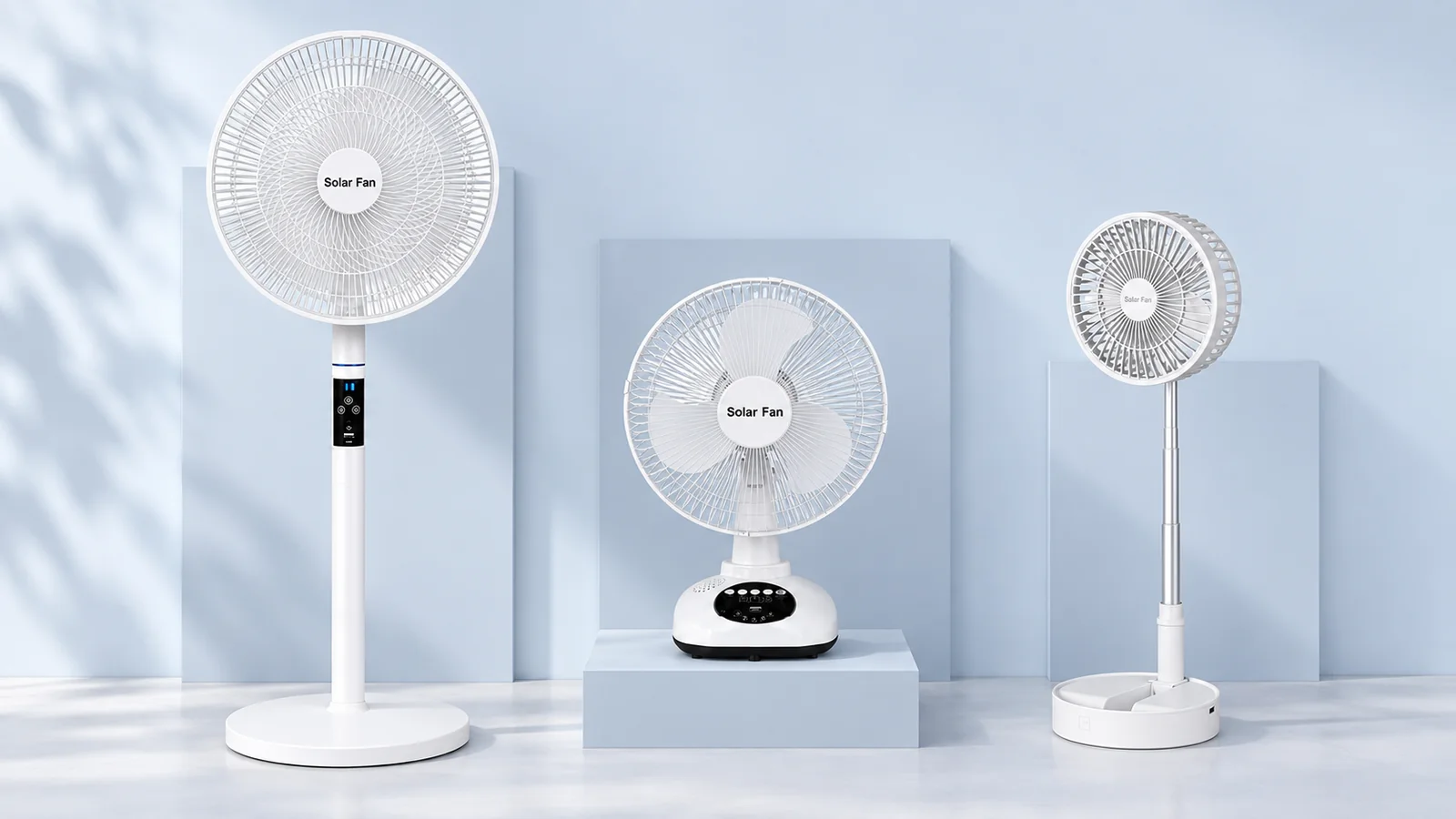
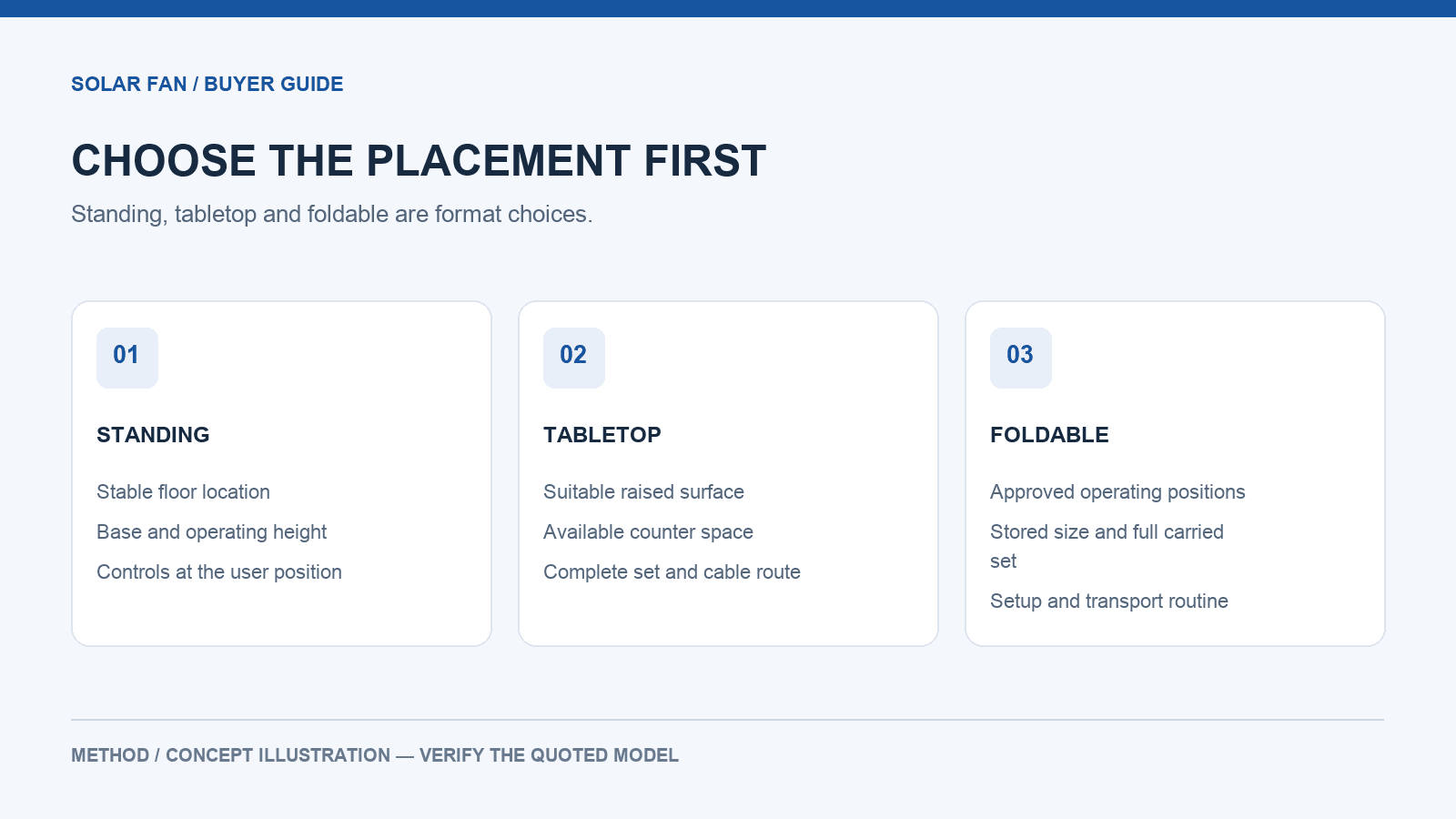
Start with placement and storage
Ask customers to describe the intended location: a room with free floor space, a shop counter, a dormitory desk or a sheltered campsite. Record whether the fan stays in one place or moves daily. Measure the available footprint and check the clearance needed around the guard and moving parts.
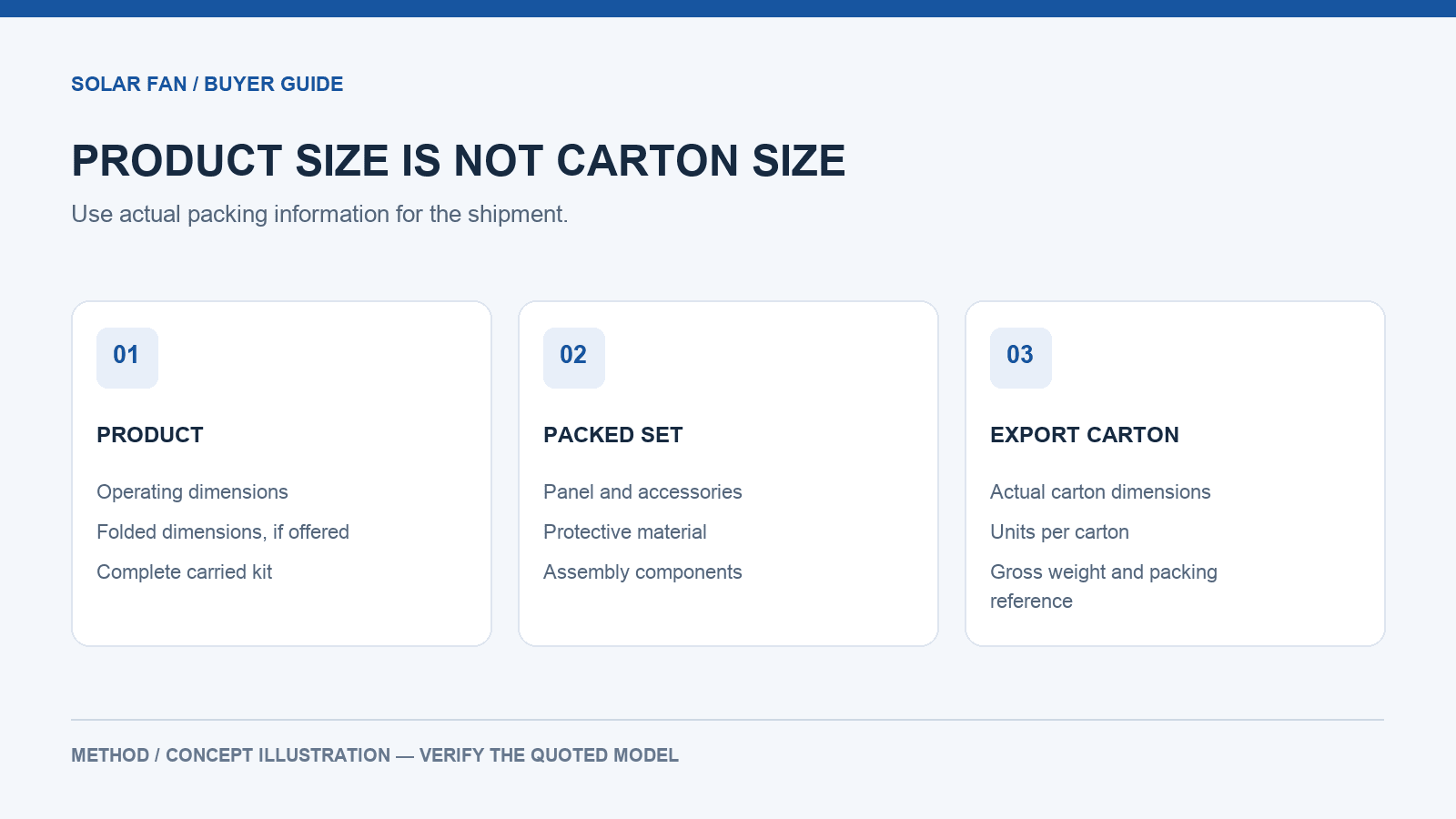
For a distributor, distinguish the user's storage space from the shipping carton. A compact operating format does not automatically mean a smaller carton, and a folding mechanism does not establish the supplied packing dimensions.
| Format | Useful selection question | Check before ordering |
|---|---|---|
| Standing | Is floor placement and a raised airflow position appropriate? | Base footprint, height adjustment, stability, controls and assembly |
| Tabletop | Is a stable desk or counter available? | Base dimensions, airflow position, cable route and nearby obstacles |
| Foldable | Is compact storage or frequent carrying a priority? | Folded dimensions, weight, locking arrangement and charging kit |
Standing fan vs table fan: compare the placement first
Draw the customer's usable space before choosing a shape. A solar standing fan places airflow above a floor base; a solar table fan relies on an appropriate raised surface. Check where people sit or work, the available support and the cable route to the charging location. Head height alone does not establish useful airflow across a room.
For a shop counter, a tabletop set may avoid taking floor space but can reduce working space on the counter. A standing set may be easier to position beside a seating area but needs a stable floor location. Measure the base footprint and the clear space needed for any movement. Compare the assembled sample with those requirements instead of judging only the catalogue photograph.
Choose the format that fits placement, then compare performance at the same useful position. A larger-looking head is not an airflow measurement. If airflow matters to the order, ask for a defined test method and result for the complete offered model.
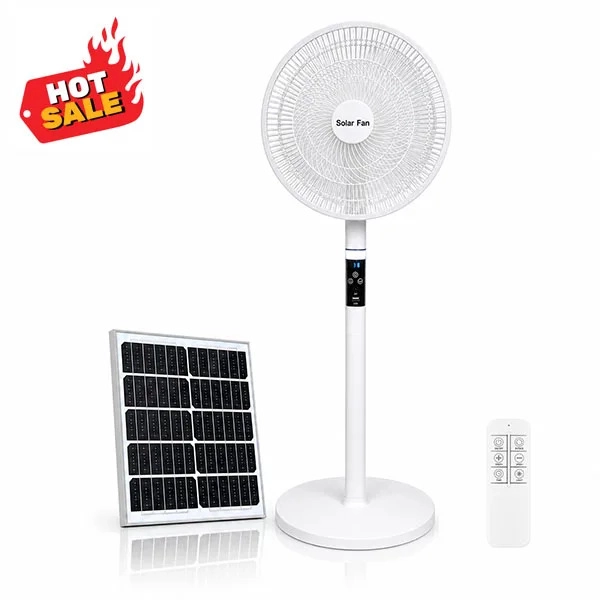
Standing fans: check the complete floor setup
A standing solar fan can suit buyers who want airflow at an elevated position without using a desk. Check the base, pole, supported adjustment and required assembly rather than judging the product only by fan diameter.
The solar standing fan collection is the next step for comparing this format. For a specific shortlist, review the T919 solar fan details, including its controls and technical table. Ask for the current quoted version when confirming the order.
During sample evaluation, check stability on the intended surface, the usable adjustment range and how the controls work from the normal sitting position. If oscillation is included, check the clearance through the movement range. Do not infer stability or adjustment limits from a product photograph.
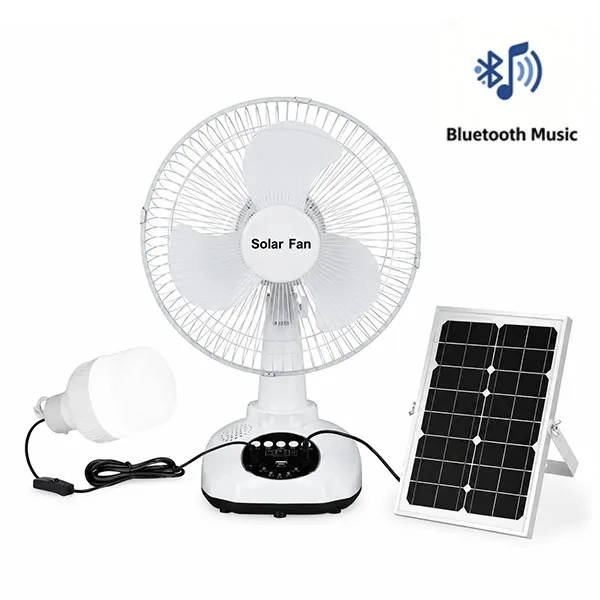
Table fans: define the supporting surface
A tabletop solar fan needs a suitable surface and a safe cable route. A shop counter and a bedside table can require different footprints and control access. Confirm whether the panel will be placed separately and whether the supplied cable reaches the planned charging location.
Extra functions should be selected deliberately. A light or speaker shown on one model should not be treated as a standard feature of every table fan. The portable solar fan collection compares tabletop and compact formats; use the model cards to identify the offered functions.
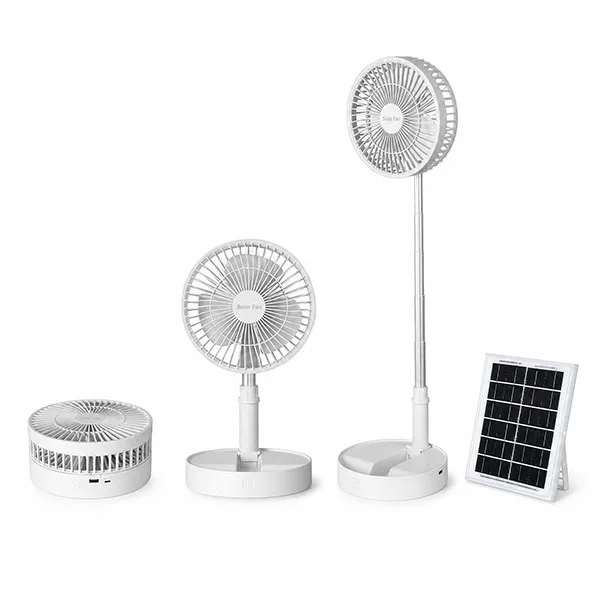
Foldable fans: verify the stored configuration
A foldable solar fan can be a useful shortlist when storage space and carrying are priorities. Check both folded and operating dimensions, the setup procedure, approved positions and how the charging equipment is carried. A fan that folds may still require a separate panel and adapter.
The T8 foldable solar fan page provides a model-level route for this comparison. Evaluate an actual sample's opening, closing and placement rather than assuming that every folding design behaves the same way.
What makes a foldable solar fan genuinely portable?
Portability describes the complete kit, not just the folded fan body. Include the solar panel, adapter, cables, remote and any quoted lights in the carrying assessment. Ask for the fan's folded dimensions and the packed dimensions of the whole set. A compact folded shape can still need a separate rigid panel that occupies more bag space.
Try setup and storage on an actual sample. Confirm how the pole extends, how the head is positioned, which parts lock and which positions are approved. Look at whether a person can set up the intended routine without tools or repeated readjustment. Follow the instructions rather than assuming that a folding mechanism can be used as a carrying handle.
The T8 catalogue image shows the same design in different positions. Those views illustrate a format; they are not three products included in one order. Confirm the actual kit list and the version's dimensions before estimating transport space or selecting retail packaging.
Compare performance after choosing the format
Keep the airflow position separate from performance claims. Compare runtime at the required speed, starting charge and enabled functions. For noise, request the measurement conditions rather than interpreting “quiet” as a specific dB value.
For a wholesale enquiry, send the target market, preferred format, placement space, carrying requirement, charging sources, required functions, quantity and destination plug. Ask for the exact kit and carton information. Send your format-selection requirements to turn the comparison into a model shortlist and comparable quotation.
Compare assembly, controls and shared-use convenience
An importer should consider who assembles the product after delivery. Ask which components arrive fitted, what the user must attach and whether the supplied instructions show the same version. A format with a separate pole and base may have a different first-use process from a folding design.
Test the controls at the intended location. For a standing fan, check whether the user can reach them comfortably and whether the supplied remote works as described. For a table fan, check that the control position remains accessible when it is placed beside the panel or other items. Timer, light, speaker and device outputs must be confirmed per model; they do not follow automatically from the format.
For shared spaces, observe the adjustment routine as well as steady operation. Note whether moving or tilting the unit changes stability, whether cables obstruct access and where accessories will be stored. A convenient demonstration setup is useful only if customers can reproduce it in their available space.
Shipping size and storage size answer different questions
The folded product dimensions describe the item in one state. A retail box or export carton includes protection and may contain a separate panel, accessories or several units. Use quoted carton dimensions, units per carton and gross weight for a freight enquiry. Do not calculate shipment volume from the folded fan image alone.
Ask how fragile parts are separated and how the base, head and panel are protected. If assembly parts are packed separately, confirm how they are identified. Have the approved sample packing photographed so the purchasing and logistics teams use the same reference. Any alternative packing should be agreed before shipment.
For retail channels, also consider shelf presentation and the customer's return trip. A box that displays the full kit clearly can help explain what is included, while a confusing image of several positions can make customers expect extra components. Keep the product illustration and supplied-component list consistent.
A three-route shortlist for distributors
| Buyer requirement | Start with | Check before deciding |
|---|---|---|
| Airflow beside a seated group or shop floor | Standing format | Base space, operating height, stability and controls |
| Cooling at a desk or counter | Tabletop format | Available surface, head position and complete kit |
| Frequent storage or transport | Foldable format | Folded size, full carried set and setup procedure |
These routes are starting points, not performance rankings. A household may prefer a standing model; a small shop may choose a tabletop unit; a folding fan may be used indoors rather than on a trip. Ask customers about their routine before treating one format as the only suitable choice for an entire market.
Shortlist one or two relevant models and test them against the same requirements. Use the standing solar fan collection for floor formats and the portable collection for compact alternatives. Model details should then settle the actual configuration and operating limits.
Format-selection questions
Is a solar pedestal fan always stronger than a table fan?
The format describes placement. Compare defined airflow, operating settings and the complete model before making a performance conclusion.
Does foldable mean the whole kit fits in a small bag?
Not necessarily. The panel, adapter and other included components may require separate space. Ask for the dimensions and weight of the complete carried set.
Can one fan be used in both table and standing positions?
Some adjustable designs offer different positions. Confirm the supported positions and adjustment procedure for the selected version; do not generalize across all models.
Should shipping volume be calculated from product dimensions?
Use the actual packing specification, units per carton and gross weight. Product and carton dimensions are different measurements.
What information helps the supplier recommend a format?
Send the available placement space, user position, storage requirement, charging plan, required functions and destination. Add the shortlisted models and quantity so the comparison can move to a specific offer.