


A solar fan for home backup should be selected around the period when grid power is unavailable. The important questions are where it will be used, how much airflow the user needs, how it will be recharged and which functions must remain available. The longest advertised runtime alone does not answer those questions.
For importers and home-appliance distributors, define a realistic household use case before choosing the product. The solar fans for home collection is the commercial next step for comparing suitable formats and requesting a configuration.
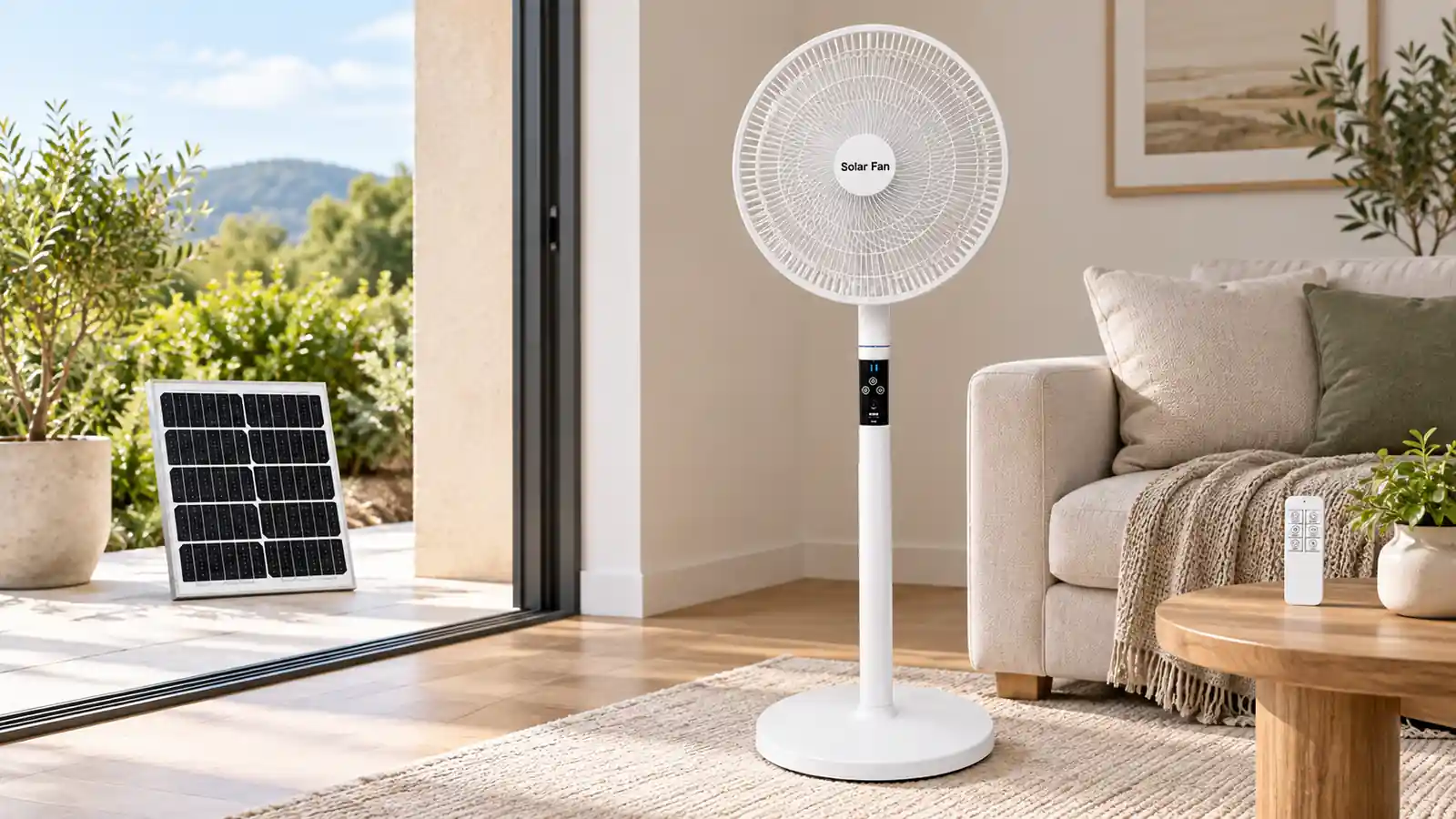
Define the backup period and operating settings
Record when the fan is needed and for how long: daytime use, evening backup or a particular room during a power cut. State the preferred speed and whether oscillation or a light is needed. Avoid treating all household users as having the same requirement.
Ask for runtime at those settings and a stated starting charge. A low-speed fan-only result is not the same as operation with several functions enabled. If the fan will be used while charging, confirm that the offered version supports that operating arrangement.
Use the battery and charging collection when comparing stored energy and model-specific charging choices. Keep battery ratings, runtime and charging time as three separate checks.
Plan a home power-cut routine before choosing a battery
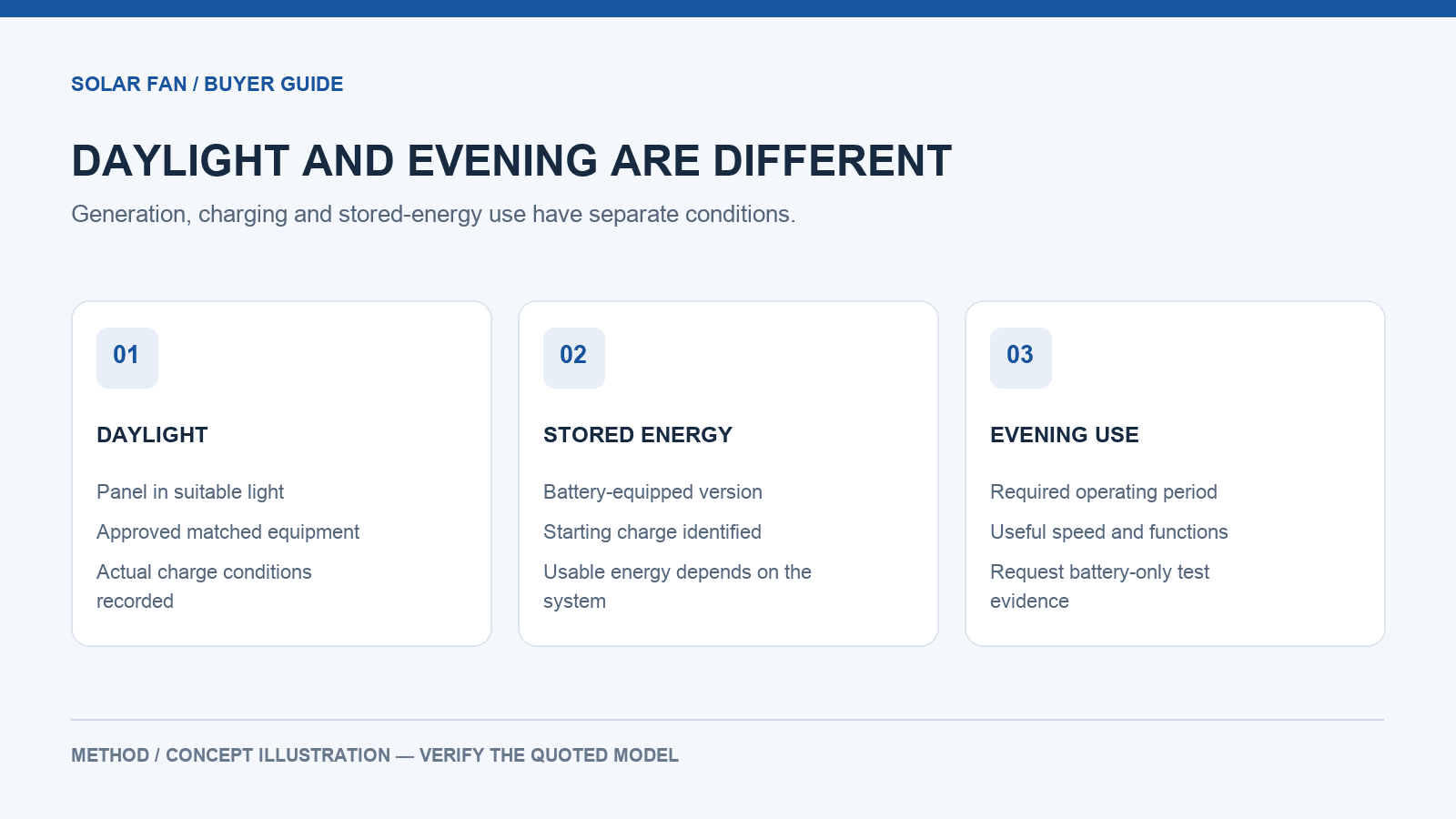
Divide the expected outage into practical stages. A family may need airflow during dinner, a quieter setting later and only selected functions overnight. Write down which stage matters most, the intended duration and the setting the user would actually choose. A single maximum-runtime headline does not describe that routine.
The plan should also show when the battery can be recharged. If grid power is available before the outage, an approved mains adapter may be part of the routine where supported. Solar charging offers another route, but the panel needs a suitable daylight location and enough opportunity to replenish the energy used. Indoor storage and outdoor panel placement are separate decisions.
The Department of Energy's explanation of solar storage distinguishes energy generated by the panel from energy stored for later. For the selected fan, ask the supplier how those functions are implemented and request the relevant operating instructions. Do not assume automatic backup switching just because a battery is included.
What to check in a rechargeable fan for power outages
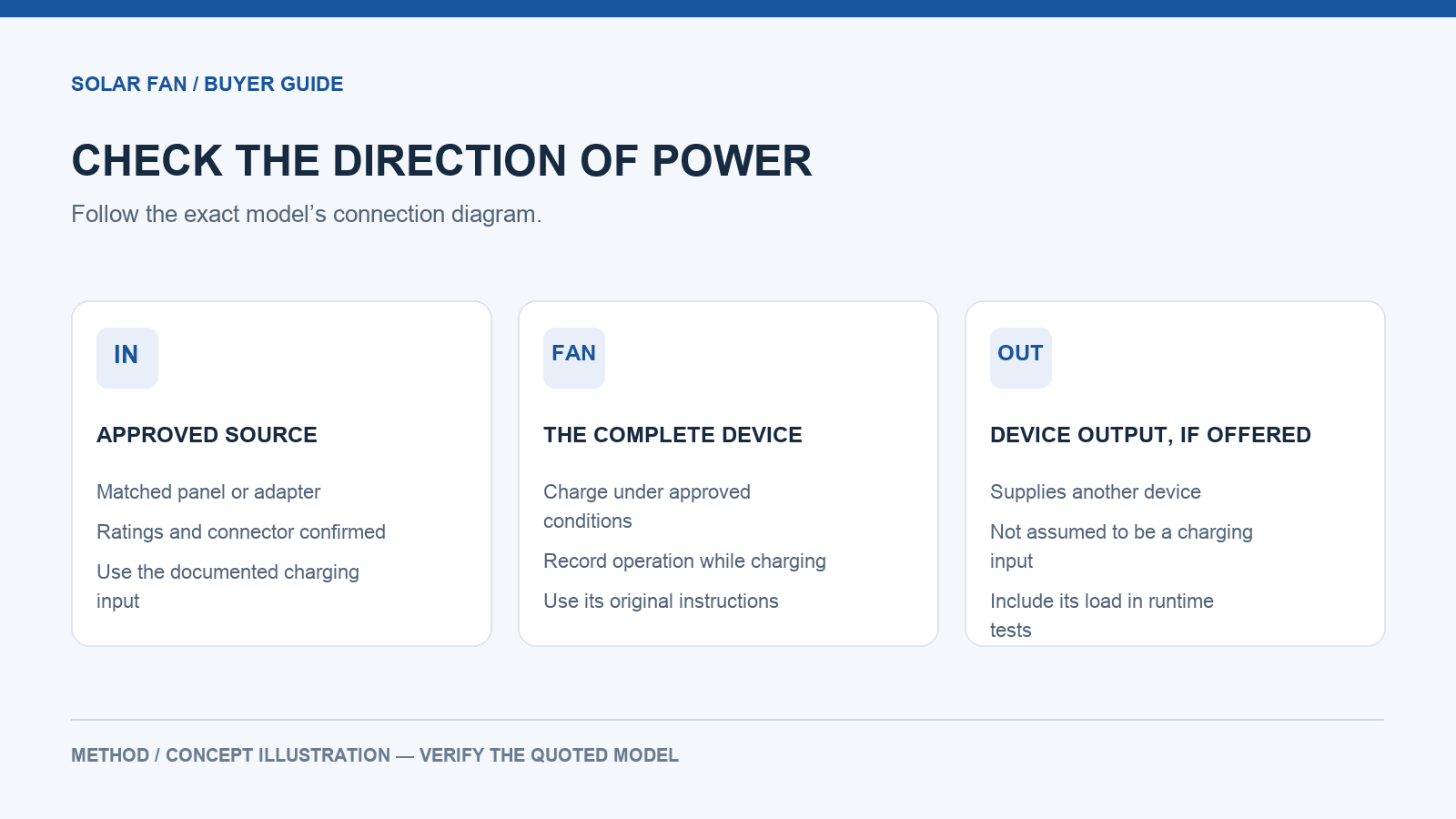
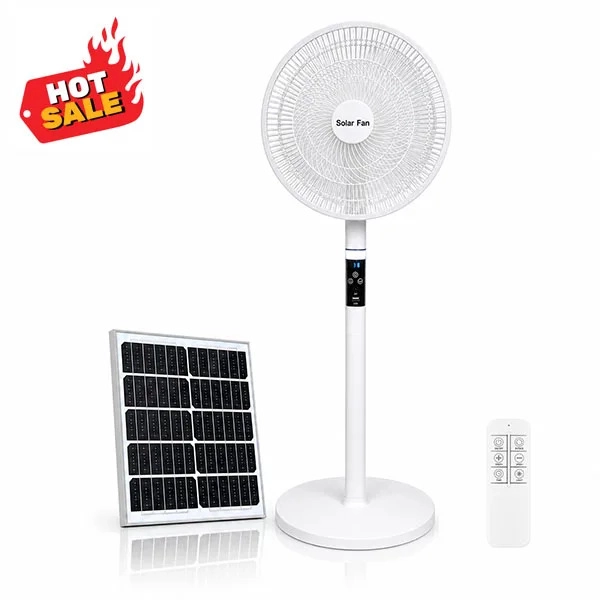
Check the whole kit: fan, battery arrangement, approved charging equipment, destination plug, cable and any accessories. If a remote or light is important to the buyer, put it on the required-component list. Ask whether the quoted version supports operation during charging and whether settings need to be restored after charging or a battery shutdown.
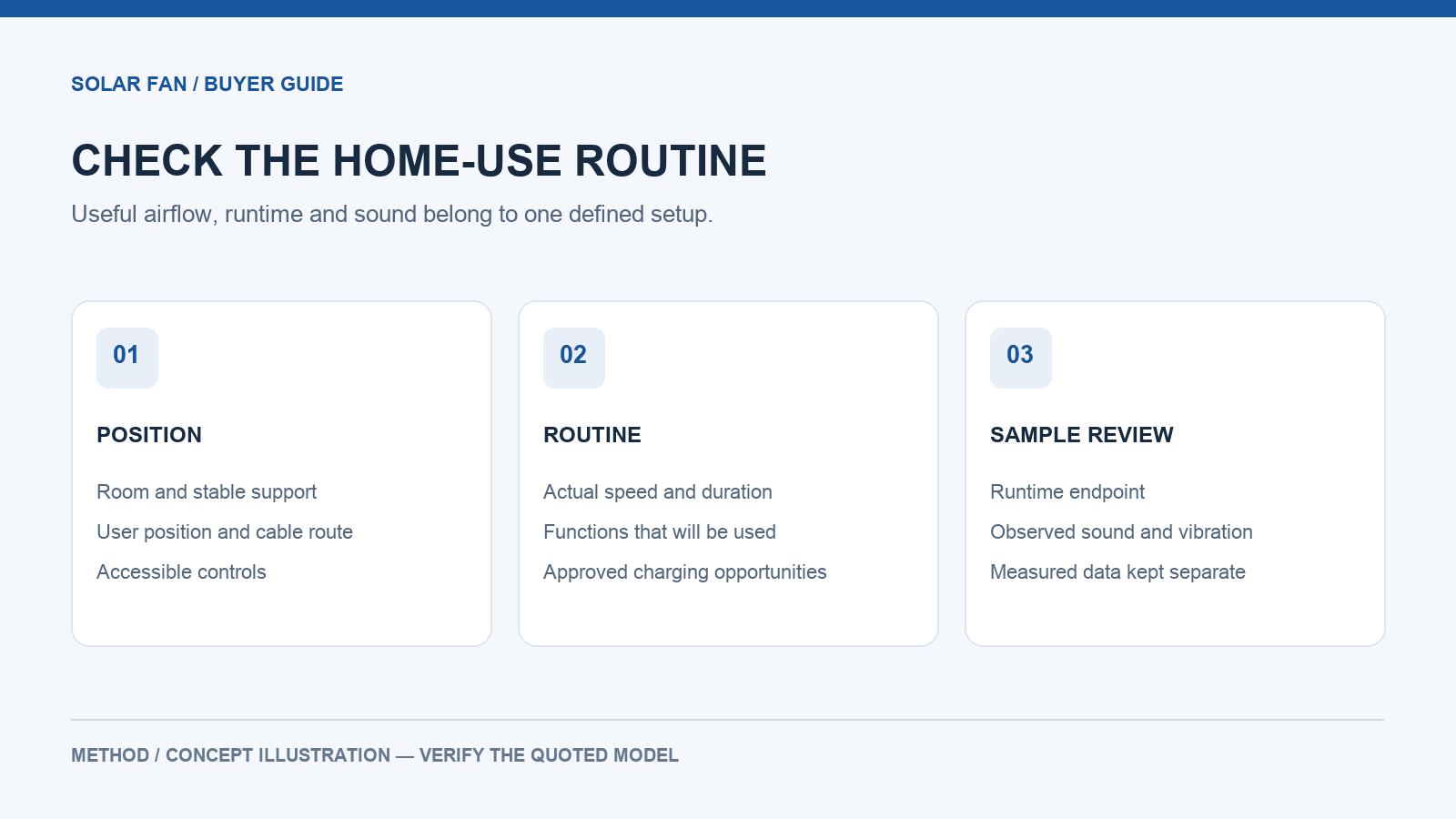
Try the intended routine rather than testing only the fastest speed briefly. At the relevant settings, observe airflow at the user's position, ease of control and any vibration. If several people will share the fan, check the available head adjustment and oscillation where offered. Record what was enabled in the runtime test.
For distributor orders, the instructions and retail explanation should use the same configuration. Customers should be able to identify the charging input without confusing it with a device output. Confirm the original manual's connection diagram and do not replace it with an illustration of another model's ports.
Plan charging before the next power cut
Identify the available charging sources and the supplied equipment. Confirm the approved adapter, destination plug, panel and input connection for the exact order. Do not describe mains, USB or another charging method as universal across all solar fans.
For solar charging, consider where the panel can receive light without shade, while the fan and electrical connections remain in the conditions permitted by the instructions. Check cable length and routing. A shaded balcony or a panel behind an unsuitable window should not be assumed to deliver the panel's rated output.
Request a charging observation with weather, starting charge and operating state recorded. For a market with unreliable power, ask what practical recharge options are available for the selected version rather than relying on a single ideal-sunlight statement.
Match placement to the room
Check the intended floor or tabletop area, the base footprint and access to controls. Keep cables out of walking routes. Provide room layout and placement constraints when asking the supplier to recommend a format; fan diameter does not establish coverage for every room.
For a standing format, the T919 solar fan details provide a specific next step. Check its specification, controls and assembly guidance, and match the quotation to the version being evaluated.
Placement: where the fan and panel should go
Choose a stable surface or floor location with clear space around the fan according to its instructions. Check the base footprint, head position, guard condition and cable route. Keep the fan's intended location practical for moving around the room. Verify that controls remain accessible once the product is installed in the planned position.
A panel needs a different assessment. Find a location with usable daylight, examine shade during the intended charging period and check whether the supplied arrangement reaches that location. Panel positioning depends on the actual site; copying one angle or facing direction for every country is not a sound selection method.
The panel's location does not establish that the fan, adapter or every connector can remain exposed outdoors. Treat charging and operating conditions separately and follow the instructions for each component. A dry sheltered demonstration is useful for explaining placement but is not proof of rain resistance.
Evaluate noise on the actual sample
“Quiet” is a buying preference, not a measurement. Ask which speed, distance and background conditions were used for any noise result. Motor design is only part of the complete fan's sound; airflow, the guard, assembly and operating settings can also matter.
For a practical sample check, listen at the intended position, try the required speeds and observe oscillation if included. Write down any vibration or unusual sound. Do not convert a subjective impression into a dB number or promise silence.
Choosing a quiet rechargeable fan for a bedroom
“Quiet” is a buying preference that needs a defined check. Ask which speed, measurement distance and room conditions were used if a supplier provides a sound-pressure result. Compare like-for-like records. A number without conditions or a generic brushless-motor claim cannot establish how the complete fan sounds beside a bed.
For a practical sample assessment, place the fan where it would be used, choose the expected speed and listen from the intended position. Note airflow sound, vibration, oscillation and any control beep or indicator light that affects the routine. A daytime demonstration in a noisy showroom may conceal details that matter in a quiet room.
Keep subjective observations and measured values separate. “Comfortable at the tested position” describes a specific evaluation; “silent in every bedroom” is a much broader claim. If numerical noise evidence is unavailable, describe the model's controls and offer a sample check rather than inventing a dB rating.
Confirm the delivered kit and service arrangements
Compare the sample, quotation and kit list. Confirm the panel, adapter, remote and assembly parts actually included. Record instructions, packing, approved cleaning procedure and how replacement parts are identified. Ask for warranty terms and availability rather than assuming every version shares the same support.
For a home-backup quotation, send your requirements: model or preferred format, target quantity, destination country and plug, intended backup period, charging sources and required functions. This gives the supplier a basis for confirming a suitable kit and the conditions behind its runtime information.
A simple household sample record
| Step | What to write down |
|---|---|
| Identify | Fan version, included kit and approved charger |
| Charge | Starting state, charging method and full-charge indication |
| Position | Surface, user distance and relevant room conditions |
| Operate | Speed, oscillation, light or other enabled functions |
| Review | Duration, endpoint, useful airflow and observed sound |
For a changing evening routine, also record when settings change. Repeat the routine under comparable conditions if the first result is unusual. Do not convert one household observation into a guaranteed result for every customer or climate.
Turn home-use questions into a useful model enquiry
Instead of requesting “the best solar fan for home,” describe the room and backup routine. State the required operating period, preferred placement, charging opportunities and functions. Ask for the battery rating and a runtime record at those settings, then discuss a sample if the sound or controls are important to the decision.
A distributor can use this brief for several customer segments while keeping the model specification fixed. One segment may value room placement; another may prioritize stored size; a third may require a particular plug or instruction language. Treat these as order requirements, not reasons to silently substitute a different battery or accessory set.
Home-backup questions
Will a solar fan run when mains power is off?
A suitable battery-equipped model can run from stored energy when charged. Confirm its operating arrangement; battery inclusion does not itself prove automatic switchover.
Is a solar fan for home use a replacement for air conditioning?
It provides airflow. Evaluate that airflow at the intended position rather than treating the fan as a promise of a particular room temperature.
Can it operate while charging?
Confirm this for the selected version and approved equipment. Do not infer support from a photograph of a connected cable.
How should I compare bedroom noise?
Use the same speed, distance and room conditions for a sample or measured comparison. Keep subjective observations separate from numerical noise ratings.
Where can I compare home-use formats?
Use the home solar fan collection and shortlist the formats that fit the room. Confirm the exact kit and specifications on the model page before requesting a quote.