


A solar camping fan needs a practical carrying and charging plan. A product with a solar panel is not automatically designed to stay outside in rain, and a rechargeable fan's longest runtime may not match an evening with lighting or other functions enabled.
For distributors building a camping or outdoor assortment, separate two decisions: how easily the fan can be transported, and whether its approved operating conditions match the intended location. Use the portable solar fan collection for compact formats, and the outdoor solar fan collection to discuss the use conditions.
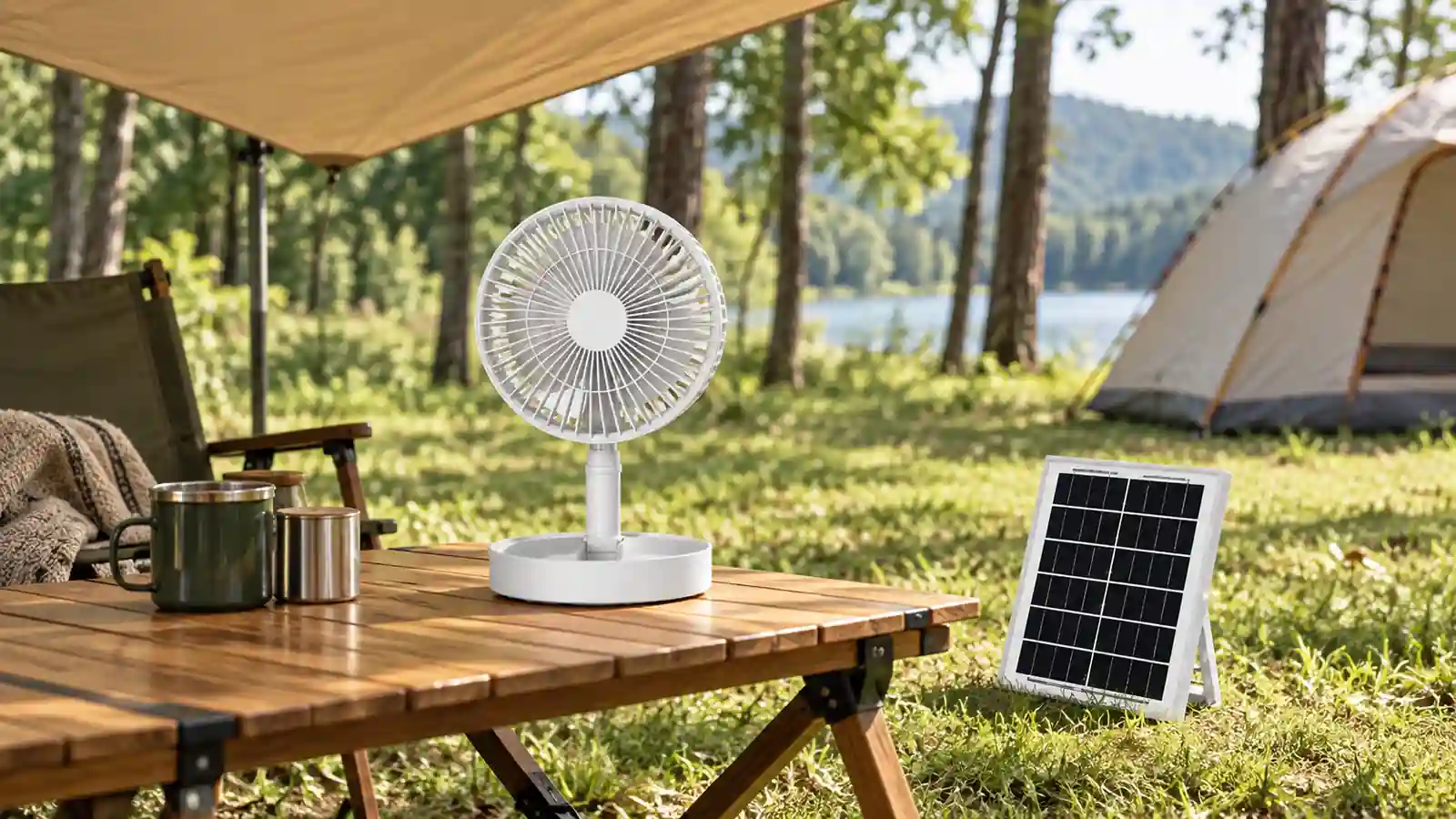
Define what “outdoor use” means for the order
Describe the setting: a dry sheltered campsite, a covered stall or a temporary seating area. State whether the fan is attended and how it will be stored. Ask for the operating limits and protection information of the exact version.
Do not infer an ingress-protection rating from the word “solar” or a camping photograph. Unless the product documentation confirms the conditions, plan for dry sheltered operation and keep the fan, adapter and electrical connections protected from rain. A panel's approved exposure conditions may differ from those of the fan and charger.
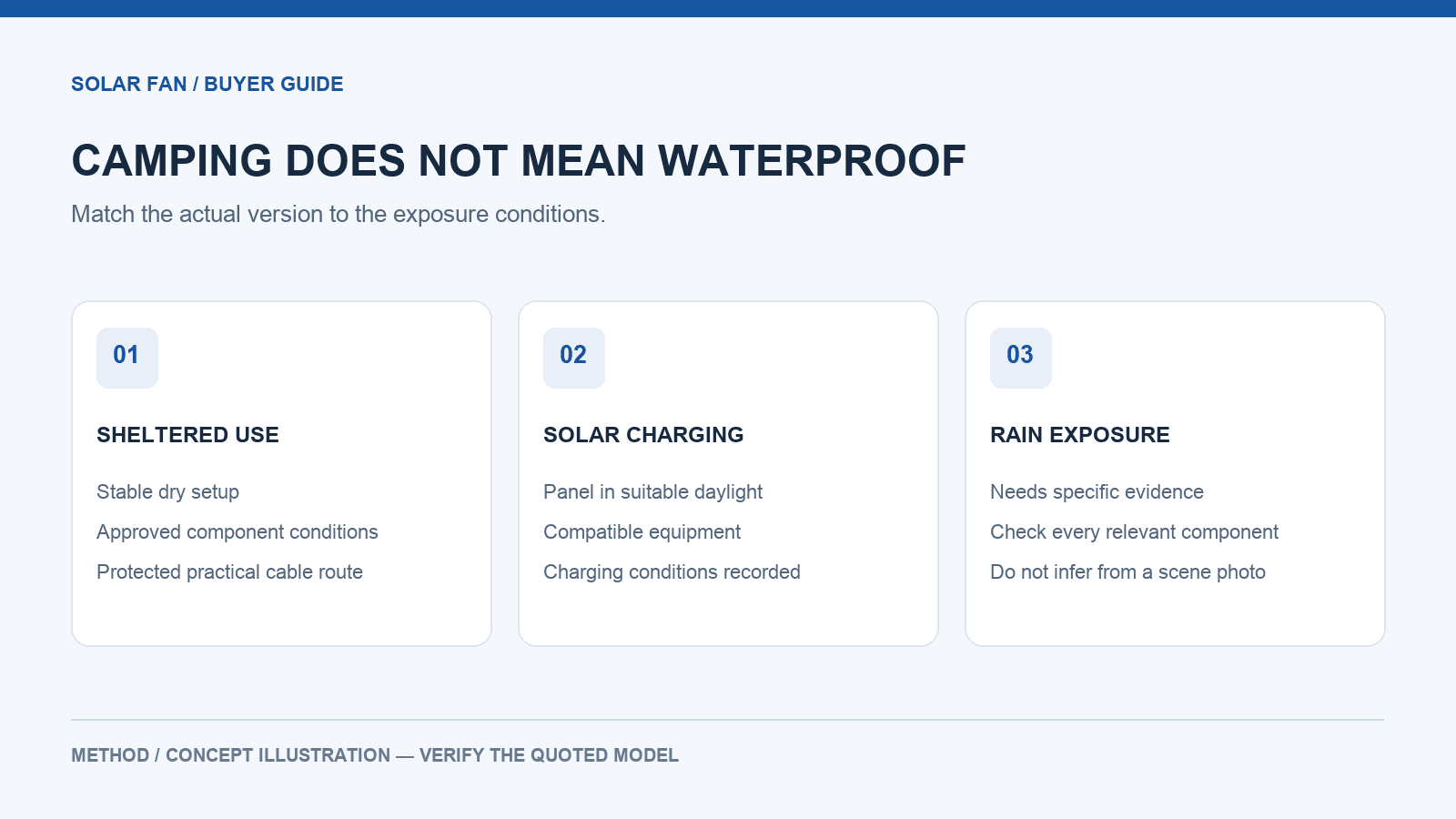
Is a waterproof solar fan the same as a camping fan?
No. Camping describes a use case; waterproof describes a protection claim that needs model-specific evidence and limits. A product can be portable and useful under shelter without being approved for rain. Ask which parts and conditions any published protection rating covers.
If the buyer needs exposure to rain, tell the supplier before selecting a model. Request applicable documentation for that exact version and do not substitute a generic outdoor photograph for it. Where no suitable version is confirmed, keep the proposed use to its documented conditions rather than changing the product's claims to fit the keyword.
After a trip, follow the supplied cleaning and storage procedure. Check that components are dry before packing and observe battery storage guidance. Identify service tasks that belong with a technician. A short trip does not remove the need to protect the panel, guard, connectors and battery during transport.
Compare the complete carried set
Check the operating and stored dimensions, weight, setup procedure and the separate items that must be carried. A foldable fan can reduce its own stored size, but the panel, cable, adapter and accessories still belong in the packing plan.
The T8 foldable solar fan page is a specific model route for buyers considering a compact format. Use its current specification and a sample to check the stored arrangement. Do not apply one model's folding mechanism or charging options to the entire range.
| Buying check | Record for the quoted version |
|---|---|
| Carrying | Stored dimensions, weight and required separate equipment |
| Setup | Base/support arrangement, approved position and assembly steps |
| Environment | Operating limits and documented protection information |
| Charging | Matched panel/adapter, input port, cable and approved sources |
| Operation | Speed and functions needed, with runtime conditions |
| Packing | Supplied kit, protective separation and carton data |
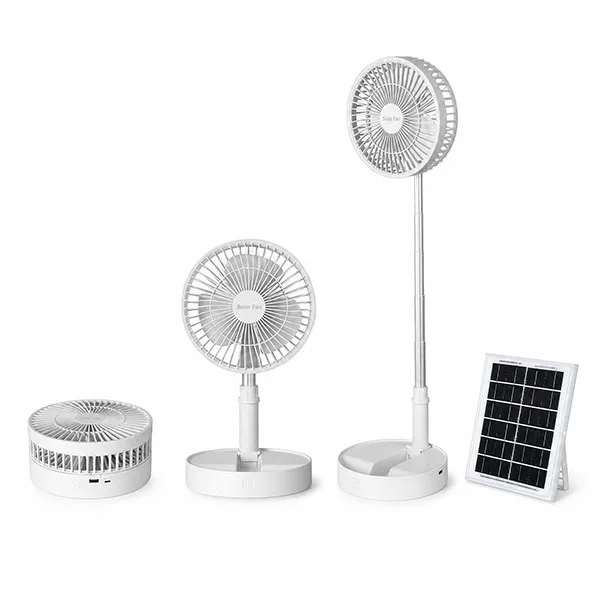
Check the portable solar fan as a complete carried set
Make a packing list for everything the customer will take: fan, panel, approved adapter, necessary cables, remote and any included accessories. Measure stored dimensions and total carried weight using the offered kit. The product's folded size is only one part of that assessment.
Try the pack-and-set-up routine on a sample. Keep the panel and guard protected during transport, locate the controls after placement and check whether the base sits securely on the intended surface. Confirm the approved positions. A fan should not be hung from a tent merely because that position would look convenient in a picture.
If a distributor sells several compact models, give each kit its own component list. Do not combine a remote from one model, a panel from another and a charger from a third into a photograph suggesting a standard set. The quotation and delivered configuration should remain the reference.
Give the panel a suitable charging location
Follow the supplied setup guidance for the matched panel. Choose a location with useful sunlight and avoid shade from a tent, roof or nearby object. Keep cable routes clear of foot traffic and strain on the connectors.
Do not prescribe one fixed panel angle for every country or season. Confirm the approved setup and record the location, sunlight and shading when evaluating charging. A charging indicator alone does not prove that the battery will be full before evening.
Confirm the correct input port before connecting equipment. A device-output socket should not be treated as a solar charging input. For an alternative source, ask the supplier to confirm compatibility for the exact model.
A solar powered camping fan needs two placement decisions
The fan's useful position and the panel's charging position may be different. Under a shaded canopy, the fan can be near the seating area while a compatible panel is placed in unobstructed daylight under its approved conditions. Check the complete supplied cable arrangement and keep the route practical. Do not assume every kit includes enough cable for every campsite.
Observe the site over the intended charging period. A spot in full daylight when you arrive may later be shaded by a tent, tree or vehicle. Use the model's approved setup and adjust the plan for the actual location. A fixed panel angle copied from a single photograph is not a universal instruction for every season and country.
Keep the actual operating limits in the decision. Outdoor use may mean a dry sheltered location, rather than exposure to rain or splash. The suitability of the panel does not establish the protection of the fan, charger and connections. Confirm each component's instructions before treating a camping illustration as an approved installation.
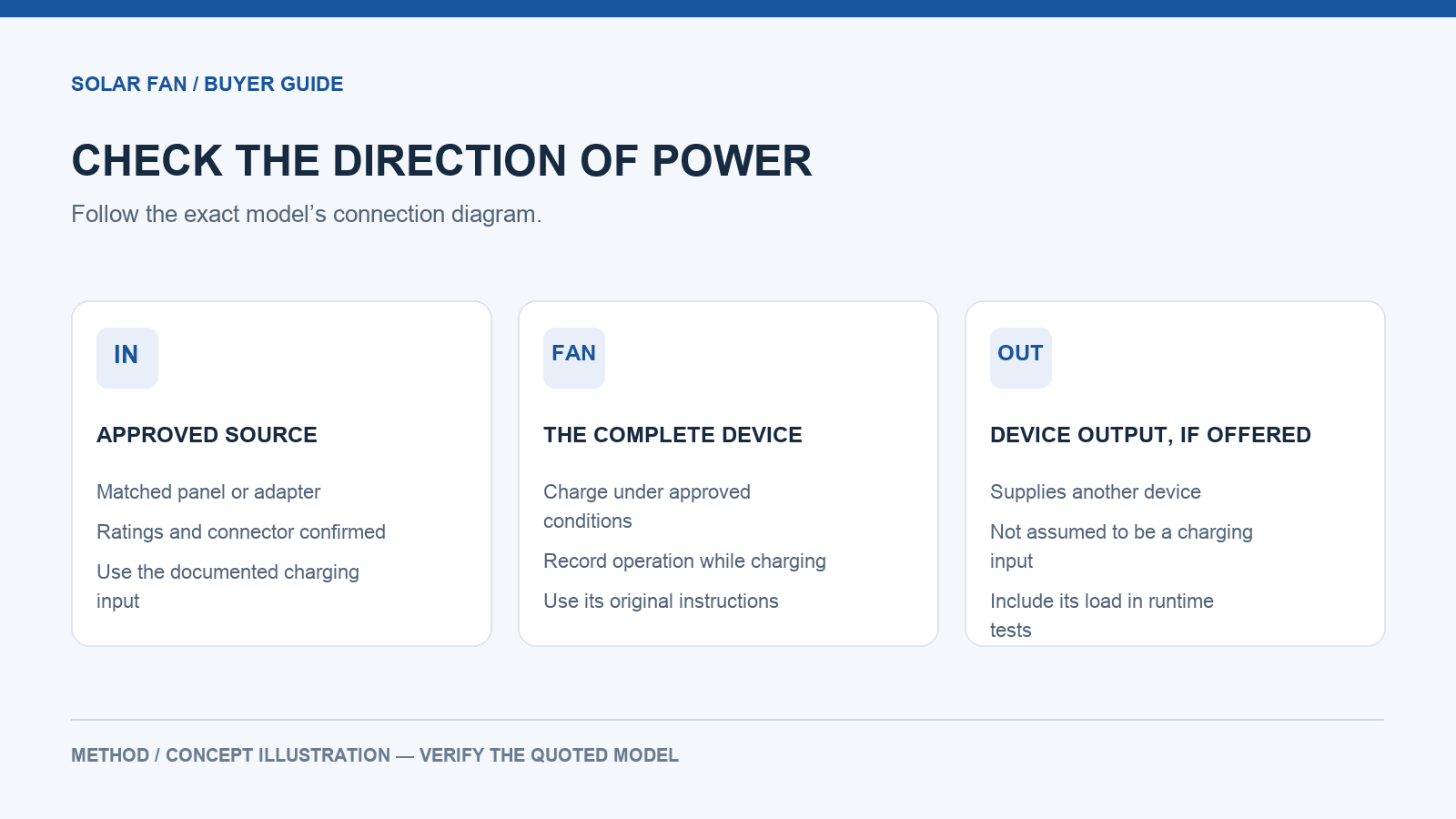
Charging input and device output are different functions
Before connecting equipment, identify the charging input shown in the model instructions. Confirm the approved source, electrical rating and connection. A device-output socket supplies another device; it should not be used as a solar charging input unless the manufacturer explicitly identifies that function for the selected version.
The connector shape alone is not enough to confirm compatibility. Check the intended voltage, polarity where relevant and supplied cable arrangement. Ask the supplier about alternative equipment before purchasing it. Do not assume that every solar fan supports USB charging, a car outlet or a larger replacement panel.
If device charging is part of the evening routine, include it in the runtime request. Record the output load and use period instead of assuming the fan-only result still applies. The supplied instructions should show the same port arrangement as the delivered sample.
Check the evening operating requirement
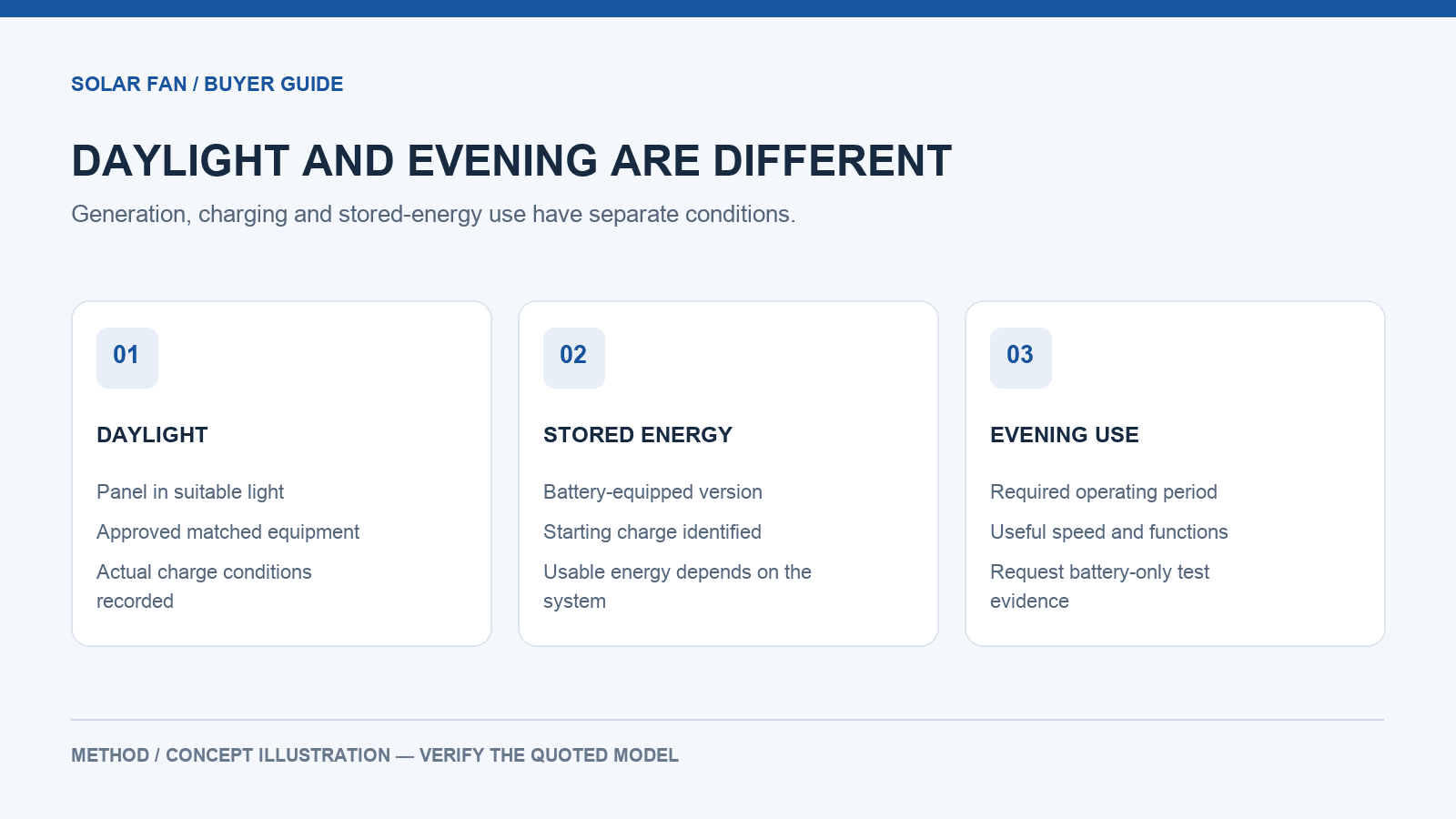
Specify the intended hours, speed and required light or other functions. Request a battery-only runtime result with those settings. Keep tests with charging connected separate from tests using only stored energy.
If cloudy conditions or shaded locations are common, ask about the approved alternative charging methods of the shortlisted model. Do not promise uninterrupted off-grid operation from panel watts or battery capacity alone.
Can a camping fan with a solar panel run overnight?
Night operation requires an appropriate source of stored energy or another compatible supply. Ask whether the selected kit has a rechargeable battery, then request its rated data and a result for the intended night routine. Solar panel wattage alone does not establish battery-only hours after sunset.
Describe the speed and any light or device-output use. A rechargeable camping fan tested at one low setting cannot be assumed to deliver the same duration at a higher setting or with additional loads. If the routine includes several stages, ask for a test that records when the settings change.
Plan the next day's recharge as well. A fan that starts the trip fully charged may perform well on the first evening, while the second evening depends on actual replenishment. Ask how the approved solar and alternative charging routes fit the proposed trip. Do not advertise uninterrupted multi-day operation without a matching energy and test record.
Confirm storage, care and quotation details
Ask how the fan and panel should be cleaned, dried and stored according to their instructions. Confirm the battery storage and recharge guidance, and identify which service tasks require a technician. Transport should protect the guard, blades, panel and connectors in the supplied configuration.
For a camping solar fan enquiry, send the intended setup with the preferred model, quantity, destination, carrying limit, charging sources, evening use and required accessories. Ask for the complete kit, packing dimensions and model-specific operating limits. These details give the supplier a clear basis for recommending a configuration without turning an outdoor scene into an unsupported performance claim.
A camping sample checklist for importers
| Requirement | Evidence to request |
|---|---|
| Fits the travel kit | Full-set dimensions, weight and packing photos |
| Works at the intended position | Approved setup and sample stability check |
| Covers evening use | Battery-only result at specified speed and functions |
| Can be replenished | Approved charging sources and conditions |
| Fits the exposure conditions | Instructions and version-specific protection evidence |
Start with the portable solar fan collection for carrying and format selection. Use the outdoor collection to discuss placement and limits. The selected model's actual specification should then determine the offer.
Camping and outdoor questions
Does a solar camping fan need direct sunlight while running?
A battery-equipped version may run from stored energy. The panel needs suitable light when solar charging is intended; confirm the selected model's arrangement.
Can the fan stay outside in rain?
Only if that exact model and its relevant components are approved for those conditions. A camping label or outdoor picture is not evidence of rain protection.
Does a folded fan include a folded solar panel?
Not necessarily. Inspect the supplied panel and complete packed set rather than assuming all components fold together.
Can I replace the panel with a larger one?
Ask for compatibility confirmation for the selected version. More rated watts do not make an arbitrary panel suitable for its charging circuit.
What helps a supplier quote a camping configuration?
Send the complete carrying requirement, destination, quantity, intended evening routine, available charging sources and exposure conditions. Include the shortlisted model and required accessories.