


A solar fan wholesale order starts with a clear definition of what you are buying. Two quotations may show similar fans while covering different batteries, panels, accessories or packing arrangements. A low unit price is useful only when the quoted sets meet the same requirements.
Before approving a bulk order, agree on the product version, complete kit, runtime conditions, sample acceptance checks and after-sales arrangements. Use the checklist below to turn a product enquiry into a quotation your purchasing and sales teams can both understand.
1. Define the use before choosing the model
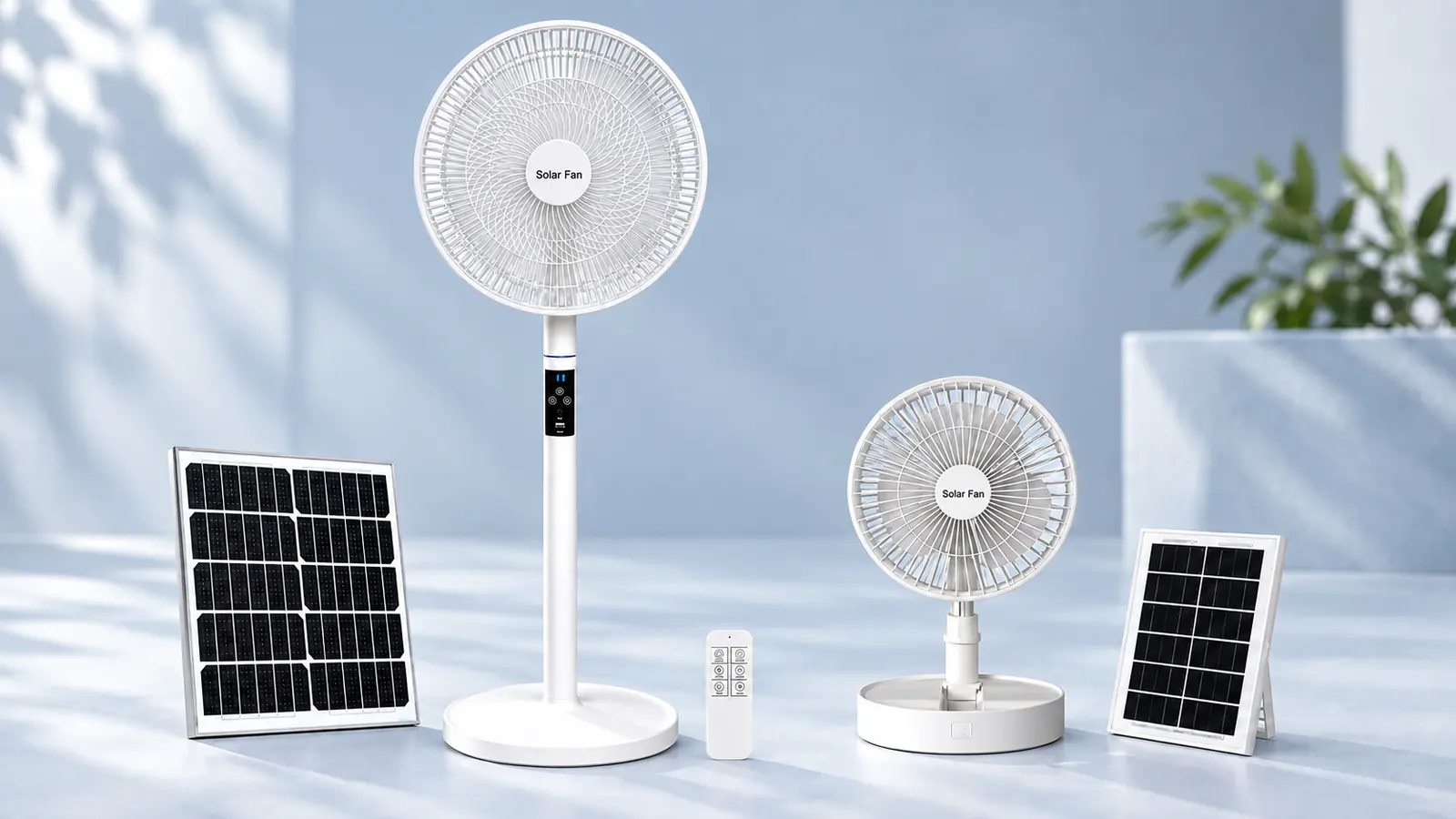
Describe where customers will place the fan, when they need it and how they will recharge it. A shop counter, a bedroom and a portable outdoor setup can call for different sizes, stands, controls and carrying arrangements. Separate essential features from optional selling points.
For distributors serving Southeast Asia or Africa, specify the actual destination country and sales channel. Confirm the required plug, instruction language and expected use with the buyer; a regional label alone does not define them.
Start with the NEWSKYPOWER solar fan range to shortlist formats. Then request a dated specification for each shortlisted model and version. Model names help identify a product, but the agreed specification should define the order.
How to evaluate a solar fan supplier before ordering
Ask who makes the offered model, which company accepts the order and who handles technical questions and after-sales claims. A clear answer helps purchasing and service teams know where to send documents. Request current model-specific specifications and photographs of the actual offered kit, rather than relying on an old catalogue page with a similar name.
Useful evidence is connected to the order: a dated specification, an identifiable sample, an agreed inspection procedure and documents that match the delivered battery and adapter. Factory photographs can introduce a business, but they do not prove runtime, compliance or stock availability. If documentation is needed for the destination market, specify the product version and ask for the applicable documents before approving artwork or labels.
Treat sample approval as a shared reference, not an informal conversation. Record the date, sample identifier, controls, supplied accessories and accepted variations. Purchasing should be able to explain exactly what was approved without asking the sales team to reconstruct a chat history.
2. Confirm the complete kit and exact version
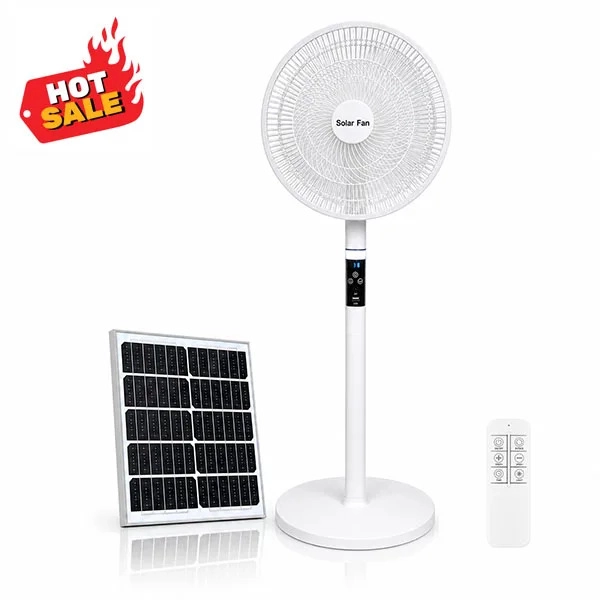
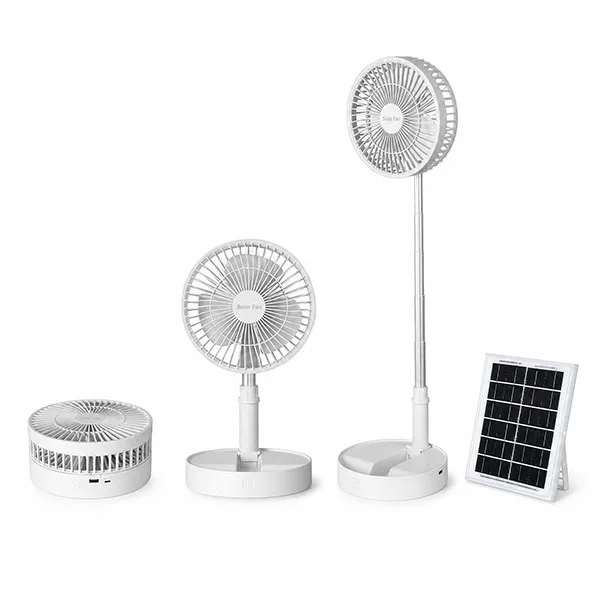
Ask the supplier to list everything included in one saleable set: fan, battery, solar panel, connection cable, adapter, remote control, mounting or assembly parts and instructions, as applicable. Mark optional items separately and record the quantity of each.
Confirm whether accessories pictured in marketing material are included in the price. Record panel and adapter identification, cable length, connector type and the supplier-approved charging arrangement. Have the supplier confirm electrical compatibility; a connector that fits does not establish that a different panel or adapter is suitable.
If the T919 standing solar fan is on your shortlist, identify the quoted version in the specification, sample label and order. Apply the same discipline to every model, especially when a supplier offers more than one configuration.
3. Compare battery energy and runtime on the same basis
For a solar fan with battery, request the battery pack's nominal voltage, capacity and watt-hour rating together. For rated energy, Wh = V × Ah; divide mAh by 1,000 to obtain Ah. Use voltage and capacity that describe the same pack. The calculation is explained in the FAA's battery watt-hour guidance.
Watt-hours describe energy; watts describe power. Rated battery energy is not a runtime test or a measurement of energy delivered to the fan. Storage and conversion involve losses, as the U.S. Department of Energy's storage explanation describes. Dividing rated Wh by an assumed constant load in W gives an idealized calculation, not a verified operating duration.
Ask for runtime records showing the exact sample, starting charge, speed setting, auxiliary functions, temperature, charging connection and stopping criterion. Compare battery-only runs separately from runs with charging connected. A low-speed result should not be presented as the duration at every speed.
Compare solar fan prices on one specification sheet
A low unit price is useful only when the offers cover the same deliverable. Make a comparison sheet with one column per supplier and one row per requirement. Record the model and revision, battery-pack voltage and capacity, included panel, adapter, plug, remote, accessories and packing. Put optional equipment in a separate row with its own price. An attractive product photograph does not establish what the quoted carton contains.
Separate the product price from sample charges, customization, inspection, transport and the agreed delivery basis. Ask what the quote includes and how long it remains valid. Two offers labelled “solar fan kit” can differ because one includes a panel and another sells it separately. Resolve that difference before negotiating a discount or presenting the offer to a distributor.
For a solar rechargeable fan, request operating time at the speed customers need. A longer low-speed result cannot fairly be compared with another supplier's high-speed result. Where the conditions differ, leave the comparison open until matching records are available. Avoid choosing a supplier by the largest battery number or the longest headline runtime alone.
4. Approve a sample against a written record
Agree on the acceptance criteria before testing. Check assembly, stability, controls, charging indications, accessory fit and the functions included in the quotation. Record noise observations at a stated speed and distance; do not turn a subjective listening check into a decibel claim.
Use the same procedure for competing samples. Keep solar-charging observations separate and record weather, shading, panel placement and whether the fan was running. A charging indicator alone does not establish a full-charge time.
The following is a blank working record, not a set of test results.
| Sample record field | Enter during evaluation |
|---|---|
| Identity | Supplier, model/version, sample ID, specification date and photos |
| Configuration | Battery identification, panel, adapter and accessories received |
| Test setup | Date, temperature, charging method, starting charge and speed setting |
| Functions and runtime | Functions enabled, start/end times, charging connected or disconnected, stopping criterion |
| Inspection and decision | Assembly, controls, observed issues, evidence, agreed limit and pass/recheck decision |
Keep the approved sample and written record as references for the production order. Sample approval does not replace the agreed checks on the bulk shipment.
A practical sample inspection sequence
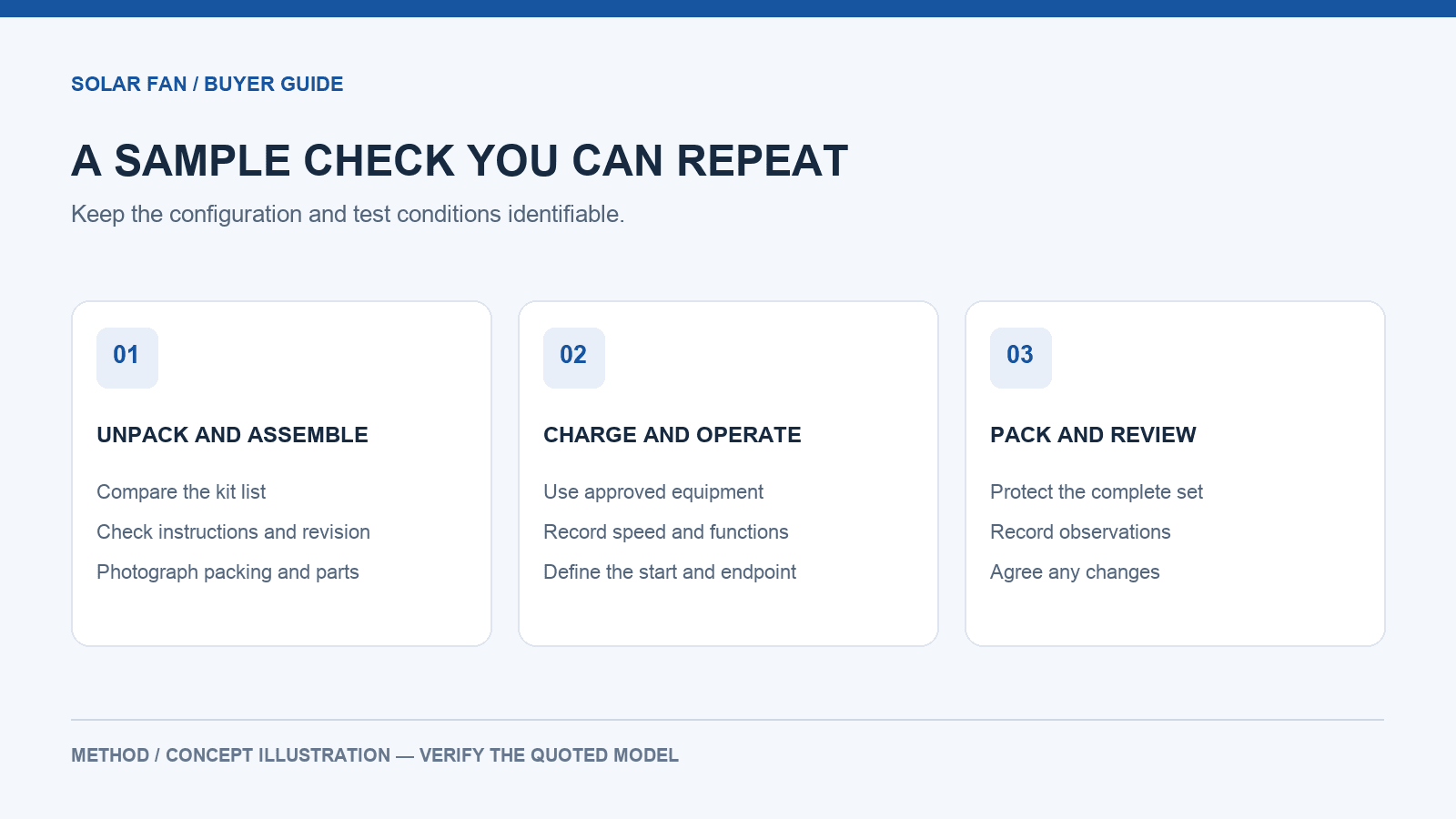
Start with an unpacking check. Photograph the unopened carton, protective inserts, included components and any visible damage. Compare the contents with the quotation. Assemble the fan using the supplied instructions and check that the guard, base and adjustment mechanisms fit properly. Do not improvise with a charger that merely has a matching plug.
Next, test the controls at the intended operating position. Check speed changes, oscillation, timer, remote and any other quoted features individually. Note the room conditions and operating settings. Test the approved charging method separately from battery-only runtime so the two results are not confused. Record the full-charge criterion and the point at which the runtime test ends.
Finally, repeat the intended customer routine: charge, move the complete kit, set up, run and store. This often exposes practical issues that a brief powered demonstration misses, such as unclear instructions, a difficult folding mechanism or insufficient cable reach. Send photographs and observations to the supplier while the sample revision is still identifiable.
| Inspection stage | Record to keep | Decision it supports |
|---|---|---|
| Unpacking | Kit list, packing photos, visible condition | Whether the quoted set was delivered |
| Assembly and controls | Model, procedure, selected functions | Whether users can operate the offered version |
| Charging | Approved source, starting state, completion criterion | Whether the recharge procedure is understood |
| Battery-only operation | Speed, functions, duration, endpoint | Whether the result matches the intended use |
| Storage and transport | Complete carried set and packing arrangement | Whether the format fits the sales channel |
5. Send a quotation request with comparable fields
Give each supplier the same requirements. Ask them to identify deviations clearly, rather than silently substituting a different battery, panel or accessory. Separate the sample offer from the bulk-production offer.
| RFQ field | What to request or specify |
|---|---|
| Destination and quantity | Country, delivery destination, sales channel, trial quantity and anticipated bulk quantity |
| Product definition | Model/version, dated specification, required features and complete kit list |
| Energy and operation | Pack V/Ah/Wh, charging arrangement and runtime conditions with supporting records |
| Price basis | Currency, unit price, quantity breaks, included items, delivery basis and named place |
| Order conditions | Minimum order, sample costs, payment terms, quote validity and production lead-time starting point |
| Packing | Units per carton, carton dimensions, gross/net weights, protection and assembly state |
| Branding and documents | Artwork, manuals, labels, requested destination documents and any additional charges |
| Service | Warranty scope, claim procedure, replacement parts, availability and costs |
Compare the total scope behind each price. If one quotation excludes the panel or uses different packing, clarify those differences before judging the price gap.
Build a request for quotation that gets a useful response
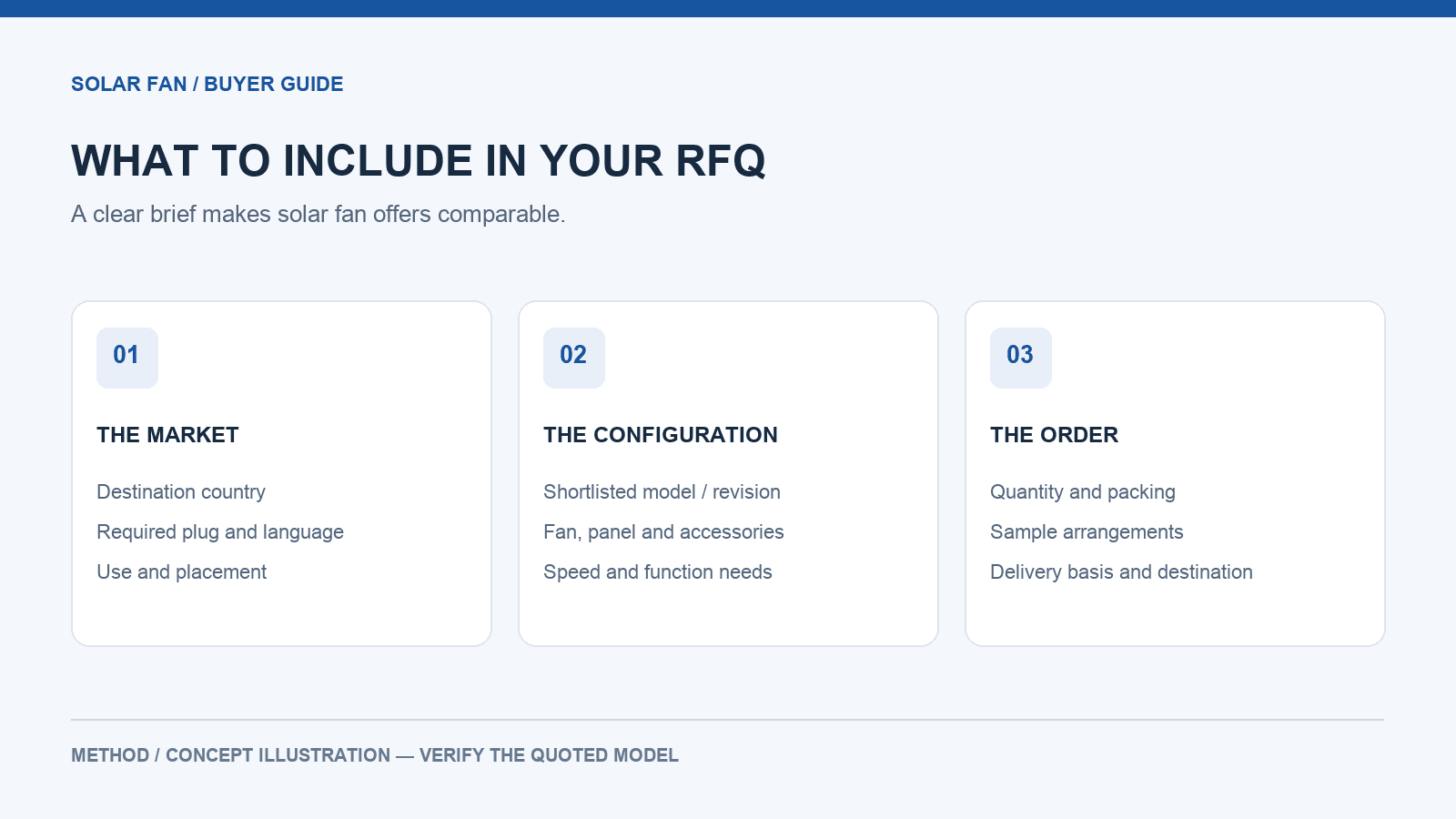
An enquiry such as “send your best solar fan price” leaves the supplier to guess the configuration. A better request names the target country, preferred format, shortlisted model, quantity, complete kit and charging requirement. Add the required AC plug, intended daily use and functions. If you need branded packaging or a particular instruction language, describe that separately.
You can use this starting brief: “Please quote the selected model for our destination market, with the panel and accessories listed individually. Confirm the battery-pack V, Ah and Wh, charging methods, runtime test conditions, packing dimensions, sample arrangements and delivery basis. Show optional equipment separately and identify the specification revision.” Replace each general description with your actual requirement before sending it.
This level of detail also makes the next conversation easier. If price is too high, you can discuss a specific accessory or packing option rather than unknowingly accepting a different battery or charger. Keep revised offers beside the approved sample record and obtain agreement on material changes.
6. Check packaging and after-sales support
Request photographs or an agreed packing sample showing how the fan, panel and accessories are separated and protected. Confirm which parts require assembly and whether the instructions match the delivered version. Use the quoted carton dimensions and weights when asking your logistics provider for a freight estimate.
Ask which replacement parts can be supplied, how they are identified and which versions they fit. Useful questions cover adapters, remotes, blades, guards, control boards and battery replacement arrangements, where applicable. Confirm whether a repair belongs with a service technician or the end user under the product instructions.
Get the warranty scope, exclusions, evidence needed for a claim, responsibility for freight and replacement process in writing. Do not assume a parts list means every part is stocked or interchangeable across models.
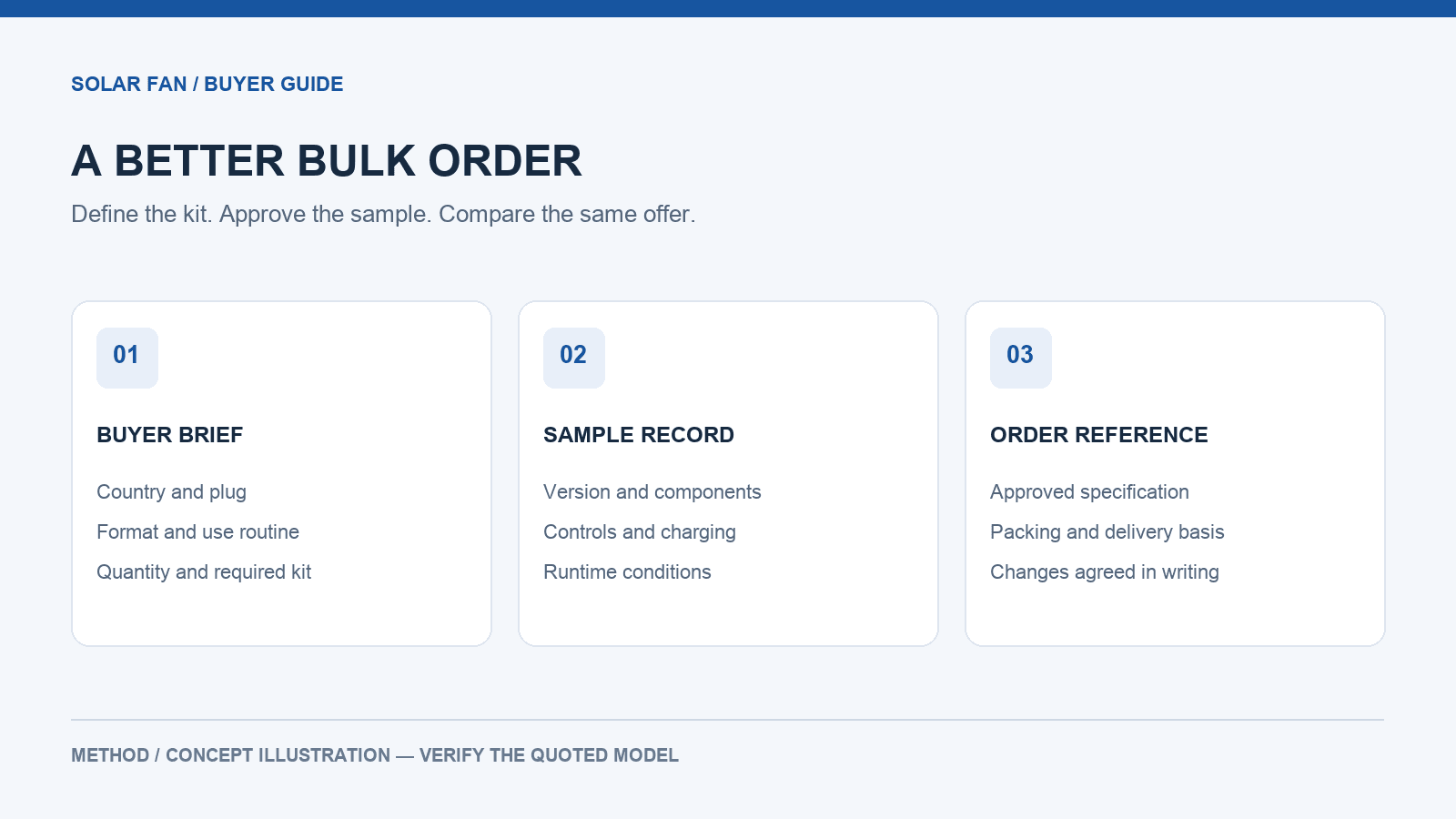
7. Turn the approved sample into a clear purchase specification
Before releasing the order, reconcile the approved sample, final quotation, specification and packing list. Record how substitutions or specification changes will be approved. Keep version references on the documents used by purchasing, inspection and sales teams.
To discuss a NEWSKYPOWER order, send your solar fan requirements with the destination, target quantity, shortlisted model, required kit and expected operating conditions. Those details give the supplier a practical basis for confirming a configuration and preparing a comparable quotation.
Wholesale buying questions
Is the solar panel included in every solar fan wholesale offer?
No. Confirm the included panel, cable and adapter on the itemized kit list. A panel pictured beside a fan may describe an available configuration rather than everything included in the price.
What should I request before a bulk order?
Request the model revision, complete specification, kit list, sample procedure, packing information and written commercial terms. Agree how the delivered products will be checked against the approved sample.
Can I compare suppliers by solar fan price alone?
Compare like-for-like kits and delivery terms first. Battery data, included equipment, packing and agreed service arrangements can change the meaning of the unit price.
Does a successful sample prove every production unit will be identical?
A sample defines the reference configuration. An agreed order specification, change-control process and inspection procedure are still needed to check the shipment.
Where should an importer start model selection?
Use the solar fan collection to shortlist formats, then request the exact model's current specification and kit. Keep the buying checklist beside the quotation so the commercial discussion stays specific.