


Choose Solar Powered Street Lamps for Your Road Project
NEWSKYPOWER supplies solar powered street lamps in integrated, semi-integrated and split configurations for municipal roads, community streets, parking areas, access roads and commercial outdoor projects. Compare the models below to find a suitable layout for your site and maintenance needs.
Start with road width, pole height, pole spacing and nightly lighting hours. Then match the lamp, solar panel and battery to the installation location and required backup time. Send us these project details for a model recommendation.
Solar Powered Street Lamp Models for Road Projects
Use the model cards to compare housing layout, solar-panel arrangement and available functions. Send your road dimensions and operating requirements for a model-specific recommendation.

Rated LED power: 30W–120W. Integrated industrial series with LiFePO4 battery storage, MPPT control and a die-cast aluminum housing.
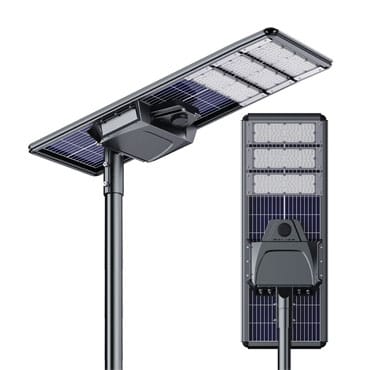

Rated LED power: 40W–120W. Integrated industrial series with a mono solar panel, LiFePO4 battery and die-cast aluminum housing.


Models: X1-400W / X1-600W / X1-1000W / X1-1200W. These are nominal model labels. Luminous flux: 4800 / 5600 / 8800 / 10800 lm. Separate mono solar panel and LiFePO4 battery.


Models: MJ-LH9300 / MJ-LH9400 / MJ-LH9500 / MJ-LH9600. Nominal model labels: 300W / 400W / 500W / 600W. LED type: SMD2835.
Feature of Solar Powered Street Lamp

Review lamp and component coverage alongside your project’s maintenance needs.

Compare compact assemblies and separate-panel layouts to suit the available mounting space.

Consider enclosure and connection protection for rain, dust and the installation environment.

Match battery capacity to the lamp load, lighting schedule and required backup time.
Compare Solar Powered Street Lamp Configurations
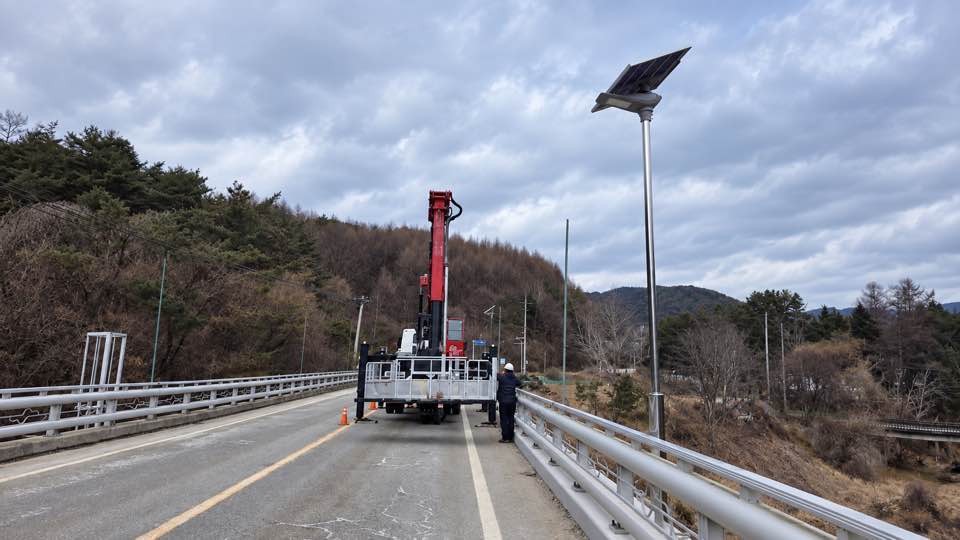
Compare an integrated LKH or SSP solar street lamp with a separate-panel X1 or NF configuration. Integrated units combine the panel and lamp into a compact assembly; separate-panel models allow panel orientation to be considered independently. The product shown is the NF series with a separate solar panel.
For smaller residential access roads and outdoor access areas, compare the integrated QH01 all-in-one solar street light (3,200–4,800 lm) and E7 T-series solar street light (2,436–3,926 lm). Their 200W–500W product designations are nominal model names; select by verified light output and site layout.
For detailed options, explore our all-in-one solar street lights, semi-integrated solar street lights and split solar street lights.

How to Select a Model for Your Road Project
Solar street light design starts with the road layout. Road width, number of lanes, pole height and pole spacing work together with the lamp’s optical distribution to determine coverage and uniformity. Compare these factors alongside lamp output rather than relying on nominal wattage alone.
For an existing road, send a drawing or site photos with the pole positions. For a new installation, include the proposed layout and target lighting level. Add the nightly operating schedule and rainy-day backup requirement so the solar panel and battery can be considered together with the lamp.
What to Send for a Model Recommendation
Send NEWSKYPOWER your project location, road dimensions, preferred pole height, lighting schedule, backup requirement and quantity. Tell us whether you need lamps only or a system including poles and installation hardware.
If you already have a shortlist, include the model names and any project drawings. This gives us a clear starting point for comparing suitable configurations. For the full range, view all solar street light models.
Model specifications, available options and warranty terms are set out in the selected product datasheet and order quotation.
Solar Powered Street Lamp Project References
- Municipal and Community Roads
- Commercial and Industrial Areas
- Parking and Access Roads


Related Solar Street Light Categories
Please provide the project location, road width, number of lanes, pole height, pole spacing, nightly operating hours, required rainy-day backup and quantity. A road drawing or site photos will help explain the layout and any lighting targets.
The main difference is how the solar panel, battery and lamp are arranged. Integrated models use a compact assembly; semi-integrated and split designs separate selected components. Compare mounting space, panel placement and maintenance access before choosing a structure.
Pole height affects the distance and angle between the lamp and the road surface. It should be assessed together with road width, pole spacing, optical distribution and the target lighting level. A higher pole does not automatically provide better or more uniform lighting.
Selected models support adjustable controller schedules and dimming profiles. Share when the road is busiest and when reduced lighting is acceptable, so the operating profile can be matched to the project’s lighting and battery requirements.
Rainy-day backup depends on battery capacity, lamp load, dimming schedule and local solar conditions. Tell us how many nights of backup you need and the operating hours for each night, so battery capacity and solar-panel sizing can be evaluated together.
Inclusions depend on whether you request lamps only or a complete system. List the pole height, mounting method and required accessories in your inquiry, and check that each required item appears in the quotation.
Selected models offer different panel and battery options. The useful combination depends on the lamp load, available mounting space, local sunlight and backup requirement. Share these conditions when comparing configurations.
IP ratings vary across the range. Use the rating listed for the selected model, and consider the protection of connectors and any separate battery or controller enclosure as well as the lamp housing.
Depending on the model and project, the document package may include a datasheet, packing list, installation drawing, lighting calculation and inspection record. Send your required document list with the inquiry so its availability can be reviewed before ordering.
Review the warranty period and covered components in the quotation for your chosen model. Include any project-specific warranty or service requirements in your inquiry so they can be addressed before the order is placed.