


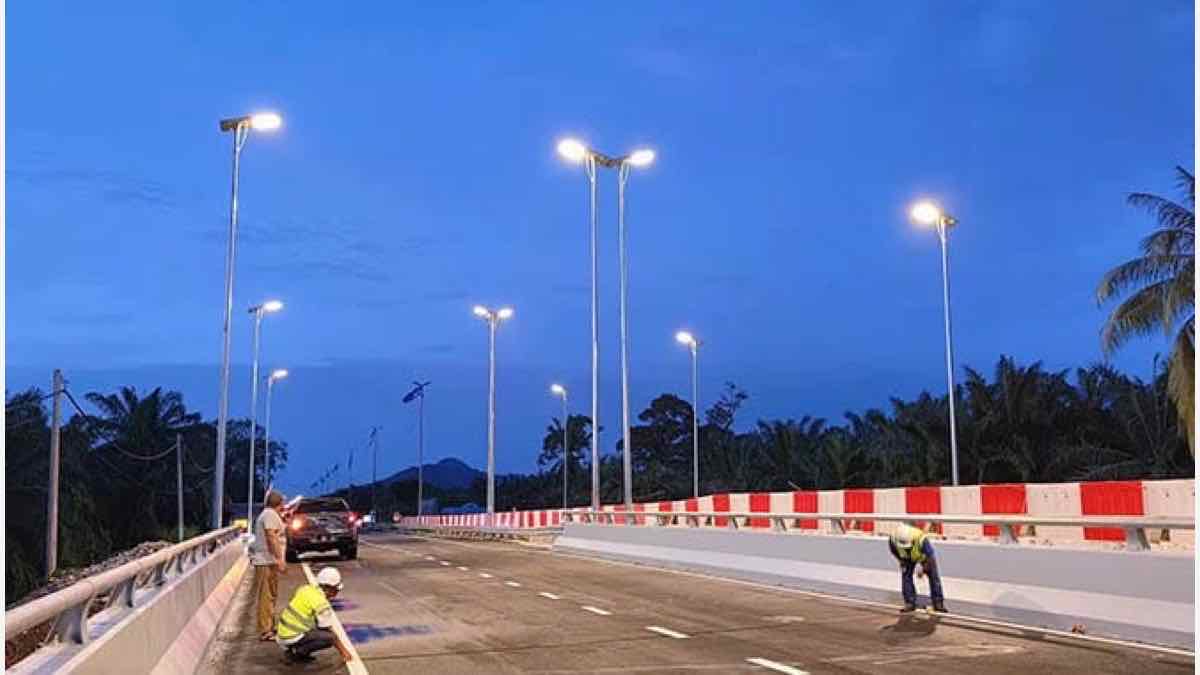
Commercial outdoor lighting includes pole-mounted area lights, floodlights, wall-mounted fixtures, courtyard and post-top lights, bollards, pathway lights, and canopy or low-ceiling fixtures. The right combination depends on what people need to see, where the lights can be installed, and when each area operates.
For a wholesaler, that means building a range around different customer tasks. For a project buyer, it means dividing the site into lighting zones before comparing products. A light suitable for a landscaped walkway may not suit a loading bay, even when both are sold as outdoor LED lights.
This guide explains the main commercial outdoor lighting fixtures, the information needed to compare them, and where solar power fits. Use it to shortlist product families, then discuss the exact configuration with the supplier.
1. Start with the Lighting Task: A Quick Selection Table
Commercial lighting classifications include wall-mounted, pole-mounted, decorative, canopy, bollard and floodlight families. The U.S. Department of Energy's exterior-lighting guidance provides a useful reference for these categories. The table below turns that classification into a buying checklist; it is not a product availability list.
| Fixture family | Typical task | What to compare before buying |
|---|---|---|
| Pole-mounted area and roadway lights | Vehicle routes, parking areas and open circulation spaces | Distribution, mounting height, pole positions, glare and structural interfaces |
| Floodlights | Directed illumination of entrances, work areas, signs or selected perimeter zones | Beam shape, aiming, mounting position and light beyond the intended area |
| Wall-mounted lights | Doors, building edges and side passages | Useful light on people and walking surfaces, mounting height and window sightlines |
| Courtyard and post-top lights | Pedestrian spaces, plazas and landscaped commercial grounds | Light distribution, visual comfort, appearance and pole compatibility |
| Bollard lights | Low-level lighting beside paths and landscaped routes | Optical control, mounting stability and the actual contribution to path visibility |
| Small pathway and landscape lights | Route marking, planting accents and decorative layers | Whether the purpose is guidance, decoration or usable task lighting |
| Canopy and low-ceiling lights | Covered entrances, service areas and parking structures | Ceiling clearance, shielding, wiring and suitability for the covered environment |
Solar and grid-connected describe the power system, not the fixture's lighting task. A solar floodlight and a grid-connected floodlight may serve similar tasks while requiring different installation, energy and maintenance checks.
2. Commercial Outdoor Lighting Design by Building Zone
An effective commercial exterior lighting plan starts with a marked site drawing. For outdoor lighting for commercial buildings, add doors, pedestrian routes, vehicle movements, operating hours, existing lights, trees and neighboring windows. Then assign a purpose to each zone.
Entrances and pedestrian transitions
People approaching a doorway need to recognize the entrance, see changes in level and move between indoor and outdoor light. Compare the view from both directions. A bright fixture above a door can still leave faces or steps poorly lit if its distribution or mounting position is unsuitable.
Consider wall-mounted or overhead lighting where the building allows it. Add nearby path or courtyard lighting when the approach extends beyond the entrance fixture's useful reach. Check visibility from the car park and from inside glazed doors.
Building edges, service yards and loading areas
Exterior commercial building lighting may need to support deliveries, staff access or security observation after customer areas close. Ask what activity continues, which surfaces must be visible and whether vehicles or stacked goods will block the light.
Floodlights and wall-mounted fixtures are candidates for selected areas. Review aiming from the driver's position and from neighboring properties. A single powerful light aimed across the whole yard can produce glare while leaving deep shadows behind obstructions.
Parking, paths and landscaped spaces
Parking spaces and vehicle lanes require coordinated coverage. Walking routes also need clear transitions, particularly between parked vehicles and building entrances. Our commercial solar parking lot lighting guide examines layout, pole height and system selection in more detail.
For gardens and pedestrian courtyards, combine functional illumination with the desired appearance. Low-level markers can define a route without providing all the light required for that route. Use the garden and courtyard light selection guide to compare installation formats.
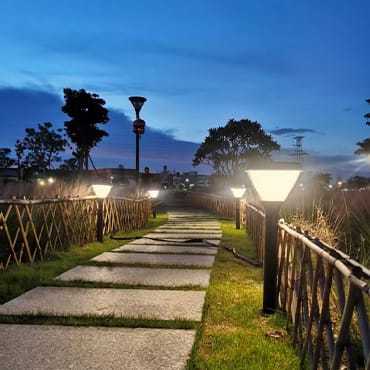
Different mounting heights can serve different roles along a path; the photograph illustrates the arrangement, not a measured lighting result.
A practical zoning example
Consider a small commercial property with a car park, a front entrance, a delivery door and a planted walkway. This is a planning example, not a completed project or a lighting calculation.
| Zone | First selection question | Next evidence to request |
|---|---|---|
| Car park | Can the proposed pole arrangement serve both parking rows and access lanes? | A layout using the proposed fixture's photometric file |
| Front entrance | Can arriving visitors see the door and the walking surface comfortably? | Mounting details and a sample review from approach positions |
| Delivery door | What loading activity continues after closing? | Required operating schedule and proposed beam/aiming information |
| Planted walkway | Is the aim route marking, usable path lighting, or both? | A coordinated fixture plan and nighttime sample observations |
This approach produces separate, comparable requirements instead of one generic request for “bright outside lights for commercial buildings.”
3. Compare the Main Fixture Types
Pole-mounted lights for roads and open areas
Pole-mounted lighting offers more freedom to position light away from the building. That freedom also introduces foundations, lifting, wind exposure, maintenance access and vehicle-conflict questions.
Evaluate height and spacing together with the actual distribution. More watts or a taller pole do not automatically improve the ground-level result. Confirm the luminaire mounting interface before ordering a pole, and use the solar street light pole and foundation guide to prepare interface information.
Floodlights for directed illumination
Commercial outdoor flood lighting is useful when light must be directed toward a defined area or object. Compare the beam at the intended mounting position, not only a close-up product photograph. A sign, an entrance and a loading apron can require different aiming and operating schedules.
Separate-panel solar designs may allow the light and panel to occupy different positions. Confirm the permitted cable arrangement and mounting hardware for the exact configuration. The solar flood light buying guide explains brightness, runtime and application checks.
Commercial outdoor wall lighting and landscape fixtures
Wall-mounted lights can serve building approaches where there is a suitable fixing surface. Bollards and courtyard fixtures bring lighting into pedestrian spaces, often with a different visual scale from roadway equipment.
For commercial outdoor landscape lighting, compare daytime appearance as well as nighttime behavior. Similar housing colors do not prove matching color temperature, controls or light distribution. Sample combinations are useful for hotels, retail courtyards and office grounds. Decorative commercial outdoor lighting can create ambience or highlight features; decide whether it must also provide useful walking visibility. Commercial solar landscape lighting and solar path lighting also require a suitable charging position for each selected configuration.
Canopy and low-ceiling fixtures
Covered entrances and service areas introduce a different mounting environment. Check ceiling height, driver sightlines and access for maintenance. A fixture installed beneath a roof also needs a suitable power arrangement; an integrated solar panel under the same roof may not receive useful sunlight.
Include canopy lighting in the site assessment, then confirm the required fixture and supply arrangement separately. Do not substitute a convenient product simply because it is described as waterproof.
4. Compare Specifications That Affect the Installed Result
Buying commercial LED outdoor lighting by a wattage label alone leaves important differences unresolved. Request information for the quoted configuration, and use the same headings for every supplier.
| Item | What the buyer should obtain | What it helps decide |
|---|---|---|
| Light output and distribution | Luminaire lumen data, relevant test conditions and an IES/LDT file where a layout is required | Whether light reaches the intended surfaces |
| Layout and mounting | Proposed positions, height, tilt, fixing details and site obstructions | Coverage, glare, installation access and interfaces |
| Color and appearance | Quoted color temperature, available options and representative samples | A coordinated look across the property or product range |
| Operating controls | Hours, dimming stages, sensor behavior and override method | Which areas remain usable as activity changes |
| Environmental suitability | Model-specific enclosure, temperature and material information | Suitability for the installation environment |
| Solar energy system | Panel rating, battery voltage and capacity, operating program and design assumptions | Whether charging and nighttime demand can be reconciled |
| Maintenance | Access method, replaceable components and configuration identification | Service planning and repeat-order compatibility |
Lumen output describes emitted light; it does not by itself establish illuminance at a particular point. For projects requiring a calculated layout, review the distribution and mounting assumptions together. A product image or a generic coverage circle cannot replace that information.
Controls deserve the same attention as the fixture. Agree which zones remain lit, which may dim and when activity requires a brighter level. The DOE exterior-lighting controls guidance is useful planning background; the operating sequence still needs to suit the property and applicable local requirements.
5. When Does Commercial Solar Outdoor Lighting Make Sense?
Solar lighting can be worth evaluating where extending power would require disruptive work, where installation is phased, or where the site needs a suitable off-grid lighting arrangement. Its suitability depends on the available solar resource, panel location and required nightly operation.
Check the panel location before selecting the system
A good position for the light may be a poor position for its panel. Buildings, roof overhangs, trees and parked delivery vehicles can create recurring shade. Review seasonal conditions, access for cleaning and any restrictions on panel mounting.
An integrated fixture simplifies some component connections but ties panel placement more closely to the luminaire. A separate-panel arrangement can offer another layout option, subject to the actual product's cabling and mounting requirements.
Compare energy and operating schedules together
Record the required operating hours and any dimming or sensor stages. Battery capacity in amp-hours is not directly comparable across different voltages. Nominal battery energy is calculated as voltage multiplied by amp-hours; usable energy and delivered runtime also depend on the system and operating conditions.
A claim of “all-night lighting” should identify the brightness schedule. Continuous low output, timed dimming and sensor boost are different proposals. Review the intended program against the activities in each zone.
Keep a grid-connected option in the comparison
Where an adequate electrical supply already exists, compare complete installed and maintained alternatives. Solar equipment may avoid some trenching, but still involves mounting, commissioning, cleaning and battery service. Grid-connected equipment also has installation and operating costs.
Prepare the comparison using the actual site. Do not count an avoided trench unless that trench would otherwise be required, or assume that all buildings need the same solar configuration.
6. Use Real Product Configurations to Ask Better Questions
The following examples show how different product formats lead to different purchasing checks. They are candidates for evaluation, not a ready-made lighting design for every commercial site.
LKH-60W: an integrated pole-mounted option
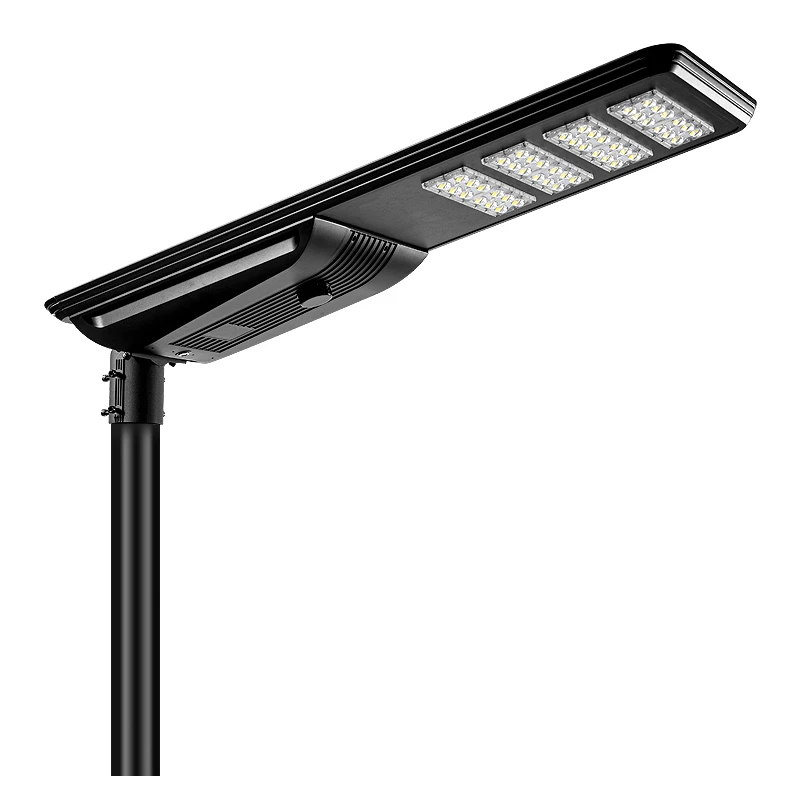
The documented LKH-60W configuration in the LKH solar street light range pairs an 18 V / 80 W panel with a 12.8 V / 30 Ah battery, or 384 Wh nominal energy. It is a candidate for the pole-mounted branch of a road or parking-area shortlist. Confirm the panel's exposure, mounting interface, operating program and matching photometric data for the proposed location.
SWL-001P: a wall-mounted option
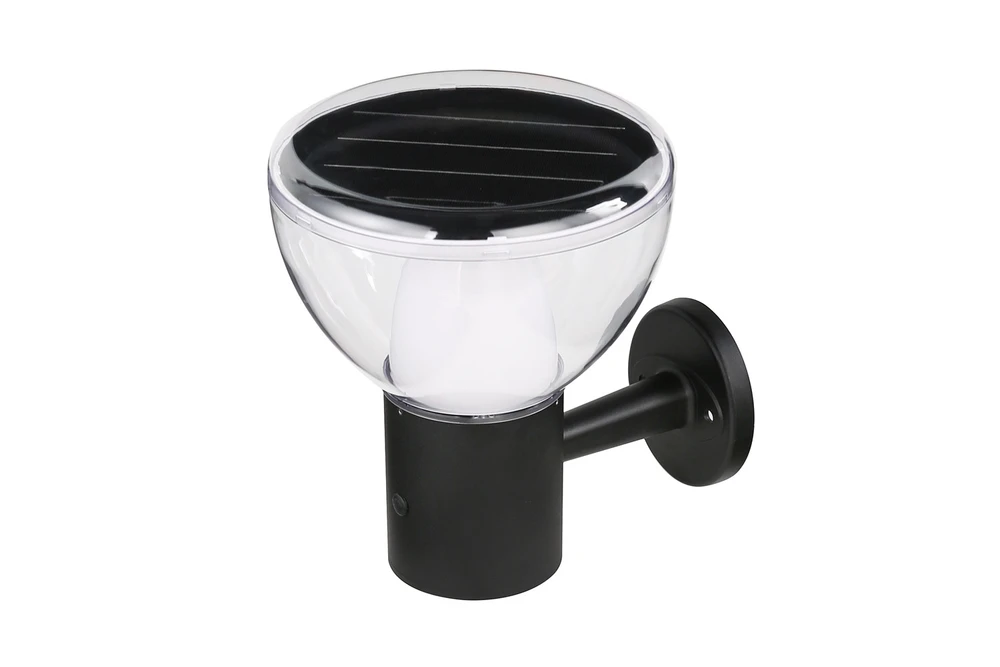
The SWL-001P solar wall light specification lists a 5 V / 4.5 W panel and a 3.2 V / 6 Ah battery, equivalent to 19.2 Wh nominal energy. Its configuration includes 3000 K and 6000 K color-temperature choices in one fixture. For an entrance or side-path shortlist, inspect the top panel's exposure beneath eaves and assess the actual mounting position.
MJ-BW800: a separate-panel floodlight option
The ordinary MJ-BW800 configuration in the MJ-BW solar flood light range lists a 5 V / 50 W separate panel. This format allows the light position and panel position to be considered separately. Confirm the quoted cable, connectors and mounting accessories; the pictured sample kit does not define every order's package. The model's “800” designation is not evidence of an 800 W electrical load.
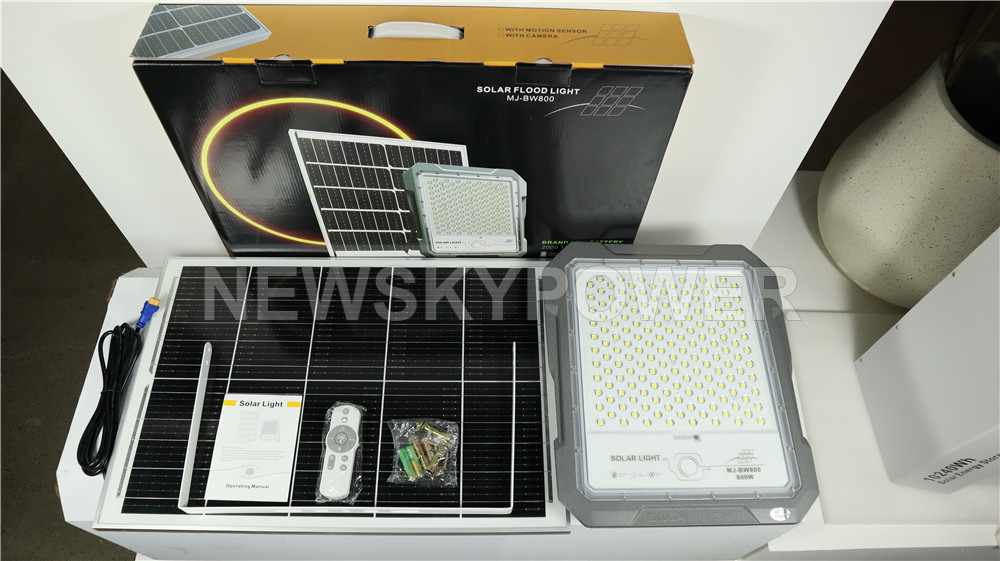
These are documented configuration examples, so match them to the current quotation. The two nominal battery-energy values explain stored-energy scale; they do not establish comparative brightness or runtime. Delivered operation also depends on the load, control program, usable energy and charging conditions.
Browse the solar outdoor lighting product range after defining the task. Ask for a quotation that names the exact configuration and its supporting documents, rather than accepting a category name as a complete specification.
7. Turn the Shortlist into a Wholesale or Project RFQ
For project procurement, send a marked layout or clear site photographs, location, quantities, installation restrictions, operating hours and the areas that need priority. State whether a photometric layout, samples or a phased proposal is required.
For distributors and wholesalers, build a product matrix around customer uses. Keep entrance lights, path-lighting products and larger-area equipment identifiable within the range. Record each SKU's configuration, color options, labels, packing and intended application; a shared catalog cover does not make components interchangeable.
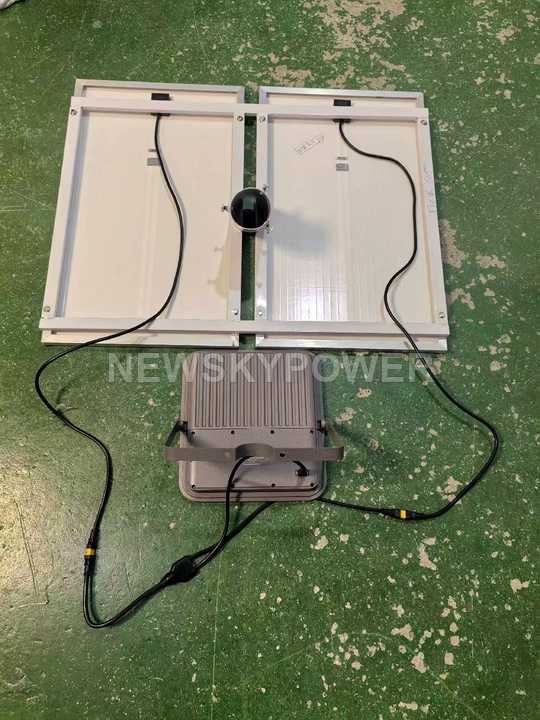
Panel cables, connectors and supports are part of the installation package. Confirm them against the quoted configuration.
Make quotation lines comparable
A quotation line should describe a repeatable configuration. Here is an illustrative structure, not a completed quotation:
| Quotation field | What to record on the same line |
|---|---|
| Task and fixture | Entrance / wall-mounted light / exact model and revision |
| Energy and operation | Quoted panel and battery; agreed operating program |
| Installation package | Bracket, cables, connectors and fixing responsibilities |
| Order and approval | Quantity, packing version, approved sample and relevant documents |
If one offer includes a panel, bracket and scheduled dimming while another lists only the light and an unspecified runtime, reconcile those items before comparing unit prices.
Before approving a bulk order:
- Match the quotation, sample and specification sheet to the same model and revision.
- Confirm what the package includes: light, panel, brackets, cables, pole or other required accessories.
- Agree sample checks for appearance, controls, mounting and the intended nighttime task.
- Request the documents relevant to the destination and installation; confirm their product and configuration scope.
- Record spare-part identification, replenishment arrangements and how later configuration changes will be communicated.
The solar landscape lighting sourcing checklist develops the range, packaging and version-control steps. To discuss a product shortlist, send Newskypower your application, destination, quantities and operating requirements.
8. Frequently Asked Questions
1. What are the main types of commercial outdoor lighting?
The main families include pole-mounted area and roadway lights, floodlights, wall-mounted lights, courtyard or post-top fixtures, bollards, pathway lights, and canopy or low-ceiling lights. Select them by lighting task and installation position. Solar and grid-connected are power-system choices within suitable applications.
2. What is the best exterior lighting for commercial buildings?
The best option is the combination that fits the site's tasks. Divide the property into entrance, building-edge, service, vehicle and pedestrian zones. Record what must be visible and when each operates. Compare distribution, mounting, glare, controls and power arrangements before choosing models or quantities.
3. Can one floodlight illuminate an entire commercial property?
It depends on the property's geometry and requirements, but one fixture can leave obstructions and transitions unresolved. Check the actual beam, mounting position and sightlines. A combination of area, entrance and pathway lighting may better serve different tasks without directing excess light into adjacent spaces.
4. Are bollard lights enough for a commercial walkway?
Some can contribute useful path lighting, while others mainly mark the route or create a visual effect. Assess the proposed model's distribution at its intended installation height. Where visibility requirements extend beyond that contribution, evaluate additional wall, courtyard or pole-mounted lighting.
5. How many lumens does a commercial outdoor light need?
There is no single lumen figure for every installation. Start with the task, site dimensions, mounting conditions and required lighting performance. Use the proposed fixture's photometric information where a layout is needed, rather than translating a wattage label into an assumed coverage area.
6. Can solar lights be used around a commercial building?
Yes, where panel exposure and system capability can support the required nighttime operation. Check building shade, mounting access, operating schedules and seasonal solar conditions. A suitable light position does not automatically provide a suitable panel position.
7. Can solar lighting work beneath a canopy?
The light and its panel may need different positions. Check whether an appropriate separate-panel product supports the required cable route, connectors and mounting arrangement. If a suitable panel position or energy balance cannot be established, assess another power arrangement.
8. Should commercial outdoor lights stay at full brightness all night?
The schedule should follow site activity and the requirements of each zone. Entrances, staff routes and delivery areas may operate differently. Any dimming or sensor strategy should preserve the required visibility; “all night” should be accompanied by a defined operating program.
9. What should wholesalers check before ordering a mixed product range?
Confirm the role and configuration of each SKU, then align samples, options, labels, packing and spare-part records. Check compatibility separately rather than assuming it from similar appearance. Keep approved revisions identifiable so repeat orders reproduce the intended range.
10. What information helps a supplier prepare a useful quotation?
Provide the destination, application, quantity, layout or site photographs, available mounting positions, required operating hours and any existing power supply. Add the desired product mix, sample needs and documentation requirements. For solar options, include information about shade and possible panel locations.