

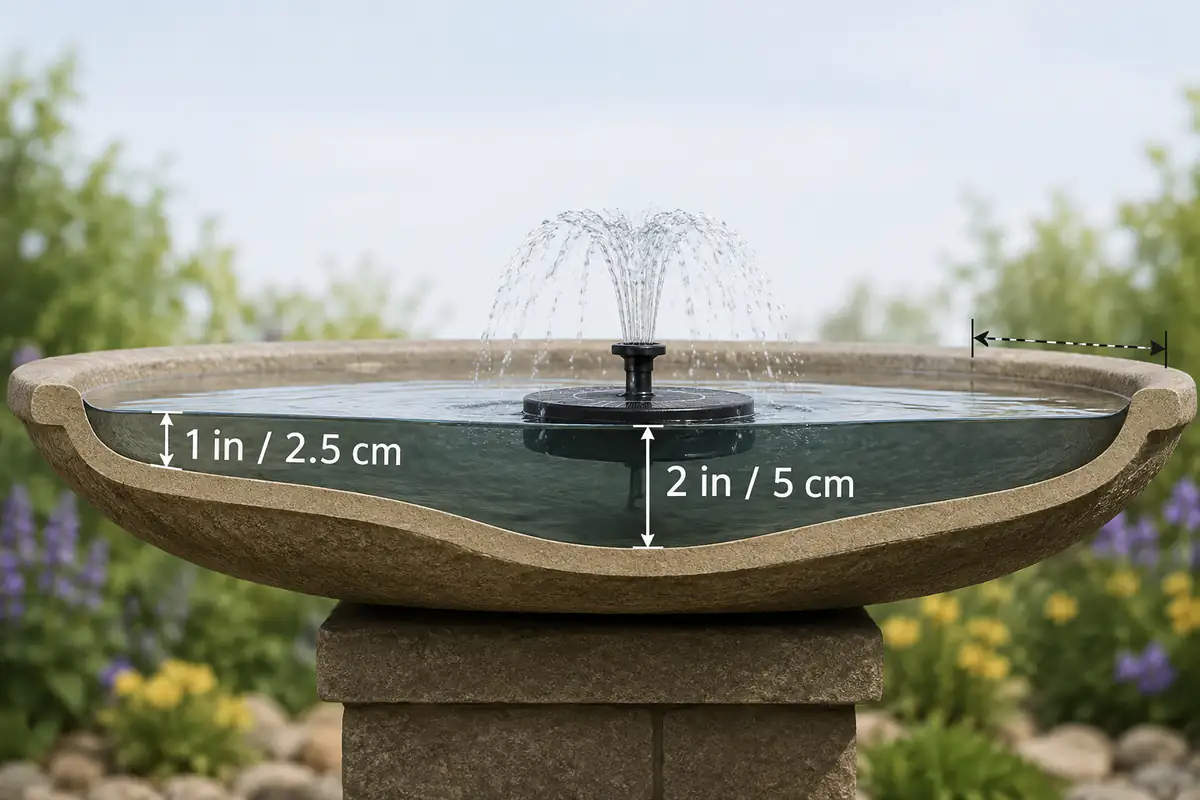
Basin-layout illustration. The 1-inch and 2-inch labels describe bird-access zones. The NEWSKYPOWER fountains discussed below need at least 3 cm (about 1.2 inches) of operating water depth; a shallower bird-access edge is a separate area.
The right bird bath size for a solar fountain accommodates the disc, stabilizing arms, spray landing area and shallow access for birds. Measure the usable inside diameter at the normal waterline, and maintain at least 3 cm (about 1.2 inches) of operating water depth for the NEWSKYPOWER fountains covered here. A fountain that fits inside the rim can still be unsuitable once it floats, sprays or loses water.
For retailers and purchasing teams, this is a compatibility task. Whether selling a fountain alone or bundling it with a basin, the aim is to establish which combinations can be demonstrated and described accurately. This guide turns the measurements into a sample record and a practical setup instruction, without assuming that one bowl size works for every model.
What to Measure Before Selecting a Solar Fountain
Record the following for the actual basin, rather than relying on its advertised exterior size:
- Usable internal width at the intended waterline.
- Water depth at the pump, center and bird-access edge.
- Basin shape, including sloped walls and uneven sections.
- Disc diameter and the working range of stabilizing arms.
- Nozzle pattern and the observed spray landing area.
- Clearance between the spray and the nearest rim.
- Water-level change during operation and refill needs.
For an oval or irregular basin, measure more than one direction. The narrowest usable section may determine where the disc can move and whether the arms can hold a useful position. Record any decoration or stones that reduce this space.
A product listing stating only “fits most bird baths” gives the buyer little to verify. A measured example with the basin, nozzle and operating conditions identified is more useful than an unqualified universal-fit claim.
Separate Bird-Access Depth From Pump Operating Depth
Cornell Lab's birdbath guidance recommends shallow water: around 1 inch at the edges and no more than about 2 inches in the middle, preferably with a gradual slope. This helps explain bird access, but it does not specify the depth required by every pump.
The pump needs enough water to keep its intake supplied. Too little water can lead to air intake, uneven spray, weak flow or a stop. The minimum operating water depth for the NEWSKYPOWER fountains in this guide is 3 cm (about 1.2 inches). Keep that depth throughout operation and refill before it falls below 3 cm. A shallower bird-access edge must remain separate from the fountain's operating area; do not derive pump requirements from a generic garden illustration.
If a bird-access recommendation and a pump requirement cannot both be met in a particular basin, change the basin or fountain combination. Do not make the entire bowl deeper merely to fit a pump without considering where birds can stand and enter.
Never assume dry-run protection from the fact that a unit is solar powered or has a waterproof rating. Follow the model's operating instructions and check the water level regularly. Do not let a sample run dry to establish whether it has a protective function.
Compare Disc Dimensions Without Confusing Them With Basin Size
The published NEWSKYPOWER dimensions provide a starting point for physical fit:
| Candidate model | Listed disc diameter | Listed nozzle count | What remains to check |
|---|---|---|---|
| AS01A | 13 cm | 6 | Arm range, at least 3 cm operating depth and the selected nozzle's landing area |
| AS10B | 16 cm | 6 | Clearance in the narrowest usable basin section |
| SP33D | 16 cm | 7 | Physical fit plus battery/light operating requirements |
| SP32D | 16.5 cm | 7 | Arm setting, water containment and the selected operating mode |
These are published disc dimensions, not approved minimum bowl sizes. The pages list four stabilizing arms, but their count does not define the minimum and maximum working span. Ask for the actual range and confirm it with the sample.
A smaller disc may be easier to accommodate physically, yet a wide nozzle pattern can still throw water out of a compact bowl. Conversely, a larger bowl can provide more space but fail on depth, slippery footing or poor placement. Compare the complete setup before deciding on a retail bundle.
For the broader distinction between daylight and illuminated models, use the main solar fountain buying guide and battery configuration comparison.
Check the Spray Landing Area, Not Just Spray Height
A spray-height figure tells you about vertical reach under the conditions used to obtain it. It does not tell you the horizontal landing diameter in your basin. Nozzle shape, available power, wind, water level and movement of the floating disc all affect containment.
Start with the lowest practical pattern permitted by the instructions. Observe the fountain in the intended position and sunlight. Water should return comfortably inside the rim, not merely touch it on a calm day. Check again in a breeze appropriate to the intended setting, because fine droplets can travel outside even when the main stream remains inside.
Do not convert a listed maximum spray height into a universal bowl-width rule. For detailed adjustments, follow the overspray and centering guide.
A useful comparison changes one item at a time: keep the basin and position the same while trying another supplied nozzle, then record the different landing areas. If the disc moves toward an edge, correct the centering before comparing nozzle performance. Otherwise the result mixes two different causes.
Consider Water Reserve and Falling Levels
A basin that passes a freshly filled demonstration may not remain suitable throughout use. Wind carries droplets away; evaporation and bird activity also reduce the level. A small volume can reach the pump's operating limit quickly even when its initial depth looks adequate.
Mark the starting level and record the ending level after an agreed observation period. Note the weather, nozzle and any refilling during that period. The purpose is to identify realistic use instructions, not to claim one refill interval for every climate.
If water loss is excessive, reduce spray width or height, reconsider the basin, or choose a more sheltered location that still provides the required sunlight. A battery may allow operation when direct light drops, but it does not protect a shallow basin from emptying. Sunlight behavior is explained in the cloud and shade guide.
Review Basin Shape, Surface and Bird Access
A gradual slope provides different standing depths. Stable, cleanable stones or a rough ledge may offer shallow footing, but they must not roll, obstruct the intake or make the disc tilt. Keep them away from the spray path; a stone near the rim can redirect water out of the bowl.
Smooth steep walls and deep vertical sides can leave little usable bird-access area despite generous total volume. Inspect the basin when wet, and consider how the user will empty and clean it. More water is not automatically a better setup if it makes handling and routine maintenance difficult.
The bird-friendly fountain guide discusses gentle flow and placement. It should support sensible retail demonstrations, not a promise that a particular basin will attract every species. The cleaning guide helps plan maintenance access around any added stones or decorations.
Use a Basin Compatibility Record for Sample Approval
For a bundled fountain and birdbath, identify both items. For a standalone fountain, test representative basin types relevant to your channel and describe the limits of those observations.
| Record field | Suggested entry | Use in the purchasing decision |
|---|---|---|
| Product identity | Fountain model, sample version, basin item and photos | Links the result to a reproducible combination |
| Usable width | Measurements at the normal waterline, in more than one direction if needed | Shows real floating and arm clearance |
| Water depth | At least 3 cm at the fountain's operating area; record shallow edge and starting level separately | Separates pump operation from bird access |
| Centering | Arm setting and contact points | Shows whether the disc remains appropriately positioned |
| Spray | Supplied nozzle identification and observed landing area | Supports nozzle instructions and product photos |
| Water loss | Observation period, weather, initial/final levels and refills | Supports realistic maintenance wording |
| Decision | Accepted setup, required change or unsuitable combination | Prevents an untested combination becoming a sales claim |
Agree on acceptance criteria with the supplier before using the record to approve an order. Do not treat one successful setup as a test certificate for all products or basins. Retain a photo of the accepted arrangement with the relevant instruction version.
Turn the Results Into Useful Retail Instructions
For a fountain-and-basin set, show the approved nozzle, water level and arm position in the setup sheet. For a standalone product, explain how customers measure their own basin and what to do when the spray falls outside it.
State the minimum operating water depth of 3 cm consistently in the specification, packaging and manual for these NEWSKYPOWER fountains. Keep the accessory list and maintenance instructions consistent too. Keep a technical operating limit separate from the recommended bird-access depth. Avoid labels such as “any bowl,” “maintenance free” or “no refilling needed.”
If a customer reports that the fountain does not work, request a photo of the entire basin as well as the pump. The fountain troubleshooting guide can help separate basin fit and water-level problems from other causes. A fit check should come before declaring a pump defective.
Check Fountain and Basin Compatibility Before Quoting a Bundle
Send the candidate model, basin interior dimensions, water depths, photos, intended channel and estimated quantity through the NEWSKYPOWER solar fountain inquiry entry. Confirm that the setup maintains at least 3 cm of operating water depth, obtain the arm-range information, and agree on sample checks before finalizing the set.
For a wider sourcing brief, return to the buying guide. If the product is already in use, include the observed problem and nozzle rather than treating a support message as a new purchasing request.
Frequently Asked Questions
1. Is a 2-inch-deep bird bath suitable for a solar fountain?
Two inches is about 5 cm, which is above the 3 cm minimum operating depth of the NEWSKYPOWER fountains covered here. Basin shape, clearance and spray containment still need checking. Provide separate shallow access for birds and keep the fountain's operating depth from falling below 3 cm.
2. How much wider should the bowl be than the disc?
There is no universal margin. Check the disc, arm range, movement and actual spray landing area, with additional room for the intended outdoor conditions.
3. Can buyers use the disc diameter as the minimum bowl diameter?
No. A disc that just fits has no demonstrated allowance for arms, movement or overspray. Measure and evaluate the complete combination.
4. Can stones make a deep basin more suitable for birds?
Stable, cleanable stones can create shallow footing, but they should not roll, block the intake, tilt the disc or deflect spray outside. They also need routine cleaning.
5. Why does a fountain fit but still spray water out?
Physical fit does not account for nozzle width, wind, drifting or a curved basin. Start with a lower pattern and confirm that the fountain remains centered.
6. Does a bigger birdbath always work better?
A wider basin may provide more spray clearance and water reserve. Excessive depth, slippery surfaces, poor placement or difficult cleaning can still make the combination unsuitable.
7. Is the same minimum water depth valid for every model?
The NEWSKYPOWER fountains covered in this guide require at least 3 cm (about 1.2 inches) of operating water depth. Do not extend that figure to other manufacturers' pumps, and keep it separate from bird-access depth recommendations.
8. What should a retailer show in a compatibility photograph?
Show the whole basin, actual nozzle, disc position and normal water level. A useful setup photo should make the approved arrangement understandable rather than display only the tallest spray.
9. What should accompany a basin sample sent for checking?
Include the candidate fountain model, basin dimensions, depth measurements, photos, expected channel and intended operating setting. Identify whether the request concerns a retail bundle or a standalone fountain.
10. What should happen if a sample combination fails the fit check?
Record the reason, such as inadequate depth, restricted arm movement or overspray. Adjust the basin, nozzle or candidate model and repeat the relevant check before approving instructions or the order.