


Choosing a solar fan starts with three practical questions: where will people use it, how long must it run without charging, and where will the next charge come from? Answer those before comparing blade size, battery capacity or price. A solar rechargeable fan is useful when its complete configuration fits the customer's daily routine.
This solar fan buying guide helps importers, distributors and buyers move from a broad requirement to a short list of suitable models. It covers standing, table and foldable formats, battery energy, panel charging, controls and sample checks. The resource library also brings together our focused guides, so you can investigate a particular decision without starting again.
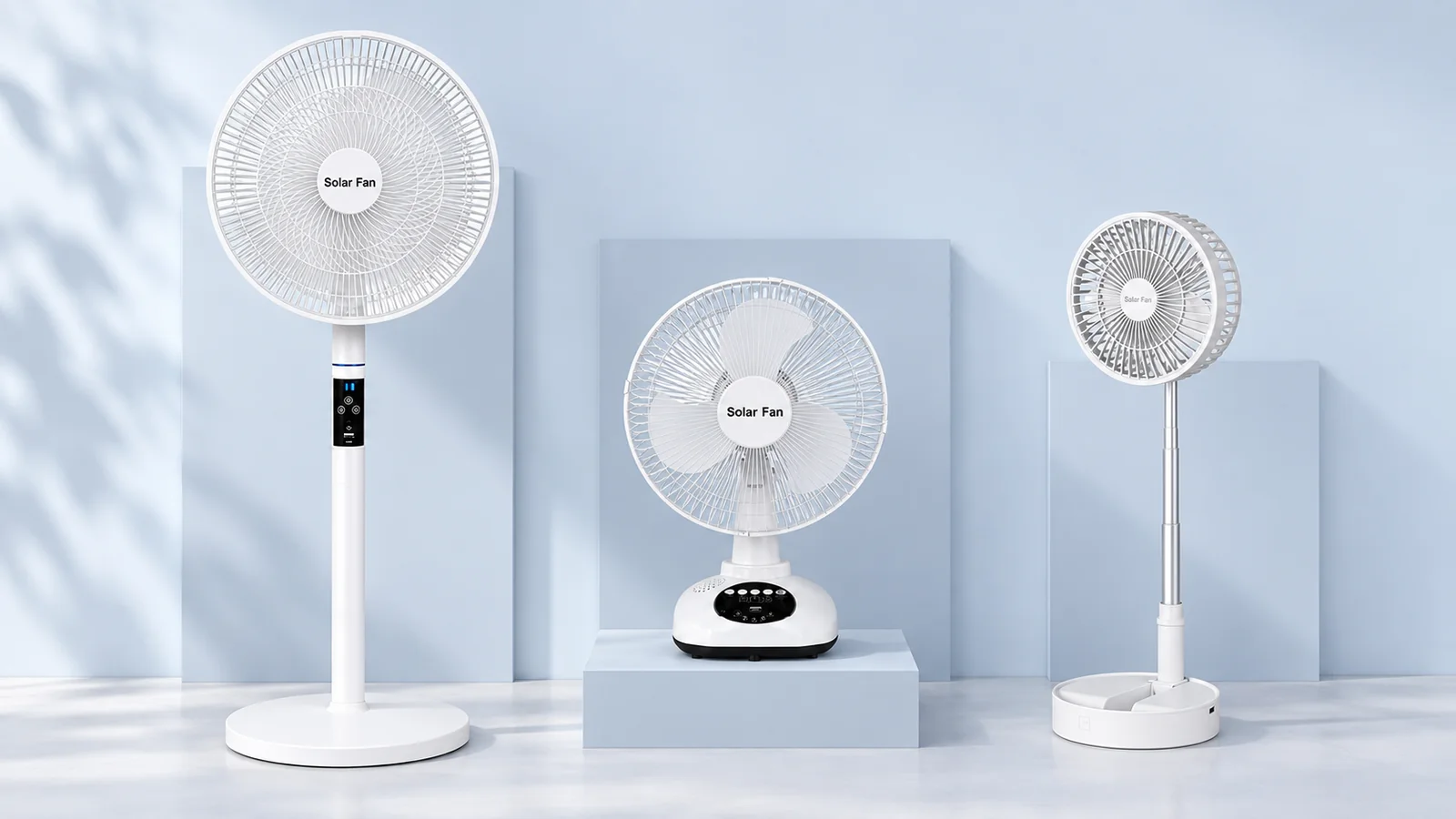
1. Start with the job the fan needs to do
A household using a fan during evening power cuts has a different requirement from a stall using it in daytime or a camper carrying the whole kit. “Solar powered” describes an energy source; it does not establish the required airflow, operating hours or weather resistance.
Write a short use brief: placement, distance from the user, daily operating period, preferred speed, access to sunlight and access to approved adapter charging. For a distributor, add the destination country and sales channel. “Africa” or “Southeast Asia” alone cannot define the plug, instructions or expected use.
| Buyer need | Start by checking | Product range to review |
|---|---|---|
| Explore the available types | Formats, features and exact kit contents | Complete solar fan range |
| Run after sunset or during a power cut | Battery energy, target-speed runtime and recharging opportunities | Solar fans with battery |
| Put the fan beside seating or on a shop floor | Height, base footprint, head adjustment and assembly | Solar standing fans |
| Move or store the fan regularly | Whole-kit weight, folded size, panel and cable storage | Portable solar fans |
| Plan household backup cooling | Room placement, sound, controls and charging routine | Solar fans for home |
| Use a floor fan temporarily under shelter | Stable ground, dry electrical parts and documented exposure limits | Solar outdoor fans for sheltered use |
These routes overlap because a battery-backed standing fan can serve more than one use. Choose the route matching your main problem, then compare the individual model. A category name should help navigation rather than act as proof that every model has the same capabilities.
2. Understand what a solar fan system actually includes
A solar fan with solar panel may use a separate panel connected by a cable. A rechargeable version also stores energy in a battery for later operation. Some products support a matching mains adapter; the permitted charging sources and connections must be confirmed for the exact version.
A direct-sun fan without storage cannot be treated as an evening backup fan. Equally, a rechargeable fan with a phone-charging output is not automatically a fan that can recharge from a phone charger. Follow the manufacturer's connection instructions instead of judging a port by its shape.
Ask whether the quoted solar fan kit contains the fan, battery, panel, panel cable, adapter, remote and any lighting accessories. Record optional items separately. A photograph with several accessories is useful for identification, but the quotation's bill of contents defines what arrives.
The U.S. Department of Energy explains that storage allows solar energy to be used when sunlight is unavailable. For a small rechargeable fan, that principle still needs a model-specific runtime check; storage does not guarantee uninterrupted operation. See solar energy and storage basics.
3. Choose the format before comparing extra features
Standing solar fans: check height and floor space
A standing or pedestal format lets you position the fan head above the floor beside seating. Check the assembled height, base dimensions, cable route and head adjustment against the customer's actual space. For retail distribution, also check the assembly instructions and which tools or fasteners are supplied.
A larger blade diameter does not, by itself, prove better airflow at the user's position. Ask for the measurement method if airflow data is supplied, or compare samples at the same distance and useful setting. Avoid treating the number of speed levels as a measurement of wind strength.
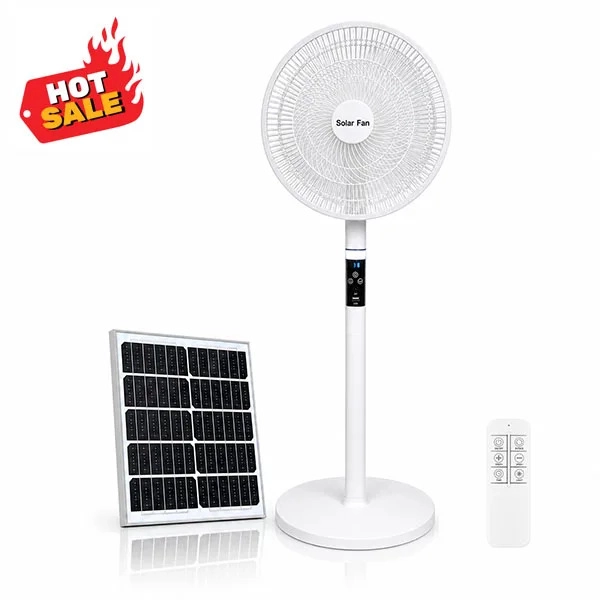
The T919 standing solar fan is one model to review when a floor-standing format and remote controls matter. Use its current specification and sample record to assess the order; this guide does not assign it a universal runtime or room coverage.
Solar table fans: check the supporting surface
A table format may suit a counter, desk or bedside surface where there is enough space and a stable base. Measure the footprint and identify where the charging cable will run. A compact head can still require substantial desk space once the stand and controls are included.
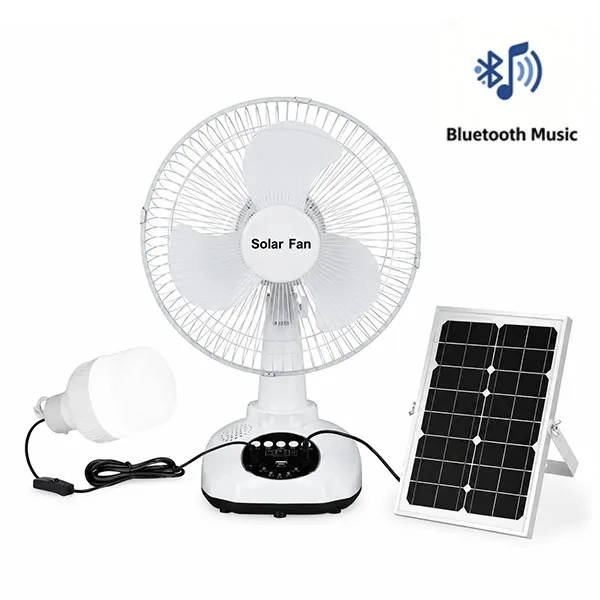
The T9 solar table fan provides a table-format example. If a speaker or lighting accessory is relevant, include its use in the battery test rather than comparing it with a fan-only result from another model.
Foldable and portable solar fans: compare the whole carried kit
A foldable fan can reduce storage space, but the panel, adapter and cables still need somewhere to go. Ask for the folded dimensions and total carried weight, and test whether the joints hold the selected position after repeated adjustment.
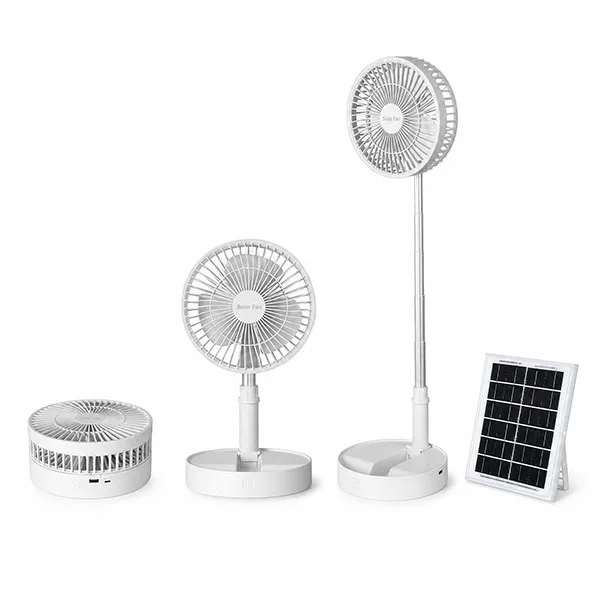
The T8 foldable solar fan is a useful starting point for comparing storage and height adjustment. Compact packing, comfortable carrying and adequate airflow are separate checks. A portable solar fan for camping must satisfy all three for the intended trip.
4. Compare battery energy, then verify runtime
When comparing a solar fan with battery, request the battery's nominal voltage, capacity and rated energy. Ah and mAh express capacity; Wh lets you compare rated energy when voltages differ. Convert mAh to Ah by dividing by 1,000, then multiply voltage by Ah. The FAA's battery guidance uses this relationship to explain watt-hours.
For a mathematical example, 12V × 5Ah equals 60Wh, while 3.7V × 10Ah equals 37Wh. The second number has more Ah but less rated energy. Neither example is a NEWSKYPOWER product specification, and neither establishes usable runtime.
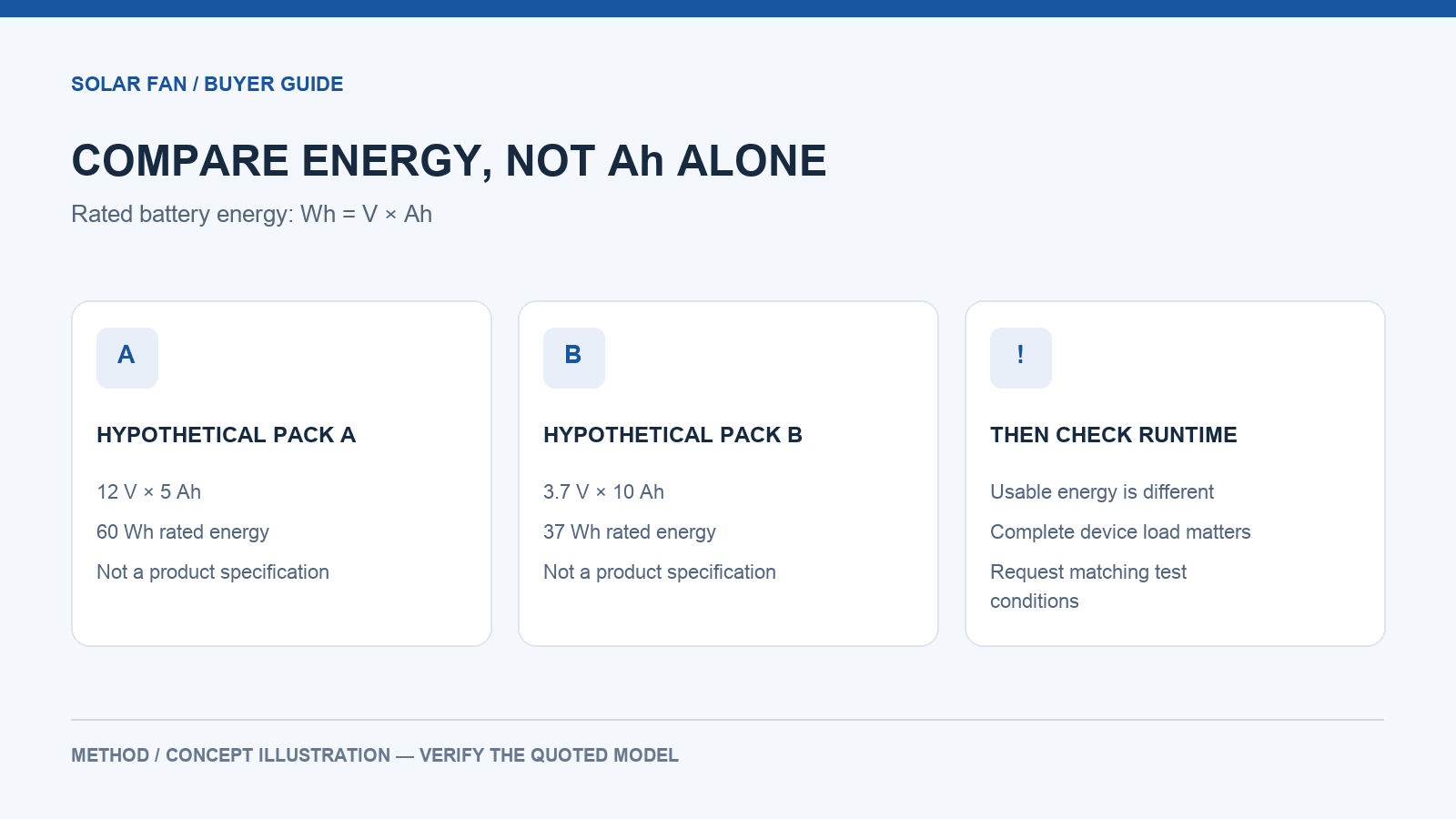
Actual solar fan battery runtime depends on usable energy and the complete load: speed, oscillation, lighting and supported external-device outputs. Starting charge, battery condition and test conditions matter too. A maximum low-speed claim should not become a promise for full-speed household use.
Request a battery-only test with charging disconnected, a documented starting charge, the selected speed and accessory settings stated, and a clear endpoint. Record whether the endpoint is shutdown, a warning or reduced airflow. Two suppliers using different endpoints may report different hours for similar equipment.
Ask for the setting your customer will actually use. A low-speed demonstration may be appropriate for close personal airflow, but it cannot establish that a distant seating position remains comfortable. Compare airflow and operating time together, rather than choosing the longest advertised number.
5. Check charging as a daily routine
Battery storage solves only part of the problem. The next question is whether the kit can recharge during the customer's available charging window. Panel rating, sunlight, shade, location and the device's charging circuit influence the result; panel watts alone do not establish solar fan charging time.
Place the fan where people need airflow and the panel where it receives suitable sunlight. Check the supplied cable reaches between those locations without creating a trip hazard or straining a connector. Do not assume an extension cable or larger replacement panel is compatible.
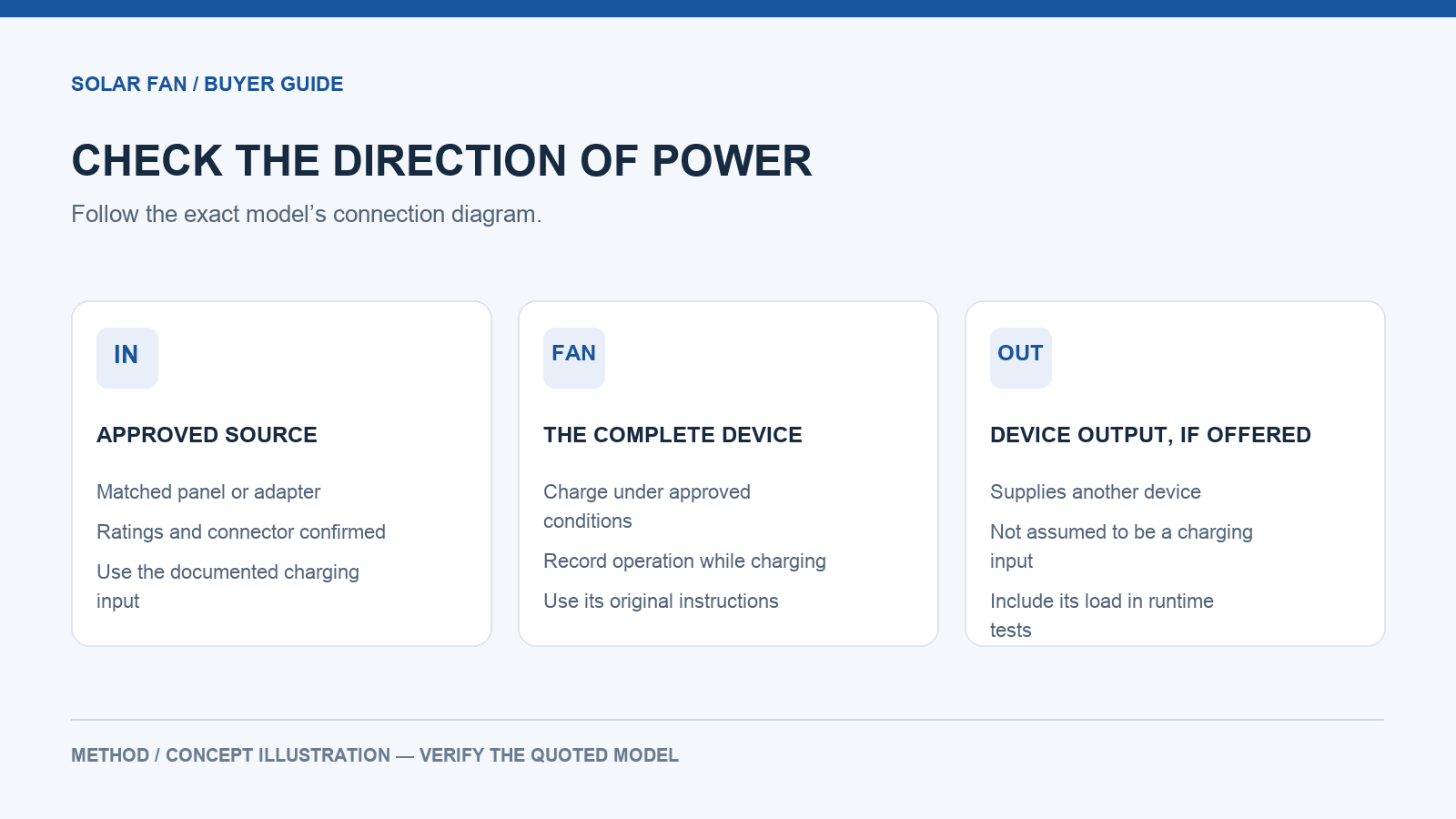
For supported adapter charging, verify the adapter output, approved fan input and destination plug. A travel plug does not change electrical compatibility. Also ask whether operating while charging is supported, and whether the battery continues to charge at the chosen operating setting.
Consider two situations. For evening home backup, the buyer should test daytime recharging followed by the intended evening schedule. For a camping weekend, the buyer should check the starting charge, available panel location and use across consecutive days. One fully charged demonstration does not establish a repeatable daily energy balance.
6. Match airflow, sound and controls to the user
The best solar fan for a particular buyer is the one that meets a defined use brief. A motor label, premium appearance or long feature list cannot replace the sample check. Compare airflow at the intended distance and sound at the setting needed to achieve it.
A quiet rechargeable fan for a bedroom should be evaluated in a suitably quiet environment, with distance, speed and oscillation recorded. Check indicator brightness, night-light control and remote operation as well. “Silent” or “noiseless” is not a meaningful substitute for a measured result or a clearly recorded sample comparison.
A brushless motor is one part of the complete design. Battery energy, blade geometry, controls and operating load also affect performance. Our brushless motor solar fan article explains the motor principle; use model-specific data for the product you order.
Check everyday operation without relying on a sales demonstration. Can the user identify the charging connection, change speed, switch off a light and use the timer? Does the remote supplied with the sample match the manual? Clear controls and instructions can be more valuable to a distributor than an accessory customers do not use.
7. Keep home backup and outdoor use within clear limits
For a solar fan for home backup, define the expected outage period and how the battery is maintained between outages. Ask about behaviour when mains charging stops; automatic changeover and operation while charging should not be assumed. Check the selected model's instructions and sample behaviour.
A circulation fan improves comfort through air movement rather than acting as an air conditioner. The UC Berkeley fan guidebook describes selection around the intended air speed, distribution and space constraints. Match the airflow to occupied positions instead of promising a fixed room-temperature reduction.
For a solar camping fan or sheltered outdoor floor fan, distinguish portable use from permanent weather exposure. A sunny panel location does not establish a rain rating for the fan, battery or connectors. Request documented protection limits before specifying rain, spray, dust or coastal conditions.
Also check stable placement, dry storage and the route between the panel and fan. A folding design may be convenient indoors or under cover, but that convenience does not establish waterproof performance. When the intended exposure exceeds the documented limit, choose a different solution rather than rewriting the product claim.
8. Compare price on an agreed configuration
A useful solar fan price comparison includes the same battery version, panel, adapter, controls, accessories and packing. Separate the product price from freight, taxes and other quoted commercial costs. A fan-only offer and a complete solar fan kit should not share a comparison column without identifying the difference.
| Comparison item | Record for each offered model |
|---|---|
| Identity | Model, revision and dated specification |
| Placement | Format, footprint, assembled and stored size |
| Energy and operation | Battery V/Ah/Wh, chosen speed, runtime test conditions |
| Charging | Panel rating, input, connector, cable and supported adapter |
| Contents | Included components and priced options |
| Packing | Actual carton size, gross weight and units per carton |
| Service | Written warranty, claim procedure, parts and repair arrangements |
| Commercial terms | Quantity basis, price basis, lead time and delivery terms |
For a bulk order, use the same request for each supplier. Request relevant documents for the actual battery and adapter, and confirm destination requirements with the appropriate specialist. An unrelated certificate or a factory photograph is not proof that the offered version meets a particular requirement.
Keep after-sales costs in view. Ask how a replacement battery, cable, remote or adapter is identified and supplied. Clarify which maintenance tasks belong to the customer and which require service. Record warranty terms in writing rather than inferring a duration from a general marketing page.
9. Check a sample before selecting the order version
A sample should resolve the important uncertainties in your use brief. Start with an unpacking record and kit count. Assemble it using the supplied instructions, photograph the labels and controls, then check charging and battery-only operation under recorded conditions.
Choose pass criteria before testing. For example, a household-backup buyer can specify a required operating period at the selected speed; a portable-kit buyer can specify the maximum carried weight and stored size their channel needs. These are buyer requirements, not performance claims about the models pictured here.
Repeat the everyday routine where it matters: folding and reopening, remote operation, charging in the intended location and using the relevant accessories. Note any interruptions and the actual conditions. A short video helps explain usability, while the written record preserves the settings needed to compare samples.
For distributors, retain the approved model, version, kit list and packing reference with the order. Agree on production inspection separately. A sample establishes a reference for acceptance; it does not prove that every future unit is identical without an agreed inspection process.
10. Solar fan resource library: choose your next question
Use this library to go deeper into the decision that matters to your order. Each focused guide covers one buying question; the product collections help you compare available models afterward.
Bulk purchasing and supplier comparison
Solar Fan Wholesale Buying Checklist: What to Confirm Before a Bulk Order
For buyers preparing a distributor or importer order. Covers the complete kit, supplier evidence, sample approval, packaging and comparable quotations. Next step: explore the complete solar fan range and request a model-specific offer.
Battery energy, runtime and charging
Solar Fan Battery Runtime: How to Compare Ah, Wh and Speed Settings
For buyers deciding whether a rechargeable configuration fits the required hours. Explains energy ratings, repeatable runtime tests, charging checks and battery replacement. Next step: compare battery-backed models under matching conditions.
Standing, table and foldable formats
Standing, Table or Foldable Solar Fan: Which Format Fits Your Market?
For buyers choosing placement, storage and carrying arrangements. Covers assembled versus stored size, supporting surfaces and whole-kit packing. Next step: shortlist standing or portable models for the intended setting.
Household use during power cuts
Choosing a Solar Fan for Home Backup During Power Cuts
For buyers planning a household backup routine. Covers charging access, placement, bedroom sound checks and operation during an outage. Next step: select a home-use format and test the actual daily schedule.
Camping and sheltered outdoor use
Solar Fans for Camping and Sheltered Outdoor Use: A Buying Checklist
For buyers comparing a complete carried kit and its permitted use conditions. Covers panel placement, evening use, storage and the difference between portable convenience and weather protection. Next step: compare portable models or sheltered-use floor fans.
Brushless motor principles
Why Are Brushless Motor Solar Fans More Efficient?
For buyers who want to understand motor design before reviewing the complete fan. Next step: combine the motor explanation with battery, airflow and operating-setting evidence from the selected model.
11. Request a solar fan recommendation that can be checked
Send NEWSKYPOWER a brief that connects the product to its use. If you already have a shortlist, include the exact model names and the configuration being compared. If you are still choosing, explain the setting and required operating period first.
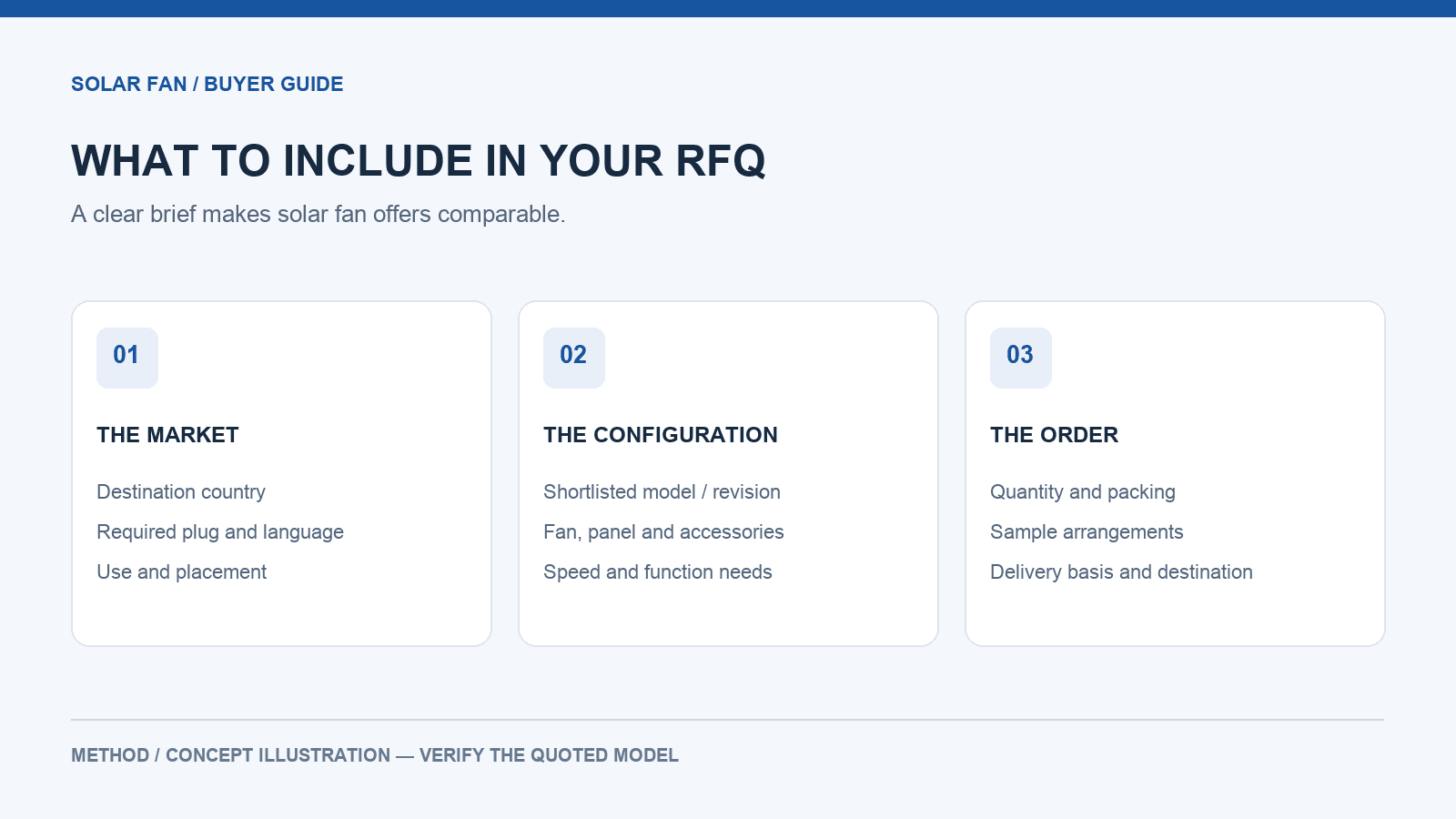
Include your destination country, quantity, sales channel, preferred format, required speed and operating hours, charging opportunities, plug requirement and sample or bulk-order stage. Add any limits on carried weight, carton size, lighting or other accessories. Ask for a current specification, kit list and sample test conditions together.
For example: “We are comparing T919 and a table-format model for household backup. Please quote the specified kits for our destination, confirm the adapter and plug, and provide battery-only runtime at the speed shown in the sample demonstration.” Replace those details with your own requirement; a precise question produces a more useful comparison.
Send your solar fan buying requirements or return to the product range to review the available formats.
Solar fan buying questions
1. How do I choose a solar fan without knowing the model first?
Define placement, required operating hours, useful speed and available charging sources. Choose the format that fits the space, then compare complete configurations and test a sample. These steps narrow the options without assuming that the biggest battery label or lowest price gives the best fit.
2. Can a solar fan work at night or without sunlight?
A battery-backed model can use stored energy while the battery has sufficient charge. A direct-sun model without storage needs a suitable energy source. Ask which design is offered and request runtime at the intended setting; “solar” alone does not guarantee night operation.
3. Is battery mAh enough to compare two solar fans?
No. Read capacity together with nominal voltage and rated Wh, then compare useful airflow and measured runtime. Differences in voltage, usable energy, speed and accessory loads can make a larger mAh label misleading as a standalone comparison.
4. What size solar fan is best for home use?
There is no universal size for every room or user. Check the distance to occupied positions, supporting surface or floor space, height and airflow at the useful speed. Evaluate sound under the same conditions. Request documented airflow data or compare samples rather than guessing coverage from blade diameter.
5. Does every solar rechargeable fan include a solar panel?
Do not assume it. Confirm the exact kit contents, panel rating, cable, adapter and accessories in the quotation. Product photographs may illustrate options or several models. Ask for a written list of what is included in the price you are comparing.
6. Can I charge the fan through any USB or DC socket?
No. Identify the documented charging input and its permitted rating. Some USB or DC ports supply external devices and are outputs. Use the approved source and connection instructions for the exact model instead of plugging a panel into an unverified socket.
7. Is a portable solar fan automatically suitable for rain?
No. Portability describes carrying and storage, not water protection. Confirm documented exposure limits for the fan and electrical connections. For camping or sheltered outdoor use, plan a stable, dry fan position and a suitable panel position within the model's permitted conditions.
8. Does a brushless motor guarantee quiet operation and long runtime?
No. The complete fan design and operating setting determine the result. Compare sound at the intended distance and runtime at a stated speed, starting charge and accessory load. Treat motor type as one selection factor rather than a substitute for model evidence.
9. How should I compare solar fan prices from different suppliers?
Match the product version, battery, panel, adapter, controls, accessories and packing first. Then compare commercial terms and service arrangements. Ask about any missing item or unclear specification before deciding that a lower quotation represents the same product.
10. What should I send when requesting a sample or bulk quotation?
Provide the destination, quantity, use brief, preferred models or format, required operating period, charging access and plug. Specify relevant accessories and packing requirements. Ask for the current specification and kit list; MOQ, lead time and warranty need confirmation for that offer.