


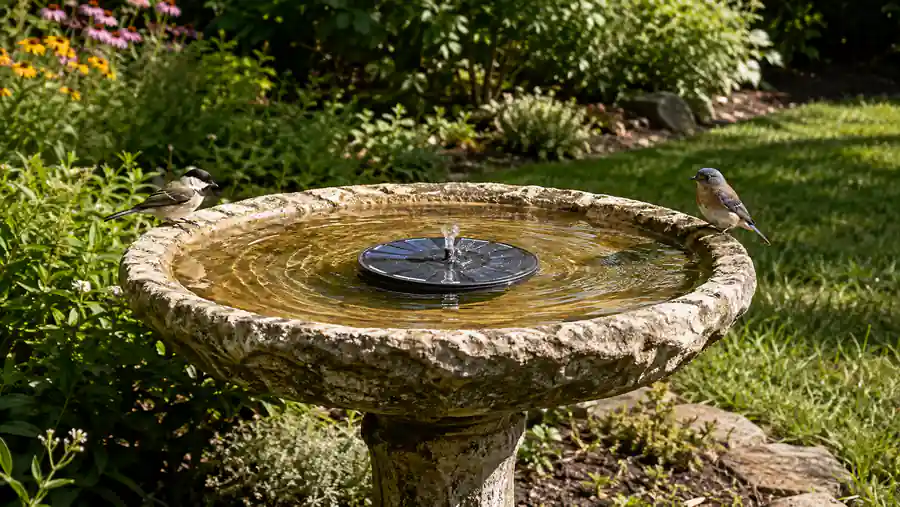
Illustrative garden scene; not evidence of a specific model or bird-attraction result.
For retailers, distributors and importers, choosing a solar fountain pump for bird bath use starts with the assortment you intend to sell: the basin sizes customers use, the available sunlight, the desired daytime or evening display, and the instructions your channel can provide. The highest panel wattage or tallest spray does not, by itself, make a better retail product.
This guide covers compact floating fountains for bird baths and decorative bowls. It explains how to shortlist a daylight model or battery-and-LED configuration, evaluate samples, and prepare a clear bulk-order request. Large pond circulation, irrigation and continuous aeration require a different selection process.
Use the NEWSKYPOWER solar fountain range alongside this guide. Choose the intended application first, then agree on the model, accessories, packing and performance description before ordering.
1. Define the Channel and Application Before Comparing Models
A garden-center display, an online listing and a fountain bundled with a specific bowl need different purchasing information. A bundled product can be checked with its actual basin. A standalone fountain needs clear compatibility guidance because customers will place it in many different bowls.
Prepare a short buying brief:
- Destination market and sales channel.
- Standalone fountain or a set supplied with a basin.
- Typical usable bowl width, depth and shape.
- Daytime water movement, limited evening lighting, or both.
- Direct-sun availability and likely wind exposure.
- Candidate models, estimated quantity and sample requirements.
- Retail packaging, instruction language and labeling needs.
Do not rely on a product name such as “solar bird bath fountain” to define every feature. A floating solar panel, rechargeable battery and LED lighting are separate configuration choices. The component and operating-principle guide explains the terms for purchasing teams that are new to this category.
2. Decide Between Daylight Operation and Battery + LED Models
Direct-drive fountains use the solar power available at that moment. Spray can strengthen in bright sun, weaken under clouds, and stop in shade or at night. This is suitable for a daylight product proposition when the listing clearly explains the sun requirement.
Battery-buffered fountains store energy for supported operating modes. Depending on the controller and available charge, this can provide limited operation through light changes or an evening display. The battery does not remove the need for sunlight, cleaning or sufficient water.
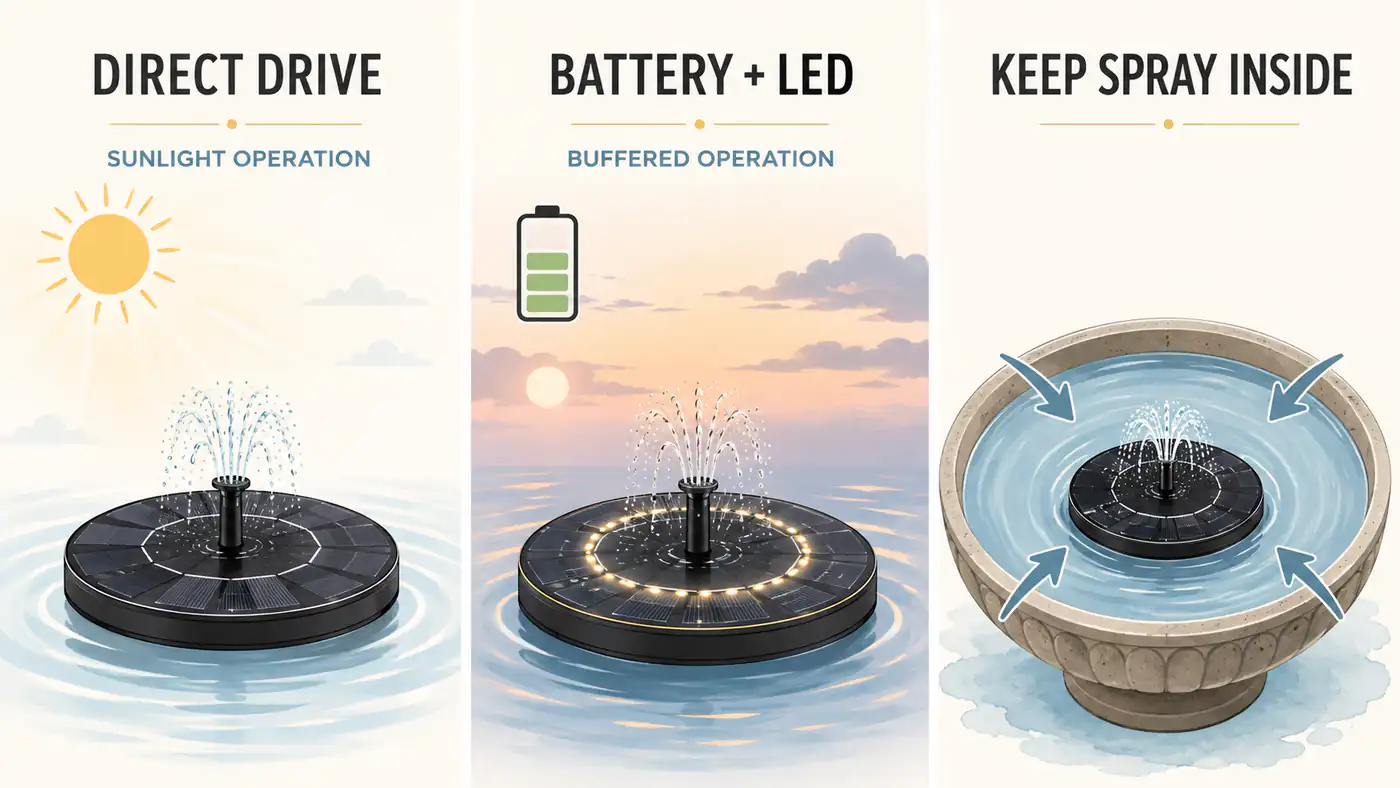
Category illustration: operating concepts, not a model-specific performance test.
For an assortment with more than one price or feature tier, distinguish the variants by a real buyer benefit and by the instructions they need. A battery model also introduces charging expectations, battery documentation and service questions. Compare these responsibilities as well as the quoted unit price. Our battery-backup sourcing guide provides a configuration checklist; the cloud and shade guide explains the operating limits.
3. Shortlist the Current Fountain Configurations
The following figures are published product specifications, not results from an independent side-by-side test. Confirm the supplied version on the quotation and approved sample.
| Model | Listed disc diameter and panel | Listed configuration | Procurement question |
|---|---|---|---|
| AS01A / AS10B | 13 / 16 cm; 1 / 1.4 W monocrystalline panel | Daylight range; 6 nozzles; DC brushless motor | Which disc and nozzle combination fits the bowls sold through your channel? |
| SP33D | 16 cm; 3.5 W monocrystalline panel | 1,200 mAh lithium battery; 8 LEDs in 7 colors; 7 nozzles | Does the lighting presentation match the assortment, and what charging and operating conditions support it? |
| SP32D | 16.5 cm; 3.5 W monocrystalline panel | 1,800 mAh / 3.7 V lithium battery; 32 RGB LEDs; 7 nozzles | Is the RGB display required, and how will the selected pump and light modes be described? |
SP33D and SP32D list four hours of night backup. Treat this as a published reference requiring defined charging and operating conditions, not a guarantee of four hours every evening. A higher mAh number alone does not establish longer runtime, particularly when the lighting load and battery voltage differ or are not both specified.
The model pages list spray ranges of 10–16 inches for AS01A, 10–20 inches for AS10B and SP33D, and 10–18 inches for SP32D. These heights do not define a compatible basin diameter. Nozzle pattern, water depth, light and wind affect where the spray lands.
After shortlisting, use the inquiry entry on the solar fountain collection page to request a model comparison. Include your market, candidate models, expected quantity and whether battery lighting is required.
4. Check the Basin, Spray and Water Depth Together
Panel wattage alone does not determine spray height. Maximum flow and maximum head are different pump reference values, not a promise of actual nozzle spray height; evaluate the supplied pump, nozzle, sunlight and water level together.
Measure the usable inside diameter at the normal waterline, not the decorative outer rim. Check curved walls, ornaments and any shallow sections that could catch the disc. Allow space for the stabilizing arms; the number of arms does not tell you their usable adjustment range.
The pump's minimum operating depth and the bird-access depth are different requirements. The NEWSKYPOWER solar fountains covered here require a minimum operating water depth of 3 cm (about 1.2 inches). Keep the water at or above 3 cm throughout use, not only when first filling the bowl. For bird access, Cornell Lab's birdbath guidance recommends shallow water, approximately 1 inch at the edges and no more than about 2 inches in the middle, with a gradual slope.
A basin must satisfy both conditions. If the chosen pump cannot operate while maintaining suitable shallow access, change the basin or fountain combination. Do not turn a general birdbath recommendation into a universal pump specification.
Start with a low, narrow spray. Observe whether water returns comfortably inside the rim and how the water level changes in a breeze. High sprays may look impressive in a listing but create a poor match for small bowls. Use the basin compatibility checklist before approving a bundle, and the overspray guide when choosing the demonstration nozzle.
5. Agree on a Sample Evaluation Record
A useful sample review records conditions as well as outcomes. Agree with the supplier on the sample version and what counts as an acceptable result before using the observations to approve a bulk order.
| Check | Record for each sample | Decision it supports |
|---|---|---|
| Identity and contents | Model, label, nozzle set, arms and supplied instructions | The quoted configuration matches the sample |
| Basin fit | Internal dimensions, operating depth, arm setting and photos | Suitable combinations and setup instructions |
| Daylight behavior | Weather, panel shading, nozzle and visible spray | Accurate description of daylight operation |
| Battery operation | Charging conditions, start state, pump/light mode and stop time | A qualified runtime statement |
| Water containment | Nozzle, wind conditions, starting and ending level | Nozzle choice and refill guidance |
| Maintenance access | Parts the instructions allow users to remove | Feasible cleaning and support materials |
Use repeat observations when conditions vary. A single sunny demonstration cannot establish typical cloudy-weather performance, and one tested basin cannot prove compatibility with every bowl sold in a market. Keep dated photos or short videos associated with the exact model and configuration.
Do not deliberately run a pump dry to discover whether protection exists. Confirm protective functions and any verification method with the supplier. Battery housings and sealed electrical parts should not be opened as a routine buyer test.
6. Include Packaging, Manuals and Support in the Order Discussion
For retail supply, the delivered item includes more than the fountain. Confirm the package contents, model identification, nozzle storage, stabilizing-arm instructions and the language required for the destination channel. If private-label packaging is requested, agree on artwork, version control and approval before production; availability and commercial terms must be confirmed for the order.
Ask the supplier to distinguish user-serviceable parts from sealed assemblies. Determine which replacement nozzles, filters or other parts can actually be supplied, how they are identified, and how a support request should be documented. Do not assume every internal part is separately available.
Use the pump-cleaning guide to structure customer instructions and the fault-finding checklist to organize support messages. Keep a maintenance question separate from a new bulk-purchase inquiry so the correct information reaches the appropriate team.
Confirm minimum order quantity, sample charges, production timing, packaging costs and warranty terms in writing for the selected configuration. A general category page is not a substitute for an agreed quotation or order specification.
7. Write Retail Claims That Match the Product
Product photographs should show a basin and spray pattern the sample can actually support. Explain that integrated solar panels need suitable sunlight. For battery models, state the operating mode and charging conditions beside a runtime claim, rather than hiding them in an unrelated FAQ.
Bird-related copy also needs care. A fountain can provide moving water, but no nozzle or LED configuration guarantees visits from a particular species. See the bird-friendly fountain guide. Water movement also does not make a fountain a continuous mosquito-control device; retain the maintenance advice in the mosquito and cleaning guide.
Request a Solar Fountain Assortment Quote
Send NEWSKYPOWER the destination market, channel, candidate models, estimated quantities, basin information and preferred daylight or battery/LED configuration through the solar fountain range inquiry entry. Add sample, packaging and manual requirements. These inputs make it possible to discuss a suitable assortment and confirm the remaining supply conditions.
Solar Fountain Reading Hub
Choose the next guide according to the purchasing or support decision:
Configuration and sample checks
- Battery backup: configuration and sourcing
- Clouds and shade: operating limits
- Basin size and water depth: compatibility
- How solar fountains work: components and controls
Setup and after-sales support
- Preventing overspray and water loss
- Troubleshooting a fountain that stops working
- Cleaning the pump safely
Birdbath knowledge and retail claims
Other Buying Guides
For a broader off-grid product assortment, the following guides cover separate product decisions.

Frequently Asked Questions
1. Is battery backup worth it?
Battery backup can be worth considering when customers need supported operation through brief changes in sunlight or a limited evening LED display. For daytime use in direct sun, a direct-drive model is simpler. Buyers should compare the actual operating modes, charging conditions, battery-service requirements and sample results, rather than assuming a battery guarantees all-night operation.
2. How many watts should a solar fountain pump for a bird bath have?
There is no universal wattage. Disc dimensions, nozzle behavior, water depth, battery charging and lighting matter alongside panel power. Maximum wattage alone is not a selection rule.
3. Will a floating solar fountain work in shade?
Direct-drive flow commonly weakens or stops when the integrated panel is shaded. A charged battery may support permitted modes for a limited time. Neither arrangement provides indefinite operation without sufficient solar input.
4. How deep should the water be for birds and the pump?
For the NEWSKYPOWER fountains covered in this guide, maintain at least 3 cm (about 1.2 inches) of operating water depth and provide separate shallow access for birds. Refill before the operating depth falls below 3 cm. This specification does not establish the requirements of other manufacturers' pumps.
5. Are tall sprays better for attracting birds?
Not necessarily. A gentle, low spray leaves calmer shallow water for drinking and bathing; no spray pattern guarantees bird visits. A tall or wide spray can also empty a compact bowl through overspray. For retail demonstrations, choose a nozzle that returns water inside the intended basin and explain the need to refill.
6. Does four-hour night backup mean all-night operation?
No. It is a published model reference to evaluate under stated conditions. Ask which charging period, starting charge, nozzle and light mode were used; actual operation can be shorter.
7. What should a buyer check in a sample kit?
Check model identity, accessories, instructions, basin fit, sun-dependent behavior, battery modes where relevant, water containment and cleaning access. Record the conditions so the approved sample can guide the order specification.
8. Can the customer replace the battery?
Do not advertise user replacement without model-specific instructions. Ask how battery-related service is handled and avoid telling customers to open sealed electrical housings.
9. Can packaging and manuals be customized?
Discuss the requested artwork, language, labels and package contents when requesting a quotation. Confirm feasibility, quantities, costs and timing for the particular order rather than assuming standard terms.
10. What information is needed for a bulk quotation?
Provide the destination market, sales channel, candidate models, quantity, intended basin or application, battery/lighting preference and sample or packaging requirements. Request confirmation of the remaining commercial and technical details.